Showing posts with label thankfulness. Show all posts

Monday, October 11, 2021

Thankful and Not-So-Thankful: Reckoning with Our North American Legacy


Imagine this: 

You are a young mother nearing her due date living just outside of Seattle, Washington, but you fear going out in public. You know that if you give birth in a hospital, the US Government will likely confiscate your newborn and put it up for adoption. You want your baby. You are prepared to love and nurture it in your family home on the land of your great grandparents.

Sound far-fetched? 

This happened with regularity in my lifetime, in the 1970s. I learned about this travesty by listening to a children's audio book as we traveled this summer. I Can Make This Promise, by Christine Day, is the story of a girl who discovers that her mother was put up for adoption at birth, even though her birth mother wanted her and was prepared to care for her. Simply being "Indian" and unmarried resulted in the confiscation of her child. Although this particular story is fictional, it is based on history.

Imagine this:

You are a young family in British Columbia, raising your children in the community where your parents and grandparents and their parents and grandparents have always lived. One day, police arrive and take your children by force, citing the need to educate them properly. They are taken to a residential school run by the Church, where they are forced to  cut their hair, wear a uniform, and speak only English. They never return home -- not for holidays or funerals. You never hear from them again. You suspect that they are dead, but you are told nothing.

Sound far-fetched?

This happened with regularity in my Dad's lifetime, throughout the 1900s as late as the 1990s. I mention my Dad because he was born in the small town of Enderby, British Columbia to recent immigrants from Europe who spoke broken English. Just 90 minutes away was one of Canada's largest residential schools, which boasted 500 students in the 1950s and operated until after I was born. You might have seen the Kamloops Indian Residential School in the news this summer, when 215 unmarked graves were discovered there, most of them children.

Before her death, my grandmother told me a story about my Dad's birth, when the nurses whisked him away to perform an elective surgery without so much as asking for her consent. She had no intention of circumcising him because in Europe only Jews practiced circumcision (keep in mind that this is on the heels of WWII, when circumcision could be a matter of life or death). That was bad enough, but if she had been a Native American, she may never have have seen him again. My own father could have grown up in a residential school. 

Stories from these schools are nauseating -- regular beatings and repeated rape by residential school staff, starving children as punishment, and a stated policy to "kill the Indian in the child." This happened in North America. This happened in living memory.

Having recently moved from Canada to the US, my holidays are still feeling jumbled. Today is Thanksgiving Day in Canada, but Indigenous Peoples Day in the US. So today, on Canadian Thanksgiving, I'm reflecting on things that I am thankful and not-so-thankful for in relation to the history of indigenous peoples.

  • I'm thankful for my students at Prairie College (Three Hills, Alberta) who studied the history of residential schools and presented their findings to our class. You can learn more about the important work of Canada's National Centre for Truth and Reconciliation on their website.
  • As painful as it was, I am thankful to have had my eyes opened to the darker side of North American history, whose effects are still felt today.
  • I'm thankful for growing awareness of this issue, which creates space to grieve together and imagine a different future.
  • I'm not thankful for the role the church played in the confiscation of "Indian" children in the US and Canada. Mostly well-meaning folks perpetrated cultural genocide, seeing their own way of life as superior and failing to recognize how the gospel is good news for every culture, not just their own.
  • I'm not thankful for how church leaders were able to abuse children with impunity for so long. Lack of accountability put thousands of children at risk, and the generational effects of that trauma on survivors are still being felt. 
  • I'm not thankful for decades of cover up in white spaces that has continued to silence the voices of indigenous people as they cry out for justice.

Reckoning with our shared history is no easy task. Both the US and Canada have a legacy of violent oppression toward indigenous peoples. Most difficult to swallow is the church's role in that legacy. I am not equipped to outline all the ways this has been expressed, but these snapshots offer a glimpse of what I've learned in recent years.

I leave you with this new song by my friend, Brian Doerksen. Brian lives in British Columbia (and worked with me at Prairie College). In the wake of this summer's discovery of unmarked graves in Kamloops, Brian wrote this song. He recognized the need for us to sit with this hard news, to feel its sorrow, and to weep with those who have been weeping for generations. I'm thankful for his courage.


Thursday, July 2, 2020

Three Misconceptions about Lament

Things are bad in this world of ours. An awful lot of hard stuff is going on. If there was ever a time to cry, this is it. But many Christians shy away from lament because they believe lament is somehow sub-Christian or perhaps they think it won't do any good. 

I've identified three reasons Christians avoid lament. All three are misconceptions. We'll tackle them one at a time:

(1) Lament shows a lack of faith.

If we really believe that God is good and powerful and that he will win in the end, then we would not need to lament, right? Singer-songwriter Michael Card disagrees. In his book A Sacred Sorrow: Reaching Out to God in the Lost Language of Lament, Card says this: 
"Lament is the deepest, most costly demonstration of belief in God. Despair is the ultimate manifestation of the total denial that He exists." (55)
In other words, if you did not believe in the existence of God, there would be no reason to lament. It would do no good. It's because we do believe in God, and trust him as the only one who is able to make things right that we present our most desperate requests to him.

In fact, the Bible offers many examples of faithful men and women who bring prayers of lament to God. Those prayers made it into our Bibles without condemnation. Some of them were included in the book of Psalms, the prayer book of the Bible. Their presence in Scripture implies that we are invited to pray laments, too.

Michael Card explains it this way: 
"People like Job, David, Jeremiah, and even Jesus reveal to us that prayers of complaint can still be prayers of faith. They represent the last refusal to let go of the God who may seem to be absent or worse -- uncaring. If this is true, then lament expresses one of the more intimate moments of faith -- not a denial of it. It is supreme honesty before a God whom my faith tells me I can trust. He encourages me to bring everything as an act of worship, my disappointment, frustration, and even my hate. Only lament uncovers this kind of new faith, a biblical faith that better understands God's heart as it is revealed through Jesus Christ." (31)
Lament is not faith-less, it's faith-full.
 
(2) Lament is the opposite of gratitude. 

How can we lament when the Bible urges us to "give thanks in all circumstances" (1 Thessalonians 5:18)? Doesn't thankfulness preclude lament? One might think so, but again Scripture shows us that lament and gratitude go hand in hand.

In Psalm 44, the sons of Korah remember with gratitude the way that God has acted on Israel's behalf in the past (vv. 1-8). It's against the backdrop of their gratitude that they can plead with God to rescue them again (vv. 9-25). The character of God expressed in history leads them to trust God's future deliverance:
"Rise up and help us; rescue us because of your unfailing love." (Psalm 44:26)
We need not fear that lament will shut out our gratitude. For reasons I'll explain further below, lament and gratitude actually depend on one another.

(3) Lament will lead to despair. 

Some of us don't want to lament for fear of becoming bitter old souls. We don't want to get stuck. But on the contrary, it is our refusal to lament that leads to bitterness and despair. When we try to carry the grief on our own or manage our own solutions to life's deepest problems, the pressure is too much to bear.

Emmanuel Katongole explains, 
"Pain . . . has the ability to destroy language, to reduce the victim to silence. This silence is a form of powerlessness, a paralyzing form of despair. Therefore, the ability to voice grief, to find words to speak the unspeakable and to name pain, is a form of resistance to the paralyzing silence." (Born from Lament: The Theology and Politics of Hope in Africa, 56)
The pathway to joy requires us to pass through the gateway of lament -- acknowledging that all is not well in the world and that we believe our God is able to do something about it. Until we look our pain and loss directly in the face, we will be unable to let it go. 

Have you seen the Pixar movie "Inside Out"? When it seems like everything has fallen apart, Joy learns an important lesson: the value of Sadness. You can watch a clip here. Joy tries valiantly to cheer up Bing Bong by distracting him, but Sadness holds the key: by acknowledging the pain of Bing Bong's loss and making space to grieve, he is able to move forward and soon they are (literally) back on track.

So let's imagine that I've convinced you that lament is not sub-Christian. You might be wondering what to do next. What if you are just not the "emotional" type? How can you tell if you need to lament? How do you start?

One way to tell that we have unexpressed grief is when we lose our capacity to feel deep joy. I like to think of the spectrum of emotions that we experience as a window. On the left side of the window are emotions that we tend to characterize as negative -- anger, grief, fear --  while on the right-hand side are the emotions we see as positive -- joy, gratitude, delight. 

Photo credit: Rob Wingate on Unsplash
Hanging inside our emotional window is a set of old-fashioned drapes. Perhaps you remember the kind. To close the drapes, you pull a looped cord on one side of the window and both drapes gradually close until they meet in the middle. Our emotional life is like this. We cannot block just one side of the window. Closing the left side means closing the right side as well. If we suppress our feelings of grief or anger, we make it impossible to feel gratitude and joy.

I am not a trained counselor, but it's been my experience that if I find it hard to laugh along with others or enjoy a happy gathering, there is likely some unexpressed grief lodged in my soul. We can never recover our joy by imagining away our sorrow. We have to face it. Name it. Pray it. And thereby release it to God. Then we can pull our drapes open and let light back in the room.

That's why I'm so thankful for the book of Psalms. It tutors us in prayer, giving us words when we have none, and modeling the full range of ways to connect with God. If we categorize the psalms into  lament, praise, and other psalms, we find that there are more laments than any other type of psalm. That should tell us something about the life of prayer, and it should give us courage to bring our sorrows to God. 

If you have been feeling numb, you can start by making a list of things that are bothering you. It may be news headlines or it may be personal. Then bring your list to God. Find a psalm that expresses your heart -- maybe Psalm 4 or Psalm 88. Pray those words and add your own. God wants to hear your heart.

Sunday, July 23, 2017

Blueberries and Trust

We bought our house in Oregon sight unseen back in 2014. Crazy, I know. Except that we had family members kind enough to comb the area, take loads of pictures, talk to neighbors, and smell each room. They helped us make an excellent choice. And we had a good God who had prepared the way.

When our moving truck arrived I was delighted to discover three blueberry bushes in the front yard, planted years earlier, laden with ripening fruit. Within a couple of weeks, I was picking 3 cups of blueberries each morning, then 4, then 7. I counted over a hundred cups of berries that summer -- enough for a whole winter's worth of smoothies.

No thorns, no sweat, no planting or tending. Berries just ready for us to eat.

As I picked in the early morning light, the words of Deuteronomy 6 often floated through my mind:
10 When the Lord your God brings you into the land he swore to your fathers, to Abraham, Isaac and Jacob, to give you—a land with large, flourishing cities you did not build, 11 houses filled with all kinds of good things you did not provide, wells you did not dig, and vineyards and olive groves you did not plant—then when you eat and are satisfied, 12 be careful that you do not forget the Lord, who brought you out of Egypt, out of the land of slavery.
We were not the first to experience God's good provision. Israel's bounty came with a warning -- "don't forget who provided all this!" So here I am remembering. To me the blueberries were a tangible (and tastable!) daily refresher on God's goodness. I didn't even know I wanted blueberries, but here they were, and I was grateful.

This summer we're eating blueberries like crazy. We can't take them over the border with us to Canada, so we're relishing juicy handfuls and sharing them with friends. And as if God wanted to end this story with an exclamation mark, he provided a garden-watering job for Ana this month that has been mouth-watering for the rest of us -- a garden brimming with raspberries and blackberries that would rot if we didn't eat them. And so we have. Handfuls of the most delicious berries we've ever eaten.

Our God is so good. And we can trust him to go before us and prepare the way. He provided berries in Oregon City. He'll provide abundantly in Three Hills, too. God is like that.

Before we moved to Oregon, the kids would often ask, "Will our new house have a ____?" or "Can we buy a house with _____?" In my thoughtful moments, I answered, "We'll see what God provides!" As it turned out, he granted room to flourish and recover from the intensity of PhD studies, another amazing set of neighbors, and berries. Lots and lots of berries. The same God who provided blueberries arranged for my Canadian citizenship 40 years before anyone knew I would need it. That's impressive.

The LORD promises neither a rose garden nor a blueberry bush, but he does promise to be with us always. Ultimately, that's all we need.

Thursday, November 24, 2016

Remembering the Alamo: A Thanksgiving Homily


The crumbling facade of a stone building is missing its roof and part of its second floor. A pile of stone rubble sits in the courtyard. In front of the building are a horse-drawn carriage and several people in 1850s-style clothing: women in long dresses with full skirts and men in fancy suits with top hats.
By Unknown - Frank Thompson, The Alamo (2005),
p. 106, Public Domain 
"Remember the Alamo!"

The cry, unbidden, echoed through my mind the moment I saw it. I was staring at Google Maps, locating my hotel in relation to the rest of the conference venues. And there it was: "The Alamo." Right across the street from my "home base" in San Antonio.

I paused, 5th grade history lessons distant and faded.

"Remember the Alamo?"

What exactly was I supposed to remember? Something about Texas, I think. An old fort, maybe? But that's as far as I got. Whatever happened there had long ago had been discarded as one of those "useless" facts that would not help me in real life.

Israel was also called to "Remember!" Remembering was not just the means to an "A" in history class. It was the key to the survival of their faith. Without memory, faith fades.

And here's where the Alamo comes in. Why don't I remember the Alamo? Because I only heard about it once, in a history class. In order to truly remember, in order for it to matter, the story must be consciously inscribed on my memory through recital. I don't remember the Alamo because the story has not become part of my story. I ceased to tell it as soon as the childhood test was turned in.

Psalm 135 and 136 are psalms of remembrance. They walk through Israel's history, retelling what God has done and thereby keeping those memories alive for each new generation. Psalm 136 sounds the rhythmic refrain, "his love endures forever."
Give thanks to the LORD, for he is good.
His love endures forever...who by his understanding made the heavens,
His love endures forever...to him who led his people through the wilderness;
His love endures forever...and freed us from our enemies.
His love endures forever. (Psalm 136:1, 5, 16, 24)
For Israel to cultivate a faith that endured, they knew they must keep telling the story.

My quick weekend trip to San Antonio left no time for sightseeing. I attended three breakfasts, two receptions, ten paper presentations, a council meeting, seven meetings reconnecting with friends and mentors, a podcast interview, and two publisher meetings. In between all this I wove my way through the book displays, hunting for spring textbooks, pitching book ideas, and buying the books on my list.

I was told it only took a half hour to see the Alamo, but since my hotel was a 10-minute walk from the conference venue, and I was going strong from 7am to 10:45pm each day, I missed the opportunity to see it.

The Alamo (Photo: Rex Koivisto)
Ironically, though, I will always remember the Alamo. I will remember it as the place where God came through in a dramatic way for me. I arrived in San Antonio with a "hole" on my resumé. I was (essentially) unpublished. Sure, I had written several book reviews, and I had a small contribution in a student resource on the Septuagint, and I had been blogging for years, but in order to get a permanent job, I would need a book contract. This was the next crucial step in my transition from "student" to "professor"—to demonstrate that I could and would make an ongoing contribution to scholarship.

I went to San Antonio with one prayer and one goal: a book contract.

And I came home with two!

It was a miracle weekend, and we will always be grateful.

Wikipedia tells me that the Alamo was an important battle in the fight for Texan independence. It was not a victory, but a battle the Texans lost to the army of Santa Anna. That defeat became a rallying cry for Texans to join the cause and take back territory. In a sense, then, my Alamo was years ago, when I stared failure in the face and considered giving up.

I am so glad I didn't. God has carried us through thick and thin.
His love endures forever!

What has God done in your life this year? Today is the day of remembering. Tell the story as you gather with family and friends. Only in the retelling will we "remember the Alamo."

Sunday, September 4, 2016

encountering the light of Christ

When you enter the doors of a new church, anything could happen. Churches with dwindling numbers are often surprised to see a new face, as the greeters were this morning to see me. But their warmth made me feel right at home.

A single ring of chairs stood empty around the center microphone on the circular platform, expectant. A Steinway occupied the far end of the circle, its melodies soaring to fill the sanctuary and encircling all of us.

Pews faced the middle. I sat in the second row, waiting, observing. I was early. In time, others came and found seats in the first few rows. I knew no one. I had been invited by the son-in-law of a member to speak during the Sunday school hour. That was my only earthly connection.

A pamphlet in the pew back explained how a Quaker-style service works. Quakers embrace silence as they embrace each other, welcoming the opportunity to listen and learn from the spirit of Christ in their midst. The unprogrammed quiet is a soothing balm in a hurried life.

A man rolled in on a motorized wheelchair, making his way to the front to greet another worshipper, and then me. Jerry refused to let his disability cripple his contribution to the warmth of the community. (I learned later that he was relatively new himself, and that the man he greeted was there for only the second time. Signs of life.)

As the service unfolded, I gathered that this was a grieving community, searching for direction, wondering how to respond faithfully to a series of events that left most of their pews empty. I wondered, then, if I should scrap my seminar on 'Understanding Biblical Prophecy' and speak instead about lament, or about how to be rooted in the face of life's storms (Psalm 1–2). How does one walk into a community and speak without first listening long? first loving and hearing?

In those quiet moments, I asked the Lord to guide me. By the time I reached the classroom after the service, I knew I should stick with my original topic and trust that God had guided my preparation. I suspected (rightly, I'm told) that Quakers typically camp out in the Gospels. That was my bridge to the prophets. How can one possibly understand the richness of the Gospels without an understanding of the Old Testament prophets? Spontaneously, I began in John 9, linking Jesus' miracle to Isaiah's commission in chapter 6. Then we moved into Isaiah 7 to examine verse 14, always a Christmas favorite. Both passages illustrate the value of reading the text closely for its historical, literary, and theological dimensions. They also illustrate the inherent dangers when we don't.

The hour flew by, followed by several follow-up conversations and a long lunch. I returned home with a full heart, grateful for the privilege of fellowship with other Christ-followers and grateful that I have the most wonderful subject matter in the world to teach -- God's Word -- which truly does not return void.

Encounters like this one are not accidental. God uses each personal connection in some way as we spur one another on to love and good deeds. A Quaker might say that the light of Christ within each of us illuminates the community as we gather. I'd say that pretty well sums up what happened today!

Monday, May 23, 2016

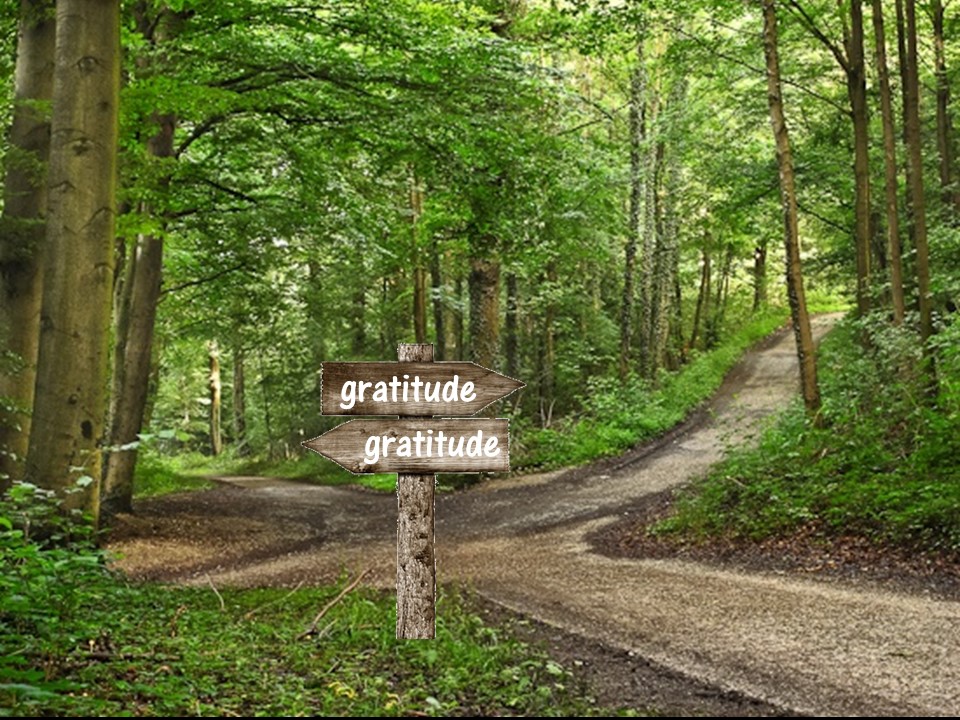
a simple path to joy (part 2): the intersection of gratitude

In my first post in this series, I claimed that true joy is impossible to find when we are living in denial. We begin our journey to joy by facing life's messes head on and choosing to be honest. That's how we enter the gateway on the path to joy.

Next we come to an intersection, and we have to make our second choice: gratitude. We cannot be everything we might have been, have everything that can be had, go everywhere there is to go. We can only be and do and have this. Once we have faced our disappointments with brutal honesty, we are free to move on with gratitude for what our life actually holds.

Our world is full of constant reminders of what we don't have. Ads surround us incessantly, telling us all day long about the products and services that will make life easier, or sweeter, or more successful. But joy depends not on what we have but on our disposition towards what we have. The Greek philosopher Epicurus warned, "Do not spoil what you have by desiring what you have not." Put another way, "Happy is the woman who wants what she has." In fact, sometimes we uncover joy by having less, by simplifying our lives -- clearing out our closets and giving things away. Every item we own gets a piece of our care and attention until we have no energy left to care for the things that really matter. It is freeing to declutter, to downsize, to keep only what we actively use.

But this intersection on the pathway to joy isn't only about what we have. It's also about where we are and who we've become. There are more possibilities in life than we have time to try, more opportunities than we can pursue. When we cultivate the habit of thankfulness, our hearts are positioned for joy. We cannot take every path, but we did take this one. To spend our time wondering about all the other paths we could have taken robs us of joy. I am not an astronaut. I am not a midwife. I am not a famous singer. I am not a jungle missionary. I am not even one of those amazing stay-at-home moms who actively volunteers at the elementary school and whose kids have really creative birthday parties every year. Saying 'yes' to one path has meant saying 'no' to others.


About a year ago we realized that I would probably never finish my doctoral degree unless I started to say 'no' to good opportunities. I resolved not to say 'yes' to anything but family until I was finished. At first it was painfully difficult. The things I was asked to do were right up my alley. They were things that would energize me. Ways to plug into my church and my community for which I was uniquely suited -- lead a small group, speak in chapel, teach a college class. But after half a dozen difficult 'no's' my schedule was completely open for the task I dreaded -- revising my dissertation. And I discovered that when I had complete focus, I did much better work and enjoyed it far more than before! I relished the gift of concentration. We shoot ourselves in the foot when we try to do it all or have it all, or spend our energy wondering what would have happened or what could have been. Those things are not. This is what is. Here is where we are. So let's embrace it and move forward with gratitude. 

This is a sure way to begin to find joy. But what about the uncertainties ahead? In my next post, I'll talk about what to do when we can't see around the bend in the road.

Sunday, August 23, 2015

unforgettable day

Rocky Mountain National Park (Photo: C. Imes)
The gray morning crept through the valley, but we were already awake, dressed, and loading the van with muffins, cameras, and water bottles. After just minutes we showed our pass to the ranger and entered Rocky Mountain National Park. Our aim was to see more wildlife by beating the sun and the crowds. But tourist season had already sent most wildlife into hiding. Other than a few deer by the roadside and a handful of elk across a distant valley, we saw nothing but marmots. No matter how long we craned our necks at the rocky ridges, they were silent and still, yielding no life.

Rocky Mountain National Park (Photo: C. Imes)
It was a bighorn I wanted to see most, but instead our drive up Fall River Road and then Trail Ridge Road offered breathtaking vistas of peaks awash in the morning sun—the golden hues catching the rocky crags and then sliding slowly like honey until the brilliance was everywhere. Vibrant greens, patches of last winter's snow, stunning blue lakes and skies, boulders in browns and reds and white, tiny flowers clinging to fragile tundra—it was nothing short of majestic.

Three hours later we finally emerged from the park and entered a day filled with other activities—a high-ropes adventure course, fishing, a meal, race cars, and bumper boats.

But no tourist activity could match the bookends of our day. After dinner we headed up again, this time with blankets, and drove back into the park as the gray shroud descended again and light drained from the sky. We could see just well enough to lay our blankets in the meadow beside the parking area and settle in for a spectacular show.

Rocky Mountain National Park
(Photo: Kristin Camfferman)
Our eyes adjusted to the gathering darkness. We talked and laughed freely, not wanting any wild visitors to join us. The stars began to make their appearance. When it was truly dark we gasped as the first streak of light sliced the sky above us. Then another. And another.

The dark canvas stretched impressively from horizon to horizon. Without city lights we saw thousands of stars—even the milky way. It was the perfect backdrop for a meteor shower that sovereignly collided with our mountain vacation. In that one night I saw more "shooting stars" than in all my 38 years put together. Some were faint and short. One fireball tore a path across the entire northwestern edge of the sky, leaving a long trail.

We had seen at least a dozen when the chill set in our bones and the ache in my back told me it was enough. A brilliant bookend to an unforgettable day.

Tuesday, January 6, 2015

Best Gifts of 2014

Photo: Carmen Imes
In honor of the traditional day on which the gifts of the magi are remembered, I'm thinking about gifts I received in 2014. Some of the most precious ended up as popular blog posts, too. A painting, a pottery bowl, great books to read, friends who point me to Jesus, an adventure in Israel, and a year's worth of family memories. There were many other gifts, too, that I didn't blog about, but these are worth celebrating!

The Gift of Art . . .

       April 19 - A Pottery Bowl
       Sept 23 - A Painting

The Gift of Great Books . . .

      April 8 - Called to Be Saints
      April 22 - The Sweet Side of Suffering

The Gift of Friendship . . .

       Dec 15 - A Chat With Jesus

The Gift of Shared Adventure . . .

       May 18 - A Trip to Israel

The Gift of Children . . .

       Jan 8 - Days to Treasure
       Apr 13 - Things to Laugh About

Tuesday, August 19, 2014

one ordinary life

The trail along the Salmon River offered cool shade that August afternoon. Countless trees, some of them wider than I am tall, others just fledglings, flanked both sides of the river. My eyes landed on a massive trunk and I craned my neck to see its towering top. If that one tree wasn't here, how different this stretch of trail would be! You could almost miss it, the expanse of dull brown bark beside the trail. But it's absence would change everything. Beside the path on either side, leafy ferns crowded together in the shade of the tallest tree, safe from the sun's scorching rays.

Salmon River, Oregon. Photo: C Imes
I climbed down the bank and walked on the stones, worn smooth by centuries of melting snow. Glancing across the water, I noticed a fallen tree. The steep bank where it once stood proudly had been washed downstream, lacking roots to trap topsoil. I stood there, pondering. You could certainly take a tree like that for granted, one of many, until it is gone. The refreshment of a hike through the woods depends on a great number of ordinary trees, growing up side by side, steadily reaching heavenward and shading the earth with their spreading limbs. (Just outside the national forest, on the drive home, lay evidence of mass destruction, several acres hacked to the ground all at once, with their bloody stumps baking in the summer sun.)

Who are the shade-givers in my life -- the ordinary people whose faithfulness makes this world a place worth living? Good neighbors blend in with their surroundings, seeming ordinary enough. But if we pause to imagine life without their stability -- their day-in-and-day-out caring for their corner of the world -- we discover what a difference they make. Subtract one tree and you have a hole in the sky, fewer branches for nesting, the topsoil washes downstream. A bleak landscape gradually replaces the forest. The exposed branches of neighboring trees grow dry and brittle...

My mind drifts back to Hudson Street, the place I called home for the first 9 years of my life. I can still smell it -- the wholesome aroma of Suzie's bread wafting across the street. It's been almost 30 years, but I can still taste the soft buttered slice, fresh from her oven on baking day. Suzie's hands and face and apron smudged with white flour as she answered the door bell. Warm lumps rising in the oven. Then punching and pulling and rolling the dough until it was just right for braiding.

I can still hear her voice, strong and warm, with its European lilt. Swiss neighbors, like swiss chocolate and swiss bread, are hard to forget.

Is that why I've always felt a part of me come alive at the smell of fresh bread baking? It takes me back to those innocent days -- sandboxes and swings, gardens and neighbors who cared. There were others who didn't -- who were more likely to be drunk and yelling than pulling out their knee-high weeds, but Suzie and Marion made up for the whole lot. They were the stately oaks across my Hudson who kept the rich topsoil from washing away. It was their shade under which I flourished and grew. I know Suzie prayed for us then and still does.

I braided my first loaf the other day and thought of Suzie. Her steady demeanor, her no nonsense, no drama way of life. Her long, black (now white) tresses that I only rarely saw loose, when she brushed them. Every day she braided and twisted them into a bun on the back of her head. Suzie and Marion were nosy in the kindest way. "Mare" used to let himself into our backyard each day to check our thermometer and our vegetable garden, as if he didn't have enough of his own garden, bursting with produce. My brother, John, used to stand with his toes right up to the tippy edge of the sidewalk and call for him, "Mare! Mare!"

I'm guessing Suzie canned lots of things and cooked up a storm. But all I remember is her braided bread, for me one of the most delicious smells of childhood. (I wonder -- is her kitchen valance still hanging? -- the one stuck to the wall with the chewing gum I chewed just for her?)

A cherished visit with Suzie and Marion in 2005
I realize now that some of the houses I've imagined while reading books are really Suzie's house, with its galley kitchen looking out over the back yard, its family-sized table off the living room where her children ate their meals growing up, and where John and I sat after they were grown and gone, to fill our mouths with bread still hot from the oven. The piano with a hymnal close at hand. The living room with its inviting circle of couch and chairs. The box of children's books waiting to be read.

My world was a better place because of Suzie. She may be ordinary, but without her my life would have had an empty place. Suzie sheltered us on Hudson Street, providing a safe haven in a broken world. Her bread nourished the body and her company nourished the soul.

Never underestimate the power of an ordinary life well-lived.

Wednesday, January 1, 2014

Best 13 Posts of 2013

Some of these posts got a lot of hits. Others didn't. These are simply my favorites:

On Family ...
Feb 9 - raising world changers - introducing your kids to heroes
June 3 - the memory we (almost) missed - embracing adventure
Sept 15 - rite of passage - Emma plans to run away from home

On Faith ...
Feb 21 - The Waiting Place - on the gifts found while waiting
Mar 13 - volunteering for the pink slip - extreme generosity
July 1 - shedding our (theological) skin - reconciling academic learning with faith
July 17 - note to self - reflections on being His
Aug 13 - something worth having - the value of hard work 
Sept 21 - divine appointment - the wonder of God's creativity
Oct 3 - saying grace - finding grace when we are weary
Nov 13 - eschatology when it matters most - the value of knowing that God wins
Nov 20 - silver linings - on the blessings that come in hard times
Dec 5 - naming the gifts - on the gifts wrapped in suffering

If a common thread connects these posts, it is that Jesus walks with us through every season of the soul. He meets us in our time of need and whispers his grace, if we have ears to hear. Difficult journeys yield breathtaking views. Difficult projects yield greater rewards. And underneath the muck and mess of life, his goodness is the bedrock on which we can build.

Thanks for journeying with me in 2013. It has not been an easy year, but I have encountered the sweetness of God's presence in life's most bitter moments. May our eyes be open in 2014 to the riches of his great love for us!

Thursday, December 5, 2013

naming the gifts


We would rather not receive them. We’d rather mark them “return to sender” and move on with things as they are. But we don’t get to choose our gifts. The Wise Gift Giver chooses for us. At first it looks like a mistake, or at least a white elephant. This? For me? Never! It must be some kind of joke. This doesn’t belong in my life! But in fact God sees far ahead, and he knows just what we’ll need to make it through the seasons to come. So he starts working well ahead of time to get us ready.

I don’t mean to say that God is the author of suffering. He’s not. But he treasures the opportunity that suffering affords to meet us in a special way and to refine us.

As I look back over my life these ugly gifts are some of the most vivid, and (in time) most precious.
The gift wrapped in rejection was confidence in who I am in Christ.
The gift wrapped in the blackness of sin was a profound appreciation for God’s holiness.
The gifts wrapped in poverty were dependence on God and resourcefulness.
The gifts wrapped in illness were dependence on others and sensitivity.
The gift wrapped in the ache of homesickness and culture shock was a thirst for more of God.

2013 has been a year rich in gifts—
The gift wrapped in pressure is productivity.
The gift wrapped in spiritual conflict is heightened discernment.
The gift wrapped in mismanagement is wisdom (for next time).
The gifts wrapped in waiting are perseverance and trust.
The gift wrapped in failure is grace for others and myself.
The gift wrapped in confrontation is humility and grace.
The gift wrapped in injustice is identification with Christ.
The gift wrapped in isolation is the sweetness of His presence.
The gift wrapped in correction is growth.
The gift wrapped in suffering is empathy.
The gift wrapped in layer after layer of disappointment is a well-worn path of prayer to the throne (a path that gets easier and easier to find).
These are gifts I wouldn’t wish on anybody. They are miserable to receive. On the other hand, once we receive them with thanks we become stronger, richer, deeper, and softer. At some point we see ourselves in the mirror and realize that we are not who we once were. These gifts we didn’t want have transformed us. Most importantly, we are profoundly aware that we cannot do life on our own. We need Him. Desperately. And that’s the best place to be.
What gifts has God given you this year?
[note: If you clicked on any of the links in this post, you probably noticed that God started preparing me for 2013 a long time ago. As hard as it was, 2004 cleared out the underbrush so that I could find a path to God through suffering—a path I have trod repeatedly this year. He is a good God, and His gifts are unmatched.]

Thursday, November 28, 2013

full of thanks

I've said before that Thanksgiving is my favorite holiday. Along with millions of Americans, I'm counting my blessings today. Right at the very top of my list this year is a man who has invested the past 43 years of his life ministering to students like me. As we gather around his table to give thanks my heart will be full to bursting. You can be sure of that.

I arrived in Baltimore last week Wednesday for 6 days of annual meetings for the various academic societies of which I am a member -- ETS, IBR, and SBL. I presented papers at each conference, reunited with friends, interacted with scholars from around the world, and stayed up late talking with roommates night after night. But the highlight was undoubtedly the ETS session on Thursday afternoon. A world class cadre of scholars gathered in the Baltimore Convention Center for a session entitled “Deuteronomy as Good News: A Conversation with Daniel I. Block.” The event was billed as a response to Dr. Block’s work on Deuteronomy following the publication of his NIV Application Commentary and two spin-off volumes of essays on the book. It was that, but it was also the unveiling of a surprise Festschrift in his honor. In commemoration of his 70th birthday earlier this year, Dr. Block’s friends, colleagues, and former doctoral students contributed 597 pages of essays relating to the message of Deuteronomy, published by Eisenbrauns. In the academic world, a Festschrift is probably the highest honor one can receive. It's a symbolic induction into the scholarly hall of fame, the Oscar award of academia, the proverbial "well done, thou good and faithful servant."  

For Our Good Always: Studies on the Message and Influence of Deuteronomy in Honor of Daniel I. Block is a treasure-trove of reflections on the biblical book that has become Dr. Block’s favorite. The entire work is edited by three of his former doctoral students, a labor of love for their mentor (Jason DeRouchie, Jason Gile, and Kenneth Turner). A Festschrift doesn't make anybody rich (least of all the publisher), but it celebrates the riches of a lifetime of scholarship and teaching ministry.

By the time I arrived at Wheaton in the fall of 2011, the Festschrift was already planned and the essays were in production. However, I was in the right place at the right time to help with reconnaissance and arrange for a celebration dinner with all the contributors. At the dinner I had the privilege of listening to tribute after tribute to Dr. Block's scholarship and character. I count myself among those whose lives have been forever changed because of this man. He has shaped my writing and thinking, trained and modeled faithful study and teaching, and most of all, he has opened his heart wide and welcomed me in as his own daughter.

It's not difficult to figure out why Dr. Block's students love him so much. His enthusiasm for God's Word is contagious, his scholarly output formidable, and his love for his students knows no bounds. Outside the classroom, he and Ellen have walked with students time and again through unspeakable pain and exhilarating joy, and those ups and downs have forged an unbreakable bond. I'm profoundly grateful that God saw fit to weave our stories together, and that this year we can join hands around the table and give thanks together.

Wednesday, November 20, 2013

silver linings

Some seasons of life we'd rather not endure. Heavy black clouds dampen everything and choke out joy. We long to turn the corner, to pack up and move on. But there are graces even on the darkest day, graces we cannot see in the sunshine. If we have the courage to stare into the blackness with our eyes wide open, looking for Him, we'll discover untold riches.

When trials are more than we can bear alone, we discover that we are not alone. Hugs are longer. Prayers are deeper. And the Scriptures come alive in fresh ways. We realize anew that He knows what we're going through, and He made provision for us long before we entered this valley. What's more, our eyes are opened to the sufferings of others. We recognize the burdens they carry, because we've carried them, too.

When things look bleak, we discover the power of gratitude. Each hour not saturated in trouble becomes a gift. Each good night's sleep a blessing. Each friend who knows and cares a boon to the soul. Each part of life not touched by trouble carries a new sparkle that we once missed. When our appetite returns and our stomach behaves normally, we receive it with thanks.

When perspective is hard to gain and harder to keep, we discover the urgency of spiritual disciplines. We no longer read the Scriptures because we should, but because we must just to make it through the day.  Confession and forgiveness have immediate bearing on our ability to cope. It no longer seems like a stretch to pray without ceasing.

Spiritual hunger is one of the gifts God grants us when life is hard. So are gratitude and deeper community.
Though I don't suggest that we wish for suffering, when it comes (and it will) we can open our arms to receive what God has to give us in that season. The black clouds of suffering always come with the silver linings of his grace. We can't necessarily discern it right away, but if we keep staring, we'll learn to see what's there.

Thursday, October 3, 2013

saying grace

Outside rain is pouring down, making a symphony of car and house and ground and tree. As each drop splashes I feel myself calm, relax, and let go. It's been a long day, a long week, a long month, really. And wouldn't it be honest to say it's been a long 10 years? A long string of transitions, a sharp set of learning curves? Unrelenting pressure (self-imposed, no doubt) and a mountain of hard work.

I am tired.

The rumble of distant thunder reminds me of the graces that have brought joy today. An affirming email. A knock on my carrel door. Two knocks. Dear friends just checking in. A kind student asking about my work. A high five from someone who has stood in my shoes and knows. Being greeted by name. Belonging, in this place.

The rain slows. I hear the downspouts trickle. There is more, so much more.

Old friends, come to see us. Shared memories. A love note from Easton. Emma's joy in walking me to the corner. Ana's hugs, so frequent these days. Danny's strength, holding me steady when pressure mounts and making space for me to win, for us to win. Morning dew crowning each vibrant blade of grass, erect and glittering as the sun's rays angle through branches still heavy with leaves.

"Joy is a flame that glimmers only in the palm of the open and humble hand."*

And so I hold open my empty, empty hand, ready to receive. Ready to name the gifts, to say the graces.

A dissertation breakthrough. A conversation full of hope. A place at the table. A window into someone's heart. Children who love to snuggle and read, who delight in my silly accents. Students eager to grow. Empathy. The still small voice that says, "Well done," when I've given all I possibly can and there's so much more to do.

Grace.

"Leave the hand open and be. Be at peace. Bend the knee and be small and let God give what God chooses to give because He only gives love and whisper surprised thanks."**

Thanks.

*quote from Ann Voskamp, one thousand gifts, 177.
** quote from Ann Voskamp, one thousand gifts, 178-79.

---------------------

Postscript: I awake in the wee hours of the morning to another downpour. My sleepy ears make out the rhythm—grace, grace, grace. And—soul wide open—I receive it with thanks.


Saturday, September 21, 2013

divine appointment

We had no idea. Slipping outside and starting up the hill together, hand in hand, Mom and Daughter, we were thinking of ice cream. We chatted as we walked, swinging our arms. We laughed. At the stop sign we waited, and then crossed the street and stepped onto campus. The lawn's expanse and massive trees always inspire me. But today . . .

I can't recall who noticed it first, the smooth white icing clouds in the East, fading up into lovely pink and lavender haze. Still walking, we looked up, drawn into the beauty, and then slowly turned and stopped, awestruck. Behind us the sky was a stunning turquoise, laced with puffy white trails. The blue's intensity held us, transfixed. We kept staring as celestial winds hastened north, pulling wisps of white in their wake. Down below, beyond the trees, the horizon shone molten yellow, like liquid, brilliant gold. We soaked it in, speechless.

What if we had missed this! We moved uphill together, hoping to catch more of the Artist's painting. In those brief moments everything changed again—from turquoise to resonant blue, from honey gold to flaming fuchsia. Far above us the winds kept coaxing, drawing airy strings across the firmament. At last we surrendered, hearts bursting at the seams. We entered the student center and bought our ice cream, but the memory of that sky pulled us back outdoors, expectant.

Less than 5 minutes had elapsed, but the grand exhibition was over. Some cosmic hole had opened up and all the vibrant color had drained away, leaving only a pale and tired blue in its wake. The horizon was quenched. Our hearts, too, were silent—awed by the display of His majesty.

The heavens declare the glory of God;
the skies proclaim the work of his hands.
Day after day they pour forth speech;
night after night they reveal knowledge.
They have no speech, they use no words;
no sound is heard from them.
Yet their voice goes out into all the earth,
their words  to the ends of the world.
Psalm 19:1–4

Monday, April 29, 2013

gifts at low tide (redivivus)

I've been thinking a lot lately about a very difficult season Danny and I went through almost 10 years ago. We were in the Philippines, desperate for resolution to our questions and longings. Thankfully, the lessons we learned in that spiritual desert prepared us to face similar seasons since then. Perhaps you, too, are at low tide. If so I hope this story (taken from my old blog) will encourage you. Our heavenly Father doesn't waste a thing.

----------------------------------------

Photo from the Whatcom County Website
We had been driving along the coast for miles, in search of the perfect view. Washington State has a lot of beautiful coastline, but so far we had seen mostly mud littered with boats. The tide must have been at an all time low. Just when we had gone about as far as you can go without crossing the border into Canada, we stumbled upon a huge viewing deck overlooking a bay behind an exclusive resort. There were no fences or fees, so we stopped and climbed out to survey the scene. Little did we know that the treasures awaiting us would be below, not beyond the deck.

A floating dock skirted the deck, it's steep ramp nearly pitching us forward into the bay. We found the shadows below the viewing deck pungent and fishy. It took only a moment to figure out why. Rows of solid wood columns had been anchored into the ocean floor, supporting the deck above. Clinging to each log above the waterline were dozens and dozens of sea creatures - brown sea anemone, folded closed for lack of moisture; bright purple and pink starfish, each stretching a foot in diameter; mussels, clamped shut. Just under the surface hairy anemones floated and swayed in the current. Nearly transparent jellyfish pulsed past, freeform. I can't say that it was beautiful, but for someone who grew up in a landlocked state, this quick stop was proving to be quite an education! Because of the unusually low tide, we were getting a rare glimpse of the ocean's hidden life.

Photo Courtesy of This Website
Why do I bother retelling this odd experience? As we explored that day, I was reminded of my own inner searching these past months. Being at low tide emotionally and spiritually has not been fun. The odors of selfishness and impatience have often been dominant; "dying to self" does not smell (or feel!) nice. Parts of my personality that used to be vibrant have folded in upon themselves for lack of water. Gifts and skills once fully functional have clamped shut, ill-suited for life on land. But despite these 'losses', I've received blessings that rarely come at 'high tide'. Unexplored areas of my soul have been exposed. I am less self-confident, but freer. Rather than fearing what lies hidden within myself or others, I have found a new contentment, knowing that whatever is discovered there is not beyond His ability to transform into something beautiful.

I do not understand my own soul fully. I cannot pretend to have seen everything that lies beneath the surface. But I know He is there, healing and loving me. And that is making all the difference.

Sunday, December 9, 2012

the story God is writing

Ten years ago today, Danny, Eliana, and I boarded a plane bound for the Philippines, officially moving from "appointee" to "field" status with SIM, an interdenominational church-planting mission. We moved from green and temperate Oregon to the hot and sticky concrete jungle of metro Manila, where we studied Tagalog and learned how to live away from our families and our own culture. The adjustment was difficult, but we came to love mangoes and jeepneys, open markets and the smiling vendors who worked there. New faces became part of our story, and we theirs, as our lives were knit together.

We had no idea that our sojourn in the Philippines would only last 2–1/2 years before SIM would recommend that we relocate to Charlotte, NC, so that Danny could serve in a more strategic role at SIM's international headquarters. He's filled an administrative position for Sports Friends (a ministry of SIM) ever since—tracking funds so that young people around the world can experience the love of Christ through a godly mentor. Charlotte, too, was far from home and family, and some of the cultural differences took us by surprise. We learned to like sweet tea and "barbeque," our neighbors' drawl and our neighbors, period. New chapters in our story included Gordon-Conwell, Good Shepherd UMC, public schools for our kids, and enriching fellowship with other SIM missionaries.

Our next move took us to the Midwest, where winters are cold and days are short, but people are equally friendly. After 18 months in Wheaton we feel right at home. Family is still far away, but we're finding community just the same. Thanks to Skype and email Danny can communicate with teammates in Ethiopia and Thailand, Nigeria and Peru from his attic office. Thanks to this blog, I can keep in touch with a wide circle of friends while I study in the library in preparation for teaching ministry. Our story has become one of anticipation, wondering what doors God will open when my schooling is over and we are free to move again.

Looking back on 10 years of ministry with SIM, our hearts are full of gratitude. We've lived in 10 different homes over these past 10 years, attended 7 different churches and 16 different schools. We've been in 11 countries and 31 states. In each of these places God has blessed us with more friends than we can possibly count whose stories have intersected with our own.

This year for Christmas we're going on a pilgrimage of sorts to see some of those dear friends. We'll get to stop in Charlotte to reconnect with neighbors, friends, and our church family—a special bonus after 18 months away. Our ultimate destination, though, is SIM's retirement community in Florida, where we'll spend Christmas with Phil and Julie Parshall.

Phil and Julie were there 10 years ago at the airport in Manila when our plan landed, waiting in the humid night air for a first glimpse of the eager young family from Oregon who had come to join their work. Their friendly welcome meant so much to us after some 30 hours of travel with a toddler in tow. The Christmas we spent together just a couple of weeks later was the first of many more shared holidays, though none of us knew it at the time. Who could have foreseen that when we left the Philippines Phil and Julie's retirement would soon follow, and they would end up choosing an apartment in Charlotte just over a mile away from us?

We had nearly 6 more happy years together in Charlotte as God continued to interweave our stories. Shortly after we left Charlotte Phil and Julie moved to Florida. This Christmas will be the 6th or 7th we have spent with them. The Parshalls (and so many others) have been part of God's provision for us in these 10 years away from home. As Jesus reassured his disciples,


"And everyone who has left houses or brothers or sisters or father or mother or children or fields, for my name's sake, will receive a hundredfold, and will inherit eternal life." Matthew 19:29 NRSV

We don't know what the next 10 years will hold, or who else will walk onto the pages of our story and stay for a while. No one does. But the Author knows what he's doing, and if we let him hold the pen it will turn out beautifully in the end.

Sunday, November 25, 2012

full home ... full heart

After 6 days straight of academic conferences, it was a delight to come home to family. My parents were able to join us, and the kids had a whole week off of school. Never has a week gone by so fast, but we enjoyed every minute of it. Together we soaked in the food, games, late night conversations, Sears Tower (now called the Willis Tower), Cosley Zoo's Festival of Lights, downtown Wheaton, a campus tour, Thanksgiving, and Christmas. Celebrating Thanksgiving and Christmas back-to-back has its challenges (like having everything ready on time), but now the rest of the season will be easy, right?

The highlight of the week was gathering around the table with my "brother" Austin and his wife Heather. Austin is a fellow Blockhead (i.e. one of Dr. Block's doctoral students), and he and Heather have become like family to us. It was fun to celebrate God's goodness together! We ate and played 'pin-the-feather-on-the-turkey.' We read all of Deuteronomy 8 together, but our theme verse was verse 10–
"When you have eaten and are satisfied, praise the LORD your God for the good land he has given you."
He has, indeed, blessed us in so many ways. We are profoundly grateful!

Saturday, November 24, 2012

full head ... full heart

Last week I succumbed to the wonderful sort of malady that strikes all who attend ETS, IBR, and SBL—mental gluttony. Falling each year on the week before Thanksgiving, ETS, IBR, and SBL are remarkably similar to that American holiday characterized by

  • sitting too much, 
  • eating too much, 
  • gaining weight, 
  • and feeling profoundly grateful. 
The primary difference between ETS/IBR/SBL and Thanksgiving is that, in the case of the former, the consumption is mental, not physical (the prices of food at most conference centers and hotels ensure that I do not overeat). The smorgasbord of papers presented on just about any topic defy description. Still, my weight gain is measured in pages, not pounds—the deep discounts offered by every major publisher are simply too much to resist. (This year's prize acquisition was HALOT for only $99!)


At ETS I attended 14 paper presentations, 5 meetings, and the annual banquet.
At IBR I attended 8 paper presentations or responses to papers.
At SBL I attended 22 paper presentations and 3 meetings.


As with previous conferences, this year was simply packed with conversations with former classmates and professors as well as publishers and scholars I know from my research and TA work for Dr. Block. These conferences bring out the most outgoing side of me. I talked personally or asked questions of 17 of the 44 presenters or moderators for sessions I attended, and stopped to meet many others whose work I had read in the past year. I could give a much longer list, but highlights included conversations with Bruce Wells, Herbert Huffmon, Andrea Weiss, Sandra Richter, Terrence Fretheim, Miles Van Pelt, Peter Vogt, William Eerdmans and John Oswalt. It's amazing to rub shoulders (literally, since some of the sessions are very crowded) with great scholars whose work has helped me immensely.

The other big highlight was having my Dad along for the day on Monday to see my world. He was a great sport, attending paper after paper on Esarhaddon's Succession Treaty and its affinity with Deuteronomy 28, and listening to conversations that must have seemed quite pedantic (such as debates over the ending of one word in Psalm 24:4). I inherited my love for learning and my knack for networking from him, though, so I think he had fun seeing "himself" in this world—so different from the world of kitchen remodeling he regularly inhabits. He's looking forward to using some of his new words (like 'prosopological exegesis') on my brother when they get to the job site Monday morning. Sorry, John. I really am.

And so on Monday evening we headed home, loaded down with new books, my head full of new insights and new stories, tremendously grateful for the gift of learning and the gift of friends. ETS, IBR, and SBL did more than fill my head. They filled my heart as well.

Friday, October 12, 2012

why "tell me the story"?

If you sit down and read documents from the ancient Near East (I realize very few of you have actually done this . . . but stay with me), it doesn't take long to notice the difference between the vast majority of ancient writing and the Bible:

The Bible is full of stories. Lifelike stories. Stories about real people, warts and all, who muddle about trying to listen to God and obey him. But most of all, stories about God's great acts in history.

Why tell all these stories?

Not for entertainment. Not as "royal records" (the documents that served that function in ancient Israel have been lost). No, what we have to understand about the ancient world is how historical narratives functioned. You see, the one place we have this type of "historical narrative" in other ancient Near Eastern cultures is in treaties. In a covenant between two parties, "the past was recounted for the specific purpose of instilling a sense of gratitude as the foundation and ground for future obedience" (from George Mendenhall's article on "Covenant" in the Anchor Bible Dictionary). If a king asks someone to swear loyalty to him, he first recounts all the generous things he has done to benefit the other party.

The stories of God's great acts in history are told for a reason.

They show us who HE is, and why He deserves Israel's highest praise and deepest devotion. This is why the Ten Commandments begin with a statement that changes everything: "I am Yahweh, your God, who brought you out of Egypt." That story-in-a-nutshell stands as a potent reminder that God asks nothing of his people without first giving them everything. His "laws" do not enslave. If he had meant for Israel to be slaves he would have left them in Egypt. Instead he set them free. And in their freedom he painted a portrait of what life-in-freedom-with-Yahweh looks like—a life free from enslavement to other gods and their every whim, a life free from worry about whose they are (they belong to Him and bear His name!), a life free from worry about possessions (they rest in His provision), free from disrespect, free from worry about premature death, the lure of a neighbor's advances, a ruined reputation, or the loss of what is rightfully theirs. (See Lochman's book for a beautiful exposition along these lines.)

But wait. The Ten Commandments are not designed to protect our own freedoms. If we read them carefully, we see they are designed to protect the rights and freedoms of our neighbors. As Daniel Block has often said, they function like the 'Bill of Rights' except that they are the 'Bill of Someone Else's Rights.'

Because of what God has done to set us free, we are to live in such a way that others can be free. Again and again, the stories remind us that freedom is a gift, a fragile gift, and that we best protect it by living life God's way. That's why we need someone to tell us the stories.

And that's why the stories are told.

The author of Hebrews, whoever it was, gets that. He (or she!) spends a great deal of time recounting the Old Testament stories as a reminder of what God has done, and what that means for believers in Jesus. Just as God set the Israelites free from Egyptian bondage, so he has set us free from bondage to fear and death. That freedom ought to transform everything, because that's what stories do. They tell us how it is. And who we are.

"Therefore, since the children share in flesh and blood, he likewise shared in their humanity, so that through death he could destroy the one who holds the power of death (that is, the devil), and set free those who were held in slavery all their lives by their fear of death. ... Thus we must make every effort to enter that rest, so that no one may fall by following the same pattern of disobedience." (Hebrews 2:14–15; 4:11 NET)