Showing posts with label ministry. Show all posts

Sunday, March 9, 2025

Foreword by Esau McCaulley

 I've been keeping a fun secret for several months, and I finally get to tell you!

My good friend Esau McCaulley agreed to write the foreword to my new book for IVP Academic. Both of us love the church with all of our hearts. To love something is not to pretend that it's perfect, but to help it become what it was always meant to be. I respect Esau as a biblical scholar and author, but also as someone who has been willing to call attention to abuse in the church while investing deeply and personally in its flourishing.
Esau is the Jonathan Blanchard Associate Professor of New Testament and Public Theology at Wheaton College, but we knew each other before either of us had a PhD. He has published his dissertation, a stirring memoir, an insightful book on reading Scripture as an African American, a book on Lent, and several children's books--a wide breadth of writing! He was the lead editor on the recent book, New Testament in Color and edits the 'Fullness of Time' series for IVP on the church calendar. He's working on two New Testament commentaries. He writes for the New York Times and travels to speak regularly. He has his own podcast and has been on many others. I'm grateful for the way he is serving the church with the gifts God gave him. And I'm thankful that he took the time to read and recommend my book to you!
Check out Esau's books here.
My new book, Becoming God's Family: Why the Church Still Matters, is a biblical theology of the presence of God in the community of faith. It's a trek through Scripture to see the sometimes surprising ways that God works among (and despite) his people. The book is peppered with personal stories and other illustrations to help you understand and apply what you're reading.

Esau says this about it: "Readers will find that Dr. Imes has the rare gift of being a biblical scholar that can speak to the academy, clergy, and people in the pews at the same time. In this book she demonstrated the ability to translate a lifetime of learning into accessible writing without being simplistic or assuming that her audience cannot handle complex ideas."

This book is for four types of people:

1. Those on the verge of leaving the church. Maybe you're the one saying, "Give me one good reason to stay."
2. Those who've already left the church and wonder what they're missing or if they made the right decision.
3. Ministers who want a more robust ecclesiology based on the narrative of Scripture.
4. People who loved Bearing God's Name and Being God's Image and want more biblical theology that's accessible.

Which one are you?
If you enjoyed Bearing God's Name and Being God's Image, this book completes the trilogy. Please consider preordering it! Amazon has a price guarantee for preorders, so if the price drops between now and the book release, you'll be charged the lower amount. Preorders are a significant factor in whether bookstores decide to stock a book and whether Amazon promotes it, so it's a helpful way to support the project. If you aren't able to buy it now, you can add it to your wish list on Amazon. That helps, too.
Preorder here or wherever you buy books.
Thanks, friends, for your enthusiastic support!

Wednesday, October 26, 2022

Rethinking Disability in the Church

It was 1991 or thereabouts. My Dad's cousin had come for a visit, and we had the glorious opportunity of bringing Jane to church with us. We had recently made a major church transition -- from Christian Reformed to (wildly) charismatic. Our new church had lively worship, dancing in the aisles, prophetic words, and (cue dramatic music) healing prayer. The latter was of particular interest to us because Jane had been in a car accident as a teenager and become a quadriplegic. 

Everyone loved Jane. She was the glue that held the extended family together. Her penmanship was stellar, even without the use of her hands. She carefully held her pens in her mouth to write letters that were pages long. She drew incredible art with her mouth -- beautiful enough to print and sell as greeting cards. Jane was keeper of memories, planner of reunions, and our family's favorite destination in Southern California (ok, Disney was fun, too, and if Aunt Jane came along, you could get to the front of every line!). 

Traveling with a wheelchair was not easy, so her visit to Colorado to see our family was highly anticipated. Her parents drove out with their wheelchair-accessible van for a visit. My grandfather built a ramp so that she could easily access the house. Jane's parents and my grandparents were not interested in visiting our church. (They were convinced we had fallen off the deep end!) But my Dad was allowed to borrow the van to bring Jane with us to church.

Although it was 30 years ago, I can still vividly remember our drive to church. My anticipation soared. I had seen a person in a wheelchair go forward for prayer, and I had watched them get up and walk. I was utterly convinced that Jane would leave church walking on her own two feet. All the way to church my brother and I gushed about what the Holy Spirit would do. We couldn't wait to witness a miracle!

Photo by Hans Moerman on Unsplash
I was only 14 or so at the time. Chalk it up to immaturity, but I never once considered how our effusive faith might have felt to Jane. It never occurred to me that our excitement might have been painful or awkward to her. We never asked whether she wanted healing prayer. We just assumed. I never wondered what would happen to her faith or to ours if she didn't walk out of that service on her own two feet.

I don't clearly remember the service or the drive home, but we were sober. Quiet. Disappointed. I wonder how Jane felt. A few days later we went on an outing to a park. A group of Christians approached and surrounded her wheelchair and asked if they could pray for healing. That was the first time I realized how awkward it must be to have so much attention from well-meaning people--even strangers--who wanted to "fix" her broken body.

During those years in a charismatic context, I mainly thought about disability as a physical problem that needed medical or miraculous healing. While I still believe that Jesus can and does heal, I 've begun thinking differently about disability. Perhaps the places where healing is most urgently needed are our attitudes and our communities.

Twenty years after that "unsuccessful" healing service, I was in seminary. Gordon-Conwell offered seminars each semester on special topics. One was on disability in the church. Our focus was on accessibility and inclusion. One assignment was to interview someone with a disability to find out what barriers prevented their full participation in the life of the church. It was eye-opening to think for the first time about how much body strain a wheelchair user may experience when their wheelchair is parked on a slope or when conversation partners are standing. I learned that churches rarely have accessible platforms and that sometimes the fellowship hall or classrooms are impossible to reach. I learned that I should always ask first before pushing someone's wheelchair.

When someone using a wheelchair or walker enters our community, if we're paying attention, we quickly discover ways we have failed to make our institutions accessible to all. Thankfully, building codes ensure accessibility for new construction projects, but churches and schools often have older buildings. We were so blessed to have a student in a wheelchair a few years ago at Prairie College. She had a can-do attitude about participating in the community, so I didn't hear her complain that the only bathroom she could access was on a different floor of the dorm than her bedroom, or that a couple of guys had to carry her upstairs in her wheelchair to reach the campus social events, or that the wheelchair ramps weren't always shoveled after snowstorms. Most classrooms could not be reached by elevator, so the registrar had to schedule hers in the the rooms she could access. Her presence gave us eyes to see where we needed to prioritize renovations. 

Bethany McKinney Fox does not consider herself disabled, but she has offered a similar gift to the church by opening our eyes to the ways we cause unintentional hurt or fail to remove barriers to inclusion. Her book, Disability and the Way of Jesus: Holistic Healing in the Gospels and the Church investigates Jesus' healing stories from the perspective of disability. By sharing her experiences as a friend of those with disabilities, Fox has helped me to see areas where I need to grow. 

For one, I had never considered how the healing stories in the Gospels might be painful or awkward for people with disabilities. Even more, the way we teach these stories can cause harm. Fox walks readers through biblical stories from various points of view -- medical practitioners, people with disabilities, pastors and church leaders -- showing how what we see depends on who we are. She demonstrates how Jesus' healing ministry involves far more than bodily restoration. Jesus's healing addresses the whole person and their community. It says as much or more about who he is than about the disabled person.

Her last chapter casts a vision for church communities that include a wide range of people from able to disabled, participating fully. She challenges churches to think not only about providing access but also reshaping corporate worship to better meet the needs of the entire congregation. In a recent article for Christianity Today magazine, Fox and Rosalba Rios consider how the pandemic has expanded our vision of what is possible. They suggest, "Now that we are in an extended season of adaptation, churches that have been less flexible or unwilling to change their structures may be called to a new sense of imagination."

Improving accessibility for people with obvious disabilities yields benefits for so many others whose disabilities are less obvious. This is true in schools as well as the church. For example, at Biola University, when we post a scanned book chapter for students, it must be an accessible pdf (one page at a time, rather than a 2-page spread, with extra space trimmed away and optical character recognition so that e-readers can successfully read them). This obviously benefits blind students, but it also benefits the significant percentage of students we serve with dyslexia, whose reading comprehension is much higher when they can hear the text. 

Fox's congregation includes people with physical and intellectual disabilities on staff. They've reshaped their services around shared meals and community. Multisensory experiences and interpersonal interaction are essential to effective teaching in her context. Fox's vision presents new possibilities for the full participation of all its members. The result is messy, but beautiful.

Fox describes able-bodied people as "temporarily abled." We're all dependent as babies, and we'll be dependent again at the end of life. Any of us could be just moments away from some debilitating injury or disease. Rather than thinking of the able-bodied as normative, we could think along a spectrum of abilities. Many people who appear able-bodied carry hidden disabilities such as chronic pain, learning disabilities, or social anxiety.

Some people with disabilities long for healing. Others embrace their embodied limitations as part of their identity -- whether blind or Downs syndrome or wheelchair bound. Yes, Jesus could heal their bodies, but he hasn't chosen to do so. Perhaps Jesus' greater hope is to heal the community from our inattention to the ways we have made it difficult for others to fully participate. One treasure in Fox's book is the stories she includes, told in first-person by disabled friends about their experiences in the church. This is one reason I've shared Jane's story.

Being God's Image:
Why Creation Still Matters
Coming May 2023 from IVP
In 2018, Jane went home to be with Jesus after 45 years after her accident. At the time she was the longest surviving quadriplegic in California history. Maybe that was the miracle? She, her parents, and her other caregivers figured out the right routines to keep her hydrated and nourished and to ensure that she didn't get bed sores. The community of care gathered around her was rich in love. She often told us that she didn't feel like she belonged in her broken body, like she was trapped. Maybe today she's walking streets of gold. But maybe, just maybe, Jesus is pushing Jane's wheelchair and feeding her manna and Jane finally feels fully at home in her own skin. I don't know exactly how these things work in the new creation, but I'm open to a wider range of possibilities than before.

I explore this and many other aspects of what it means to be human in my forthcoming book, Being God's Image: Why Creation Still Matters (IVP, May 2023). I learned so much while researching and writing this book. I hope it helps others the way it helped me!

Sunday, September 4, 2022

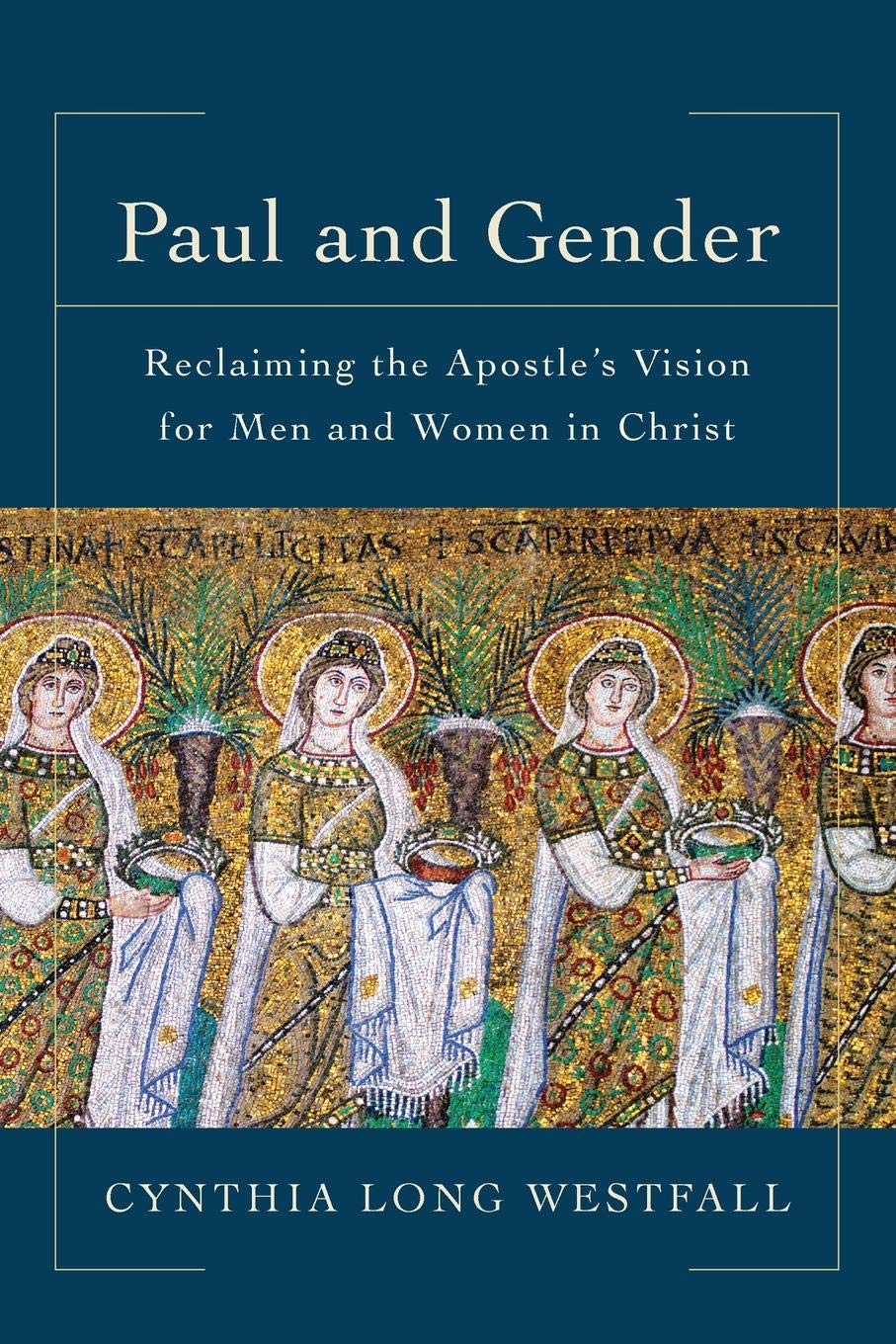
Review of Cynthia Long Westfall, 'Paul and Gender'

Photo of Cynthia Long Westfall's book, Paul and Gender
Photo: C Imes
Cynthia Long Westfall's Paul and Gender: Reclaiming the Apostle's Vision for Men and Women in Christ is a tour de force. 

It's not a new book (c. 2016), but I finally took the time to read it, and I'm so glad I did.

Dr. Westfall is a graduate of Biola (where I teach), and currently serves as Associate Professor of New Testament at McMaster Divinity College in Hamilton, Ontario, Canada.

In the stuffy room marked "Paul's Views on Women," where a weary debate has been at an impasse for centuries, Westfall raises the blinds and throws open the windows, letting in light and fresh air. With my three degrees in theology and four-and-a-half decades in the church, I thought I had heard it all. But just ask my husband (at home) if he's ever seen me gasp so many times while reading, and if I've ever interrupted him so many times to read him a sentence or a paragraph.

Here are a few nuggets:

  • "Pauline theology of ministry was based on metaphors of slavery and service so that any believer (gentile, slave, or female) could assume any function in the house church without violating the hierarchy of the Greco-Roman culture" (6; cf. 266). Later she explains that words like "pastor" and "deacon" were not technical terms until long after the New Testament. We associate them with prestige and authority, but they would not have had that connotation to Paul's recipients.
  • Westfall problematizes the simplistic views of Greco-Roman authority, showing the many men were under women's authority (as children, slaves, or clients to wealthy women) and that most women had some measure of authority in the domestic sphere (e.g., pages 23, 267).
  • She notes in that context a woman's "unveiled head signified sexual availability, so that a woman slave or a freedwoman was prohibited from veiling" (29). Therefore, "Paul's support of all women veiling equalized the social relationships in the community . . . [and] he secured respect, honor, and sexual purity for women in the church who were denied that status in the culture" (33-34).
  • Paul regularly used male metaphors for all believers and female metaphors for those in church leadership. "Paul's use of maternal imagery for pastoral care illustrates a compatibility of pastoral care with feminine commitment and the female role of nurture" (53).
  • Westfall argues cogently that "head" in Paul is a metaphor that relates to source rather than to authority. While she is not the first to contend for this reading, I found her explanation particularly insightful. "Christ is the source of man's life because he is the creator who formed man in Genesis 2:4-9. Man is the source of woman's life because she was created out of man in Genesis 2:18-23" (86).
  • She demonstrates from Paul's own letters that Paul does not believe women are more prone to deception than men. "Women as well as men in the Christian community are in danger of deception, but the same remedies are available: biblical correction and teaching" (116).
  • Westfall explains the historical background that likely prompted Paul's strange statement about women being "saved through childbearing" (1 Tim 2:15). "Artemis was the patron goddess of the city of Ephesus, and she was literally the savior to whom the women went for safety and protection in childbirth" (136). It is very likely that in 1 Timothy 2, Paul is addressing false teaching in Ephesus and urging women to trust God to watch over them during their vulnerable experience of childbirth.
  • On eschatology, she writes, "According to Paul, there is no differentiation in humanity's destiny on the basis of gender, race, or status. Women, as well as gentiles and slaves, have a shared destiny of authority and rule... Women cannot have a final destiny that was not their intended purpose of function at creation. Rather, it is a transcendent norm for men and women to share dominion" (147).
  • Paul is counter-cultural. "Christianity undercut essential patriarchal rights by requiring men to be faithful in the same way that the culture had required women to be faithful" (203).
  • She explains that in Greek, "Masculine is the default gender, and it cannot be assumed that women are excluded as referents form masculine nouns, pronouns, and so forth, particularly in catchphrases, unless they are excluded by the context" (270).
  • Westfall notes that Paul's letter to Timothy was personal, addressing specific problems in the congregation in Ephesus. "A document like Paul's Epistle to the Romans would have been a more logical place to make a clear prohibition on women teaching and in ministry" (297).

I cannot do justice to this rigorous book with a list of bullet points, but I wanted to give you a taste of the sorts of claims she is making. Westfall's conclusions are carefully researched and well argued. She has a way of turning things inside out to help readers see what has been hiding in plain sight. Her book simultaneously delighted and depressed me. If she's right -- and I think she is -- then this book offers good news for women who have long felt called to ministry in the church. But at the same time, Paul and Gender saddens me. I feel the weight of the fact that some corners of the church have unnecessarily missed out on hearing the Spirit-empowered voices of women for a very long time.

Church leaders, I beg you to read this book. You can't afford not to.


Sunday, November 14, 2021

Reflections on The Rise and Fall of Mars Hill

It's likely that I'll remember 2021 in part as the year in which Mike Cosper narrated my solo drives and weekend walks. Often I wondered if I could take yet another heart-sickening story of the abuse of power in the church, but I kept coming back, like a moth to the flame. 

If you're not familiar with it, The Rise and Fall of Mars Hill is an audio documentary sponsored by Christianity Today about the Seattle mega-Church called Mars Hill pastored by Mark Driscoll -- its origins, rapid growth, M.O., and the toxic culture of leadership that lead to its messy end. 

I have never met Mark Driscoll, never listened to one of his sermons, and never read one of his books, so why did I invest over a dozen hours listening to this podcast?

In the first place, it's well produced and well articulated. The sound design is fantastic and the stories are compelling. Christianity Today set a high bar with this one.

More importantly, it helps to explain a movement I could not understand at the time -- among other things, how a conservative pastor could say such crass things about sex, gender roles, and manhood from the pulpit and get away with it. Like most evangelicals with an ear to the ground, I had seen and heard clips of inflammatory things that Mark Driscoll said from the stage (around 2012), and I was deeply concerned. I later learned about his highly unethical ploy to get one of his books on the New York Times bestseller list. It was hard to miss the news about the raft of plaigiarism found in his books. And I knew that in spite of his church elders' attempt to lead him through a disciplinary process, Mark had resigned and headed to Arizona . . . where he planted a new church.

The Rise and Fall of Mars Hill shines a spotlight on abusive power dynamics that are too-often operative in Christian churches and institutions. Cosper traces various threads to help us see the origins of unhealthy ideas and the ways that they hurt people. At the same time, he highlights the stories of those who experienced radical transformation in their lives in the early days of Mars Hill. 

I believe God calls the church to bear his name with honor. In the case of Mars Hill, the quest for growth-at-all-costs was paired with Mark Driscoll's growing refusal to be accountable to seasoned leaders in his church network or even to his own board of elders. We can learn a lot from this story. It stands as a modern day parable of sorts, warning of the dangers associated with a leader having too much power, too fast, without godly character and life experience to prevent that leader from going off the rails. Unlike a parable, this one has real collatoral damage. So many former members are still trying to pick up the pieces and make sense of what happened.


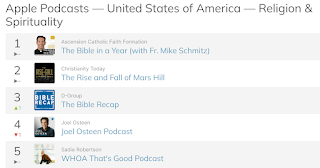
Ironically, the podcast has been a sensation of its own. Today it's ranked #2 in religion podcasts in the US. This probably says something about our our collective desire to hear grizzly tales of others' demise. It probably also points to how widespread these problems are in the church. I'm guessing it appeals to a lot of people who would like to understand a conservative brand of Christianity that prides itself on fidelity to Scripture but puts up with a bully in the pulpit. Probably all of these reasons. (As a side note, it's in very interesting company on the top 5!)

I've listened to The Rise and Fall in part because of its popularity. As an educator and lover of the church, I want to be in the loop about what people are hearing and how they are processing. If you've listened to at least part of the series, how has it personally challenged you? Leave me a note in the comments below.

Personally, I've been sobered by what well-meaning people will tolerate when a strong personality is at the helm. The podcast has given us much to lament. It renews my appreciation for institutional structures that have rigorous checks and balances in place. It's also a reminder that character matters a whole lot. For Driscoll, his popularity became the "proof" of his effectiveness and the "fruit" of "his ministry" -- but how many of those metrics could be traced to people who tuned in because they were incredulous? Just because people are listening, that doesn't mean the teaching is sound. The Old Testament prophet Jeremiah warned against false prophets who told people what their itching ears wanted to hear (Jeremiah 6:14).

If the podcast series has left you disillusioned about the church, a good next step might be to read Scot McKnight and Laura Barringer's book, A Church Called Tov (tov is the Hebrew word for "good"). It's on my short list of books to read next. McKnight and Barringer write about how to cultivate a healthy church culture where stories like this one will not keep happening. May the overwhelming popularity of this podcast awaken the church to stop tolerating abuses of power and instead cultivate communities marked by faithful and humble service!

Thursday, March 12, 2020

Being the Church during the COVID-19 Pandemic

You know that scene in "The Sound of Music" where the Von Trapp family sings their farewell at the Salzburg Music Festival? Everyone is emotional at the thought of how WWII is changing everything. People are leaving who should not have to leave. Everyone is uneasy.

Chapel this morning felt like that.

No, we had no armed guards at the exits, but one student after another stopped at the hand sanitizer station and entered the room lathering their hands. Greetings were awkward as we all tried to be friendly without shaking hands or hugging. Our main speaker was piped in on video, rather than risking exposure, since he'd been traveling in affected areas. All these are silent reminders of how in one week, we have all become much more aware. Aware of germs. Aware of the real possibility that meeting together is a luxury we may have to relinquish.

We're in the middle of our Global Connections Conference (GCC) at Prairie College. Our theme this year is NOW. HERE. THIS.

It's hard to imagine a more pressing world concern at this moment than COVID-19. Friends of mine at institutions across the United States are scrambling to move classes online while grieving the loss of embodied community for the rest of the semester. Conferences, classes, services, athletic competitions, concerts, lectures, class trips -- all cancelled for friends south of the border. And while Canadians are good about taking everything in stride and no one in our community is freaking out, there is a growing sense that even out here on the prairies we, too, will be affected. Soon. As I write this, our contingency team is meeting.

Singer-Songwriter Steve Bell at Prairie College's 
Global Connections Conference, March 2020

Our morning speaker was singer/songwriter Steve Bell. His stories were balm to anxious souls. His vulnerability made space for our own grief. And he closed with a song based on the words of Teresa of Avila, "Christ has no body here but ours."

Steve told the baffling story of the rapid spread of Christianity in 150 CE. This backwater sect following a crucified leader should not have captured the hearts of the Roman empire, but it did. Why? A plague. Citing the work of sociologist and historian Rodney Stark, Bell told us how early Christians embraced the news that "God so loved the world," and that this news should have sounded ridiculous. In the Roman world, "gods don't love, they are users," he said. In that day, worship was the equivalent of someone in a cage with a hungry lion desperately saying, "Nice kitty!" People didn't worship their gods out of love or in response to love, but in order to placate them. In contrast, Christians really believed that God loves people. And they knew that love is our way to God because God is love (he picked up this sentence from a sermon by David Witticum, who got it from Augustine).

So, in the face of the plague, when everyone else fled, Christians stayed. They knew they must love what God loves. They loved radically, at risk to their own lives. Steve's closing words to us felt like the farewell of the Von Trapp family. There was a palpable sense that today could be our last meeting as a community for quite some time--that everything was about to change. (Note: I have no official word on this. It just seems inevitable, given how many other schools have closed their doors.)

The risk of death appears to be much lower with the Coronavirus than it was with the plague of 150 CE. Still, the risk is real for the elderly and those with compromised immune systems. We will know people who die from this. Current estimates hover around a 4-5% death rate. How can we love well in this strange new world?

We may not personally feel at risk, but there are people in our circles who are. Taking precautions protects them, too. It's not a matter of fear, but of love. If you don't like people telling you what you CAN'T do, here's a list of what we CAN do:
  • We can wash our hands more thoroughly and more often. 
  • We can minimize human-to-human contact.
  • We can regularly disinfect door handles, light switches, and hard surfaces, even if it's not in our job description.
  • We can cancel or postpone unnecessary meetings.
  • We can think creatively about how to be the church even when we can't meet in person.
  • We can think creatively about how to teach online.
  • We can refrain from stockpiling resources that everyone needs, such as toilet paper.
  • We can offer to pick up groceries for friends who aren't safe to go out.
  • We can offer to pray over the phone with those feeling anxious.
  • We can text and email to check on people we would normally encourage in person.
  • We can curtail all unnecessary travel and take a hard look at what seems necessary.
  • We can pray for stamina for health care workers and let them have the masks.
  • We can pray for wisdom for civic and community leaders who are making difficult decisions.
  • Above all, we can STAY HOME if we have a fever or cough.
A pastor friend posted on Facebook that all meetings of more than 250 people in the state of Washington were strictly prohibited, including churches, for the time being (Oregon made a similar announcement today, and so did Alberta, just a few moments ago). Someone responded angrily, implying that this is a breech of first amendment rights--the right to congregate. He seemed to feel this was a form of persecution. Please hear me: This is not religious persecution and it's not unbridled fear. Quarantine is a form of love. Experts are telling us this is the best way to stop the spread and protect the vulnerable in our communities, and that we need to act fast to have the highest success rate. So for the love of God and the love of your neighbor, stay home. 

Maybe COVID-19 will re-teach us what we have forgotten--that we are made for embodied community. As wonderful as social media is, it can never replace a handshake or a hug. And as inspiring as online sermons can be, they cannot replicate the taste of bread and wine or deep-throated song in community. This quarantine won't last forever. Hopefully it will be just long enough to help us more deeply appreciate that we were made for each other and that we can't be fully ourselves in isolation. See you on the other side!

Tuesday, January 21, 2020

Author Interview: Kristen Padilla, "Now That I'm Called"


Image result for now that i'm called kristen padilla
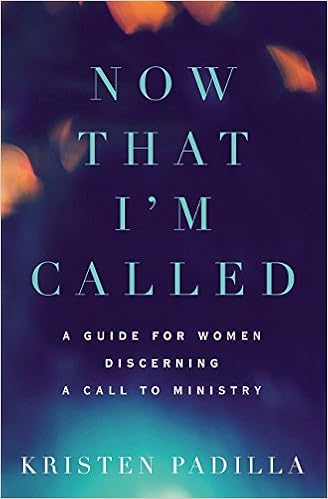
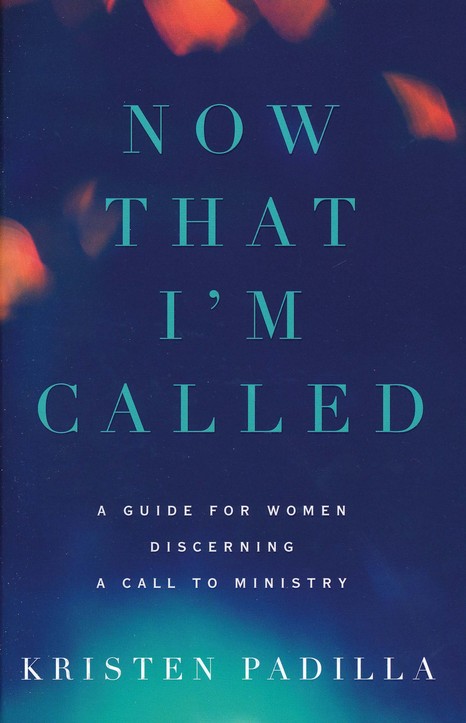
Today I had the privilege of interviewing Kristen Padilla about her book entitled Now That I'm Called: A Guide for Women Discerning a Call for Ministry (IVP 2018). I have already recommended her book to students multiple times, so it was great to hear the backstory of the book.

Since the particular roles open to women differ from one denomination to another, Kristen explores ways that women from all kinds of churches can walk in obedience to God's call to participate in his mission. In her book, she says, "I want people, especially women, to understand that receiving this kind of call does not mean that they must hold a church office -- the role of a pastor, elder, or deacon, for example. The Holy Spirit gives gifts to the people of God, and these gifts can be exercised outside of a particular office in the church" (13). Her approach makes this book suitable for women from churches across the theological spectrum.

What inspired you to write this book? I was inspired to write this book for several reasons. First, I wrote this book because I saw a need for it. When I was a young woman sensing a call to vocational ministry, I had no one and no resource to guide me through the discernment process, the questions pertaining to being a woman in ministry, and next steps. As I say in my book, I felt like I was in a dark room with my arms outstretched trying to find my way to the door. By the time I was in seminary and had conversations with other women my age or younger called to ministry, I realized my story was not unique—it was the story of many women called to ministry. Thus, God put the idea and passion for this book in my heart, and ten years later it finally came to fruition. Second, I wrote this book out of a deeply held biblical conviction that God calls women to gospel ministry and that the Church of Jesus Christ needs women who are called by God to engage in gospel ministry in the church and world. I wanted to write a book that would encourage and aid these women in the journeys of discernment for the purpose of equipping future generations of female ministers of the gospel.

What was the most difficult aspect of the project? The most difficult aspect of writing was perhaps the most obvious one: writing a chapter on 1 Timothy 2:11-15. As many know, this passage has been used to silence and forbid women from many avenues of gospel ministry. It is the battleground where most of the fighting regarding women in ministry takes place. In my mind, I could not write a book for women called to ministry without addressing this passage of Scripture. However, I wanted to demonstrate a fidelity to the authority of Scripture and a humble and generous interpretative posture and tone. I also wanted to address head-on problematic and false interpretations that have held many women from pursuing ministry, namely that the female gender is by nature more easily deceived and that a certain “creation order” is a fail-proof guard against false teaching.

Author Kristen Padilla
What do you want readers to take away from your book? I want readers to walk away with a theological and biblical vision for women in ministry. I want them to see in Scripture that God’s plan has always included women and that women play an equally vital and important role in gospel ministry. My prayer is that women who read the book walk away with confidence grounded in Scripture and theology to follow God’s call to serve him in whatever role he has called them in obedience and humility.

Your book occupies the unpopular middle ground between the debate over women in ministry–not progressive enough to satisfy those who ordain women and too progressive for those who don't. What was your heart behind writing for those in this middle space? This is a great question. One of the first responses I received from the book was told to a friend of mine, “I wasn’t sure if she was complementarian or egalitarian.” A compliment or a criticism? I made the decision early on to write a book from that neither-complementarian-nor-egalitarian space or the in-between space for two reasons. First, I wanted the book to meet women in churches and traditions on both sides of this interpretive divide. My goal is to address the beginning of one’s call to vocational ministry—to lay the groundwork, if you will. Therefore, secondly, I did not see the need to talk from a strictly complementarian or egalitarian perspective, whatever that means today, since my goal wasn’t to talk about ordination or roles per se. I believe these two approaches have more in common than is often acknowledged. Most women in these so-called camps are tired of the debate and want to focus on the question: does God call women like me to serve him in ministry? I actually believe that this “in-between” space includes many women. This does not mean I do not have a particular interpretation of 1 Timothy 2:11-15 nor does it mean I am somehow theologically neutral when it comes to the roles of women in ministry. However, I did not believe it would be helpful to advocate from one perspective or another given the purpose of this book. Some will “blacklist” books if they are written from the other “side.” Even though I tried to stay in that middle space, I knew that for some my book would not be complementarian or egalitarian enough and would therefore be censored. This is indeed what has happened. In spite of this, I strongly believe that there is a strong middle and ecumenical ground where conversations about women in ministry can and should take place. I pray the posture and position I take in the book draws people together rather than exclude them.

In the year since your book has released, you've undoubtedly heard from many readers. What would you like to say to those who haven't read it yet? Or what would you want to add to what you've said in the book? Yes, I have been very fortunate and blessed to have heard from readers around the world, namely women for whom the book came at a time in their life when they needed biblical encouragement and guidance concerning the next steps in ministry. Hearing personal testimonies from readers is an author’s great reward. To those who haven’t read the book yet, I would of course say, “Read it!” On a more serious note, I try to bring out from Scripture stories of women called by God to proclaim the word of God for the people of God. There are many examples of women in Scripture doing just that—proclaiming a message from God to edify people in their day, and, by God’s design as Holy Scripture, edifying us today! In my book, I put the stories of these women next to stories of well-known men in Scripture to show a common pattern in how he calls and uses both men and women for his purposes. It would be a shame if the discussion about women’s place in God’s kingdom was limited to a few verses from the New Testament and did not take into account all of Scripture. If I could revise the book today, I would add more examples of women God uses in Scripture whose words are included for our edification today, such as the wise woman of 2 Samuel 20 and the Queen of Sheba. I want to continue to shine a light on the ways in which God is using women in his kingdom, which is why I am glad to say that I am writing a second book with Dr. Timothy George on women of the Reformation. My prayer is that the Church would be filled with God-called, theologically trained spiritual mothers who, alongside spiritual fathers, are equipping the saints for the work of ministry.

Thanks, Kristen, for writing this book and giving us a glimpse of your journey!

Wednesday, November 27, 2019

Best Books on Women in Ministry

People often ask me for book recommendations on the topic of women in ministry. Here are some of the books that I loan out most often, organized roughly from the most accessible to the most academic.

Image result for kristen padilla now that i'm calledKristen Padilla, Now That I'm Called: A Guide for Women Discerning a Call to Ministry (Zondervan, 2018)

Kristen writes for women who sense a call to ministry but are not sure how to carry it out in their context. Her book is sensitive to long-standing gender roles and dynamics in complementarian congregations and does not presume that readers are egalitarian. She warmly affirms the giftedness of women and encourages them in their quest to be faithful to God's call.

Alan F. Johnson, ed., How I Changed My Mind about Women in Leadership: Compelling Stories from Prominent Evangelicals (Zondervan, 2010)

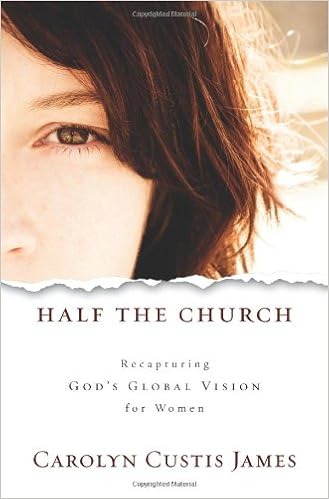
Image result for half the church carolyn custis jamesThis book is a treasure of stories about men and women who have shifted toward a more egalitarian outlook. A collection of testimonies rather than a systematic argument, this book shows the struggles of Christian leaders to be faithful to Scripture, their "aha!" moments, and the humility it took to admit that they had been wrong.

Carolyn Custis James, Half the Church: Recapturing God's Global Vision for Women (Zondervan)

Carolyn's book urges women to step up and participate in kingdom work. We can't sit back and expect the men to do everything! God created us to work as a team, side-by-side ruling over creation. Carolyn addresses some of the most common arguments for male-only leadership that are rooted in the creation story and in the letters of Paul, showing the problems with those interpretations and inviting readers to consider the urgency of God's design for partnership. This book is one that the entire church, not just women, need to read.

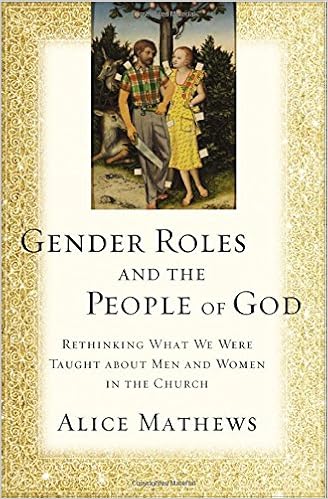
Image result for alice mathews gender roles
Alice Mathews, Gender Roles and the People of God: Rethinking What We Were Taught about Men and Women in the Church (Zondervan, 2017)
This is an accessible introduction to the key biblical text that so often figure in the debates over women in ministry. Dr. Mathews has been teaching a course at Gordon-Conwell Theological Seminary on this topic for many years, and this book is the best of her classroom content, now available to everyone.

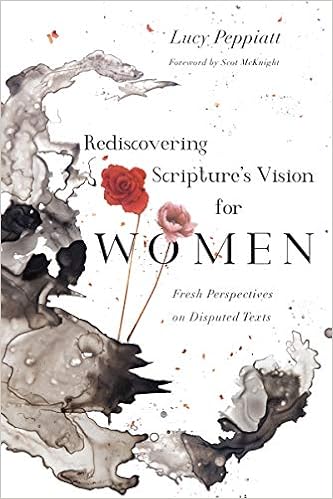
Related imageLucy Peppiatt, Rediscovering Scripture's Vision for Women: Fresh Perspectives on Disputed Texts (IVP, 2019)

Lucy's book is a brand new release from InterVarsity Press. As she reexamines the relevant biblical texts, Peppiat "finds a story of God releasing women alongside men into all forms of ministry, leadership, work, and service on the basis of character and gifting, rather than biological sex. Those who see the overturning of male-dominated hierarchy in the Scriptures, she argues, are truly rediscovering an ancient message―a message distorted by those who assumed that a patriarchal world, which they sometimes saw reflected in the Bible, was the one God had ordained." (from publisher's book description)

Craig S. Keener, Paul, Women, and Wives: Marriage and Women's Ministry in the Letters of Paul (Baker, 1992)

Dr. Keener's book landed on my desk on an interesting day. An invitation to preach had just been retracted on account of my gender (the pastor got complaints when people found out I was coming). Dr. Keener examines the cultural and historical context that motivated Paul's statements, offering a new perspective on how to read them responsibly.

Image result for cindy westfall paul and genderCynthia Long Westfall, Paul and Gender: Reclaiming the Apostle's Vision for Men and Women in Christ (Baker, 2016)

Dr. Westfall explores the broader question of gender according to Paul, revisiting the most controversial texts to offer a fresh perspective. She is historically grounded and moves the debate forward in helpful ways based on the latest research.

You'll notice that the subtitles of several of these books share a similar tone: recapturing, rediscovering, rethinking, reclaiming. These authors all agree that something is missing in Evangelical churches today. In our efforts to obey the Bible, our churches have implemented practices that inadvertently prevent gospel ministry and silence the Spirit's work. These authors -- all of them Evangelicals -- call us back to the Scriptures to take another look. Things are not as simple as many have assumed ("women, be silent"), and our faithful reading and practice of Scripture depends upon a careful reassessment. If Scripture is to remain our authority for faith and practice, we cannot afford to get this wrong.

Thursday, September 12, 2019

The Body of Christ, Broken for You: What Communion Taught Me About Church

It may not seem like such a big deal to stand there holding a tray of bread squares. Don't be fooled. It's a very big deal.

Let me back up. Two years ago I arrived at Prairie College as professor of Old Testament. I was ready to teach and ready to serve. In my first couple of weeks here, a colleague approached me to see if I'd be willing to help serve communion at our convocation chapel. I was surprised at how much this meant to me. Forty years old at the time, I couldn't recall having ever been asked to serve communion before. I've attended church my entire life -- not casually, but devotedly. If there is such a thing, I'm a professional Christian. I've dedicated my life to this faith, to this message. I've been to Bible college and seminary. I spent 15 years as a missionary. But I'm a woman. Perhaps that's why I had never been asked to pass out bread squares and tiny cups of juice to fellow believers.

For chapel we passed the trays down long rows. Somehow I messed up the every-other rhythm or sent the wrong tray first down the row, which meant that people were trying to hold a cup while passing a tray and taking bread. That didn't work very well (these things take practice, of which I had none!). In the end, everyone was served and our job was done. I felt mostly like an imperfect cog in a machine. Happy to help, but nervous and clumsy.

The body of Christ, broken for you (Photo: C Imes)
This year was different. This year at our convocation chapel those of us serving stood at the front of the auditorium. Everyone came forward to receive communion. I held the tray of bread as people passed in front of me. I looked each one in the eye and told them, "The body of Christ, broken for you."

The music was a bit loud. I'm not sure whether most of them even heard me. But something powerful happened as I said over and over, "The body of Christ, broken for you." I knew most of these people by name. I knew many of their stories. Some of them I loved deeply. Others -- to be frank -- not so much. In context of these relationships, those simple words became profound as my heart silently completed each sentence:

"The body of Christ, broken for you . . . whose body is also broken."
"The body of Christ, broken for you . . . whose spirit is crushed."
"The body of Christ, broken for you . . . whose mental health is tenuous."
"The body of Christ, broken for you . . . whose family is estranged."
"The body of Christ, broken for you . . . whose sin is still hidden."
"The body of Christ, broken for you . . . who is growing in grace."

A few people approached who I've never really clicked with. People who annoy me. They've never seemed to like me, either, but they had no choice but to come to me for bread.

"The body of Christ, broken for you."

My words to them were the same as to all the others, and this time the Spirit gently convicted me. Would you withhold love from one I love enough to die for?

I felt ugly places in my heart close over with forgiving love as I silently repented.

I heard a still small voice say to me, "The body of Christ, broken for you . . . who have failed to love." I needed as much grace as every other person I served. The ground is level at the foot of the cross.

This story didn't take place in church. It was in a college chapel. But it illustrates one reason why listening to a sermon via podcast can never replace church attendance. Sunday morning is not primarily an intellectual transaction, nor is it primarily concerned with my vertical relationship with God, though it includes both of those dimensions. When we show up together at the foot of the cross, divisions are healed, grace is conveyed from one person to another, and we become just a little bit more like the family of faith God intended. As Kevin Peters said in his message that day,
"Our God is radically relational. . . . God designed us to be connected to him and to each other."
Mark Jonah had introduced communion with Hebrews 12:1-2, focusing particularly on the words, "Jesus . . . for the joy set before him, endured the cross." Mark always assumed that this joy was the joy of heaven awaiting Jesus, an eternal reward for faithfulness. Lately, though, he has been discovering a new dimension of Jesus' joy -- the joy of restored relationships now. Jesus knew that his death would have an immediate effect on relationships here. That joy made his suffering worth it. That joy is the reason we bother with church.

Yes, the body of Christ is broken. But it's brokenness brings life to you . . . and to me.

Sunday, September 4, 2016

encountering the light of Christ

When you enter the doors of a new church, anything could happen. Churches with dwindling numbers are often surprised to see a new face, as the greeters were this morning to see me. But their warmth made me feel right at home.

A single ring of chairs stood empty around the center microphone on the circular platform, expectant. A Steinway occupied the far end of the circle, its melodies soaring to fill the sanctuary and encircling all of us.

Pews faced the middle. I sat in the second row, waiting, observing. I was early. In time, others came and found seats in the first few rows. I knew no one. I had been invited by the son-in-law of a member to speak during the Sunday school hour. That was my only earthly connection.

A pamphlet in the pew back explained how a Quaker-style service works. Quakers embrace silence as they embrace each other, welcoming the opportunity to listen and learn from the spirit of Christ in their midst. The unprogrammed quiet is a soothing balm in a hurried life.

A man rolled in on a motorized wheelchair, making his way to the front to greet another worshipper, and then me. Jerry refused to let his disability cripple his contribution to the warmth of the community. (I learned later that he was relatively new himself, and that the man he greeted was there for only the second time. Signs of life.)

As the service unfolded, I gathered that this was a grieving community, searching for direction, wondering how to respond faithfully to a series of events that left most of their pews empty. I wondered, then, if I should scrap my seminar on 'Understanding Biblical Prophecy' and speak instead about lament, or about how to be rooted in the face of life's storms (Psalm 1–2). How does one walk into a community and speak without first listening long? first loving and hearing?

In those quiet moments, I asked the Lord to guide me. By the time I reached the classroom after the service, I knew I should stick with my original topic and trust that God had guided my preparation. I suspected (rightly, I'm told) that Quakers typically camp out in the Gospels. That was my bridge to the prophets. How can one possibly understand the richness of the Gospels without an understanding of the Old Testament prophets? Spontaneously, I began in John 9, linking Jesus' miracle to Isaiah's commission in chapter 6. Then we moved into Isaiah 7 to examine verse 14, always a Christmas favorite. Both passages illustrate the value of reading the text closely for its historical, literary, and theological dimensions. They also illustrate the inherent dangers when we don't.

The hour flew by, followed by several follow-up conversations and a long lunch. I returned home with a full heart, grateful for the privilege of fellowship with other Christ-followers and grateful that I have the most wonderful subject matter in the world to teach -- God's Word -- which truly does not return void.

Encounters like this one are not accidental. God uses each personal connection in some way as we spur one another on to love and good deeds. A Quaker might say that the light of Christ within each of us illuminates the community as we gather. I'd say that pretty well sums up what happened today!

Tuesday, April 12, 2016

lasting impressions and do-overs

Is it possible to retire from retirement? Last week my grandparents moved from their retirement home in the mountains to a retirement facility just one block away from my childhood home. This time it's for real -- downsizing, purging, relinquishing memories and positioning themselves closer to medical care, meals, and household assistance.

This move to Denver brings my grandparents back into the orbit of those who made such a mark on my childhood. Men and women who filled the pews on Sunday morning, and whose names filled the address book we kept by the phone. Our perpetual problem was that address books never allowed enough pages for the letter "V": VanderVeen, Vermeer, Veenstra, Verstraate, VanderHorst, VanHeukelem, Van Stelle, Vander Ploeg, Van Dusseldorp, and on it went. We managed to surround ourselves almost entirely with other Dutch families -- our Christian Reformed Church, the Christian school started by CRC families where my brother and I attended, the businesses run by CRC families, and even Dutch neighbors who, like us, had settled close to all these things.

We lived just 4 doors down from Third CRC. Stepping out the front door in the morning, we could see the brick corner of the church, with windows to the nursery where we began our childhood (and the mural our mom painted of Noah's Ark), the library where we filled our arms with Christian books, Sunday school rooms, and the consistory room where Dad participate in deacon's meetings and where I sat nervously at the big oval council table, being interviewed by a dozen men in suits before my public profession of faith. Now the men and women who used to shake our hands and pat our heads shuffle down hallways one block to the East, in that brick building that was once new, heading to meals, their frames bent and their skin too loose. Among them is our pastor from so long ago. My grandparents are their newest neighbors.

I remember Reverend Kok as tall and broad, with a booming voice. I knocked on his door once, hands trembling and gasping for breath. I had run to the parsonage with an urgent confession. While playing in the church yard mid-week, as we often did, I had broken a basement window. Looking back, I would like to give Reverend Kok a "do-over." What he ought to have said was, "Don't be afraid, Carmen. It can be fixed. It took a lot of courage to come tell me the truth. Thank you for your honesty. Well done. This mistake doesn't define you, your integrity does." What he really said was, "I hope you have plenty of money in your piggy bank." This terrified me. He didn't intend to be mean, but by the time my 10 year old feet had pounded the pavement all the way to my house almost a block away, I was a mess. The tears burst and I blubbered my confession to Dad, who told me not to worry. He could fix it, and I didn't need to pay for it. After that we didn't skateboard on the wheelchair ramp any more.

Two other memories of Reverend Kok cast him in a different light. The first showed his insecurity, perhaps. I don't remember the context of his sermon, but I remember him suggesting that none of us young people would want to become pastors when we grew up. It was almost a rhetorical question, I think. "None of you wants to be like me when you grow up. (Right?)" He meant that we probably didn't want to go into pastoral ministry. Unbidden, and without any hesitation an unspoken response welled up inside me. "Oh, but I do!" I'm not sure that I thought it was actually possible. After all, I was a little girl, not a little boy, so pastoral ministry was not an option. But I couldn't think of anything more wonderful to do with my life. Reverend Kok represented the pinnacle of vocational excellence to me. I'll never forget his angst the Sunday after televangelist Jimmy Swaggart was caught with a prostitute (mostly I remember it because he said the word "butt" from the pulpit, as in, "today we [Christians] are the butt of every joke." I still feel the shock of hearing that, almost 30 years later.).

But my favorite memory begins one Sunday morning when I was distracted during the sermon, studying the maps in the back of the pew Bibles, because they were the only pictures available. It was a New Testament map that grabbed my attention -- a New Testament map that included the city of Jericho. My little brain couldn't quite wrap itself around that one. Didn't the walls fall down? Wasn't it destroyed? At the end of the service all the grown ups filed out of the sanctuary, shaking Rev Kok's hand. I carried the pew Bible along with me, open to the map, and planted myself right beside him. Craning my little neck (I told you he was tall!), I asked if I could ask him a question. His attention divided, he kept shaking hands and nodding at folks while he listened to my question about Jericho. Then he gave me an answer I didn't expect. "I don't know, but I'll try to find out."

The next Sunday I waited impatiently until the end of the sermon. I filed out with everyone else and planted myself beside him again, intensely curious. When there were no more hands to shake he turned to me. "Well, I looked at a book on Jericho this big [here he held out a bent finger and thumb probably 3 inches apart, thoroughly impressing me], and here's what I learned. After Jericho was destroyed, it wasn't supposed to be rebuilt, but somebody did it anyway. He lost both of his sons for disobeying God, but the city has been there ever since." (See 1 Kings 16:34 for the story)

I went away with a full heart and a dawning appreciation for biblical scholarship. Rev. Kok had taken me seriously. My questions mattered. And they had answers. There were books full of them.

I wonder how instrumental that conversation was in setting me on the trajectory that led me to Wheaton. My insatiable fascination with the Bible has only grown with time. What if Rev. Kok had waved me aside and told me my question was silly? Where would I be?

My Dad spoke with Rev. Kok last week, when my grandparents were signing papers on their new apartment. Rev. Kok wanted to know if I was still a good Calvinist. (I've forgiven Dad for lying in response, as he was answering the more important question that Rev. Kok ought to have asked.) I'd like to give Rev. Kok a do-over when I make it to Denver to see my grandparents in their new home. I'd like to hear him ask, "Do you still love Jesus? Are you walking faithfully with him?" For that, my answer is a resounding "YES!"

Tuesday, December 8, 2015

a beautiful thing

Photo: Aviva by Kameel
The line wound its way out of the Mediterranean restaurant and wrapped around the corner. We took it as a good sign, and so we attached ourselves to the end and waited along with everyone else. The clientele were not just conference attendees, but locals, and no one seemed the least bit disturbed about the wait. Another good sign. Soon we found out why. A smiling hostess with a tray of samples worked her way down the line. "Lentil soup," she offered. "Try it. You'll see. It's good." The lilt of her accent told me that she would know, and her obvious joy in working there boded well. It was good.

Kameel Srouji (Photo: Aviva by Kameel)
Still, nothing could have prepared me for the personna behind the counter. A tastefully decorated wall had shielded our view of the food line until we rounded a corner just steps away. "Hello! Welcome to Aviva. How can I make you happy?" His booming voice filled the atmosphere with life, enthusiasm. His tall frame matched his voice. His sweeping movements made food service an art form. "Excellent choice. It's natural. It's fresh. It's delicious." The customer two ahead of us smiled his thanks and moved down the line. Again the voice boomed, "Welcome to Aviva. You're beautiful. I love you. I need a hug."

A hug? Doesn't that break some kind of food service code? Nevertheless, the businessman in front of us in line ducked around the counter into the kitchen area to hug the man who was larger than life. The chef's eyes twinkled. He lost no time in filling another plate. "Thank you. God bless you. Have a beautiful weekend."

I'm afraid I was a bit thrown, wondering if this was for real. (Is he saying "God bless you" because he heard that the Evangelical Theological Society is meeting next door? Did some study show that enthusiasm is good for business?) When I got to the cashier, I asked, "Is he always like this?" A big smile spread across her face. "Every day!"

Photo: Aviva by Kameel
The energy was palpable.
The food was delectable.

And so the next day, with another friend, I did my time in line again. Brittany had her kids along with her at the conference, and her mom came to watch them. So the five of us waited, tasted falafel, and rounded the corner.

The booming voice. "You came back! How can I make you happy today?" (How can he possibly remember me when he serves hundreds of customers every day? Is it because he looks every one of us in the eye and recognizes that we are made in the image of God?) I suspect so.

Brittany asked if there was something less spicy for her kids. "Ah! For the little ones. This one is on me. No charge. Tell me -- what do they like to eat?" He proceeded to pile a plate with falafel, shwarma, grilled vegetables, and hummus. "Your children are beautiful. Thank you for feeding them real food!"

Kameel's passion for food is obvious!
Photo: Aviva by Kameel
It is not every day that you meet someone who is happy at work, someone energized by their labor who does it with excellence. Kameel is one of those. And the entire restaurant pulsed with this life. It occurred to me then that people come to his restaurant for more than just calories. They pay for lunch and get love, kindness, affirmation. His passion for eating well and living well is contagious.

When I arrived home from Atlanta I was still thinking about Kameel. We found him online, smiling just the way I remembered. I also learned the source of his joy. Kameel is a Catholic believer from Nazareth, eager to share God's love with everyone he meets.

When we have the privilege of meeting someone who has "found their calling" in life it's a beautiful thing. In that moment we get a glimpse of God's creative and redeeming power at work in our midst. Kameel's passion rekindled my own passion to serve God wholeheartedly in my own corner of the world. Whether restaurant or classroom, office or farm, retail outlet or machine shop, when we're doing what we were born to do, and doing it well, He gets the glory.

"And whatever you do, whether in word or deed, do it all in the name of the Lord Jesus, giving thanks to God the Father through him." (Colossians 3:17)


Monday, November 16, 2015

when you don't (think you) have what it takes

A friend said it so beautifully, I couldn't help but share. She is beyond busy, faced with overwhelming needs and not enough hours in the day to respond. Myrto writes,

"It is always a sling and a few stones. It is always trumpets and a few ram horns. Let's face it, you have to get a bit ridiculous, a bit pitiful, a bit pathetic to fight the Lord's battles. Chariots, armors, weapons, anything that screams 'success' won't do. Only 'losers' recruited."
"The ministry is always small, weak, unpromising, always standing in the desert before the great giants in the land. Every year we have to take hold of our slings, pick up a few stones."

In ourselves, we lack. Whether time or money or education or creativity or courage, when we measure ourselves against the task that must be done, the deficit is painfully obvious.

But into this vacuum, the Spirit of God shows up, ready to work. He delights in our weakness, so he can demonstrate his strength. But still we must act. The stone doesn't sling itself, the wall doesn't build itself, the dissertation doesn't write itself, the children don't raise themselves...

Our part is to simply obey. To give our best. And then to watch as God transforms our feeble offering so that it becomes more than enough.

With Him you do have what it takes. You can count on that.

-------

p.s. I wrote this post weeks ago, before my NIV series was finished, and so I scheduled it to appear later. Now, on the night before it's set to go "live," I'm re-reading it . . . absolutely delighted at how God has done it again. He took my feeble offering, the fully revised dissertation that I submitted two weeks ago, and made something beautiful of it. I had given my best effort, honestly not knowing if it would be good enough. In the words of Dr. Block, "Congratulations on getting it to this stage. You have worked very hard, and it has paid off magnificently. Go out and celebrate." Needless to say, WE DID!


Tuesday, May 19, 2015

an unlikely blessing

I am trying to recall if I have ever heard a woman give a benediction before.

This search through my mental files is complicated by the fact that I have very rarely heard a woman preach.

There was Leslie, draped in black robes, who took the pulpit one Sunday evening in my childhood church. This I did not understand. Her vestments were foreign, to be sure, but stranger still was her gender. How could a woman preach God's Word to a roomful of Christian Reformed men — men who spent a good deal of time arguing over whether a woman could even pass the offering plate? This contradiction tugged my small brain into knots. I probably squirmed in my pew and scanned the sanctuary for furrowed brows. I suppose she even blessed us, but I don't remember. My Opa, who never missed a service, must have been livid. I was simply puzzled.

Then there was a woman in 2005 whose name I can't recall, and whose message I could not understand. She spoke Dutch. Oma and I had traveled together to the land of her birth, the plot of ground where she grew to adulthood, and the church in which her faith was formed. It was startling to see a woman take to the stage in the very church that had produced my conservative grandmother. I sat there, intensely curious, I — a woman — who felt called to teach God's Word. What would Oma say? The service ended. I braced myself as Oma turned to me with the inevitable judgment. "Well," she pronounced with considerable disgust. "You could have done much better." I'm sure my eyebrows rose, unbidden. Was this my grandmother's blessing? I received it as such.

Rebecca, a riveting speaker at Good Shepherd in Charlotte.
Octavia, who captivated us in chapel at Gordon-Conwell.
Maggie, drawing us into the story by performing a monologue as Mary, the mother of Jesus.
Karen, offering a simple, back-to-the-basics homily at the IBR worship service one year.

If I push myself, perhaps I could fill the fingers on both hands. I who am 37 years old and have rarely missed a Sunday. I'll do the math for you. That's 1,924 sermons, not counting evening services or chapel messages in college or Sundays since my last birthday. So perhaps it's not surprising that I cannot conjure up a picture of a woman pronouncing the blessing at the close of the service.

At least 99.5 times out of a hundred, it's been a man.

And so when Pastor Dave invited me to give the benediction after my sermon on Mother's Day, I hesitated. Is that ok here? sermon is already outside the box for most conservative evangelicals. I didn't want to start a riot. He assured me that it would be fine, and so I agreed.

The priestly blessing in Numbers 6 is one of my favorite parts of the entire Bible. I've spent a lot of time thinking about it, studying it, and writing about it. But this is a blessing only the priests are authorized to give. And they are all men. And these are not just nice words, they are efficacious words -- they do something. With these words the priests confer the Name of Yahweh on his people, verbally branding them as His own (see Numbers 6:27). They invite God to act on behalf of his covenant people in accordance with his promise.

I no longer believe that gender is a prerequisite for preaching. For similar reasons, I think "blessing" is not limited to clergy (or to members of just one Israelite tribe, for that matter). We are, after all, a "kingdom priesthood" (1 Peter 2:9) and in Christ there is "neither male nor female" (Galatians 3:28). But frankly, I don't have much practice with benedictions, and hardly any precedent. It might have looked as awkward as it felt when I extended my hands over the congregation that Sunday.

But I meant every word.

May the LORD bless and protect you.
May the LORD smile on you and be gracious to you.
May the LORD show you his favor and grant you his peace.
Numbers 6:24–26

Tuesday, September 23, 2014

after the storm

Art speaks powerfully. The artistry of Israel's tabernacle captured a sense of God's majesty with its gold overlays, fine fabrics, rich colors, and sparkling gemstones. Images of cherubim, lush fruits, and verdant trees evoked memories of the Garden. Aaron's fabulous clothes illustrated his role as intercessor for the nation. The design of the tabernacle and its furnishings was important enough to God that he gave Moses detailed plans to follow and set apart two men uniquely gifted in the arts to carry out the work (Exodus 30:1–11).

In a recent web article, Christian leadership guru Michael Hyatt claimed,
"Art has the power to point us to the divine, to the ultimate Artist. It doesn’t answer all the questions, but it can shine a light on questions we didn’t even know we had."

My friend, Jasmine May, author of Deep Waters, has graciously agreed to let me share some of her beautiful artwork with you. Like the artistry of the tabernacle, Jasmine's art speaks. While our journeys have been vastly different, we've both experienced pain and brokenness as well as healing.

"After the Storm" by Jasmine May
Her painting so stunningly portrays the state of my soul. The worst of the storm is over and the sun has begun streaming down from the clouds. The tree is surprised to look down and discover that she has not been destroyed. In fact, the power of the storm has stirred up deeper beauty. Her joy unfolds like a flower. Jasmine explains, "As the wind blows the leaves, it carries the seeds of the tree's beauty to the world at large, spreading life."

Thanks, Jasmine, for sharing this gift with the world and lifting our eyes to look to God!