Showing posts with label Zondervan. Show all posts

Monday, January 1, 2024

2023 in Books


I set a goal to read 40 books in 2023. I only completed 37 (though I started a dozen more . . . some of them abandoned, some still in progress). Here is the breakdown by category of those I finished, with all the details on GoodReads:

  • 9 memoir 
  • 1 poetry
  • 5 fiction
  • 12 Biblical studies
  • 7 practical theology / ministry
  • 2 academic theology
  • 1 self-help

If you decide to order a copy of any of these books, may I recommend my favorite bookstores? Hearts and Minds Books takes orders and ships anywhere in the US. Three Hills Books in Alberta and Regent College Bookstore in B.C. are great sources for books in Canada. I'm not making commission on the sales of any of these books, but I believe in small, well-curated bookstores!


The surprising blessing for me this year was memoir. I loved reading about people's diverse experiences of the world: from the deep South to the South Side of Chicago, and from the rust belt to the White House, and from Down Under to Ethiopia. All ten of these were worthwhile (or I wouldn't have finished them), but two that were especially excellent were Beth Moore's and Esau McCaulley's. 

  • Beth Moore, All My Knotted-Up Life
  • Esau McCaulley, How Far to the Promised Land: One Black Family's Story of Hope and Survival in the American South
  • J. D. Vance, Hillbilly Elegy: A Memoir of a Family and Culture in Crisis
  • Michelle Obama, Becoming
  • David Bennett, A War of Loves: The Unexpected Story of a Gay Activist Discovering Jesus
  • Wendy Widder, Every Road Goes Somewhere: A Memoir about Calling
  • Tripp Johnston, Soul Brothers: Two Men, Two Worlds, One Purpose (an encouraging story about true partnership and friendship in cross-cultural missions)
  • Joan Didion, A Year of Magical Thinking (about grief)
  • Octavio J. Esqueda and Benjamin D. Espinoza, eds., The Hispanic Faculty Experience (about Latino/a faculty experiences in Christian higher ed)

The single book of poetry I read was breathtaking. I highly recommend Amanda Gorman, Call Us What We Carry. Gorman is a wizard with words, wise beyond her years. Highly recommended.

Most of the biblical studies books I read this year related to gender issues because of a paper I was writing. Each one of these was helpful, with a special shout out to Carolyn Custis James' Malestrom, which constructively answers one of today's most pressing questions: What does it look like to embrace manhood without perpetuating the toxic versions that have left so much hurt in their wake? Karen González's book on immigration was also very accessible and insightful. Every one of these was worth my time:
In the category of practical theology I read books on prayer, discernment, purity culture, and social commentary. My favorite was Dennis Edwards' new book on humility, which offers crisp insights on why the pursuit of humility pairs well with the pursuit of justice. I blogged about it here.
The best academic book I read in theology was without a doubt Christa McKirland's God's Provision, Humanity's Need: The Gift of Our Dependence. In this adaptation of her doctoral dissertation, Christa makes a strong case that to experience flourishing, humans must enter into a relationship with God. That is, we need God. We are dependent on the God who made us. In the Western-European world, which values independence, self-sufficiency, and autonomy, Christa brings us back to the truth about ourselves and the beauty of dependency.

I also released two books myself this year. Being God's Image is a prequel to Bearing God's Name (IVP 2019). They can be read in either order. One highlight this year was recording the audiobook myself! The Illustrated Psalms in Hebrew has been four years in the making and is my first book coauthored with one of my students. 

  • Being God's Image: Why Creation Still Matters (IVP) is a book that explores what it means to be human. In a nutshell, I claim that every human being is the image of God, and that our status as God's image was not lost or diminished at the Fall. Our vocation as stewards of creation opens up a whole host of creative and collaborative possibilities that extend into the new creation. A few highlights in its first 6 months in the world: Being God's Image was a finalist for the IVP Reader's Choice awards. The Englewood Review of Books recognized it as one of the Best Books of 2023. The Holy Post Podcast chose it for their book club, and it made the bestselling new releases list in September for the Evangelical Christian Publishing Association. I blogged about it here.
  • Illustrated Psalms in Hebrew (GlossaHouse) is a co-authored project with R. Mark Reasoner that pairs the entire Hebrew book of Psalms with beautiful illustrations and my own English translation. If you're learning Hebrew and want to incorporate daily language practice in your devotional life, this book is for you. I blogged about it here.
I also wrote a book this year. It will be a while before it hits the shelves, but Oscar Baldelomar and I co-authored the first draft of a book on Scripture and Multicultural Identities. It's aimed at youth pastors, high school teachers, and parents of minority and multicultural families to help adolescents navigate their ethnic identities in light of Scripture. I'm excited about this project!

In the new year, I plan to read more books about Exodus as well as books about the church--especially recent works that explain trends in church attendance and participation. I'll be continuing to work on my commentary on Exodus for Baker Academic as well as a book for IVP on why the church still matters. 

Since I enjoyed memoir so much this year, do you have any others to recommend? 

I'd also love to read another book of poetry. Do you have a favorite that's a must read? Let me know in the comments below.

Here's to another great year of reading and writing!

Wednesday, December 29, 2021

Best Books of 2021

As usual, I've compiled a list of the most important books I read this year. The only criteria are that I read them in full and found them well written, helpful, and worth sharing. I read 42 books this year, ranging from youth fiction to published dissertations. Many of them were very good! These are the ten books I recommend most highly across several genres. (You can find brief reviews of all the books I read on GoodReads).

Children's Picture Book

The Story of God with Us is luminous and profound, grounded yet winsome. This is a children's book for a new generation of discerning parents and grandparents. Today more than ever, our world craves a unifying narrative and yet expects excellence. Aedan Peterson's illustrations bring delight to the biblical narrative so thoughtfully retold by Kenneth Padgett and Shay Gregorie. The Story of God with Us is a gift to behold! Best of all, this book is the first of many from a brand new publisher, Wolfbane Books. I love their Bible Project-esque vision of teaching biblical theology to kids in a captivating way.


Young Adult Fiction

Everything Sad is Untrue (A True Story) is the well-told true story of a 12-year-old Iranian refugee in Oklahoma. It's a gift to see the world through his eyes. You'll discover the beauty of Persian culture and become more aware of aspects of your own culture that you take for granted. Reading this book will help you develop empathy for the plight of those who are forced to leave their homes because of religious persecution. We listened to the audio book narrated by the author on a long drive. The book has won multiple awards, and it's no wonder why!

Adult Fiction

All the Light We Cannot See is a Pulitzer Prize winning work of historical fiction set in France during WWII. I listened to the audio book on our move from Canada to Southern California, and it made the hours fly by. Such an intricate plot and compelling characters!


Books in Biblical Studies

Abraham's Silence is the most important book I read this year in biblical studies, and I was so honored to have been able to endorse it. Richard Middleton revisits a familiar Old Testament story -- the binding of Isaac in Genesis 22 -- and turns it on its head. What if Abraham is not the hero of this story? What if this story demonstrates his failure rather than his faith? Middleton pairs a close reading of Genesis 22 with the book of Job and the lament psalms, suggesting that Abraham fell short of truly knowing Yahweh and what he desires. God invites prayers of protest, not silent and unquestioning obedience. I will never read this story the same way again!

Who Shall Ascend the Mountain of the Lord? was a rich read from one of my favorite Old Testament scholars. Michael Morales unlocks the book of Leviticus, showing its literary design and tracing its themes. I'm so grateful for his careful work.

Books on Christian History

Kristin Kobes Du Mez' Jesus and John Wayne ought to come with a gift certificate for therapy. As a child, I had a book by Ann Jonas called Round Trip. It is a picture book that you read from start to finish, then flip over and read upside down back to the beginning. All the images in the book work right-side up as well as upside down. Jesus and John Wayne turned my childhood narrative upside down. Du Mez resituated household names like James Dobson and Ronald Reagan -- even Billy Graham -- in a wider field of view to show me the shadows they cast. Christian retail, "family values," "law and order," homeschool networks, and men's retreats all changed shape, too, under Du Mez' careful scrutiny. For those (like me) who thought that Evangelical support for Donald Trump was a puzzling anomaly, Du Mez demonstrates that it fits squarely in the Evangelical narrative as it has developed over the past 50 years. She guides readers through decades of religious and political leadership to highlight the emergence of a militant, masculine version of Christianity that has captured the imagination of white Evangelicals. I'm thankful for Du Mez' careful work to expose the abuses and imbalances of white Evangelicalism. Her voice contributes to a collective day of reckoning. I pray it's not too late.

Robert Chao Romero's Brown Church approached the history of Christianity from a different angle, outlining centuries of Latina/o Christian social engagement and theological reflection. For Latinos who feel there is little room for them in the brand of evangelicalism described by Du Mez in Jesus and John Wayne and for others who long for authentic Christianity, Romero recovers a rich heritage. For those of us who have thought only of Latin America as a mission field rather than a model and source of inspiration, this book offers an invitation to flip the script and begin learning.

Books for Academics

The Flourishing Teacher was my companion through a year of teaching. I've written about it before, but it bears repeating. Christina Bieber Lake has an uncanny knack for knowing just how I'm going to feel at any given point in the academic year. She offers sage advice for professors with lots of grace. In this book, I gained a mentor and friend.

Another treasure this year was a book Lake recommends, The Courage To Teach by Parker Palmer. Palmer goes beyond technique to nourish the soul of educators. I read through it with a group of colleagues and found it inspiring and practically helpful.

BONUS: New Reference Tool

I must admit that I have not read all 1000+ pages of Gary Schnittjer's new exegetical resource, but I expect to keep turning back to it for years to come. The first of its kind, The Old Testament Use of Old Testament catalogues and discusses exegetical allusions, that is, places where the Old Testament unpacks or develops other passages from the Old Testament. Schnittjer has carefully assessed the strength of each potential passage and highlighted key issues for busy professors, pastors, and students.  

I have a tall stack of books I'm hoping to read in 2022. What's on your list to read?


Monday, December 6, 2021

Best Books on Historical and Cultural Backgrounds of the Bible

Although I had already been through four years of Bible College, in seminary a whole new world opened up to me. As an undergrad I developed a deep committment to reading the Bible as literature and on its own terms, without the potential distortion of outside sources. This was a wonderful season of training for me as I became sensitive to the literary contours of biblical stories.

In seminary, under the guidance of different professors, I discovered the value of studying the historical and cultural backgrounds of the Bible. Here's why: the Bible did not drop from the sky, leather bound, with our names embossed on the cover. Reading the Bible is a cross-cultural experience. We are guests in an ancient context, where people speak other languages, where people's hopes and dreams are profoundly shaped by their own contexts, and where society as a whole operates under different values and assumptions. 

In order to be competent readers of Scripture, we must attend to the contexts in which is was written. Every passage has a literary context, a historical context, and a theological context. Neglect of any of these dimensions results in a "flat" reading. In particular, if we ignore the historical context of a passage we run the risk of distorting it. Without interrogating our own cultural lenses, we are likely to impose modern values and assumptions on the text. I see this happen all the time in class, as students encounter stories that strike them as strange.

This is why I'm particularly passionate about training students to attend to both the literary and historical dimensions of the text. We practice developing skills in narrative and poetry analysis and we also consider the historical and cultural contexts of the Bible. We live in a wonderful era in which resources are more readily available than ever before! 

Here are five resources that I find myself repeatedly recommending:

The Cultural Backgrounds Study Bible - Available in the NIV, NRSV, and NKJV translations, this full-color study Bible includes a wealth of information at your fingertips, right where you need it when reading the Bible. It is not designed as a devotionally inspiring study Bible, but a reference tool to help readers understand the cultural context of Scripture. I require it for my Bible classes so that students have a solid resource for a lifetime of study.

The Zondervan Illustrated Bible Backgrounds Commentary - This is a more extensive (and of course, more expensive) resource than the study Bible above, with full-color photographs, charts, and insightful notes on every book of the Bible. Every church library should have this resource on hand for Bible studies and sermon prep.

The Dictionary of Daily Life - This gem is a more recent addition to my library that I've already used many times. It contains an alphabetized collection of articles on aspects of daily life in ancient Israel (and the Greco-Roman world). For example, if you're studying Exodus 2, you could read articles on Bathing, Midwifery, Infanticide, and Adoption. The articles are well researched and written.

The Dictionary of Biblical Imagery - This tool is more on the literary side of things (rather than historical/cultural), but it helps with precisely those images that are unfamiliar to modern readers. For example, if you're reading along in Daniel and want to know the significance of the beasts with horns, you could read the article on "horns" in the Bible. Each article traces the use and development of a particular image across the biblical canon, with sensitivity to cultural context.

Ancient Near Eastern Thought and the Old Testament - I read this book in graduate school while taking a class on ancient Near Eastern Backgrounds with John Walton. It was immensely helpful in reshaping my imagination so that I could see what ancient people cared about. It's written for graduate students read, but even if you're not in school, if you're serious about understanding Bible backgrounds, it is well-worth your time.

If this list is two long for you, then I'd recommend this dynamic duo which should prove helpful no matter what part of the Bible you are studying: The Dictionary of Daily Life and The Cultural Backgrounds Study Bible. Both are well worth the sticker price, and both are currently on sale.


Wednesday, November 27, 2019

Best Books on Women in Ministry

People often ask me for book recommendations on the topic of women in ministry. Here are some of the books that I loan out most often, organized roughly from the most accessible to the most academic.

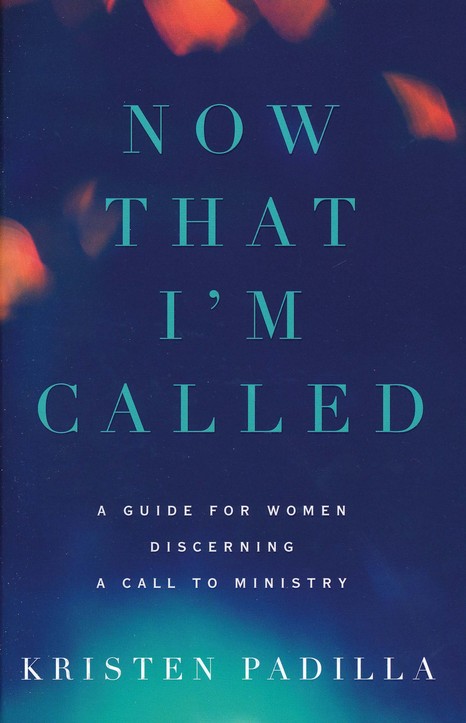
Image result for kristen padilla now that i'm calledKristen Padilla, Now That I'm Called: A Guide for Women Discerning a Call to Ministry (Zondervan, 2018)

Kristen writes for women who sense a call to ministry but are not sure how to carry it out in their context. Her book is sensitive to long-standing gender roles and dynamics in complementarian congregations and does not presume that readers are egalitarian. She warmly affirms the giftedness of women and encourages them in their quest to be faithful to God's call.

Alan F. Johnson, ed., How I Changed My Mind about Women in Leadership: Compelling Stories from Prominent Evangelicals (Zondervan, 2010)

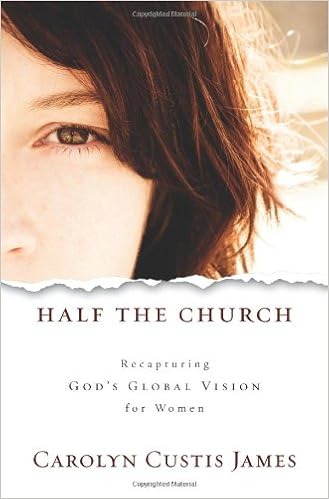
Image result for half the church carolyn custis jamesThis book is a treasure of stories about men and women who have shifted toward a more egalitarian outlook. A collection of testimonies rather than a systematic argument, this book shows the struggles of Christian leaders to be faithful to Scripture, their "aha!" moments, and the humility it took to admit that they had been wrong.

Carolyn Custis James, Half the Church: Recapturing God's Global Vision for Women (Zondervan)

Carolyn's book urges women to step up and participate in kingdom work. We can't sit back and expect the men to do everything! God created us to work as a team, side-by-side ruling over creation. Carolyn addresses some of the most common arguments for male-only leadership that are rooted in the creation story and in the letters of Paul, showing the problems with those interpretations and inviting readers to consider the urgency of God's design for partnership. This book is one that the entire church, not just women, need to read.

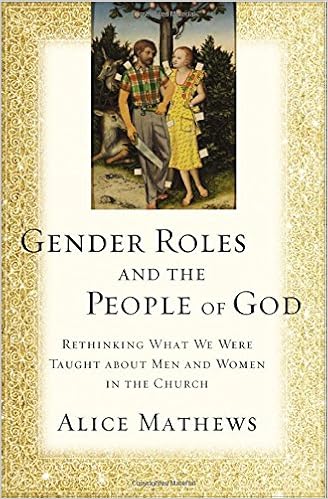
Image result for alice mathews gender roles
Alice Mathews, Gender Roles and the People of God: Rethinking What We Were Taught about Men and Women in the Church (Zondervan, 2017)
This is an accessible introduction to the key biblical text that so often figure in the debates over women in ministry. Dr. Mathews has been teaching a course at Gordon-Conwell Theological Seminary on this topic for many years, and this book is the best of her classroom content, now available to everyone.

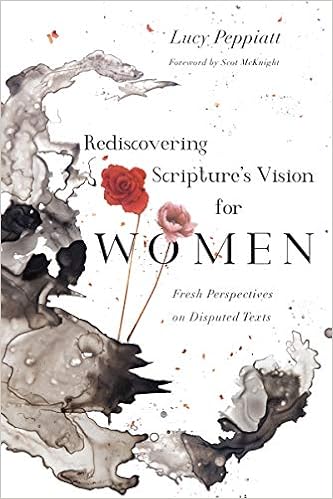
Related imageLucy Peppiatt, Rediscovering Scripture's Vision for Women: Fresh Perspectives on Disputed Texts (IVP, 2019)

Lucy's book is a brand new release from InterVarsity Press. As she reexamines the relevant biblical texts, Peppiat "finds a story of God releasing women alongside men into all forms of ministry, leadership, work, and service on the basis of character and gifting, rather than biological sex. Those who see the overturning of male-dominated hierarchy in the Scriptures, she argues, are truly rediscovering an ancient message―a message distorted by those who assumed that a patriarchal world, which they sometimes saw reflected in the Bible, was the one God had ordained." (from publisher's book description)

Craig S. Keener, Paul, Women, and Wives: Marriage and Women's Ministry in the Letters of Paul (Baker, 1992)

Dr. Keener's book landed on my desk on an interesting day. An invitation to preach had just been retracted on account of my gender (the pastor got complaints when people found out I was coming). Dr. Keener examines the cultural and historical context that motivated Paul's statements, offering a new perspective on how to read them responsibly.

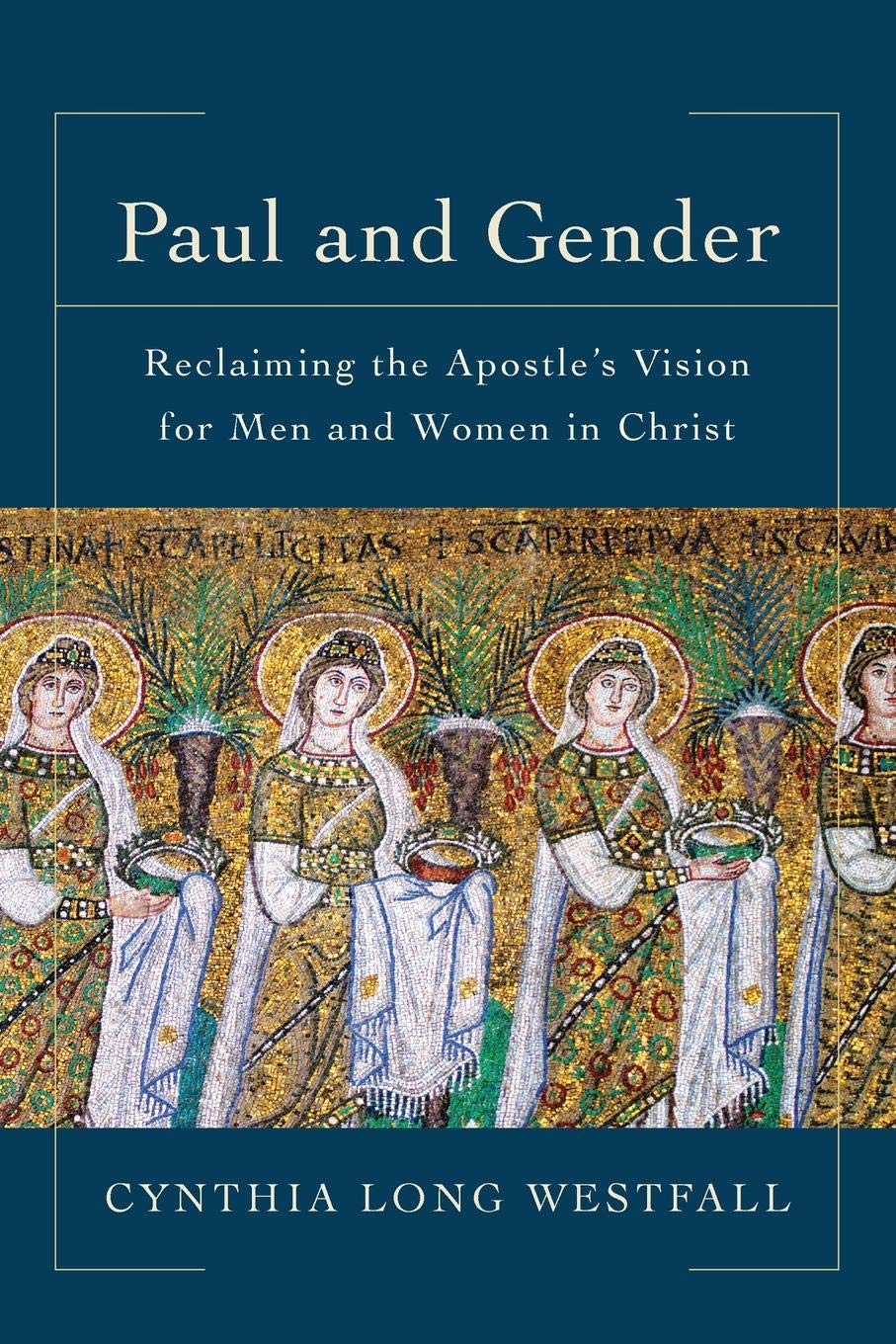
Image result for cindy westfall paul and genderCynthia Long Westfall, Paul and Gender: Reclaiming the Apostle's Vision for Men and Women in Christ (Baker, 2016)

Dr. Westfall explores the broader question of gender according to Paul, revisiting the most controversial texts to offer a fresh perspective. She is historically grounded and moves the debate forward in helpful ways based on the latest research.

You'll notice that the subtitles of several of these books share a similar tone: recapturing, rediscovering, rethinking, reclaiming. These authors all agree that something is missing in Evangelical churches today. In our efforts to obey the Bible, our churches have implemented practices that inadvertently prevent gospel ministry and silence the Spirit's work. These authors -- all of them Evangelicals -- call us back to the Scriptures to take another look. Things are not as simple as many have assumed ("women, be silent"), and our faithful reading and practice of Scripture depends upon a careful reassessment. If Scripture is to remain our authority for faith and practice, we cannot afford to get this wrong.

Monday, July 8, 2019

Foreword by Christopher J. H. Wright!

I'm so grateful that Dr. Christopher J. H. Wright agreed to write the foreword for my new book, Bearing God's Name: Why Sinai Still Matters (IVP)

Chris Wright is the author of my all-time favorite book, The Mission of God: Unlocking the Bible's Grand Narrative (IVP) as well as many other helpful books on the Old Testament, including the just-released The Old Testament in Seven Sentences (IVP), which I plan to read soon. Wright has a special gift for making scholarship accessible to the church, and he's devoted his entire career to cultivating biblical scholarship around the globe. One book I've recommended countless times is The God I Don't Understand:Reflections on Tough Questions of Faith (Zondervan).

Wright's IVP author page gives an impressive list of published works and ministry roles:


Christopher J. H. Wright (PhD, Cambridge) is international ministries director of the Langham Partnership, providing literature, scholarships, and preaching training for pastors in Majority World churches and seminaries. He has written many books including commentaries on Deuteronomy, Jeremiah, Lamentations, and Ezekiel, The Mission of GodCultivating the Fruit of the SpiritOld Testament Ethics for the People of God, and Knowing Jesus Through the Old Testament. An ordained priest in the Church of England, Chris spent five years teaching the Old Testament at Union Biblical Seminary in India, and thirteen years as academic dean and then principal of All Nations Christian College, an international training center for cross-cultural mission in England. He was chair of the Lausanne Theology Working Group from 2005-2011 and the chief architect of The Cape Town Commitment from the Third Lausanne Congress, 2010.
When I first read The Mission of God, I was beginning my doctoral work on the concept of bearing Yahweh's name under the supervision of Dr. Daniel Block at Wheaton College. I found that Wright had already zeroed in on this biblical theme and explained it beautifully, but he had not connected the wider theme with the command "not to bear the LORD's name in vain" (Exodus 20:7). I'm delighted that Wright found my interpretation convincing, and that he was willing to let this project bear his name as well. It's an honor to have his partnership in introducing my new book to the world!

Tuesday, June 26, 2018

TIME, Trump, The Death of Socrates, and The Art of Biblical Interpretation

Journalism ethics is all the rage this week (literally), with a provocative TIME magazine cover on the topic of immigration. (With apologies to readers interested in the politics of immigration and assurances to those weary of the debate, this post is not about immigration, but rather the relationship between art and truth). Are the facts at odds with the truth?

The Facts: President Trump has never met this girl from Honduras. Her separation from her mother at the border was only momentary, as her mom was searched. Afterward they were (at least temporarily) reunited as they awaited processing.

The Truth: Still, the girl comes to represent the many hundreds of children who have been separated from their parents while seeking a better life. The moral outrage following the public's realization of this is understandable, no matter how you propose to handle illegal immigration.

TIME's cover reminds me of a painting from the 1700's -- "The Death of Socrates," by Jacques-Louis David. David depicts Socrates surrounded by his disciples, on the verge of drinking his death sentence in poison. He teaches until the final moments of his life, remaining stoic in the face of death.

"The Death of Socrates" by Jacques-Louis David (1786)
Public Domain / Wikimedia Commons
Here's the connection with TIME's cover: Plato, from whom we learn the story of Socrates' death, was not present when it happened, yet David depicts him seated at the foot of the bed, slumped over and facing away.

Why include such an inaccuracy in this painting?

The Facts: David knew from Plato's own writings that he was not present at Socrates' death.

The Truth: Plato was deeply affected by Socrates' death and opposed it. By positioning him at the foot of the bed, looking away, the artist accurately captured Plato's disposition toward the death of his esteemed colleague. If Plato had been missing from the painting, we would lose this central point the artist is trying to make -- a point that coveys the truth of history creatively.

From time to time, feathers are ruffled when someone dares to suggest that the writers of Scripture  were brilliant artists. To some, this implies a disconnect with truth and a denial of divine inspiration. The second objection is easily solved. The God who created all things endows humans with creativity and invites us to participate in his work. As a prime example, take Bezalel and Oholiab, the men charged with designing the tabernacle (Exodus 31). These men were Spirit-filled and skilled creatives, in spite of the fact that their task was to construct something that already had very detailed blueprints. If their creativity was not a valuable asset for this project, God would have been better served finding an automaton. No, he chose humans, men who had spent years honing their skills in weaving and engraving and woodworking and all types of art.

But does art imply a disconnect with truth? Put another way, would the exercise of artistic license in the production of sacred Scripture get in the way of truth?

A great place to test this theory is in the Gospels. Matthew, Mark, Luke, and John each tell us the story of Jesus. With their words they paint a portrait for us of his life and ministry. They share much in common, at times even whole episodes or chapters. But there are differences, and some of these are rather puzzling. Did Jesus drive out the money changers in the temple at the beginning of his ministry (as John tells it)? or at the end (as Matthew, Mark, and Luke recount)?  Some Christians assume that Jesus must have driven them out twice -- once at the beginning and another time at the end of his ministry. But could this be an example of creative license?

Each Gospel writer introduces us to the historical Jesus by showing us something distinct about who he really is -- the Jewish Messiah (Matthew), the suffering Son of God (Mark), the Savior for all people (Luke), the Son who reveals the Father (John). To show us what is true about Jesus, in some instances they are best served by rearranging events so that everything will point in the direction they want us to look. This is not because they are trying to hide the truth, but because truth is their main concern. They arrange the details so that we as readers don't get muddled -- so that we can see what they see.

Matthew, Mark, and Luke may have saved this story until the end to illustrate how the opposition to Jesus gained momentum, resulting in his crucifixion. On the other hand (I suspect this is the better explanation), John may have chosen to tell us about the temple cleansing earlier because he's arranging the episodes of Jesus' life topically. The temple cleansing fits a string of stories illustrating Jesus' redefinition of Jewish institutions (sacred vessels, temple, rabbis, and sacred sites; John 2:1-4:54).* The cluster of stories among which the temple cleansing sits is followed by a series of stories in which Jesus redefines Jewish festivals (Sabbath, Passover, feast of Tabernacles, and feast of Dedication). Together, these two clusters make up the "Book of Signs," where John presents 7 signs that reveal Jesus' identity and call people to faith, setting us up for the "Book of Glory," where Jesus is glorified by offering his life on the cross.

However you slice it, artistic license is clearly at work. Either somebody moved this event out of chronological order, or all four gospel writers chose to omit a second occurrence. In my opinion, the truth has been gloriously served.

*For a fuller discussion of John's arrangement of material, see Gary M. Burge, Lynn H. Cohick, and Gene L. Green, The New Testament in Antiquity (Zondervan, 2009), 216-219.

Tuesday, August 2, 2016

a textbook that inspires

I'm working on a really fun assignment this week. About 6 weeks ago, Zondervan Publishers asked me to help them develop instructional resources for a textbook by one of my mentors, Karen Jobes, on Hebrews and the General Epistles (James through Jude). What I'm writing won't come out in print, but it will be made available digitally to professors who adopt this textbook for their New Testament courses. I'm writing chapter summaries, collecting key words, coming up with quiz questions, and developing basic PowerPoint slides for classroom use. I've used Zondervan's instructional resources like this for the classes I've taught, and believe me -- they are a blessing!

The BEST part is that I'm getting paid to learn.

Last week I was introduced to a new couple, and when they found out I was a Bible scholar, they popped their current nagging question, "So who wrote Hebrews?" It just so happened that I had worked through Dr. Jobes' chapter on the authorship of Hebrews the previous day, so I had an answer ready. Gaining knowledge is one benefit of this kind of study. (By the way, if you want to know the answer you'll have to read the book for yourself!)

But what strikes me most about this textbook is the depth of wisdom it offers for the Christian life. Dr. Jobes' writing is clear and compelling. Her theological insights are profound. Here are a few of my favorite gems from the chapters on Hebrews:
"Death is not a punishment; it is the inevitable consequence of turning away from the source of life, which is God himself." (119) 
"[Sabbath rest] is not an invitation to idleness, spiritual or otherwise. Rather, it is a place of being where the normal routines of a right relationship with God can be established and enjoyed, because Christ has resolved the crisis of humanity's separation from God and an eternal stability has been achieved." (131)
"Anyone worried about committing the unforgivable sin or becoming apostate hasn't done so. Apostates are by definition hardened to God and arrogant toward what he has said by the Son." (141)
"The reason the unforgivable sin is unforgivable is that by rejecting the work of Christ as something other than the gracious work of God, one cuts oneself off from the only means of forgiveness and the only salvation that God offers. It is, therefore, the only sin that cannot be forgiven." (140) 
"To stay in a spiritually immature state under the delusion that it is okay to sin is like walking backward in the dark toward the cliff of apostasy." (141) 
Dr. Jobes also has great sections on the cultural and Scriptural background for understanding Jesus' role as the Son of God, on what it means in a Roman context to be an "heir," on the reasons that Jesus supersedes the Old Testament, and on the meaning of "perfection" in the book.

If you're a layperson who is motivated to understand the New Testament more deeply, you could profitably work your way through this book on your own. It's filled with helpful pictures, charts, and a glossary that will guide you. If you're a professor who will be teaching on this part of the Bible, don't miss this great resource!

p.s. In case you're wondering, Zondervan didn't ask me to write this. I simply felt that this resource was too good to keep to myself!

Wednesday, April 27, 2016

prostitutes, polygamy, and other gnarly things in the Old Testament


The Old Testament is full of fodder for questions. Gnarly questions about violence and sexual deviancy and deception and war. Every year new books are released that try to wrestle with these questions from a Christian point of view. Here are a few examples from recent years, most of them focused on violence in the Old Testament:

Last year David Lamb added a second book of his own to this collection: Prostitutes and Polygamists: A Look at Love, Old Testament Style (Zondervan, 2015). I was asked to review it for Themelios, the digital journal of The Gospel Coalition. My review went live yesterday.

I hesitated to accept. The book struck me as edgy and irreverently playful on a subject matter that deserves steady and non-sensational reflection. Frankly, I didn't seem to fit the target audience. But the editor had reasons to ask me (my gender, my cross-cultural experience, and my background in Old Testament ethics), so in the end I agreed to write a review. You can read it here. You might find it to be just the thing for the college group at your church, but I hope my review will help guide your group discussions in order to avoid some of the potential pitfalls of Lamb's approach.


While I have your attention, I'll put in a plug for two books I like better. Wright's book, listed first above, is an outstanding yet accessible introduction to tough issues involving suffering and evil, the Canaanites, the cross, and the end of the world. (His more scholarly tome, Old Testament Ethics for the People of God, is also well worth reading, if your attention span can last nearly 500 pages.) Paul Copan's book, listed second above, comes highly recommended as well. I haven't read the whole thing yet, but I find his approach much more satisfying than Lamb's.


If you're wrestling with some of these tough questions, please know that there are answers. From our vantage point we may never be fully satisfied with the ways that the Old Testament narrates the story of Israel's faith. It's too foreign and too far in the distant past to make perfect sense to us. But if we apply ourselves diligently to the text of Scripture and broaden our understanding of its ancient context, we can come a long way toward making sense of the Old Testament. It's a journey worth making!

Monday, December 28, 2015

what I'm reading


To a publisher it makes no difference whether I am a tenured professor or a newbie adjunct. If I have students, they want to get their books in my hands. That's good news for a bibliophile.

Zondervan leads the way in this "culture of generosity," but InterVarsity and Kregel are not far behind. I walked away from ETS/IBR/SBL this year with $534 worth of FREE books. I spent a grand total of $9.50, buying only the book on top of this stack. Some of these were free gifts to IBR members (2 from the lecture and 3 from the women's breakfast). Two are books I agreed to review for Academic Journals. Eight were given to me as potential textbooks for the Prophets class I'll be teaching at Multnomah in June. But get this: any professor who ordered FREE copies of books from Zondervan to consider using as textbooks was given their choice of another FREE book from the CounterPoints series. Really? A free book for requesting free books? Now you see what I mean about a culture of generosity.

You might insist that this is merely good marketing. I'm sure you're right (especially since I passed right on by publishers who were going to charge me half price for any books I didn't require students to buy). But for someone who is just starting out in this career, it's also a big boost. So thank you, publishers!

Monday, November 9, 2015

does the new NIV distort the Scriptures? - part 7

In a time where questions of gender, identity, and sexual orientation are at the forefront of public policy and public discourse, it's understandable that gendered language would be a sore spot for Evangelicals. In this last post of the series, I'd like to share the two reasons why I applaud the NIV translation committee for their decision about gender inclusive language. Both are a matter of mission.
(1) One principle that guided the CBT (for the NIV) in their revisions is the international nature of the English language. It is no longer adequate to consider only patterns of English language usage here in the United States when deciding what best communicates the meaning of the Hebrew and Greek. People all over the world are speaking English and will be using our best-selling translation. Therefore it is imperative that we consider international patterns of English use when translating the Word of God. Some of the changes in the new NIV were made in this spirit.  
While the average American over the age of 40 might be comfortable with masculine pronouns in gender neutral situations, this is not the case worldwide, as people’s first languages exhibit a variety of grammatical norms. We dare not put stumbling blocks in the way of those around the world who are encountering Christianity for the first time. If a passage is directed to everybody, not just men, then it is increasingly important that we make that clear in our translation using gender neutral pronouns.
(2) The second factor to consider is (for me) closer to home. I am raising three children in a country where it has become bad taste to use masculine pronouns to address mixed groups. In most academic institutions, Wheaton College included, the use of masculine pronouns in written assignments to refer to humankind or a person in general is actually against school policy. People are certainly entitled to their own opinions about whether this is a good thing. Every generation brings changes to the English language that grammatical sticklers will not appreciate. But the point is that this is the reality in which we live. Our children are being educated in a context where they are not hearing masculine pronouns used generically. As a result, it does not sound natural to them—instead the Bible sounds archaic or misleading. Do we want to persist in using Bible translations that are confusing to them? We are losing young people in droves because they perceive that the church is out of touch. This is one simple adjustment we can make for the sake of mission.
If I thought that the Committee on Bible Translation had sold the farm, I would not embrace the new NIV. If I thought that they had capitulated to a liberal agenda, I would not encourage individuals and churches to "upgrade" their pew Bibles. That is not the case here.

Several years ago Wheaton College created a policy on gender inclusive language. It reads,
"For academic discourse, spoken and written, the faculty expects students to use gender inclusive language for human beings."
School administrators go on to explain the missional motivation for this policy:
"The college seeks to equip students for service in the world for Christ. Students need to be ready to communicate in that world. We want our students to succeed in graduate school, in the corporate world, and in public communication, all settings in which gender inclusive language for human beings is expected and where the inability to use such language may well be harmful to the Christian witness."
For me that's the bottom line. A good English translation of the Bible must be based on solid biblical scholarship and able to communicate that biblical truth effectively to the wider culture. In my opinion, the new NIV fits the bill.

Friday, October 30, 2015

does the new NIV distort the Scriptures? - part 5

Today I'm tackling the second part of an accusation against the NIV translation of the Bible. The first (which was part 4 of this series) addressed the issue of single words being changed, such as "Jehovah." What's more, some Christians are deeply concerned that the new NIV has removed entire verses from the Bible.

In a way, they are right. If you compare the KJV to the NIV, you'll discover that some verses have dropped out. But the important question is WHY?

Is this an attempt to take out statements that are uncomfortable or to water down the message of Scripture?

In a word, no.

Those who translated the Bible into English in the early 1600s did the best they could with what they had, but since then hundreds of other ancient manuscripts of the Bible have come to light, including those known as the "Dead Sea Scrolls." These manuscripts are much older than those available to the translators of the King James Version, sometimes by a thousand years, and in many cases they preserve a more accurate biblical text.
"The Shrine of the Book" at the Israel Museum,
where some of the Dead Sea Scrolls are housed
Photo: D. Camfferman
The process of discerning which manuscript is better is called "textual criticism" (not because it's "critical" of the text, but because it's trying to determine the "critical" text). The goal of most textual critics is to reconstruct the oldest and most accurate text possible by identifying and removing any mistakes or later additions.

Those responsible for the translation of the NIV (the Committee on Bible Translation) want you to be confident that you hold in your hands the Word of God, not a text filled with well-intentioned additions— however "true" they may be. In some cases, a word, a verse, or even a whole paragraph was added to the text at some point in history in order to clarify the meaning or harmonize a text with a similar passage in another book. This is especially common in the Gospels, where multiple books recount the same event. Either by accident or on purpose, scribes would fill out the shorter text with details from the longer text.

The NIV translators carefully examined the manuscript evidence. In cases where a new (older) manuscript suggested that a verse was a later addition to the biblical text, they chose to eliminate it.

Here's an example:
Matthew 18:11 (NIV) - Photo: C. Imes
In the KJV, Matthew 18:11 says, "For the Son of man is come to save that which was lost."
In the NIV, there is no verse 11. Instead, a footnote reads, "Some manuscripts include here the words of Luke 19:10."
Sure enough, Luke 19:10 reads, "For the Son of Man came to seek and to save the lost."
Luke 19:10 (NIV) - Photo: C. Imes
In other words, even without this statement in Matthew 18:11, no theology has been lost. The truth that Jesus looks for and saves sinners is still in the New Testament. In the cases where a verse does not appear elsewhere, it was never supposed to be there in the first place. Thankfully, no doctrines of consequence rest on those verses.

Ironically, as with this example, many of the "missing" verses listed by concerned readers are found elsewhere in the Bible. Think with me here. If the NIV translators were trying to change the Bible, they didn't do a very thorough job.

For Zondervan's answer to this question (a shorter version of what I've said above), click here.

I've saved the most controversial objection to the NIV for last. Stay tuned!


Monday, October 26, 2015

does the new NIV distort the Scriptures? - part 4

A few minutes trolling around online will produce dozens of websites warning you about the dangers of the NIV.

Here's a quote from one of my "favorites":
"Did you know that it was written by Zondervan and they are OWNED by Harper Collins, who also publish The Satanic Bible, and the Joy of Gay Sex. NIV has removed 64,575 words from the Bible including Jehovah, Calvary, Holy Ghost and omnipotent to name but a few . . . NIV has also removed 45 complete verses."
In my next post I will respond to the more serious charge, that the NIV "removed" verses from the Bible. But first let me set the record straight:
Zondervan chooses the binding and
style of the NIV Bibles they print,
but they are not involved in the
translation (Photo: C. Imes)
  1. Zondervan is a reputable Christian publishing house, fully staffed by evangelical believers, and it continues to produce some of the finest resources available for Christian Bible study today. Yes, it was bought by HarperCollins, a secular publishing house, but Zondervan retains full control of the editing process and employs believing scholars to do this work. The content of books published by the parent company in no way affects the quality or accuracy of Zondervan's publications. 
  2. Even so, Zondervan did NOT "write" the NIV, nor did they translate it. The work was done by a team of Christian scholars (the Committee on Bible Translation, or CBT) working under Biblica according to the wishes of the original translation team. Zondervan simply makes the CBT's translation available to the wider world, choosing the binding, the size and color of the font, and the formats in which it will be printed.
  3. If a word appears to be "missing" from the NIV, it has disappeared for one of two reasons. Either the translators felt that a different word would more accurately convey the original Greek, Hebrew, or Aramaic text, or the translators determined that a word or words did not belong in the translation because the best ancient manuscripts did not include it
The word "Jehovah" is a good example. No such word exists in Hebrew. God revealed his personal name to Moses in Exodus 3:14. We can be confident that the consonants of that name are YHWH. (This is sometimes called the "Tetragrammaton," because it is made up of just four letters). However, scholars are not exactly sure which vowels were used to pronounce his name. Ancient Hebrew was written for centuries with only consonants. [Ths snds crzy bt w cn rd wtht vwls n nglsh s wll]. By the time helpful scribes decided to add dots and dashes to the Hebrew text to indicate the proper vowels (long after the time of Christ), pious Jews refused to pronounce God's personal name out of reverence. For that reason, when pious scribes added vowels to the name YHWH they deliberately used the wrong vowels so that no one would accidentally say God's name out loud. The vowels were intended to remind people to say "Adonai" (Lord) or "HaShem" ("the Name") in place of YHWH.

Some time ago, Bible scholars who did not understand this convention tried to pronounce God's Hebrew name by reading what they saw in the text -- the consonants YHWH, and the vowels meant to signal Adonai. The result was a nonsense word -- Yehowah, or Jehovah. Scholars since figured out their error, but not before hymns, churches, and even whole movements (like the "Jehovah's Witnesses") had employed the erroneous word. No one is absolutely sure how the consonants YHWH were to be pronounced. It might have been Yahweh. Another possibility is Yahu. We just don't know.

Exodus 3:15 (NIV)
Photo: C. Imes
Since the pronunciation is uncertain, most English translations have chosen to render the Tetragrammaton with four uppercase letters in English: LORD. Whenever you see that in your Bible, you can be sure that the Hebrew behind it is God's personal name, YHWH. If you see "Lord," then it's translating the Hebrew title that means "lord" or "master": Adonai.

So, did the NIV "remove" the word Jehovah from the Bible? Not exactly. They just chose to represent the Hebrew name YHWH in a different way. In my next post, I'll tackle the other part of this accusation -- that the NIV removed dozens of verses from the Bible.

Thursday, May 7, 2015

and the winner is . . .

Karen Jobes!

The Evangelical Christian Publishers Association has awarded a Medallion of Excellence in Bible Reference to Karen Jobes for her commentary on 1, 2, and 3 John, published by Zondervan.

Congratulations, Dr. Jobes!

Dr. Jobes is a dear friend and mentor, a member of my dissertation committee, and a great scholar. This award coincides with her retirement from Wheaton College, where she has been teaching as the Gerald F. Hawthorne Professor of New Testament Greek and Exegesis for 10 years. She has also taught at Westminster Theological Seminary in Philadelphia and Westmont College in Santa Barbara, California (10 years), and she's served for many years as a member of the Committee on Bible Translation for the NIV.
Next Spring the Pacific Northwest Region of the Evangelical Theological Society will have the honor of hosting Dr. Jobes as our plenary speaker. I'm looking forward to it already.

In addition to outlining the overall structure of John's letters and analyzing the Greek text, one of the strengths of Dr. Jobes' commentary is the section in each chapter devoted to Theology in Application. Here's an excerpt from the section following 1 John 4:7–16 on the question "Is God Loving?"
"People can experience many horrible things in life, leading both Christians and unbelievers to question God's love. How could a loving God let such horrible things happen as we see continually in the daily news? Without diminishing the reality of pain and suffering, John's answer would be that God has already loved each of us to the fullest extent by providing that crossover from death to life. For death is the worst this life can bring against us, but when this life has been swallowed up by eternal life, even the worst is not our defeat. Because God's fullest love has already been given in Christ more than two thousand years ago, it is not based on what we do or what others do to us. What greater gift of love could God give than freedom from death?"
 "When someone has experienced freedom from sin and freedom from death, they are able to love God and others as God intended. This is because love will not allow us to sin against others, for love is the opposite of sin. And when sinned against, we are enabled to forgive others because our Lord Jesus has atoned for that sin. We can reveal God's forgiveness and love to the offender through our forgiveness." (200, emphasis mine)