Showing posts with label New Testament. Show all posts

Sunday, September 4, 2022

Review of Cynthia Long Westfall, 'Paul and Gender'

Photo of Cynthia Long Westfall's book, Paul and Gender
Photo: C Imes
Cynthia Long Westfall's Paul and Gender: Reclaiming the Apostle's Vision for Men and Women in Christ is a tour de force. 

It's not a new book (c. 2016), but I finally took the time to read it, and I'm so glad I did.

Dr. Westfall is a graduate of Biola (where I teach), and currently serves as Associate Professor of New Testament at McMaster Divinity College in Hamilton, Ontario, Canada.

In the stuffy room marked "Paul's Views on Women," where a weary debate has been at an impasse for centuries, Westfall raises the blinds and throws open the windows, letting in light and fresh air. With my three degrees in theology and four-and-a-half decades in the church, I thought I had heard it all. But just ask my husband (at home) if he's ever seen me gasp so many times while reading, and if I've ever interrupted him so many times to read him a sentence or a paragraph.

Here are a few nuggets:

  • "Pauline theology of ministry was based on metaphors of slavery and service so that any believer (gentile, slave, or female) could assume any function in the house church without violating the hierarchy of the Greco-Roman culture" (6; cf. 266). Later she explains that words like "pastor" and "deacon" were not technical terms until long after the New Testament. We associate them with prestige and authority, but they would not have had that connotation to Paul's recipients.
  • Westfall problematizes the simplistic views of Greco-Roman authority, showing the many men were under women's authority (as children, slaves, or clients to wealthy women) and that most women had some measure of authority in the domestic sphere (e.g., pages 23, 267).
  • She notes in that context a woman's "unveiled head signified sexual availability, so that a woman slave or a freedwoman was prohibited from veiling" (29). Therefore, "Paul's support of all women veiling equalized the social relationships in the community . . . [and] he secured respect, honor, and sexual purity for women in the church who were denied that status in the culture" (33-34).
  • Paul regularly used male metaphors for all believers and female metaphors for those in church leadership. "Paul's use of maternal imagery for pastoral care illustrates a compatibility of pastoral care with feminine commitment and the female role of nurture" (53).
  • Westfall argues cogently that "head" in Paul is a metaphor that relates to source rather than to authority. While she is not the first to contend for this reading, I found her explanation particularly insightful. "Christ is the source of man's life because he is the creator who formed man in Genesis 2:4-9. Man is the source of woman's life because she was created out of man in Genesis 2:18-23" (86).
  • She demonstrates from Paul's own letters that Paul does not believe women are more prone to deception than men. "Women as well as men in the Christian community are in danger of deception, but the same remedies are available: biblical correction and teaching" (116).
  • Westfall explains the historical background that likely prompted Paul's strange statement about women being "saved through childbearing" (1 Tim 2:15). "Artemis was the patron goddess of the city of Ephesus, and she was literally the savior to whom the women went for safety and protection in childbirth" (136). It is very likely that in 1 Timothy 2, Paul is addressing false teaching in Ephesus and urging women to trust God to watch over them during their vulnerable experience of childbirth.
  • On eschatology, she writes, "According to Paul, there is no differentiation in humanity's destiny on the basis of gender, race, or status. Women, as well as gentiles and slaves, have a shared destiny of authority and rule... Women cannot have a final destiny that was not their intended purpose of function at creation. Rather, it is a transcendent norm for men and women to share dominion" (147).
  • Paul is counter-cultural. "Christianity undercut essential patriarchal rights by requiring men to be faithful in the same way that the culture had required women to be faithful" (203).
  • She explains that in Greek, "Masculine is the default gender, and it cannot be assumed that women are excluded as referents form masculine nouns, pronouns, and so forth, particularly in catchphrases, unless they are excluded by the context" (270).
  • Westfall notes that Paul's letter to Timothy was personal, addressing specific problems in the congregation in Ephesus. "A document like Paul's Epistle to the Romans would have been a more logical place to make a clear prohibition on women teaching and in ministry" (297).

I cannot do justice to this rigorous book with a list of bullet points, but I wanted to give you a taste of the sorts of claims she is making. Westfall's conclusions are carefully researched and well argued. She has a way of turning things inside out to help readers see what has been hiding in plain sight. Her book simultaneously delighted and depressed me. If she's right -- and I think she is -- then this book offers good news for women who have long felt called to ministry in the church. But at the same time, Paul and Gender saddens me. I feel the weight of the fact that some corners of the church have unnecessarily missed out on hearing the Spirit-empowered voices of women for a very long time.

Church leaders, I beg you to read this book. You can't afford not to.


Monday, December 6, 2021

Best Books on Historical and Cultural Backgrounds of the Bible

Although I had already been through four years of Bible College, in seminary a whole new world opened up to me. As an undergrad I developed a deep committment to reading the Bible as literature and on its own terms, without the potential distortion of outside sources. This was a wonderful season of training for me as I became sensitive to the literary contours of biblical stories.

In seminary, under the guidance of different professors, I discovered the value of studying the historical and cultural backgrounds of the Bible. Here's why: the Bible did not drop from the sky, leather bound, with our names embossed on the cover. Reading the Bible is a cross-cultural experience. We are guests in an ancient context, where people speak other languages, where people's hopes and dreams are profoundly shaped by their own contexts, and where society as a whole operates under different values and assumptions. 

In order to be competent readers of Scripture, we must attend to the contexts in which is was written. Every passage has a literary context, a historical context, and a theological context. Neglect of any of these dimensions results in a "flat" reading. In particular, if we ignore the historical context of a passage we run the risk of distorting it. Without interrogating our own cultural lenses, we are likely to impose modern values and assumptions on the text. I see this happen all the time in class, as students encounter stories that strike them as strange.

This is why I'm particularly passionate about training students to attend to both the literary and historical dimensions of the text. We practice developing skills in narrative and poetry analysis and we also consider the historical and cultural contexts of the Bible. We live in a wonderful era in which resources are more readily available than ever before! 

Here are five resources that I find myself repeatedly recommending:

The Cultural Backgrounds Study Bible - Available in the NIV, NRSV, and NKJV translations, this full-color study Bible includes a wealth of information at your fingertips, right where you need it when reading the Bible. It is not designed as a devotionally inspiring study Bible, but a reference tool to help readers understand the cultural context of Scripture. I require it for my Bible classes so that students have a solid resource for a lifetime of study.

The Zondervan Illustrated Bible Backgrounds Commentary - This is a more extensive (and of course, more expensive) resource than the study Bible above, with full-color photographs, charts, and insightful notes on every book of the Bible. Every church library should have this resource on hand for Bible studies and sermon prep.

The Dictionary of Daily Life - This gem is a more recent addition to my library that I've already used many times. It contains an alphabetized collection of articles on aspects of daily life in ancient Israel (and the Greco-Roman world). For example, if you're studying Exodus 2, you could read articles on Bathing, Midwifery, Infanticide, and Adoption. The articles are well researched and written.

The Dictionary of Biblical Imagery - This tool is more on the literary side of things (rather than historical/cultural), but it helps with precisely those images that are unfamiliar to modern readers. For example, if you're reading along in Daniel and want to know the significance of the beasts with horns, you could read the article on "horns" in the Bible. Each article traces the use and development of a particular image across the biblical canon, with sensitivity to cultural context.

Ancient Near Eastern Thought and the Old Testament - I read this book in graduate school while taking a class on ancient Near Eastern Backgrounds with John Walton. It was immensely helpful in reshaping my imagination so that I could see what ancient people cared about. It's written for graduate students read, but even if you're not in school, if you're serious about understanding Bible backgrounds, it is well-worth your time.

If this list is two long for you, then I'd recommend this dynamic duo which should prove helpful no matter what part of the Bible you are studying: The Dictionary of Daily Life and The Cultural Backgrounds Study Bible. Both are well worth the sticker price, and both are currently on sale.


Tuesday, June 9, 2020

Reading 'Reading While Black' While White

Esau McCaulley is professor of New Testament at Wheaton College, an ordained Anglican priest, and a fellow board member of the Institute for Biblical Research. I'm guessing that he wrote Reading While Black: African American Biblical Interpretation as an Exercise in Hope (IVP, 2020) with Black readers in mind. But this white girl found it both helpful and inspiring.

May I make a public confession? I grew up in a very monocultural environment. We were not just all white, we were almost all of Dutch descent. My family is 100% Dutch on both sides, my church was about 95% Dutch, my school K-12 was probably at least 70% Dutch and about 95% white, and my neighbors were nearly all of Northern European descent. 

I didn't like being in a white bubble. I was intrigued by other cultures. I felt called to be a missionary, to take the good news of Jesus to the ends of the earth. I learned Spanish, read missionary biographies, collected ethnic clothing, and dreamed of life in another culture. But even so, I mainly thought about what I had to offer, not what I had to learn.

I used to think that making space at the table for people of color was a matter of equality or justice, and that's part of it. People of color are made in the image of God and they should get a chance to speak. In theory, I imagined that reading the Bible with people from other cultural backgrounds would also be enriching. But I had no idea what I was missing! 

Over the past 5 years or so I've been reading more widely and adding books to my own library and to my college's as fast as I can. I'm convinced now that when we only listen to people who look like we do, we're missing out on a ton of insight. I'm discovering a rich world of biblical reflection by African, African-American, Latinx, Asian, Asian-American, First Nations, and Islander believers.

Reading While Black fills an important gap in my library as well as in my understanding. Ironically, much of what is published by minority authors reflects the politics of the ivory tower -- critical of Scripture -- at times representing a departure from the faith tradition. (There are probably a variety of reasons for this, but I suspect that university presses are simply well ahead of faith-based publishers in seeking out authors of color.) As a result, it's much harder to find published works that represent the views of the majority of churches in the global south, churches which are by-and-large conservative.

Esau McCaulley, author of 
Reading While Black 
(photo: Wheaton College)
In Reading While Black, Esau seeks to recover the resources of the Black church tradition that arises from the pulpit and the pew rather than from the ivory tower. He models a faith-filled reading of the biblical text that remains engaged with politics and justice but does not neglect the call to holy living.

Each of his chapters tackles an issue about which the Scriptures have something profound to say -- a theology of policing, the political witness of the church, the pursuit of justice, black identity, black anger, and slavery. He issues a prophetic call back to the Scriptures and to a life of faithfulness. His is not a call to "make the best of" systemic injustice, nor does he seek a violent overthrow. Esau engages tough questions with verve, urging active but peaceful resistance to injustice.

I'm grateful for his voice. I've known Esau for a while now, and I've come to trust his commitment to the authority of Scripture. I also trust him to say hard things that need to be said, but to do it with pastoral sensitivity and kindness. I'm honored to call him my friend.

Many are wondering what to do when the protests have ended. How can we keep listening? My official endorsement of the book reads:
How can the church today effectively address the racial tensions that plague our nation? Esau has convinced me that the Black Church tradition holds the key -- maintaining fidelity to the Scriptures while fully engaging in the struggle for justice. This book is an excellent starting point for those who want to listen and learn a new way forward. Esau's prophetic voice is rooted in Scripture and full of hope. Highly recommended!
Why not start here? Reading While Black was supposed to release later this fall, but due to popular demand, IVP is stepping up the release to September 1, 2020. You can pre-order a copy here. You can listen to Esau talk about the book here. You can also spread the word and leave reviews on Amazon and GoodReads as soon as it releases.

Tuesday, January 21, 2020

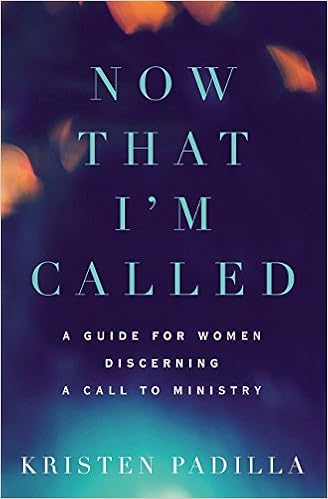
Author Interview: Kristen Padilla, "Now That I'm Called"


Image result for now that i'm called kristen padilla
Today I had the privilege of interviewing Kristen Padilla about her book entitled Now That I'm Called: A Guide for Women Discerning a Call for Ministry (IVP 2018). I have already recommended her book to students multiple times, so it was great to hear the backstory of the book.

Since the particular roles open to women differ from one denomination to another, Kristen explores ways that women from all kinds of churches can walk in obedience to God's call to participate in his mission. In her book, she says, "I want people, especially women, to understand that receiving this kind of call does not mean that they must hold a church office -- the role of a pastor, elder, or deacon, for example. The Holy Spirit gives gifts to the people of God, and these gifts can be exercised outside of a particular office in the church" (13). Her approach makes this book suitable for women from churches across the theological spectrum.

What inspired you to write this book? I was inspired to write this book for several reasons. First, I wrote this book because I saw a need for it. When I was a young woman sensing a call to vocational ministry, I had no one and no resource to guide me through the discernment process, the questions pertaining to being a woman in ministry, and next steps. As I say in my book, I felt like I was in a dark room with my arms outstretched trying to find my way to the door. By the time I was in seminary and had conversations with other women my age or younger called to ministry, I realized my story was not unique—it was the story of many women called to ministry. Thus, God put the idea and passion for this book in my heart, and ten years later it finally came to fruition. Second, I wrote this book out of a deeply held biblical conviction that God calls women to gospel ministry and that the Church of Jesus Christ needs women who are called by God to engage in gospel ministry in the church and world. I wanted to write a book that would encourage and aid these women in the journeys of discernment for the purpose of equipping future generations of female ministers of the gospel.

What was the most difficult aspect of the project? The most difficult aspect of writing was perhaps the most obvious one: writing a chapter on 1 Timothy 2:11-15. As many know, this passage has been used to silence and forbid women from many avenues of gospel ministry. It is the battleground where most of the fighting regarding women in ministry takes place. In my mind, I could not write a book for women called to ministry without addressing this passage of Scripture. However, I wanted to demonstrate a fidelity to the authority of Scripture and a humble and generous interpretative posture and tone. I also wanted to address head-on problematic and false interpretations that have held many women from pursuing ministry, namely that the female gender is by nature more easily deceived and that a certain “creation order” is a fail-proof guard against false teaching.

Author Kristen Padilla
What do you want readers to take away from your book? I want readers to walk away with a theological and biblical vision for women in ministry. I want them to see in Scripture that God’s plan has always included women and that women play an equally vital and important role in gospel ministry. My prayer is that women who read the book walk away with confidence grounded in Scripture and theology to follow God’s call to serve him in whatever role he has called them in obedience and humility.

Your book occupies the unpopular middle ground between the debate over women in ministry–not progressive enough to satisfy those who ordain women and too progressive for those who don't. What was your heart behind writing for those in this middle space? This is a great question. One of the first responses I received from the book was told to a friend of mine, “I wasn’t sure if she was complementarian or egalitarian.” A compliment or a criticism? I made the decision early on to write a book from that neither-complementarian-nor-egalitarian space or the in-between space for two reasons. First, I wanted the book to meet women in churches and traditions on both sides of this interpretive divide. My goal is to address the beginning of one’s call to vocational ministry—to lay the groundwork, if you will. Therefore, secondly, I did not see the need to talk from a strictly complementarian or egalitarian perspective, whatever that means today, since my goal wasn’t to talk about ordination or roles per se. I believe these two approaches have more in common than is often acknowledged. Most women in these so-called camps are tired of the debate and want to focus on the question: does God call women like me to serve him in ministry? I actually believe that this “in-between” space includes many women. This does not mean I do not have a particular interpretation of 1 Timothy 2:11-15 nor does it mean I am somehow theologically neutral when it comes to the roles of women in ministry. However, I did not believe it would be helpful to advocate from one perspective or another given the purpose of this book. Some will “blacklist” books if they are written from the other “side.” Even though I tried to stay in that middle space, I knew that for some my book would not be complementarian or egalitarian enough and would therefore be censored. This is indeed what has happened. In spite of this, I strongly believe that there is a strong middle and ecumenical ground where conversations about women in ministry can and should take place. I pray the posture and position I take in the book draws people together rather than exclude them.

In the year since your book has released, you've undoubtedly heard from many readers. What would you like to say to those who haven't read it yet? Or what would you want to add to what you've said in the book? Yes, I have been very fortunate and blessed to have heard from readers around the world, namely women for whom the book came at a time in their life when they needed biblical encouragement and guidance concerning the next steps in ministry. Hearing personal testimonies from readers is an author’s great reward. To those who haven’t read the book yet, I would of course say, “Read it!” On a more serious note, I try to bring out from Scripture stories of women called by God to proclaim the word of God for the people of God. There are many examples of women in Scripture doing just that—proclaiming a message from God to edify people in their day, and, by God’s design as Holy Scripture, edifying us today! In my book, I put the stories of these women next to stories of well-known men in Scripture to show a common pattern in how he calls and uses both men and women for his purposes. It would be a shame if the discussion about women’s place in God’s kingdom was limited to a few verses from the New Testament and did not take into account all of Scripture. If I could revise the book today, I would add more examples of women God uses in Scripture whose words are included for our edification today, such as the wise woman of 2 Samuel 20 and the Queen of Sheba. I want to continue to shine a light on the ways in which God is using women in his kingdom, which is why I am glad to say that I am writing a second book with Dr. Timothy George on women of the Reformation. My prayer is that the Church would be filled with God-called, theologically trained spiritual mothers who, alongside spiritual fathers, are equipping the saints for the work of ministry.

Thanks, Kristen, for writing this book and giving us a glimpse of your journey!

Thursday, December 26, 2019

My Favorite Books of 2019

I entitled this blog Chastened Intuitions as a way of recognizing that our gut feelings about something need reshaping in light of research and exposure to other perspectives. Reading is a powerful way to pursue that kind of learning. I read 40 books in 2019. The five listed below made the most significant contribution to my own growth, chastening my intuition in important ways.

Surprised by Jesus Again: Reading the Bible in Communion with the Saints
by Jason Byassee

I encountered this book as a skeptic, but I was quickly disarmed, even charmed. I did not find every reading persuasive, but I was won over by his central thesis. Byassee winsomely, playfully invites Christian readers of Scripture to delight in its mysteries and to participate in God's passionate quest to lavish his love an on ever-widening circle of faithful followers. He is right to chide biblical scholars for our lack of imagination. Reading this book has reignited my passion for a pedagogy that ushers fellow readers of Scripture into a place of wonder. A finalist in the Christianity Today 2019 Book Awards, this book is well worth reading.


The Liturgy of Creation by Michael LeFebvre

Given LeFebvre's brilliant doctoral work on Old Testament law, I expected this book to be carefully researched and lucidly written. I was not disappointed. LeFebvre skillfully brings into focus the parts of the Pentateuch readers are most likely to skip, showing how the purpose of each calendar notation in the Torah, including its opening chapter, is liturgical―to order the work and worship of the covenant people. His reassessment of Genesis 1 moves beyond the stalemate in the creation debates without recourse to extrabiblical or scientific arguments. His thesis grows organically from a close reading of the biblical text. LeFebvre shows himself to be a master teacher with pastoral sensitivity, able to patiently explain what he has so carefully studied. This book will change the way I teach the Torah. I can't wait to share it with my students!
Blood Brothers
by Elias Chacour

A powerful and enlightening story of a Palestinian Christian living in the aftermath of WWII. His story unveils the dark side of the Israeli-Palestinian conflict, its origins outside the land of Palestine, and the way both sides have been caught in the crossfire between nations whose complex interests are not above board. Chacour's hope is that Arabs and Jews can learn to live together as neighbors. He has devoted his entire life to this aim: PEACE. Such an eye-opening and hope-filled book!
Hope for the Oppressor by Patrick Oden

Hope for the Oppressor is a brave undertaking. Patrick Oden suggests that efforts to liberate the oppressed will never be successful until oppressors experience liberation, too. Without true liberation of all parties, new cycles of coercion result. But there's hope. He locates that hope in Christian community, where our notion of selfhood can be reconceived and our fractured selves healed in light of God's holy love. Oden's thesis is grounded in theologically rich readings of biblical texts and skillful engagement with historical and systematic theology. His book issues a life-giving invitation for all of us — those with privilege and those without — to participate in a different kind of kingdom. His book has the potential to fuel a revolution for those who dare to reexamine their lives in light of his claims.

Phoebe by Paula Gooder

How does a woman with a slave name end up delivering Paul's letter to the Romans? How does she have the means to undertake such a journey? How was she educated to the point that Paul chooses her to explain his letter? What did she think of the church in Rome? Gooder answers all these questions in a compelling way. She kept my attention from beginning to end. Friends who are not biblical scholars have enjoyed the book, too. Together with Holly Beers' A Week in the Life of a Greco-Roman Woman and Ben Witherington III's Priscilla, 2019 was my year to discover what is was like for women of the Roman Empire in the first century.

Tuesday, December 17, 2019

Author Interview: Holly Beers, "A Week in the Life of a Greco-Roman Woman"


Holly Beers, Westmost College,
author of A Week in the Life of 
a Greco-Roman Woman
(IVP)

Holly Beers is the author of the recently released A Week in the Life of a Greco-Roman Woman (IVP). Holly's book joins a growing number of works of historical fiction written by New Testament scholars. My copy is still in the mail on its way to me, but I have heard excellent things about it and can't wait to dive in. New Testament professor Nijay Gupta of Portland Seminary says, 
"I highly recommend Holly Beers’ new A Week in the life of a Greco-Roman Woman. Beers knows her ancient social context, but she crafts a nice story to bring it all to life. This is something I am going to try to use in the classroom the first chance I get!"
Holly, please tell us a bit about yourself -- where and what you teach, where you studied, what your areas of interest and expertise are. 

I'm from a small town in Minnesota and did my undergraduate (North Central University, Minneapolis) and master's (Bethel Seminary, St. Paul) work close to home. My PhD is in New Testament from London School of Theology. I teach at Westmont College in Santa Barbara, California, where the weather is beautiful but, to my sorrow, it does not snow at Christmas. My main specialties include Luke-Acts (my favorite is Acts, of course -- best book in the Bible!), the use of the Old Testament in the New Testament, Second Temple Judaism (the world of Jesus and Paul!), and New Testament ecclesiology (or: how Jesus' first followers "did church"). A growing area of interest and expertise for me is Pentecostal hermeneutics. I was raised Pentecostal and still consider that my tradition, and I am increasingly interested in how the global Pentecostal church is shaping biblical interpretation. 

Image result for holly beers week in the life of a"How did you get connected to this project?
I met with Dan Reid from IVP (who's now retired) several years ago when he visited Westmont. He asked if I knew of the series, and I did, as I'd read Ben Witherington's A Week in the Life of Corinth. He said that they were looking for someone to write a volume on a woman's life in the first-century world. That was the beginning of this book, as I started to imagine who the woman might be and what her life would look like. 


How long did it take you to write it?

Good question. I had planned on two years, but then I was in a Vespa accident; those injuries (concussion and broken wrist) delayed me a bit. I had a draft done in about three years, I think.


What was the most challenging aspect to figure out?

I had never written a novel before, so that was rough at first. I've read probably thousands of novels in my lifetime, because that's what I do for fun, but I'd never written one. I got into the habit of praying every time I sat down to write. I'd say something like: "Spirit of God, help me. You know I've never written a novel. Write with me and through me today." Honestly, I feel like the book is really co-authored; it's me and the Holy Spirit! 

What was one of the most exciting discoveries you made as you researched?

It was exciting to learn that women's lives were probably much more varied in the ancient world than people often assume today. They were not living cloistered lives behind closed doors; that would only have been an option for the very wealthy. Most women would have had to be out and about as a practical necessity. They would have gone to the market, interacted with a variety of people, and even worked in family trades and businesses. 

Without spoiling the story, can you tell us a bit about the Greco-Roman woman who is the main character for your novel? What is her name? What is she like? What challenges does she encounter?

My main character's name is Anthia. She is strong, practical, and thoughtful. She encounters the challenges of everyday life in her world, which include mourning the death of a close friend; keeping Artemis, the patron goddess of Ephesus, happy; helping to ensure that her family has something to eat every day; supporting her extended family; managing her husband's unpredictable temperament; raising her young son; and managing her pregnancy. 

Who do you envision reading this book?

Carmen Imes and Holly Beers at SBL in 
San Diego, 2019

I've always wanted to write a book that my mom could read. She loves the Bible and cares deeply about faith, but doesn't have formal theological training (besides having me in her life). This book is really for those who want to learn more about the world of the Bible in an accessible way, and I envision those people as being both inside and outside Christian faith. I also hope scholars read it, and that it shapes their vision of the New Testament world and the way that they communicate it to their students. It would also make a good text for a classroom. 

What are you working on next?

I have a couple of projects in the works. The first is an investigation of the use of the Old Testament in some of Paul's letters. First I'm working in Colossians, then I'll head to Ephesians. I'll be writing a commentary on Colossians and/or Ephesians for a new New Testament commentary series that is geared toward serving Christians who are charismatic or Pentecostal (broadly defined), including people outside of North America and Europe. I've always wanted my scholarship to serve the church, and this opportunity is one that still surprises me and humbles me.

Thanks, Holly, for telling us about your work!

Tuesday, July 16, 2019

Book Review: Ben Witherington's "Priscilla" and Paula Gooder's "Phoebe"

Two of the most recent contributions to the burgeoning collection of novels written by biblical scholars are worth reading. Historical fiction about the Bible is not a new genre. What's new is that reputable scholars, with PhD's in New Testament and an impressive array of other academic publications, are harnessing their training for this unique genre and publishing these works with academic publishers (in this case IVP Academic).

Ben Witherington III fills out the story of the biblical Priscilla, or Prisca, mentioned in Acts 18 and Romans 16. The New Testament does not tell us much about her -- she's a tentmaker and church leader with her husband Aquila, both of whom work with the apostle Paul, and mentor the young evangelist named Apollos. Witherington weaves these facts about Priscilla into a coherent narrative in which the aging church leader tells her story to her adopted daughter, who is coming of age.

Witherington's story is well researched and loaded with historical and theological insight. Each chapter begins with an excerpt from a historical document (e.g. Pliny the Younger). And yes, this novel has footnotes. Historical fiction is an enjoyable way to learn about life and culture in the first century, making history more accessible to students and laypeople. The chapters are short. The plot is believable. His interpretation of scripture and its context is plausible.

We're introduced to the apostles Peter and Paul as well as Apollos, the emperors Nero, Claudius, and Domitianus, seasons of persecution and pressure for the young church, the tension between Jewish and Gentile followers of Jesus, the gladiatorial games, and even the eruption of Mt. Vesuvius. We're given Witherington's conjecture about Paul's mission to Spain, his return to Rome, and his death -- none of which are recorded in the New Testament but are matters of great curiosity for biblical scholars. 

If I have one complaint, it is near the end of the book, as Priscilla and her daughter discuss the relationship between Jews and Gentiles. Their re-reading of Paul's letter to the Romans (chapters 9-11) is surprisingly flat. I've not read much of Witherington's voluminous contribution to New Testament scholarship, so perhaps his interpretation here is in keeping with what he has said elsewhere. For a stronger reading of that passage, see N. T. Wright's work. Still, my disappointment with this one chapter should not detract from the overall quality of the book. It remains a solid introduction to the contributions of women in the earliest churches.

Witherington's other books of this genre include A Week in the Fall of Jerusalem (IVP, 2017) and A Week in the Life of Corinth (IVP, 2012).  

Another outstanding book in this genre is Phoebe, by Paula Gooder (IVP, 2018) which reconstructs the life of the female deacon who delivered Paul's letter to the Romans. It's a page-turner and well worth reading!

How does a woman with a slave name end up delivering Paul's letter to the Romans? How does she have the means to undertake such a journey? How was she educated to the point that Paul chooses her to explain his letter? What did she think of the church in Rome? Gooder answers all these questions in a compelling way. She kept my attention from beginning to end. Friends who are not biblical scholars have enjoyed the book, too. Highly recommended. 

One of these days, biblical scholars need to start writing historical fiction on the Old Testament . . .

Friday, May 11, 2018

Why Andy Stanley's Statement on the Old Testament Concerns Me . . .

Andy Stanley rocked the internet this week by saying that Christians ought to “unhitch” their faith from the Old Testament. No doubt a great many who heard this were relieved. There’s a lot of gnarly stuff in the Old Testament that people struggle with (I should know. I’m an Old Testament professor whose students line up to see me during office hours.) Stanley’s pastoral motivation for making the statement is commendable. He has watched countless people leave the faith because they could not swallow the Old Testament or its God. His hope was to win them back by focusing on the resurrection of Jesus. But unhitching from the Old Testament is not the right solution.

Stanley is not the first person to talk this way. Not long after the resurrection a leader arose in the early church who felt the same way. His name was Marcion. Marcion saw a strong distinction between the God of the Old Testament and the Jesus of the New Testament. He rejected the Old Testament and even those New Testament books that he thought were “too Jewish.”

And he was rightly condemned as a heretic early in the 3rd century.

But why?

What’s so important about the Old Testament?

Stanley concedes that it is inspired, and that it gives us the “backstory” so that we can understand the New Testament. That in itself should be enough to motivate us to keep reading it. The New Testament makes little sense without it. But the relevance of the Old Testament goes deeper than that.

New Testament authors consistently use the Old Testament as their primary source for ethical reflection. In fact, they appeal to the Old Testament far more often than they appeal to things Jesus said while he was on earth, not just for the backstory, but to guide their behavior.  In other words, they are not just reminiscing about the “bad ole’ days” when they cite the Old Testament. It remains their authority. It tells them how to live after the resurrection.

Stanley made his appeal for Christians to “unhitch” from the Old Testament while preaching on Acts 15. This is a grand irony. Acts 15 narrates the proceedings from the first church “council” meeting. Leaders have gathered to figure out what to do now that there are Gentiles who want to become disciples. Do they have to convert to Judaism first? Or can they follow Jesus as Gentiles? Conversion requires circumcision, but these folks have already received an outpouring of the Holy Spirit, which complicates matters. The Spirit is a sign of covenant membership, but these are not Jews, at least not yet. What to do?

James stands up in the meeting and delivers the clincher. He quotes Amos 9 (which is, if you don’t know, in the Old Testament). It’s a mic drop moment -- not because he has just undermined the Old Testament Law, but because he demonstrated from the Old Testament itself that Gentiles can be considered covenant members without first converting to Judaism. The council is unanimous – no circumcision necessary for Gentiles. Still, they issue 4 directives for Gentile Christians – no eating food sacrificed to idols, blood, meat of strangled animals, and no sexual immorality – each of which is associated with pagan worship practices. The reason given for these directives is the law of Moses (Acts 15:21). Did you catch that? The book of Acts demonstrates precisely the point that Stanley's statement seemed to deny, namely, the law of Moses retains relevance for both Jewish and Gentile believers.

Reading it well can be tricky. Each cultural situation requires us to re-engage with it, asking new questions as we seek to be faithful to the covenant. But what we cannot do is relegate it to the archives as something of merely antiquarian interest.

So before you head out and buy your copy of the new “Perforated Bible” (which allows you to remove the parts you don’t need), wait first and read the New Testament. You’ll discover that the Old Testament cannot be so easily dismissed.

----------

Update (3/29/19): Stanley requested an interview with Dr. Michael Brown in July 2018 in which he clarified what he meant by his controversial statement. I can now better appreciate what Stanley was trying to do. That is, Stanley sees the early church leaders unhitching from the wrong worldview they had developed, a worldview associated with the Old Testament law that had misunderstood it at some level. The evidence of this worldview is Peter's unwillingness to enter a Gentile home before his vision in Acts 10. That mistaken worldview was in conflict with the new covenant and it was time to let that go. Stanley doesn't want to get rid of the Old Testament altogether. He affirms that the Old Testament, when properly understood, is essential and enriching to the Christian life. He insists that we should take our cues from Paul and Jesus for how to read it.

Stanley's primary burden is to introduce people to the reality of the resurrected Jesus first, before trying to make sense of the Old Testament. He wants them to set aside any baggage they have about the Old Testament that prevents them from entering into a relationship with Jesus. So the Old Testament is not discarded, but put on hold temporarily. I'm relieved that we have more common ground than it seemed at first. I've updated this post in light of Brown's interview, which was recently shared with me, but I'm not deleting it because Stanley's original statement still concerns me. I hope I've articulated an important corrective to the growing sentiment among Christians today that the Old Testament is irrelevant.

Friday, November 24, 2017

Practicing Biblical Hebrew the Fun Way

I'm excited to introduce you to a new set of resources from GlossaHouse publishers: The Illustrated Hebrew Bible and The Illustrated Greek Bible.

Each volume includes the unabridged Hebrew or Greek text of Scripture embedded in lively illustrations by Keith Neely. At the bottom of each page is a fresh English translation that follows the word order of the original text as closely as possible so that readers can easily locate a gloss for unfamiliar words.

To date, the published volumes include Genesis, Exodus, Mark, and a single volume that includes the Hebrew short stories of Ruth, Jonah, and Esther.


I'm personally invested in this project, having spent dozens of hours preparing the Exodus volume. It was a tangible way for me to commemorate 6 years working on the Decalogue (a.k.a. Ten Commandments). I believe my GlossaHouse English translation is the first to reflect the natural reading of the Hebrew in Exodus 20:7 that recognizes its metaphorical underpinnings: "You shall not bear the name of YHWH, your God, in vain." For the 200-page justification of this translation, you can pre-order my published dissertation. But in the meantime you can get your hands on this beautiful volume with my English translation for yourself.

These volumes would make fantastic Christmas gifts for the Language nerds in your life. They would also work well for . . .

  • Hebrew or Greek Reading Courses - Professors could require or encourage students to buy these editions to more rapidly increase fluency. Visual cues make reading more natural.
  • Hebrew or Greek Exegesis Courses - Students can opt to use these instead of BHS for class because they include the entire Hebrew or Greek text of Scripture.
  • Individuals wanting to retain biblical languages or increase reading fluency - A page or more a day would be a great way to keep up your languages!
  • Homeschool families - Children studying biblical languages at home will love these books!
  • Jewish families raising their children to read and speak Hebrew and know the Hebrew Bible.
Other volumes currently in production include Judges, Samuel, Job, John, and 1,2,3 John, plus Latin versions of Genesis and Mark. All the copies at the GlossaHouse booth at SBL sold out by the second day, so you'll want to order your copies before they disappear!

Thursday, January 5, 2017

a prayer companion for the next four years

Evangelicals have found ourselves in an awkward place this election season — heavily courted and yet publicly disdained. One day wooed, the next betrayed. There has been no easy way to navigate political conversations with friends and neighbors as emotions run deep and issues flare. Choosing how to vote created a conundrum for many people. Which policies are most compatible with Christian faith? Which issues should be highest priority—the economy? immigration? the unborn? race relations? How much should a candidate's personal beliefs (or lack thereof) and character (or lack thereof) play into our decision?

Some Evangelicals concluded that the only Christian vote was a Republican vote because it had the best chance of overturning Roe vs. Wade or was most likely to preserve the freedoms enjoyed by Christian institutions. Other Evangelicals felt passionately that the Democratic candidate best embodied the biblical ideals of caring for the poor and the oppressed. Still others felt that neither candidate had the personal character necessary to occupy the oval office. Some of us voted for a third party candidate. Others abstained in protest.

Wherever you find yourself on that spectrum, if you consider yourself an Evangelical, like it or not the polls have securely linked the president-elect with your vote. That means the world is watching, and you will be blamed for whatever happens next. A change in leadership always brings opportunities and risks. Whether you are concerned about what these next four years may hold or you are celebrating regime change, I've got a book to recommend just for you.

In a world full of pressing needs and deep divisions, this book is a call to prayer and fuel for action. For those whose hearts are heavy, this is one way to transform your burden to focused prayer. For those who are optimistic about the incoming administration, this book will augment your prayers for our new president in ways that consistently reflect God's kingdom priorities.

Offering a quote each week and a Scripture verse for each day of this four-year administration, Praying for Justice functions like a lectionary. As the authors describe it,

The title of this book contains an invitation to pray for justice, but this book contains no overt prayers. Many of the more than fourteen hundred Bible passages contained here are prayers or portions of prayers. To read these texts is to be invited to join them in prayer.  
This book invites us to use each day's verse as a meditation or reflection for that day and each week's quotation as an examination of the ways in which your life images God's redemptive justice in the world. 
This book is also a call to action. Now is not a time for Christians to sit and trust that others will take care of people on the margins of our society. Christians must not content themselves with mere social media activism or personal piety. Christians must act often. Christians must act publicly. Christians must act sacrificially. Christians must act with courage and compassion. Christians must act as if it matters - because it does.
This book was a labor of love by three of my colleagues at George Fox University. Anderson, Steve, and Paula worked like the wind for four weeks straight after election day so that you could have this resource in your hands in time for the inauguration. All the proceeds will be donated to Church World Service, to aid them in their work resettling refugees.  You can order your copy on Amazon.

Friday, December 23, 2016

Naked Bible Podcast Interview

While I was in San Antonio for the Society of Biblical Literature meetings in November, Dr. Michael Heiser interviewed me for his "Naked Bible Podcast." The Naked Bible is among the top 25 Christian podcasts today, and I was honored to contribute to it. Dr. Heiser, a specialist in Hebrew Bible and Semitics, is known for his work on the 'Divine Council' in the Old Testament and his podcast is making biblical scholarship accessible to laypeople. (I highly recommend his introductory podcasts on the Divine Council!)

In the last 20 minutes or so of Episode 131, Dr. Heiser and I discuss my dissertation, which will come out in print in the BBR Supplement Series, published by Eisenbrauns. I have not yet blogged about my dissertation, so if you're curious about my academic work, this podcast is a great way to find out more. As a special bonus, the beginning of the podcast features Dr. Heiser's interview with Dr. N. T. Wright about his recent book entitled, The Day the Revolution Began: Reconsidering the Meaning of Jesus' Crucifixion. Reverend Wright's work has been profoundly helpful to me personally and is setting the trajectory for the direction of scholarship for decades to come.

I hope you find it helpful!

Monday, October 24, 2016

Time Travel, New Testament-Style

The world of the New Testament is foreign to us -- languages, customs, religions, geography, and politics are so different from our own -- and crossing that gap can be challenging. Thankfully, two esteemed New Testament professors have made it a little bit easier for the rest of us to experience that world. Bruce Longenecker (Baylor University) and Gary Burge (Wheaton College) have each written an imaginative work of historical fiction to illuminate the New Testament.

Burge's book, A Week in the Life of a Roman Centurion (IVP, 2015) follows an officer of the imperial army, Appius, and his trusted servant, Tullus, as they are assigned to various locations around Syria and Palestine. At the end of the book, they are assigned to Capernaum and their paths cross that of a simple prophet from Galilee, an encounter that changes everything. Burge's novel is easy to read and hard to put down. The story pulled me in. Informative text boxes are placed strategically throughout the book, offering background information on 1st century practices.

Longenecker's book, The Lost Letters of Pergamum (Baker, 2003/2016), is set a few decades after Jesus' resurrection, in the Asian city of Pergamum. His main character is a Roman nobleman named Antipas whose life revolves around the acquisition of both wealth and honor and the avoidance of shame. The story itself is the collected correspondence of Antipas and Luke, who had been a traveling companion of the apostle Paul and the author of a 2-part Gospel (known to us as Luke and Acts). Luke and Antipas share a love of history and a familiarity with the Roman way of life. However, when Antipas begins reading a copy of Luke's Gospel and associating with Christians, his world begins to unravel. A surprise ending brings the book to a satisfying finish. The genius of Longenecker's book is that we encounter Jesus and his teachings through the eyes of someone at home in the Roman empire. His sophisticated tale takes a bit more effort than Burge's to engage, given the appropriately stilted style of letter-writing, but it is well worth the energy.

The two novels are exactly the same length (187 and 189 pages, respectively). Both are rooted in extensive research on New Testament backgrounds, and involve real figures such as the Emperor Domitian and Herod Antipas. Burge takes his point of departure from the New Testament stories recorded in Matthew 8:5-13 and Luke 7:1-10. Longenecker's inspiration is Revelation 2:13, and he clarifies in an appendix which points of the narrative are fictional and which are not.

Sensitive readers should be forewarned that both books are rather bloody, giving detailed descriptions of gladiatorial games, and (in the case of Burge) battle scenes. Burge also incorporates aspects of the sexual lives of his characters (with concubines and prostitutes in particular), illuminating age-old problems. I read both of these within the past week, hoping to decide which to assign for my students to read in "Gospels, Acts, and Revelation" next semester. Unfortunately, it didn't make my decision any easier! I loved them both. Which one will you read first?

Friday, August 5, 2016

gems from Jobes on James


I've spent the past few days immersed in Karen Jobes' chapters on the book of James in Letters to the Church: A Survey of Hebrews and the General Epistles. I think of Dr. Jobes like I think of a forest ranger in a National Park. While I can appreciate the park's beauty on my own, a few moments with the ranger opens up new worlds of understanding, showing me what I would otherwise miss and helping me understand the mysteries of nature. Dr. Jobes does that for these New Testament books. Having spent half a lifetime immersed in these texts, she is a proficient guide who can help me get the most out of reading them.

Here are some of my favorite gems on the book of James (emphasis mine):

"Simply put, the purpose of the letter [of James] was to instruct Jewish Christians how to live faithfully to Christ within their heritage as Jews." (166)
"James is presenting the Christian concept of a whole and unified person as the goal of spiritual maturity." (202)
"Every test [or trial in life] occasions a theological crisis, when the believer is more easily deceived or confused about who God is and how God acts." (167)
"Love for God expressed through love for neighbor is the wellspring of the faithful life wisely lived." (205)
"What is distinctive in [Jesus'] message is that he proclaims himself to be the way to life's highest good -- the way to eternal life reconciled with God." (211)
"Whatever a profession of faith in Jesus Christ might mean, it cannot mean a license to live free of God's moral order." (221)
"If believers of means [i.e. wealthy Christians] rely on their resources rather than God, if they expect to be treated with privileged status, if they oppress others to sustain self-interest, then they are 'the rich' who are condemned. . . . James's point is that Christians with resources must live differently than 'the rich' by caring for the poor; otherwise they have not truly understood and believed the gospel." (229)
On the perceived conflict between the theology of Paul and James, Dr. Jobes writes:
"Given that James and Paul, as well as Peter, left the Jerusalem Council [see Acts 15] in agreement on the epoch-making decision that Gentiles would be received as Christians without becoming Jewish and keeping the law of Moses, it seems unlikely that they disagreed over the fundamental nature of faith and salvation." (173)
"James was not writing in reference to justification but rather to describe the moral responsibilities that flow from saving faith." (219)
The final gem is a quotation from Ellen Charry's By the Renewing of Your Minds, quoted in a sidebar in Letters to the Church. This may be my new all-time favorite quote:
"The central theological task is and has always been pastoral, assisting people to know God, and by knowing him to be enabled to strive toward the excellence of his character in their own lives." (222)

Tuesday, August 2, 2016

a textbook that inspires

I'm working on a really fun assignment this week. About 6 weeks ago, Zondervan Publishers asked me to help them develop instructional resources for a textbook by one of my mentors, Karen Jobes, on Hebrews and the General Epistles (James through Jude). What I'm writing won't come out in print, but it will be made available digitally to professors who adopt this textbook for their New Testament courses. I'm writing chapter summaries, collecting key words, coming up with quiz questions, and developing basic PowerPoint slides for classroom use. I've used Zondervan's instructional resources like this for the classes I've taught, and believe me -- they are a blessing!

The BEST part is that I'm getting paid to learn.

Last week I was introduced to a new couple, and when they found out I was a Bible scholar, they popped their current nagging question, "So who wrote Hebrews?" It just so happened that I had worked through Dr. Jobes' chapter on the authorship of Hebrews the previous day, so I had an answer ready. Gaining knowledge is one benefit of this kind of study. (By the way, if you want to know the answer you'll have to read the book for yourself!)

But what strikes me most about this textbook is the depth of wisdom it offers for the Christian life. Dr. Jobes' writing is clear and compelling. Her theological insights are profound. Here are a few of my favorite gems from the chapters on Hebrews:
"Death is not a punishment; it is the inevitable consequence of turning away from the source of life, which is God himself." (119) 
"[Sabbath rest] is not an invitation to idleness, spiritual or otherwise. Rather, it is a place of being where the normal routines of a right relationship with God can be established and enjoyed, because Christ has resolved the crisis of humanity's separation from God and an eternal stability has been achieved." (131)
"Anyone worried about committing the unforgivable sin or becoming apostate hasn't done so. Apostates are by definition hardened to God and arrogant toward what he has said by the Son." (141)
"The reason the unforgivable sin is unforgivable is that by rejecting the work of Christ as something other than the gracious work of God, one cuts oneself off from the only means of forgiveness and the only salvation that God offers. It is, therefore, the only sin that cannot be forgiven." (140) 
"To stay in a spiritually immature state under the delusion that it is okay to sin is like walking backward in the dark toward the cliff of apostasy." (141) 
Dr. Jobes also has great sections on the cultural and Scriptural background for understanding Jesus' role as the Son of God, on what it means in a Roman context to be an "heir," on the reasons that Jesus supersedes the Old Testament, and on the meaning of "perfection" in the book.

If you're a layperson who is motivated to understand the New Testament more deeply, you could profitably work your way through this book on your own. It's filled with helpful pictures, charts, and a glossary that will guide you. If you're a professor who will be teaching on this part of the Bible, don't miss this great resource!

p.s. In case you're wondering, Zondervan didn't ask me to write this. I simply felt that this resource was too good to keep to myself!

Monday, December 21, 2015

a Bible read-through like you've never SEEN before

I've already introduced you to the Bible Project videos -- the best set of videos on Bible books and Bible themes I've seen to date.

Now for the big announcement... [can I get a drum roll?]

Starting in January, you can join tons of other people in reading through the entire Bible with the help of these videos. Tim and Jon have committed to releasing all 36 remaining book and theme videos in time for you to watch them on your Bible read-through journey! Most people stall out on their Bible read-through by the time they get to Leviticus. But this time will be different. Now you have expert guides to walk you through this obscure book. The Bible Project video on Leviticus is so good, my seven year old says it's his "favorite," and he's watched it multiple times.

Tim and Jon have arranged the entire Bible into readings that will take 15–20 minutes per day, punctuated by videos introducing books and themes as you come to them. You'll end up with a rich course in biblical theology as you immerse yourself in the text.

It's all free. And you can get started right here.


Let this be the year you take the plunge. Join the community. Be transformed.

Monday, December 14, 2015

rethinking heaven

What if most of what you've ever believed about heaven wasn't true? What then?

Three and a half years ago I wrote a blog post in which I suggested that this was the case. You've never seen that post, because I got cold feet, deciding it was too controversial and not worth the risk.

Since then, a growing chorus of evangelical scholars has been calling us back to a more biblical view of the afterlife (for example, Old Testament scholar C. J. H. Wright and New Testament Scholar N. T. Wright -- and how can you argue with someone who is always "Wright"?). And none has articulated it more clearly and thoroughly than biblical theologian J. Richard Middleton. In fact, his book won the Word Guild Award for the Best Book in Biblical Studies in 2014, and was selected as the Baker gift book of the year for the Institute for Biblical Research annual lecture.

Middleton says we're not going to heaven for eternity. The Bible doesn't teach that. He is not even sure that we go to heaven in the meantime, while we're waiting for Christ's return. His careful reading of passages demonstrates why.

The future that awaits us is not a disembodied existence, with mainly harps and clouds. It includes food and drink, culture and government, creativity and fulfillment. It is in fact much like Spirit-filled life today, minus the sorrow. When Jesus returns we'll walk with him right here on this earth, transformed as part of the (re)new(ed) creation. Jesus' resurrected body is the "firstfruits" of this new creation, affirming the inherent value of the created earth and giving us hope that it can be re-made to overcome the effects of sin and death.

An idea like "heaven" isn't going to die overnight, especially given its well-entrenched history stretching all the way back to Plato. We can hardly talk about salvation without talking about heaven. Middleton's book aims to change that.

Middleton boldly says,
"Not only is the term 'heaven' never used in Scripture for the eternal destiny of the redeemed, but also continued use of 'heaven' to name the Christian eschatological hope may well divert our attention from the legitimate expectation for the present transformation of our earthly life to conform to God's purposes. Indeed, to focus our expectation on an otherworldly salvation has the potential to dissipate our resistance to societal evil and the dedication needed to work for the redemptive transformation of this world. Therefore, for reasons exegetical, theological, and ethical, I have come to repent of using the term 'heaven' to describe the future God has in store for the faithful. It is my hope that readers of this book would, after thoughtful consideration, join me in this repentance." (237, emphasis mine)
Now that's worth pondering. For a long time.

Middleton also says,
"In the present, as the church lives between the times, those being renewed in the imago Dei are called to instantiate an embodied culture or social reality alternative to the violent and deathly formations and practices that dominate the world. By this conformity to Christ—the paradigm image of God—the church manifests God's rule and participates in God's mission to flood the world with the divine presence. In its concrete communal life the church as the body of Christ is called to witness to the promised future of a new heaven and a new earth, in which righteousness dwells (2 Peter 3:13)." (175, emphasis mine)
It is striking how often this same point is now being made by respected evangelical scholars. It is a truth whose time has come, and which requires us to re-think carefully how we articulate the gospel. If Jesus didn't die for us "so that we can go to heaven when we die," then why did he die?

Watch out, church. If our generation can truly grasp this, the transforming power of the gospel will be released in profound ways, right here in our midst.