Showing posts with label Matthew. Show all posts

Monday, December 19, 2022

Are Tattoos OK for Christians? (Part 1)

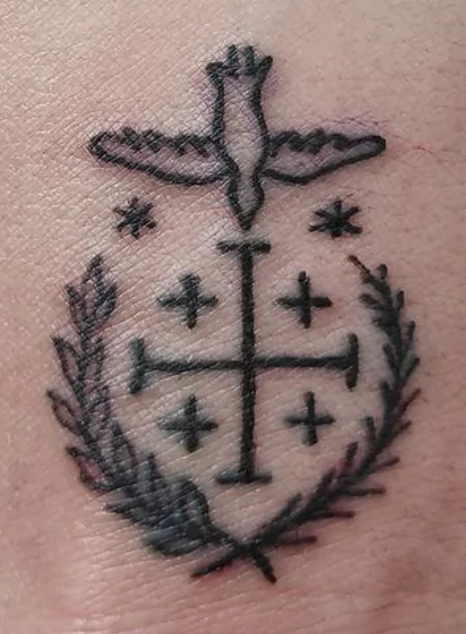
Jerusalem Cross - Razzouk Tattoo

The world's oldest tattoo shop is situated in the Christian Quarter of the Old City in Jerusalem. That in itself may come as a surprise to those who -- like me -- grew up in Christian communities that frowned on tattoos.  It's not your average tattoo parlour. For 28 generations (since 1300AD!), the Razzouk family has been tattooing Christian pilgrims, first in Egypt, and now in Israel. The shop is filled with Christian symbols -- the Jerusalem cross, the crucifix, Mary, St. George and the Dragon, the crown of Christ's victory, the dove of the Holy Spirit, and many others. 

Growing up, I don't remember seeing tattoos on any of the Christians in my community. My grandparents and parents were so firmly against the idea that the topic never even came up in our home. It was simply obvious that Christians shouldn't get tattoos because it directly contradicted Scripture. The Old Testament book of Leviticus clearly says, "Do not cut your bodies for the dead or put tattoo marks on yourselves. I am the LORD." (Lev. 19:28 NIV) For many Christians, that ends the discussion. 

But since childhood I've met many Christian friends with tattoos that did not predate their conversion. Were my grandparents wrong about this? Are tattoos actually ok for Christians? Or are these Christians disobeying Scripture?

This is a complex question that requires us to carefully think through several related issues.

To answer that question, we must consider a few things: (1) the role of Old Testament law for followers of Jesus the Messiah, (2) the purpose of this particular law in Leviticus, and (3) what a modern-day tattoo communicates. I'll talk about each of these in a separate blog post.

The Role of Old Testament Law for Christians

Christians take a variety of positions on this issue. On one end of the spectrum are those who say that all the laws have been set aside in Christ. We'll call this view the anti-law group. On the other extreme are those who say that Christians need to obey all of them. We'll call this the pro-law group. Most Christians fall somewhere in the middle, seeing ongoing validity to some laws, but not all of them. Deciding which ones still apply--and how--is the tricky part.

In Matthew 5:17-20, Jesus insists that his purpose was not to do away with the Torah or the Prophets, but to bring them to their fulfillment. He says "until heaven and earth disappear, not the smallest letter, not the least stroke of a pen, will by any means disappear from the Torah until everything is accomplished" (v. 18; modified NIV). It's obvious why those in the pro-law group would gravitate toward this passage. In fact, Jesus insists that "anyone who sets aside one of the least of these commands and teaches others accordingly will be called least in the kingdom of heaven!" (v. 19)

This is one reason I wrote a book with the subtitle Why Sinai Still Matters. I don't think that Christians can ignore the commands of the Old Testament. However, it's not as simple as following all of them. Many of the commands can no longer be kept because the temple was destroyed in 70AD. Laws pertaining to ritual purity and the sacrificial system are no longer relevant in the same way they used to be. Not only was the temple destroyed, but Jesus claimed to replace the temple with himself (John 2:19-22; Matthew 12:6). The apostles spoke of believers in Jesus as being built into a new temple (e.g. 1 Peter 2:4-8; 2 Cor. 6:16). That tells me that we no longer need to observe the laws pertaining to temple purity in the same ways that Israel did. However, we can see that Paul still felt they were instructive for believers. He tells the Corinthians that their role as the temple of the Spirit necessitated their separation from worldliness (2 Cor. 6:17). These laws still teach us about holiness and help us understand Jesus' relationship with purity, and they instruct us by analogy to ways of honoring God.

The purpose of some of the other laws (e.g., kosher diet and circumcision) was to separate between Jews as God's covenant people, and non-Jews. What we eat marks us as a community and either prevents or allows our fellowship with other people. I'm writing this post from the JFK airport in New York, where I've just come from a week in Israel. I saw firsthand how carefully Jewish communities still keep kosher food laws. Jewish passengers on my flight had different meals and scrutinized even the fruit juices to see if they were ok to drink. 

In Acts 15, leaders of the early church met together to determine how to handle Gentiles who wanted to follow Jesus, the Jewish Messiah. They prayerfully decided that Gentiles could follow Jesus as Gentiles. They did not have to first convert to Judaism by undergoing male circumcision and keeping Kosher food laws. The basis for their decision was James' exposition of Amos 9:11-12, which explicitly refers to "all the nations that bear my name." To bear Yahweh's name was to be a covenant member. The idea that Gentiles could be covenant members seemed revolutionary, but it was right there in the Prophets! 

Peter added to James' insight by noting that as he preached to Gentiles, the Spirit came upon them. Since the Spirit is a sign of covenant renewal, Peter's experience testified that God had already chosen Gentiles to belong to him. Early Jewish followers of Jesus needed to adjust their expectations of what constitutes covenant membership. 

First Peter 2:9-10 confirms this idea that Gentile followers of Jesus are covenant members. Peter is writing to a mixed audience of Jewish and Gentile followers of Jesus, but he applies to them the covenant titles conferred at Sinai: royal priesthood, holy nation, treasured possession. 

Acts 15 and 1 Peter 2:9-10 are the reason why I believe that Christians are members of Yahweh's covenant with Israel, and why I conclude that Sinai still matters for us. In Paul's words, we have been grafted into the covenant (Romans 9-11). That means the law is still relevant, even if aspects of it change on the other side of the cross. We cannot easily dismiss the rest of the laws of Leviticus. That brings us to our second question: what was the purpose of the law against tattoos? 

As I've already noted, not all the laws apply today in the same way as in Old Testament times. That doesn't mean that we can go through the Torah with a black Sharpie, crossing out the laws that no longer apply. Every law remains useful for "teaching, rebuking, correcting, and training in righteousness," as Paul tells Timothy (2 Tim 3:16). For an extended discussion of the ongoing relevance of the law with examples, see Richard Averbeck's new book The Old Testament Law for the Life of the Church. Averbeck has spent a lifetime studying and teaching Old Testament law from a Christian perspective and his approach to the subject is very helpful.

I'll address the answer to the question of the purpose of this particular law in Part 2 of this series. 


Wednesday, December 5, 2018

What Do You Expect This Christmas? (Part 2)


In the first post of this Advent series, I raised the issue of unmet expectations in our Christmas celebrations. In this post, we consider the first Christmas, which did not go as expected.

----

The Holy Family (Photo: C Imes)
Sweep away that image of a peaceful nativity. We know better. Is life with a newborn ever a “silent night”? And giving birth in a crowded house with distant relatives and their livestock is hardly a picture of “peace on earth.”

The first Christmas had more than its fair share of disappointments and unmet expectations. The Jewish people had been hoping and praying and waiting for centuries for a Savior.

Come, thou long-expected Jesus
Born to set thy people free

God had promised to send the people of Israel a king in the line of David, a Messiah –someone who could crush those who oppressed them and finally set them free. But that was a long time ago. In the meantime, other nations had dominated and abused them – first the Assyrian empire, then the Babylonians, then the Greeks, now the Romans. The Jews were weary of being mistreated. The Romans taxed them heavily and policed them ruthlessly. Jewish residents had no citizenship and no say in government. They were harassed about their worship and way of life. But for centuries they had held on to the promise that God would send the Messiah to crush their enemies and make them submit to God’s rule, ushering the Jewish nation into a glorious new age.

Finally Christmas came. A helpless baby was born to a young virgin whose fiancĂ© nearly called off the wedding. They had to travel across the country during her pregnancy for a census – the Roman oppressors’ way of counting them so they could extort more tax money to pay for an ever-expanding empire. Mary and Joseph arrive in Bethlehem only to find that their relatives’ guest rooms are full. The implication is that they must sleep on the floor near the animals. The best cradle they can manage is a feeding trough.

This is Christmas? This is the coming of the king in the line of David? This is the one who will crush the enemies of God? It’s hardly worthy of an Instagram post, much less an angelic announcement.

An angel had appeared to Joseph in a dream, telling him about the child: “Joseph son of David … do not be afraid to take Mary as your wife. For the child within her was conceived by the Holy Spirit. And she will have a son, and you are to name him Jesus, for he will save his people from their sins” (Matthew 1:20-21).

This must have come as a bit of a slap in the face to Joseph. For a people longing for deliverance from the Romans, imagine the effect when the hero shows up to save them from themselves. You are your own worst enemy. Ouch.

From our fears and sins release us
Let us find our rest in thee

When he’s about 40 days old, Mary and Joseph head to Jerusalem to dedicate baby Jesus at the temple. This is part of the Christmas story less well known. To figure out what’s going on, we need to understand a bit of history. When God rescued the Jews from slavery in Egypt back in the Old Testament era, the firstborn sons of Egyptian families died in the 10th plague. From then on, God asked Jewish families to dedicate their firstborn sons to him. That’s one reason Joseph and Mary visit the temple.

But Mary has a second reason for going. Every Jewish mother also offers two sacrifices for purification after childbirth. Childbirth is to be treated with great reverence because it is a matter of life and death. So when a new mother has finished bleeding, she is to bring a lamb and a pigeon as an offering to God, symbolizing her cleansing. Poor families may bring two pigeons or doves if they cannot afford a lamb. This is what Joseph and Mary do. Being poor, they bring two birds. Not what we might expect for the birth of a king!

"Simeon's Moment" by Ron DiCianni
(Photo: C Imes)
While they are at the temple, Mary and Joseph meet an unlikely character: Simeon. We pick up the story in Luke 2:25:
“At that time there was a man in Jerusalem named Simeon. He was righteous and devout and was eagerly waiting for the Messiah to come and rescue Israel. The Holy Spirit was upon him and had revealed to him that he would not die until he had seen the Lord's Messiah. That day the Spirit led him to the Temple. So when Mary and Joseph came to present the baby Jesus to the Lord as the law required, Simeon was there. He took the child in his arms and praised God, saying, 'Sovereign Lord, now let your servant die in peace, as you have promised. I have seen your salvation, which you have prepared for all people. He is a light to reveal God to the nations, and he is the glory of your people Israel!' Jesus' parents were amazed at what was being said about him." (Luke 2:25-33 NLT)
Simeon is an old man, and he’s been watching and waiting for God’s deliverance his entire life. He sees baby Jesus and knows instantly that the moment has finally come. God has answered his prayers!

Israel’s strength and consolation
Hope of all the earth thou art

But Simeon doesn’t stop with these celebratory words. He ends with a sober warning. We'll consider what it could possibly mean in Part 3 of this Advent Series.

Tuesday, June 26, 2018

TIME, Trump, The Death of Socrates, and The Art of Biblical Interpretation

Journalism ethics is all the rage this week (literally), with a provocative TIME magazine cover on the topic of immigration. (With apologies to readers interested in the politics of immigration and assurances to those weary of the debate, this post is not about immigration, but rather the relationship between art and truth). Are the facts at odds with the truth?

The Facts: President Trump has never met this girl from Honduras. Her separation from her mother at the border was only momentary, as her mom was searched. Afterward they were (at least temporarily) reunited as they awaited processing.

The Truth: Still, the girl comes to represent the many hundreds of children who have been separated from their parents while seeking a better life. The moral outrage following the public's realization of this is understandable, no matter how you propose to handle illegal immigration.

TIME's cover reminds me of a painting from the 1700's -- "The Death of Socrates," by Jacques-Louis David. David depicts Socrates surrounded by his disciples, on the verge of drinking his death sentence in poison. He teaches until the final moments of his life, remaining stoic in the face of death.

"The Death of Socrates" by Jacques-Louis David (1786)
Public Domain / Wikimedia Commons
Here's the connection with TIME's cover: Plato, from whom we learn the story of Socrates' death, was not present when it happened, yet David depicts him seated at the foot of the bed, slumped over and facing away.

Why include such an inaccuracy in this painting?

The Facts: David knew from Plato's own writings that he was not present at Socrates' death.

The Truth: Plato was deeply affected by Socrates' death and opposed it. By positioning him at the foot of the bed, looking away, the artist accurately captured Plato's disposition toward the death of his esteemed colleague. If Plato had been missing from the painting, we would lose this central point the artist is trying to make -- a point that coveys the truth of history creatively.

From time to time, feathers are ruffled when someone dares to suggest that the writers of Scripture  were brilliant artists. To some, this implies a disconnect with truth and a denial of divine inspiration. The second objection is easily solved. The God who created all things endows humans with creativity and invites us to participate in his work. As a prime example, take Bezalel and Oholiab, the men charged with designing the tabernacle (Exodus 31). These men were Spirit-filled and skilled creatives, in spite of the fact that their task was to construct something that already had very detailed blueprints. If their creativity was not a valuable asset for this project, God would have been better served finding an automaton. No, he chose humans, men who had spent years honing their skills in weaving and engraving and woodworking and all types of art.

But does art imply a disconnect with truth? Put another way, would the exercise of artistic license in the production of sacred Scripture get in the way of truth?

A great place to test this theory is in the Gospels. Matthew, Mark, Luke, and John each tell us the story of Jesus. With their words they paint a portrait for us of his life and ministry. They share much in common, at times even whole episodes or chapters. But there are differences, and some of these are rather puzzling. Did Jesus drive out the money changers in the temple at the beginning of his ministry (as John tells it)? or at the end (as Matthew, Mark, and Luke recount)?  Some Christians assume that Jesus must have driven them out twice -- once at the beginning and another time at the end of his ministry. But could this be an example of creative license?

Each Gospel writer introduces us to the historical Jesus by showing us something distinct about who he really is -- the Jewish Messiah (Matthew), the suffering Son of God (Mark), the Savior for all people (Luke), the Son who reveals the Father (John). To show us what is true about Jesus, in some instances they are best served by rearranging events so that everything will point in the direction they want us to look. This is not because they are trying to hide the truth, but because truth is their main concern. They arrange the details so that we as readers don't get muddled -- so that we can see what they see.

Matthew, Mark, and Luke may have saved this story until the end to illustrate how the opposition to Jesus gained momentum, resulting in his crucifixion. On the other hand (I suspect this is the better explanation), John may have chosen to tell us about the temple cleansing earlier because he's arranging the episodes of Jesus' life topically. The temple cleansing fits a string of stories illustrating Jesus' redefinition of Jewish institutions (sacred vessels, temple, rabbis, and sacred sites; John 2:1-4:54).* The cluster of stories among which the temple cleansing sits is followed by a series of stories in which Jesus redefines Jewish festivals (Sabbath, Passover, feast of Tabernacles, and feast of Dedication). Together, these two clusters make up the "Book of Signs," where John presents 7 signs that reveal Jesus' identity and call people to faith, setting us up for the "Book of Glory," where Jesus is glorified by offering his life on the cross.

However you slice it, artistic license is clearly at work. Either somebody moved this event out of chronological order, or all four gospel writers chose to omit a second occurrence. In my opinion, the truth has been gloriously served.

*For a fuller discussion of John's arrangement of material, see Gary M. Burge, Lynn H. Cohick, and Gene L. Green, The New Testament in Antiquity (Zondervan, 2009), 216-219.

Wednesday, November 4, 2015

does the new NIV distort the Scriptures? - part 6

Are you with me so far? I've attempted to answer a number of objections to the new edition of the NIV by explaining why scholars felt the translation needed updating. I've given some examples of how these principles have worked out in practice. I hope that it has been helpful.

Now we have come to the real rub: pronouns. In reality most of the other concerns raised about the NIV would apply equally to the 1984 version as to the 2011 version. The greatest controversy with the new NIV has revolved around gender-inclusive language. The outcry is actually a holdover from the Committee on Bible Translation's 2005 release, known as "Today's New International Version," which met with so much opposition it was pulled from the shelves. For the new NIV, the committee thoroughly reevaluated every verse affected by questions of gendered language, taking a more moderate approach.

I need to make one thing clear from the get-go: the NIV has not changed pronouns referring to God. As the Committee on Bible Translation explains,
"Nowhere in the updated NIV (nor in the TNIV, nor in any of the committee discussions leading up to either version) is there even the remotest hint of any inclusive language for God. The revisions solely surround inclusive language for mankind." (from "Updating the New International Version of the Bible: Notes from the Committee on Bible Translation," page 4, emphasis theirs)
However, in many places they have changed pronouns (and even nouns) that refer to people. "Forefathers" has usually been replaced by "ancestors." "Brothers and sisters" often appears where the text used to read only "brothers." The committee based their decision to do this on twin considerations:

  1. Concern for Accuracy. The translators wanted to be sure that when the original languages were intended to refer to anyone, regardless of gender, that sense was clearly conveyed in English.
  2. Concern for Communication. The committee asked Collins Dictionaries to undertake an extensive, independent study of recent publications (including sermons) in English in order to track patterns of language use over a 20-year span. They wanted to ensure that the finished translation would clearly communicate using current English idiom to avoid misunderstanding.

Here’s a simple example:
“If any man will come after me, let him deny himself, and take up his cross, and follow me” (Matthew 16:24; KJV).
Is Jesus speaking only to men? Is following Jesus something that only men are qualified to do by virtue of their gender? The KJV gives this impression to those who are not accustomed to generic use of masculine pronouns. As a result it miscommunicates the meaning of Scripture. The Greek does not use the word “man.” It simply has a generic pronoun (τις) that happens to be masculine in gender because first-century Greek was a gendered language where masculine pronouns were used in mixed gender situations.

The previous edition of the NIV recognized that this was misleading, and translated it according to the conventions of the English language in 1984:
“If anyone would come after me, he must deny himself and take up his cross and follow me.” (NIV 1984)
The new NIV, based on the Collins' research project, uses gender-neutral plural pronouns with a generic, singular subject. Grammatical constructions such as this one occur three times more often in current English discourse then the masculine singular forms once advocated by our middle school English teachers. Here's how it sounds in Matthew 16:24:
"Whoever wants to be my disciple must deny themselves and take up their cross and follow me." (NIV 2011)
Is this changing the Word of God? Is this twisting the Scriptures? Or is it ensuring that the current generation will be able to understand the Word as it was intended? I vote for the latter option.

I've tried to give you a sense for the considerations that motivated the translation committee. In my last post of this series, I'll tell you why I think this is critically important. Stay tuned!


Friday, October 30, 2015

does the new NIV distort the Scriptures? - part 5

Today I'm tackling the second part of an accusation against the NIV translation of the Bible. The first (which was part 4 of this series) addressed the issue of single words being changed, such as "Jehovah." What's more, some Christians are deeply concerned that the new NIV has removed entire verses from the Bible.

In a way, they are right. If you compare the KJV to the NIV, you'll discover that some verses have dropped out. But the important question is WHY?

Is this an attempt to take out statements that are uncomfortable or to water down the message of Scripture?

In a word, no.

Those who translated the Bible into English in the early 1600s did the best they could with what they had, but since then hundreds of other ancient manuscripts of the Bible have come to light, including those known as the "Dead Sea Scrolls." These manuscripts are much older than those available to the translators of the King James Version, sometimes by a thousand years, and in many cases they preserve a more accurate biblical text.
"The Shrine of the Book" at the Israel Museum,
where some of the Dead Sea Scrolls are housed
Photo: D. Camfferman
The process of discerning which manuscript is better is called "textual criticism" (not because it's "critical" of the text, but because it's trying to determine the "critical" text). The goal of most textual critics is to reconstruct the oldest and most accurate text possible by identifying and removing any mistakes or later additions.

Those responsible for the translation of the NIV (the Committee on Bible Translation) want you to be confident that you hold in your hands the Word of God, not a text filled with well-intentioned additions— however "true" they may be. In some cases, a word, a verse, or even a whole paragraph was added to the text at some point in history in order to clarify the meaning or harmonize a text with a similar passage in another book. This is especially common in the Gospels, where multiple books recount the same event. Either by accident or on purpose, scribes would fill out the shorter text with details from the longer text.

The NIV translators carefully examined the manuscript evidence. In cases where a new (older) manuscript suggested that a verse was a later addition to the biblical text, they chose to eliminate it.

Here's an example:
Matthew 18:11 (NIV) - Photo: C. Imes
In the KJV, Matthew 18:11 says, "For the Son of man is come to save that which was lost."
In the NIV, there is no verse 11. Instead, a footnote reads, "Some manuscripts include here the words of Luke 19:10."
Sure enough, Luke 19:10 reads, "For the Son of Man came to seek and to save the lost."
Luke 19:10 (NIV) - Photo: C. Imes
In other words, even without this statement in Matthew 18:11, no theology has been lost. The truth that Jesus looks for and saves sinners is still in the New Testament. In the cases where a verse does not appear elsewhere, it was never supposed to be there in the first place. Thankfully, no doctrines of consequence rest on those verses.

Ironically, as with this example, many of the "missing" verses listed by concerned readers are found elsewhere in the Bible. Think with me here. If the NIV translators were trying to change the Bible, they didn't do a very thorough job.

For Zondervan's answer to this question (a shorter version of what I've said above), click here.

I've saved the most controversial objection to the NIV for last. Stay tuned!


Sunday, December 9, 2012

the story God is writing

Ten years ago today, Danny, Eliana, and I boarded a plane bound for the Philippines, officially moving from "appointee" to "field" status with SIM, an interdenominational church-planting mission. We moved from green and temperate Oregon to the hot and sticky concrete jungle of metro Manila, where we studied Tagalog and learned how to live away from our families and our own culture. The adjustment was difficult, but we came to love mangoes and jeepneys, open markets and the smiling vendors who worked there. New faces became part of our story, and we theirs, as our lives were knit together.

We had no idea that our sojourn in the Philippines would only last 2–1/2 years before SIM would recommend that we relocate to Charlotte, NC, so that Danny could serve in a more strategic role at SIM's international headquarters. He's filled an administrative position for Sports Friends (a ministry of SIM) ever since—tracking funds so that young people around the world can experience the love of Christ through a godly mentor. Charlotte, too, was far from home and family, and some of the cultural differences took us by surprise. We learned to like sweet tea and "barbeque," our neighbors' drawl and our neighbors, period. New chapters in our story included Gordon-Conwell, Good Shepherd UMC, public schools for our kids, and enriching fellowship with other SIM missionaries.

Our next move took us to the Midwest, where winters are cold and days are short, but people are equally friendly. After 18 months in Wheaton we feel right at home. Family is still far away, but we're finding community just the same. Thanks to Skype and email Danny can communicate with teammates in Ethiopia and Thailand, Nigeria and Peru from his attic office. Thanks to this blog, I can keep in touch with a wide circle of friends while I study in the library in preparation for teaching ministry. Our story has become one of anticipation, wondering what doors God will open when my schooling is over and we are free to move again.

Looking back on 10 years of ministry with SIM, our hearts are full of gratitude. We've lived in 10 different homes over these past 10 years, attended 7 different churches and 16 different schools. We've been in 11 countries and 31 states. In each of these places God has blessed us with more friends than we can possibly count whose stories have intersected with our own.

This year for Christmas we're going on a pilgrimage of sorts to see some of those dear friends. We'll get to stop in Charlotte to reconnect with neighbors, friends, and our church family—a special bonus after 18 months away. Our ultimate destination, though, is SIM's retirement community in Florida, where we'll spend Christmas with Phil and Julie Parshall.

Phil and Julie were there 10 years ago at the airport in Manila when our plan landed, waiting in the humid night air for a first glimpse of the eager young family from Oregon who had come to join their work. Their friendly welcome meant so much to us after some 30 hours of travel with a toddler in tow. The Christmas we spent together just a couple of weeks later was the first of many more shared holidays, though none of us knew it at the time. Who could have foreseen that when we left the Philippines Phil and Julie's retirement would soon follow, and they would end up choosing an apartment in Charlotte just over a mile away from us?

We had nearly 6 more happy years together in Charlotte as God continued to interweave our stories. Shortly after we left Charlotte Phil and Julie moved to Florida. This Christmas will be the 6th or 7th we have spent with them. The Parshalls (and so many others) have been part of God's provision for us in these 10 years away from home. As Jesus reassured his disciples,


"And everyone who has left houses or brothers or sisters or father or mother or children or fields, for my name's sake, will receive a hundredfold, and will inherit eternal life." Matthew 19:29 NRSV

We don't know what the next 10 years will hold, or who else will walk onto the pages of our story and stay for a while. No one does. But the Author knows what he's doing, and if we let him hold the pen it will turn out beautifully in the end.

Saturday, July 7, 2012

do Catholics worship Mary?


One of the most obvious practical differences between Catholics and Protestants is our respective postures towards Mary. Protestants don’t dislike her, but she simply takes her place alongside all of the other heroes of the faith, no better than the rest. For Catholics, on the other hand, Mary is unequaled among humans. Sculptures and paintings feature Mary almost as often as Christ; Churches, schools, and holy societies are devoted to her memory. Even Notre Dame (“Our Lady”) is named after her, and the main administration building is crowned with her golden statue. The Rosary, prayed daily by devout Catholics, is punctuated with “Hail, Mary” and directed toward to the “Most Blessed Mother.” Mary is celebrated, revered, and held up as the highest example of faith. In fact, Dr. Cavadini says, “Without devotion to Mary there is something lacking in Christian worship.”

So . . . why all the fuss about Mary?

The first thing to make clear is that Catholics do not worship or adore Mary. She is instead venerated, or shown respect and devotion for her faith. Because Mary’s faith in Jesus and submission to God’s will are what make her special, contemplation of Mary fosters deeper faith in Christ. She serves as the prime example of saving faith. In class, Dr. Cavadini explained that “Devotion to Mary is devotion to the incarnation. . . . The repetition of the 'Hail Mary' calls to mind the mystery of the incarnation.” Pope John Paul II saw that in the Rosary, "Mary leads us to discover the secret of Christian joy" (On the Most Holy Rosary, 28). The Rosary is one way that Mary invites Catholics to think about Christ.

Conservative Protestants agree with Catholics that Mary was a virgin when she conceived by the power of the Holy Spirit (§484–486, 496–498). She was chosen by God for this purpose because of her “free cooperation” with the Holy Spirit, enabled by God’s grace (§488, 490). She can be thought of as the “exalted daughter of Sion,” the culmination of a long line of women who hoped in God (§489). Responding to an ancient debate, the Catechism of the Catholic Church (CCC) says it is proper to call Mary theotokos, or “Mother of God” (§495; 509). Protestants agree.

However, the Catholic Church goes on to teach two further doctrines related to Mary’s virginity that are generally not held by Protestants: her Immaculate Conception and Perpetual Virginity. The former was declared ex cathedra by the Pope, so it is considered an infallible doctrine by Catholics.

Immaculate Conception 

Catholics believe that Mary was not only a virgin when she conceived, but she was free from original sin. The CCC admits that this doctrine grew up gradually:

"Through the centuries the Church has become ever more aware that Mary, ‘full of grace’ through God, was redeemed from the moment of her conception. That is what the dogma of the Immaculate Conception confesses, as Pope Pius IX proclaimed in 1854:

'The most Blessed Virgin Mary was, from the first moment of her conception, by a singular grace and privilege of almighty God and by virtue of the merits of Jesus Christ, Savior of the human race, preserved immune from all stain of original sin.'" (§491)

Our Lady of Vladimir icon
Dr. Cavadini clarifies that Mary was, from the moment she was conceived, redeemed in anticipation of Christ’s saving work. So her freedom from original sin was on the basis of that redemption in Christ (i.e. the same way you or I are saved later in life). But not only was Mary free from original sin, the CCC teaches that “By the grace of God Mary remained free of every personal sin her whole life long” (§493; cf. 508). She “gave herself entirely to the person and to the work of her Son” (§494). Dr. Cavadini explains, “Her immaculate conception is her complete conformity to the incarnation from the moment of her conception. She was preserved from original sin on the basis of that conformity.”

No direct appeal is made to Scripture in the CCC to support this doctrine other than Luke 1:48, where Mary says, “all generations will call me blessed.” For Protestants it seems a stretch to go from “blessed” (presumably by God) to “blameless”! How do Catholics get there? Protestant readers may be relieved to see that for Catholics Mary’s holiness is derivative of Christ’s own holiness and her election is predicated on God’s grace.

More troublesome to Protestants, however, is the idea that Mary was free from original sin and never sinned during her life, because Scripture never says this explicitly. For Catholics the doctrine has a theological and typological basis. Catholics’ typological views of Mary might be compared to the baptism of infants by many Reformed Protestants. We find no explicit example of or command for infant baptism in Scripture, yet many churches practice it because they see a typological relationship between circumcision and baptism. Just as circumcision of male babies signified their inclusion in the Covenant, so baptism of children stands as a symbol of their inclusion in the New Covenant, based on the promise of God. Not all Protestants believe in infant baptism, but those who practice it have allowed a typological reading of Scripture to shape their Christian practice. This is analogous to the Catholic Church’s teachings on Mary. We might say her sinlessness flows naturally from her portrayal in Scripture as one fully submitted to the will of God. A life completely surrendered is one without sin. If we admit of even the possibility of entire sanctification (something debated among Protestants), then the Catholic vision of Mary stands as the showcase example.

But Mary is more than a role model, or example of faith. For Catholics, the doctrine of her Immaculate Conception is intrinsically connected to Christology, and it arises out of contemplation of the circular nature of the incarnation. How is the incarnation circular? Simply the idea that Mary is the “Mother of God” defies logic — how can God have a mother? Mary then, through Christ’s offering of himself, becomes the daughter of her Son — another conundrum. Edward Oakes explains,

"The implications of the denial of the dogma of the Immaculate Conception should become clear. For such a denial would then make our very salvation dependent on Mary’s free will operating independent of grace. Her Yes to God would have had to have been made, even if ever so slightly, under her own power, which would have the intolerable implication of making the entire drama of salvation hinge on a human work ..." (“Sola Gratia and Mary’s Immaculate Conception,” 3).

In other words, if Mary was not sinless, how could she have given her full consent to the incarnation? And if she was able to give full consent, would not her sinless response have been a work of God’s grace? Therefore, the grace of God must have been in operation from the very moment of her conception, preparing her for this moment of full consent. And that grace is only available on the basis of Christ’s redeeming work. Therefore, Mary is redeemed in anticipation of that saving work of Christ, and her willingness to bear the incarnate Lord makes that redemption possible. (Do you see the circle?)

Perpetual Virginity

For Protestants, another unfamiliar Catholic doctrine is the perpetual virginity of Mary. According to the CCC, Mary continued to be a virgin for the rest of her life (§499; 510). Her virginity is a sign of her faith, the “undivided gift of herself” to God (§506). She then becomes the mother of all who believe (§501; 511; 963). To the objection of Protestants that Jesus had siblings, the Catechism claims that “James and Joseph, ‘brothers of Jesus,’ are the sons of another Mary, a disciple of Christ, whom St. Matthew significantly calls ‘the other Mary.’ They are close relations of Jesus, according to an Old Testament expression” (§500). Mary’s ongoing virginity is the outward expression of her openness to God’s special work in her. She continues to embody the mystery of the incarnation.

Statue of the Holy Family on Notre Dame's Campus
If this seems to downgrade human sexuality, we should note that Catholics do not see married sex as unholy. The holy family is fulfilling a unique vocation, not one to be emulated by married couples. Marital celibacy is not praised by the apostles. On the contrary, Paul tells the married not to deprive each other of sexual fulfillment (1 Cor 7:3,5).

Protestants may still want to object to the Catholic interpretation of Jesus “brothers” as his “cousins” (Matt 13:55 and Mark 6:3). We may also see Matt 1:25 as pointing away from the doctrine of Mary’s perpetual virginity—Joseph kept Mary a virgin “until she gave birth” to Jesus. I for one have understood this to mean that after Jesus was born Mary and Joseph consummated their marriage. However, there is room for disagreement over this issue. Seen typologically, the Catholic doctrine on Mary can be squared with Scripture (though it goes beyond what the Bible explicitly says).

More on Mary


The CCC also teaches that Mary intercedes for the Church (§965; 969). Her mediation, a “maternal role,” is not meant to equal or diminish the uniqueness of Christ’s mediation, but is derivative of it and based on the doctrine of the priesthood of all believers (§969; 975; 1014). She has simply gone before us and represents the end goal of the journey of faith (§972). In fact, Catholics teach that Mary was taken up into heaven directly, where she awaits us. This doctrine is called the “Assumption of Mary” (§966, 974; cf. 1024), and it is also considered infallible. It is not found in the Bible and has no parallel in the Protestant church. It is based on a very ancient liturgical Tradition which can obviously not be proven or disproven. You could think of Enoch, who “walked with God; then he was no more, because God took him” (Gen 5:24 NRSV) or Elijah, who was taken to heaven in a whirlwind (2 Kings 2:11).

Beliefs about Mary can be a real sticking point between Catholics and Protestants. I hope that this post has helped you to understand what Catholics believe about Mary and (to some extent) why. I am coming to a place where these doctrines are at least beginning to make sense, though I am not ready to embrace all of them. Ultimate agreement may be unlikely, but respect, dialogue, and understanding are the goal.

Dr. Cavadini put it to me this way, in an e-mail exchange over this issue:

"So it seems to me that all Christians who believe in the Incarnation can share Mary as 'Mother of God,' and can begin to understand that they are truly linked in this way, and Christians less inclined to cultivate a devotion to Mary can still on the basis of this link, if they are willing to seriously consider it, have an understanding of the devotion that flourishes more explicitly in other communions, and, without participating in it, still feel a link to it, and understanding of it, and an appreciation that someone is in fact holding up that end of the spectrum." (emphasis mine)

He later reminded me that the beauty of Catholic teaching on Mary can get lost in the arguments over particular aspects, adding,

"The Mother of the Incarnate Word is not His mother just by accident—her kid happened to turn out great—but she is consulted and is aware. That maternal love is there for all of us because Christ wills it. Her maternal compassion is there for us and leads us to contemplate the divine mercy of her Son. There is nothing to be afraid of, only beauty, only the special role of a women in our redemption. . . . Remember, there is no jealousy in Heaven. No one is jealous of the Blessed Mother as though her status is competitive—only love."

Sunday, December 11, 2011

Advent Tree: Week 3

Here are my leaf designs for the 3rd week of Advent. I've switched the images for Days 20 and 21 because I realized I had them out of order. This is a very exciting week of Advent! Enjoy!

Daniel (lion)
Nehemiah (wall)
Zechariah & Elizabeth (praying hands)
Birth of Jesus (manger)
Shepherds (crook)
Temple Dedication (two doves)
Magi (star)


Day 15 - Daniel (lion) - Read Daniel 6

Sadly, the people of Israel did not listen to the prophets who told them what God was saying. They did not obey. They got worse and worse. Finally God had to take them out of the special land he had made. It was clear that they would not be able to fill it with people who honored God! So most of them, especially the smartest ones and the richest ones, were taken far away to a land called Babylon. The king of Babylon picked some of these Israelites to work for him in the palace. Daniel was one of them. Even though Daniel was far from home and far from the temple where God was worshipped, he carefully obeyed God and prayed to him every day.
What did Daniel do that showed he didn’t forget about God, even though he was far from home? He prayed every day and he obeyed God’s rules.
How did God take care of Daniel? He protected him when the king put him in the lions’ pit.

Day 16 - Nehemiah (wall) - Read Nehemiah 2:11-18 and 4:6

After 70 long years away from home, God made it possible for the people of Israel to go back to their special land. Some of them went back right away and tried to start a new life. But it was not easy. Some of their enemies had moved in and made life difficult. Their houses were in ruins, and so was the temple. The walls that used to be strong around the cities to keep them safe were broken down, so their enemies could attack them any time they wanted. One of the men who returned to the land was named Nehemiah. He was a good organizer. He got the people together so they could work together to rebuild the walls around the city. With his good leadership, it didn’t take long. But still there was great sadness, because the temple was in sorry shape, and God’s glory was gone. They needed Isaiah’s promise to come true. They needed God’s special servant to come and bring them back to him! They needed Jeremiah’s promise to come true. They needed new hearts to obey!

Day 17 - Zechariah & Elizabeth (praying hands) - Read Luke 1:5-17, 57-58, 66

God’s people lived in the land of Israel for a long time after the walls were rebuilt. Some of them wondered if God would ever send his special servant to rescue them from their sin as God promised through Isaiah, if the snake’s head would ever be finally crushed as God promised Adam and Eve, if they would ever be given new hearts like God promised through Jeremiah. No doubt some of them gave up hoping. But some of them hung on to God’s promises and obeyed him even though his answers seemed to take a long, long time to come. Zechariah and Elizabeth were two of the people who never stopped hoping. Just like Abram and Sarai, they had no children and they were getting very old. But they kept obeying God and praying for a baby.
Where was Zechariah when he heard he was going to become a father? In the temple.
Why was Zechariah in the temple? He was a priest.
What did the angel tell Zechariah his son would do? He would bring Israel back to God (just like Isaiah said the servant would do!). Could this be the servant? We’ll see!

Day 18 - Birth of Jesus (manger) - Read Luke 1:26-38; 2:4-7

While Elizabeth was pregnant and waiting for her baby to be born, God sent an angel to another young woman and told her that she, too, would become a mom. Her name was Mary. The angel told Mary that her baby was going to be a KING who would rule forever! The angel reminded her that God always keeps his promises.
Both Elizabeth and Mary had their babies. Their names were John and Jesus. John was a prophet who would get people ready for the time when God himself would visit them. That visit would be like a sunrise, shining new light on the whole land (see Luke 1:76-79). But who was Jesus? The angel said he would be a king like David. Each day from now until Christmas we’ll learn a little bit more about this miracle baby, the answer to God’s great promises to Israel.

Day 19 - Shepherds (crook) - Read Luke 2:8-20

Just after Mary’s baby was born, something happened outside Bethlehem that was a big surprise! An angel came and spoke to the shepherds who were spending the night with their sheep. Were they going to have a baby, too, Just like Elizabeth and Mary? Yes, in a way. The birth of Jesus was big news for them. Jesus was not just an ordinary baby. The angel told the shepherds that Jesus was the one they had been waiting for – the Messiah! The word “Messiah” means “anointed one.” Remember how Samuel anointed the head of David when he was chosen to become king? The angel said that Jesus was anointed, too. He would be their king! The angel also said something even more shocking. He said that Jesus was the “Lord.” Could this baby somehow be God? The shepherds were so excited they went around telling everybody the news. And it was good news.

Day 20 - Temple Dedication (two doves) - Read Luke 2:22-32; 36-40

Joseph and Mary obeyed the laws that God had given to Moses. When Jesus was still a baby, they took him to the temple to present him to God. They offered two doves as a sacrifice. When they got to the temple, they met two special people – a man named Simeon and a woman named Anna. Simeon and Anna were the kind of people who obeyed God and kept on believing that he would do what he promised, even when it took a really long time. When they saw Jesus, they knew right away that God’s promises were finally coming true! Simeon knew that Jesus was the light for the whole world promised by Isaiah. Anna started telling everyone about him.
Why did Mary and Joseph take Jesus to the temple? Because God’s law told parents to dedicate their children in the temple.
What was so special about Simeon and Anna? They kept on believing his promises even when it took a long time for them to come true. They recognized Jesus right away as God’s way of bringing salvation and light to everybody!

Day 21 - Magi (star) - Read Matthew 2:1-12; Isaiah 60:1-3, 6

The shepherds and Simeon and Anna weren’t the only ones who found out the big news. God put a special star in the sky, and some people noticed from far, far away. They knew the special star meant that a new king had been born and they traveled a long way to meet him. Remember Isaiah? Many years earlier God told Isaiah that people from other nations would come to the land of Israel because they saw the light dawning. They would bring gifts and worship the Lord. God’s promises to Isaiah were finally coming true!
Why did the magi come to the land of Israel? They saw a special star in the sky and knew that a king had been born.
Why do you think this news made king Herod angry? He was king over the Jews, and he didn’t want another king to take his place!

Wednesday, April 13, 2011

bringin' in the big dawgs

I've been meeting with some Jehovah's Witnesses off and on for about 17 months now.  We met regularly for 6 months and then took a break for the summer. We met a few more times and then I asked if we could wait until April and meet to talk about the Trinity.

I have learned a lot from Lula. She is a godly woman, dedicated to the ministry, who really knows her Bible.  She has refused to be intimidated by my 6 years of formal Bible training and knowledge of both Greek and Hebrew.  Though not formally educated herself and not paid a dime for her ministry, she has continued to come week after week to meet with me and study the Bible.  Each time we meet she brings along someone different, always another woman volunteer. Can I make a confession?  For a long time now I've wondered when she would call in her supervisor. Today she finally did.

Kevin is the district substitute superintendent for the entire Charlotte area all the way to Spartanburg.  Like Lula, he is mystified that anyone could actually read the Bible and persist in believing in the Trinity.  Often I tell them that I can see how they could read the passage in the way that they do, but that I understand it differently. Today Kevin finally asked me (in exasperation?), "If a straightforward reading of the Bible implies that Jesus is not God, but sent from God as his representative, then what would motivate you to elevate him further?"

I was so glad he asked.  I pointed immediately to a brochure Lula had given me last year entitled, Should You Believe in the Trinity? They do a good job of introducing the topic, and I especially like this: "If the Trinity is true, it is degrading to Jesus to say that he was never equal to God as part of a Godhead. But if the Trinity is false, it is degrading to Almighty God to call anyone his equal ..." (3). This is why it matters: because right worship depends on knowing God as He really is.

Though there is a number of passages that seem to suggest that Jesus was not equal to the Father (John 14:28; 1 Cor 11:3; 15:27), there are many other indications in Scripture that Jesus was more than just God's representative (John 1:1; 17:21; Acts 2:21 with 4:12). Jesus did things that only God can do.  He forgave sins, he raised the dead, he healed a man blind from birth. Jesus also made claims that were tantamount to claiming deity.  He called himself the "light of the world" (John 9:5 with Isa 60:1-2), the "good shepherd" (John 10:11 with Eze 34), the "son of man" (Matt 17:9 with Dan 7:9-10, 13-14; Rev 1:12-18), and the "I am" (John 8:54-59 with Ex 3:3-4). These claims caused great consternation among the Jewish leaders, and in several cases they tried to stone him for blasphemy! His followers worshipped him (see John 9:38), and he did not object.

I recommended two books that have been helpful for me on this issue.  One is Donald Fairbairn's Life in the Trinity: An Introduction to Theology with the Help of the Church Fathers. Not only is it written simply and beautifully, it is changing the way I think about salvation.  I highly recommend it!  Fairbairn explains that the earliest followers of Jesus saw salvation as an invitation to share in the life of the Trinity the way the Father and Son share life together.

The other book is Richard Bauckham's Jesus and the God of Israel: God Crucified and Other Studies on the New Testament's Christology of Divine Identity. This one is not quite as easy to read, but terribly profound. Bauckham argues that Jesus' actions and claims about himself prompted his early followers to include him within their concept of "one God." The first century Jewish idea of monotheism was flexible enough to allow for Jesus' inclusion in the deity without seeing God as "more than one." At the end of our discussion, Kevin admitted that he needed to go back and reexamine some things in the Bible.  And that's what every good Bible discussion should do -- push us back to the Scriptures with fresh eyes to see once again what God has revealed and how we are to respond.  Please pray for Kevin, and for me and Lula as we continue to study the Bible and discuss what it teaches.

Friday, January 8, 2010

heaven and earth

Yesterday's post may have left the impression that I believe I am sealed by the Holy Spirit because I feel like I am, and Ephesians ought to have been written for me because I like it so much.  But there is much firmer ground for the idea that we are sealed by the Holy Spirit and will reign with Christ.

What I noticed yesterday is that wherever the words "heaven" and "earth" occur together in the Bible, Jehovah's Witnesses read them as two distinct places - one for the elite, anointed ones and one for the average Christian.  (Or, ironically, one as symbolic for earthly governments and the other for society).  But this is a misunderstanding of the way these words work in the Bible!  And I think it's the root of a number of their false beliefs.  The fancy word for this figure of speech is merism, which is where two words are meant to represent everything in between.  We use merism in English when we say "she was wet from head to toe."  Do we mean that her head was wet and her toe was, too?  Are we giving special emphasis to her head and toe over other body parts?  No.  We simply mean that her whole body was wet.

Genesis 1:1 tells us that "In the beginning, God created the heavens and the earth."  The Hebrew word for "heavens" functions just like the Greek word for "heavens" and the English one, too (I suppose because of the Bible's influence).  It can mean the sky, or it can refer to the place where God dwells.  Context tells us  which meaning is in view.  Was God, in Genesis 1, making a place for Himself to live as well as for us?  I don't think so.  "Heavens and earth" is a figurative way of talking about ALL OF CREATION.  If you go on to read the rest of the chapter, you'll see that God creates the sky and the land (and everything else).

In many places after that the Bible speaks of the "heavens and the earth."  Take, for example, Isaiah 1:2, "Hear, O heavens! Listen, O earth! For the LORD has spoken."  Is God here addressing two locations - one spiritual and one physical?  No!  He is calling all of creation as His witnesses in the court case that He is about to bring against Israel.  They have rebelled against Him and creation is ready to testify.  At the end of Isaiah he declares, "Behold, I will create new heavens and a new earth" (Isa 65:17).  Are these two new places God will make?  He clarifies in the following verse what he means: "I will create Jerusalem...".  That's it.  One place.  A new Jerusalem.

Fast forward to Revelation 21:1.  John announces, "Then I saw a new heaven and a new earth, for the first heaven and the first earth had passed away."  Does he then go on to see TWO places?  One for the anointed, and one for the rest of us?  No!  He sees ONE place: "the Holy City, the new Jerusalem, coming down out of heaven from God."  (This should ring a bell).  John sees the new creation, pictured as a garden-city-temple where God will at last dwell with us as He intended from the start.  Those who are welcome to enter this paradise are "those who wash their robes" (22:14).  Is that referring to a set number of individuals (144,000 to be exact) who have been given special passes?  My JW friends would say so.  But look at Revelation 7:9ff.  There we see a "great multitude that no one could count ... wearing white robes."  These are the ones from all over the globe who will enter into the new creation and eat from the tree of life.  That's you and me! 

They carry this idea to many other places in the Bible.  Look at the beatitudes in Matthew 5.  Instead of taking this as a list of counter-cultural attributes which should characterize all the people of God, they read verse 3 and verse 5 as talking about two distinct groups of people!  One (the poor in spirit) will go to "heaven," and the other (the meek) will stay on "earth."  They are not recognizing that Matthew consistently uses "kingdom of heaven" as a label for God's Kingdom, not a place in the sky where only some will end up.  I would be very hesitant to draw a line between items 1 and 3 on a list of 9 attributes that should characterize all believers.

It all boils down to a misunderstanding of a Hebrew figure of speech.  In their desire to take the Bible "literally," JW's have excluded themselves (most of them anyway) from some of the most precious promises of Scripture.  I, for one, am looking forward to walking through those pearly gates!