Showing posts with label Torah. Show all posts

Monday, December 19, 2022

Are Tattoos OK for Christians? (Part 1)

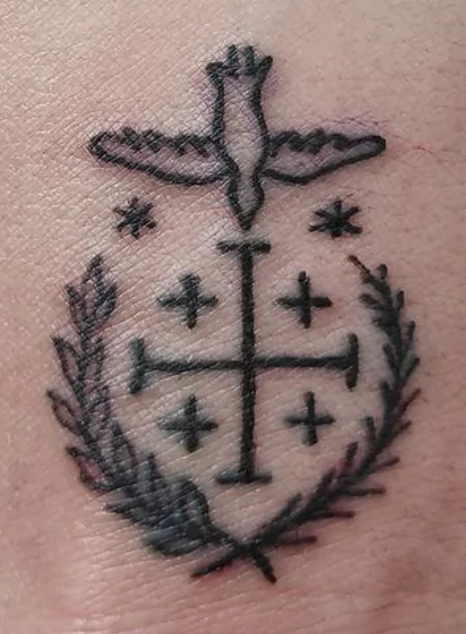
Jerusalem Cross - Razzouk Tattoo

The world's oldest tattoo shop is situated in the Christian Quarter of the Old City in Jerusalem. That in itself may come as a surprise to those who -- like me -- grew up in Christian communities that frowned on tattoos.  It's not your average tattoo parlour. For 28 generations (since 1300AD!), the Razzouk family has been tattooing Christian pilgrims, first in Egypt, and now in Israel. The shop is filled with Christian symbols -- the Jerusalem cross, the crucifix, Mary, St. George and the Dragon, the crown of Christ's victory, the dove of the Holy Spirit, and many others. 

Growing up, I don't remember seeing tattoos on any of the Christians in my community. My grandparents and parents were so firmly against the idea that the topic never even came up in our home. It was simply obvious that Christians shouldn't get tattoos because it directly contradicted Scripture. The Old Testament book of Leviticus clearly says, "Do not cut your bodies for the dead or put tattoo marks on yourselves. I am the LORD." (Lev. 19:28 NIV) For many Christians, that ends the discussion. 

But since childhood I've met many Christian friends with tattoos that did not predate their conversion. Were my grandparents wrong about this? Are tattoos actually ok for Christians? Or are these Christians disobeying Scripture?

This is a complex question that requires us to carefully think through several related issues.

To answer that question, we must consider a few things: (1) the role of Old Testament law for followers of Jesus the Messiah, (2) the purpose of this particular law in Leviticus, and (3) what a modern-day tattoo communicates. I'll talk about each of these in a separate blog post.

The Role of Old Testament Law for Christians

Christians take a variety of positions on this issue. On one end of the spectrum are those who say that all the laws have been set aside in Christ. We'll call this view the anti-law group. On the other extreme are those who say that Christians need to obey all of them. We'll call this the pro-law group. Most Christians fall somewhere in the middle, seeing ongoing validity to some laws, but not all of them. Deciding which ones still apply--and how--is the tricky part.

In Matthew 5:17-20, Jesus insists that his purpose was not to do away with the Torah or the Prophets, but to bring them to their fulfillment. He says "until heaven and earth disappear, not the smallest letter, not the least stroke of a pen, will by any means disappear from the Torah until everything is accomplished" (v. 18; modified NIV). It's obvious why those in the pro-law group would gravitate toward this passage. In fact, Jesus insists that "anyone who sets aside one of the least of these commands and teaches others accordingly will be called least in the kingdom of heaven!" (v. 19)

This is one reason I wrote a book with the subtitle Why Sinai Still Matters. I don't think that Christians can ignore the commands of the Old Testament. However, it's not as simple as following all of them. Many of the commands can no longer be kept because the temple was destroyed in 70AD. Laws pertaining to ritual purity and the sacrificial system are no longer relevant in the same way they used to be. Not only was the temple destroyed, but Jesus claimed to replace the temple with himself (John 2:19-22; Matthew 12:6). The apostles spoke of believers in Jesus as being built into a new temple (e.g. 1 Peter 2:4-8; 2 Cor. 6:16). That tells me that we no longer need to observe the laws pertaining to temple purity in the same ways that Israel did. However, we can see that Paul still felt they were instructive for believers. He tells the Corinthians that their role as the temple of the Spirit necessitated their separation from worldliness (2 Cor. 6:17). These laws still teach us about holiness and help us understand Jesus' relationship with purity, and they instruct us by analogy to ways of honoring God.

The purpose of some of the other laws (e.g., kosher diet and circumcision) was to separate between Jews as God's covenant people, and non-Jews. What we eat marks us as a community and either prevents or allows our fellowship with other people. I'm writing this post from the JFK airport in New York, where I've just come from a week in Israel. I saw firsthand how carefully Jewish communities still keep kosher food laws. Jewish passengers on my flight had different meals and scrutinized even the fruit juices to see if they were ok to drink. 

In Acts 15, leaders of the early church met together to determine how to handle Gentiles who wanted to follow Jesus, the Jewish Messiah. They prayerfully decided that Gentiles could follow Jesus as Gentiles. They did not have to first convert to Judaism by undergoing male circumcision and keeping Kosher food laws. The basis for their decision was James' exposition of Amos 9:11-12, which explicitly refers to "all the nations that bear my name." To bear Yahweh's name was to be a covenant member. The idea that Gentiles could be covenant members seemed revolutionary, but it was right there in the Prophets! 

Peter added to James' insight by noting that as he preached to Gentiles, the Spirit came upon them. Since the Spirit is a sign of covenant renewal, Peter's experience testified that God had already chosen Gentiles to belong to him. Early Jewish followers of Jesus needed to adjust their expectations of what constitutes covenant membership. 

First Peter 2:9-10 confirms this idea that Gentile followers of Jesus are covenant members. Peter is writing to a mixed audience of Jewish and Gentile followers of Jesus, but he applies to them the covenant titles conferred at Sinai: royal priesthood, holy nation, treasured possession. 

Acts 15 and 1 Peter 2:9-10 are the reason why I believe that Christians are members of Yahweh's covenant with Israel, and why I conclude that Sinai still matters for us. In Paul's words, we have been grafted into the covenant (Romans 9-11). That means the law is still relevant, even if aspects of it change on the other side of the cross. We cannot easily dismiss the rest of the laws of Leviticus. That brings us to our second question: what was the purpose of the law against tattoos? 

As I've already noted, not all the laws apply today in the same way as in Old Testament times. That doesn't mean that we can go through the Torah with a black Sharpie, crossing out the laws that no longer apply. Every law remains useful for "teaching, rebuking, correcting, and training in righteousness," as Paul tells Timothy (2 Tim 3:16). For an extended discussion of the ongoing relevance of the law with examples, see Richard Averbeck's new book The Old Testament Law for the Life of the Church. Averbeck has spent a lifetime studying and teaching Old Testament law from a Christian perspective and his approach to the subject is very helpful.

I'll address the answer to the question of the purpose of this particular law in Part 2 of this series. 


Wednesday, June 17, 2020

Book Review: Sandra Richter's 'Stewards of Eden'

I grew up in a white, American, conservative Evangelical context, where "environmentalist" was a derogatory term. To us, environmental concerns were a liberal agenda. We certainly didn't want to be guilty of getting all wrapped up in saving the planet when the thing that mattered was people and their eternal destiny. 

At the same time, being of Dutch descent, it came naturally to avoid waste. We washed and reused ziplock bags, kept scraps of paper to use for craft projects, wore hand-me-down clothes, shopped at thrift stores, hung our laundry out to dry (at least for a while), and planted a garden. We were delighted to find free stuff on the side of the road on trash day or go dumpster diving behind the local craft store to rescue stuff from the landfill. Once, when my brother and I were young, we picked up cans on the side of the highway for miles with my parents to help pay for a new Red Flyer wagon. It's probably fair to say that we did all this to save money, not to save the planet. But we also enjoyed nature as a family, camping as often as we could. 

These days I'm puzzled over the apparent disconnect between our thrifty way of life and the aversion we had to environmental concerns. The more I study Scripture, the more I see how the mandate to care for creation is actually a central part of what it means to be human! Genesis 1:26-28 outlines God's vision for human vocation, and it's directly tied to our involvement with the animals and our shared habitat: 
Then God said, "Let us make mankind in our image, in our likeness, so that they may rule over the fish in the sea and the birds in the sky, over the livestock and all the wild animals, and over all the creatures that move along the ground." So God created mankind in his own image, in the image of God he created them; male and female he created them. God blessed them and said to them, "Be fruitful and increase in number; fill the earth and subdue it. Rule over the fish in the sea and the birds in the sky and over every living creature that moves on the ground." 
Stewards of Eden, by Sandra Richter

One book that is helping me rethink my relationship with this planet is Sandy Richter's brief introduction to creation care entitled Stewards of Eden: What Scripture Says about the Environment and Why It MattersSandy is a master at making rigorous biblical exegesis accessible to laypeople. 


She knows her stuff. Her Harvard dissertation was published by de Gruyter under the title The Deuteronomistic History and the Name Theology: lešakkēn šemô šām in the Bible and the AncientNear East, which sounds intimidating before you even open the cover,
but her Epic of Eden: A Christian Entry into the Old Testament is one of the most down to earth and accessible books you'll find on the Old Testament. I've come to expect illuminating insights expressed in powerful prose. But Sandy is more than a respected author to me. She was a member of my dissertation committee and has slaved over my writing to help me improve. Were it not for her approval, I would not be Dr. Imes. We attended the same church in Wheaton for 2 years and I am honored to call her my friend. Stewards of Eden is just like Sandy -- short, but powerful, insightful and challenging.

One of the really compelling parts of Sandy's book is the chapter on Widows and Orphans. In it, she shows how our failure to practice sustainable stewardship disproportionately affects those who are economically and socially disadvantaged. In other words, the way we treat the planet affects people, especially the poorBecause most of our food and consumer products are produced and disposed of far from us, we are shielded from the sometimes devastating effects of their production and disposal. We "export" our environmental waste by manufacturing products in countries (or counties!) with looser restrictions. The implications of these business decisions will be felt for decades to come as the rich keep getting richer and the poor keep getting poorer -- their lands crippled by toxic waste. In my mind this may be one of the most persuasive sections for Evangelicals who value people over the natural world. 

The CoronaVirus pandemic is providing us with a current case in point. Sandy and I can easily work from home as professors, and while our institutions are dealing with new financial challenges, we still have homes, food, and access to health care. "Shelter in place" is more likely to feel like a "staycation" for us than a death sentence. Meanwhile, blue collar workers are in large part unable to work from home and may have very little 'cushion' with which to weather the loss of income. Lower income neighborhoods have limited access to testing and less reliable health care coverage. The Navajo Nation is a sobering example. Limited access to water (right here in North America!) and limited access to healthcare and a lower overall level of community health are contributing factors to their higher-than-average COVID19 infection and death rates. The crisis of this pandemic exposes the inequities of our society and chastens our complacency.

Sandra Richter, author of Stewards of Eden
One thing I deeply appreciate about Sandy's book is that she consistently demonstrates that Sinai still matters. Sandy takes us through God's instructions for ancient Israel to show how creation care -- including trees, fields, and animals -- is an integral part of God's expectations for the covenant community. These instructions help us see what matters to God and to human flourishing. Under Sandy's tutelage, your eyes will be opened to what these laws would have meant for the ancient landowner, an invitation to a radically generous way of life dependent on God's provision. While she does not suggest that we try to implement Old Testament law wholesale, she shows how the laws should continue to inform our ethics and practice. We, too, are invited to practice radical generosity. Sandy leaves readers with a whole list of practical ways to begin right now to reverse these trends and make a positive difference.

In my next post, I interview Sandy about Stewards of Eden -- what motivated her to write it and how we can begin to respond. You won't want to miss it!