Showing posts with label stewardship. Show all posts

Wednesday, July 7, 2021

A Personal Announcement: My Biola Story

Choosing which college to attend is a big decision. I remember back in high school as I was wrestling through my options, the guidance counselor at my Christian school went on a trip to California to visit several schools. When she returned, she sought me out to say that she had found the perfect place for me: Biola University.

That was 1994.

I was stubborn. I had already made up my mind to go to Multnomah Bible College in Portland, where I planned to study Greek and Missions so I could become a Bible translator. I had my future all planned out.

Fast forward to 2021. 

I've finally come around. I've accepted a job offer from Biola University. I'll be joining their faculty this fall as Associate Professor of Old Testament. This summer we're moving from Alberta, Canada to Southern California. It's a wee bit warmer and a whole lot more crowded. We're in for quite a change!

We have loved living in Canada. Three Hills is a friendly town with a lot of charm. Prairie College is a harmonious place to work, with eager students, devoted colleagues, and a solid mission. We've loved our church and our kids' school. But by the time you read this, we'll have said our tearful goodbyes and headed south. We're feeling drawn into this new work. In so many ways, the timing is right.

You see, I left out the middle of the story.

In 2013, I was on the home stretch of my doctoral program. Biola was looking for a professor of OT for the graduate school division of Talbot School of Theology. They specifically wanted someone to teach Hebrew. They urged me to apply. I did, and made it all the way through the process to the campus interview, but felt unsettled about it. Hebrew is not where I shine. I love teaching English Bible classes. And I'm especially fond of freshmen. We also weren't sure about living in California. Our hearts were in Oregon. Precisely then, my dissertation hit a brick wall. I had more work to do than I could possibly finish in time, so I pulled out of the process. But Biola didn't forget about me.

That was seven years ago. Since then I finished my dissertation, taught at two of my favorite schools in Oregon (neither of which offered me full-time work), and spent four years investing at Prairie College. When Biola approached me last year about a possible tenure-track position in Old Testament teaching undergraduates, we were ready. Friends, I'll be the first woman in Biola's 113-year history to hold a full-time faculty position in Old Testament. I thoroughly enjoyed getting to know my new colleagues during the lengthy application process, and I'm excited to join the team. 

Biola is a world-class institution offering a robust liberal arts education. Biola says this about its academic reputation:
U.S. News & World Report ranks Biola as a first-tier national university and on its selective list of universities with “Best Undergraduate Teaching.” The Princeton Review includes Biola on its list of “Best Western Colleges.”
I am thrilled to get to participate in their mission of providing "biblically centered education, scholarship and service -- equipping men and women in mind and character to impact the world for the Lord Jesus Christ."

Other fun facts: 
  • Biola (1908), Prairie (1923), and Multnomah (1922) were all birthed as part of the Bible College movement. Did you know that BIOLA started as an acronym? It used to stand for Bible Institute of Los Angeles. Biola still offers a strong 30-credit Bible core for every student.
  • Biola has nearly as many faculty (200) as Prairie College has students (250), and Biola has more undergraduate students (4000) than Three Hills has residents (3400). In fact, California has more residents (39.5 million) than all of Canada put together (37.5 million)! Quite a change of pace!
  • Biola is farther from "home" (Portland, OR) than Prairie is. In case your Canadian geography is rusty, Alberta is directly east of British Colombia and north of Montana. Three Hills, Alberta, is 14.5 hours northeast of Portland, while LA is about 16 hours south. However, we no longer have an international border to cross.
  • Because of the pandemic, both of my "campus visits" were online. Biola is very thorough, and there were more than 15 steps to the process, including lots of interviews on Zoom. Thankfully, I spoke in chapel at Biola 18 months ago, before the pandemic hit. I also took our oldest daughter there for a college visit 4 years ago, so I have a pretty good idea what the campus and surrounding area are like.
  • Half of my teaching load (two classes each semester) will be BBST 209: History and Literature of the Old Testament. The rest of my classes will be electives, which will allow me to teach in my areas of current research.
  • Our home in Three Hills sold in less than 24 hours, with no realtor, no listing, no sign, and only one showing. The new owners had been praying for us for months and felt called to come to Three Hills to work with young adults.
  • God provided a condo for us to rent month-to-month while we look for a house to buy. It's in Cerritos, which means "Little Hills" -- so we're moving from Three Hills to Little Hills! This condo will be our 12th address in 23 years of marriage.
  • We are STILL eating cherries from our 2017 bumper crop. I wonder what kind of fruit God will provide in our next home? (Update: lemons and tangerines!)

Wednesday, June 24, 2020

Author Interview: Sandra Richter

In this post I'm taking you behind the pages of Stewards of Eden to meet the author, Sandra Richter. Sandy, thanks for taking the time to tell us about your work!

So great to get to interact on this important topic, Carmen. Thank you for the invitation!

When did you first know that you wanted to write this book?

Sandra Richter, author of Stewards of Eden
Hmmm … that is a good question, and one I haven’t answered before. Although my love for God’s creation goes back to before I was even a Christian, the whole business of writing and speaking on this topic in Christian circles just sort of “happened.” As I narrate in the book, the first time I had the privilege of sharing a message of environmental stewardship from a pulpit was 2005 at Asbury Theological Seminary. The response was everything I could have hoped for. And to my surprise, I was asked to publish that message in the Asbury Journal. At the time of publication, I was serving on the Institute of Biblical Research planning committee, and we were casting about for a topic for the following year. I suggested that we do a plenary session on creation care. They said “yes,” if I would be one of the speakers. I was thrilled, but it also meant I had to seriously up my ante—now I needed a message appropriate for an academic conference. Man did I work hard on the research for that presentation. And in the fall of 2008 at the annual meeting … once again the response was everything I could have asked for. Rick Hess, editor of BBR was at the gathering and asked me to publish that presentation. Then there were a slew of speaking engagements—some more enthusiastically received than others. (There was a certain week-long “Holiness Conference” at a not-to-be-named Christian College where I think 17 people total showed up; then there was that walk-out at another not-to-be-named college; and, oh, the conference where I presented on humane animal husbandry in the heart of cattle country in Tulsa--that was a bit awkward!). In each of these my material evolved and developed. Usually the response was beautiful. (I’m thinking of Darryl Williamson’s "Arise City Conference" in Tampa, FL, and the older sister who stood to her feet at the end of my talk, called everybody out, and ran what could be called an altar call for me!) But I think the first time I knew I wanted to publish this book was during my tenure at Wheaton College. I realized (as I narrate in the book), that the Christian community needed a short, accessible, biblical treatment of this topic. A book that didn’t get lost on side issues. A book students could read (quickly), hand off to their parents, and they to the grandparents. I wanted to offer the Church their own book on this topic: “What Scripture says about the environment and why it matters.”  

Did you grow up in a home that valued conservation? If so, how did your parents practice conservation? If not, when did you become passionate about creation care?

No, I can’t say that I did. Like yours, my family was frugal. And like yours we camped a lot (there were a lot of us and we were military—cheap vacations!). I do think the camping and some of the adventurous places we lived as an oft-relocated Navy family awakened my deep empathy for the trials of creation. But I wasn’t raised with any sort of tutelage in environmentalism. Honestly, I think my passion for creation is part of my journey to faith. I believe that it was the image of God in me (prevenient grace for the Wesleyans out there!), and the Spirit of God calling me, that caused the majestic and fragile beauty of creation to resonate so deeply with me. As I say in the book: “When I stand at the ocean’s edge and feel the spray of its raging force on my face, when the wind silences me, when I am privileged to hold a wild creature in my hands” … my response is worship. This has always been true of me—even before I knew the Creator’s name.

What are the biggest hang-ups for evangelicals when it comes to creation care? Do you have a theory about why this is?

Having lectured and written on this topic for more than a decade at this point, I am pretty convinced that the “hang-ups” can be distilled to three issues. (1) The fact that in American politics environmentalism has been pigeon-holed into a “liberal” political agenda and has become guilty by association. Essentially, the accusation is that if you care about stewarding the planet you must also be a “liberal.” (2) The fact that we as Americans don’t typically see the impact of environmental degradation. We export most of our mess and never see the widow and the orphan picking through the trash piles we create. (3) The very unfortunate theological agenda that teaches that this earth will be annihilated at the end of the age. I deal with this misunderstanding of the New Covenant in chapter seven of the book.

You're a busy professor married to a professor with two growing daughters. What inspired you to raise chickens in your backyard? Surely not boredom?

Hah! The infamous chickens! Well Greta, Maggs, and Lucy will be thrilled to know they made the blog! Buttercup, may she rest in peace, will be grieved to have missed out. And we’ll be sure to send a note over to their sisters Sadie and Penelope who are keeping our friends Jack and Maggie in eggs these days! So, yes, I am “wicked busy,” but you make time for what you love don’t you? The chickens were a project for my youngest daughter and me. We both really wanted to do it, and Santa Barbara is a perfect place to raise chickens. California is a very libertarian state, so you can have chickens (not roosters) in pretty much any suburb. Better, you don’t have to heat your chicken coop to keep any of your hen’s feet from freezing off! More seriously, it is important to me that I practice what I preach. So in our house we recycle everything, we compost, we hang out our wash, we read labels, we eat very little meat, we have a vegetable garden, I drive a used Prius, we have rain barrels, and we’ve dropped all sorts of $$$ to landscape with native plants (which in SoCal means less water). Like any homeowner, I’m still learning (like what about solar panels?), but as I believe that environmental stewardship is a part of my responsibility as a Christian … I’m doing my best.  

Climate change is one of the most controversial aspects of the current debate about environmental concerns. Why did you choose not to talk about it in your book?


Great question. Several reasons. The first and most obvious is that the Bible has nothing to say about climate change. So any biblical theology of climate change is going to have to be an extrapolation—something I did not want to be doing in a book I promised was “just the Bible for those justly concerned.” Second and closely related, the steps any believer should be taking to curtail their own over-use of this planet and its resources will help to reverse climate change. So in many ways, climate change is a moot point. If we’d been doing our job as good stewards, we wouldn’t be having this problem. So what changes are needed? As Gus Speth, Chairman of the council on Environmental Quality under President Jimmy Carter has stated:

"I used to think that the top environmental problems were biodiversity loss, ecosystem collapse and climate change. I thought that thirty years of good science could address these problems. I was wrong. The top environmental problems are selfishness, greed and apathy."

I say it this way in the book: “The earth is the Lord’s and all it contains. He has given it to us to use in our need, but not to abuse in our greed.” When we get serious about our careless consumption of fossil fuel; when we start thinking about the supply chain for that fuel, our manufactured goods, our food; when we take stock of reckless land development … climate change will begin to unchange. So, yes, climate change is a huge issue that our carelessness has brought to the tipping point, but it is one that regular old responsible stewardship would have/still can resolve.

One of our first purchases when we moved to our current house was a 3-part trash bin for the kitchen, so that we could sort trash from plastic and paper recyclables. Our town has no recycling pick-up program, but we do have a local recycle center where we can bring our own recyclables. We've been pretty diligent about sorting trash making trips there. However, we heard a year or two ago that all the plastic recycling ends up in a landfill anyway because China will no longer accept plastics for recycling, and North America lacks the facilities to handle the volume of plastic waste. Have you explored this issue? Why should we keep sorting recyclables if it all ends up in the landfill anyway?

Yes, in 2018, China said, “We don’t want your trash anymore.” This, of course, sent major reverberations through many US businesses. If China wasn’t going to take our trash anymore, and we are now packaging everything from blueberries to underwear to new tools for our work bench in plastic, what are we going to do? The first question we should ask, of course, is why were we sending our trash overseas in the first place? Where is our sense of national responsibility? And what about the widow and the orphan in China?

The next question is, “Uh oh, if China has been recycling our plastic, do we have the infrastructure in the US to take care of our recycling ourselves?” And the answer right now is, no.  At this point we have more than 20 types of plastic packaging—and every time I go to the grocery store I see that COSTCO and Kroger have figured out a new way to use plastic for stuff that used to come loose or in cardboard. As a result, “virgin plastic” accounts for most of the plastic you and I see, which is produced by petro-chemical companies. These guys make billions producing their plastic (and will make billions more as current plans are to double the industry in the next five years). As the name implies, petro-chemical companies are using fossil fuels to make their stuff. And right now, virgin plastic costs less than 10% of the cost of recycled plastic. So what is a capitalist economy to do? The first thing we need to do is to be disturbed. Statistics such as those below should be a huge wake-up call:

  • More than 1 million seabirds and 100,000 marine animals die from plastic pollution every year; 100% of baby sea turtles have plastic in their stomachs. 
  • Every day around 8 million pieces of plastic make their way into our oceans.
  •  The Great Pacific Garbage Patch (made up primarily of plastic) is bigger than Texas. 
Then we need to do something. What to do? Vote with your pocket book. Buy plastic packaging as little as possible. Choose the “avoid plastic packaging and extra packaging” option with Amazon. When you have to buy plastic, look for “recycled” on the label. Tell your grocery store manager you don’t want your food in “clam shell” packaging. Tell COSTCO that apples don’t occur naturally in plastic bubbles. Basically, let us make it as socially inappropriate to buy and sell in plastic as it is to smoke cigarettes in the work place!

Your book goes beyond recycling to talk about mining and food production. Those case studies were incredibly eye-opening for me, especially in light of the biblical teaching on agriculture and animal husbandry that you so powerfully explain. What can one person do to make a difference in a culture marked by greed and consumerism?

Thanks for this question, Carmen. The last section of Stewards of Eden is entitled “Resources for the Responsive Christian.” This appendix gives very practical, hands-on, “I can do this,” suggestions for the average human. Things like getting informed (subscribe to an environmental magazine in order to educate yourself); voting your informed conscience (Sierra Club offers a voting guide every year); voting with your purchase power are a great way to start. Links and addresses are all in there. As above, one powerful thing all Americans and Canadians can do is vote with their purchase power. We are capitalists, oh, yes we are. And if it doesn’t sell, the industry makes changes! So when you go to the grocery store, the hardware store, the car dealership, be willing to spend a bit more to invest in the industries you want to thrive. As with all things in our fallen world, we are not actually going to be able to fix this. The Rider on the White Horse is going to have to do that. Just as I will never succeed in emptying all the brothels in Thailand, finding a home for every abused child abandoned to the foster care system, or feed every orphan in Sub Sahara Africa—I am not going to fix this either. But as a Christian, it is my sworn duty to stand in the gap. It is our calling as salt and light to demonstrate to our bruised and broken world what a citizen of heaven looks like, “to live our lives as Adam and Eve should have, as Jesus Christ has.” Environmental degradation is a global and a local issue, our neighbors are impacted by this, our neighbors care about this. Where is our witness in the mix?  In sum, what I attempt to demonstrate in the book is that God cares about this, and we must too.
It's hard to imagine a more compelling book on this topic for Christians who care about what the Bible teaches about creation. Thanks for your excellent work to help us think well about environmental stewardship! 


Thursday, October 18, 2018

Calling all World Changers!

I have an unlikely bit of advice for all those hoping to change the world:

Invest in Institutions

Photo: C Imes
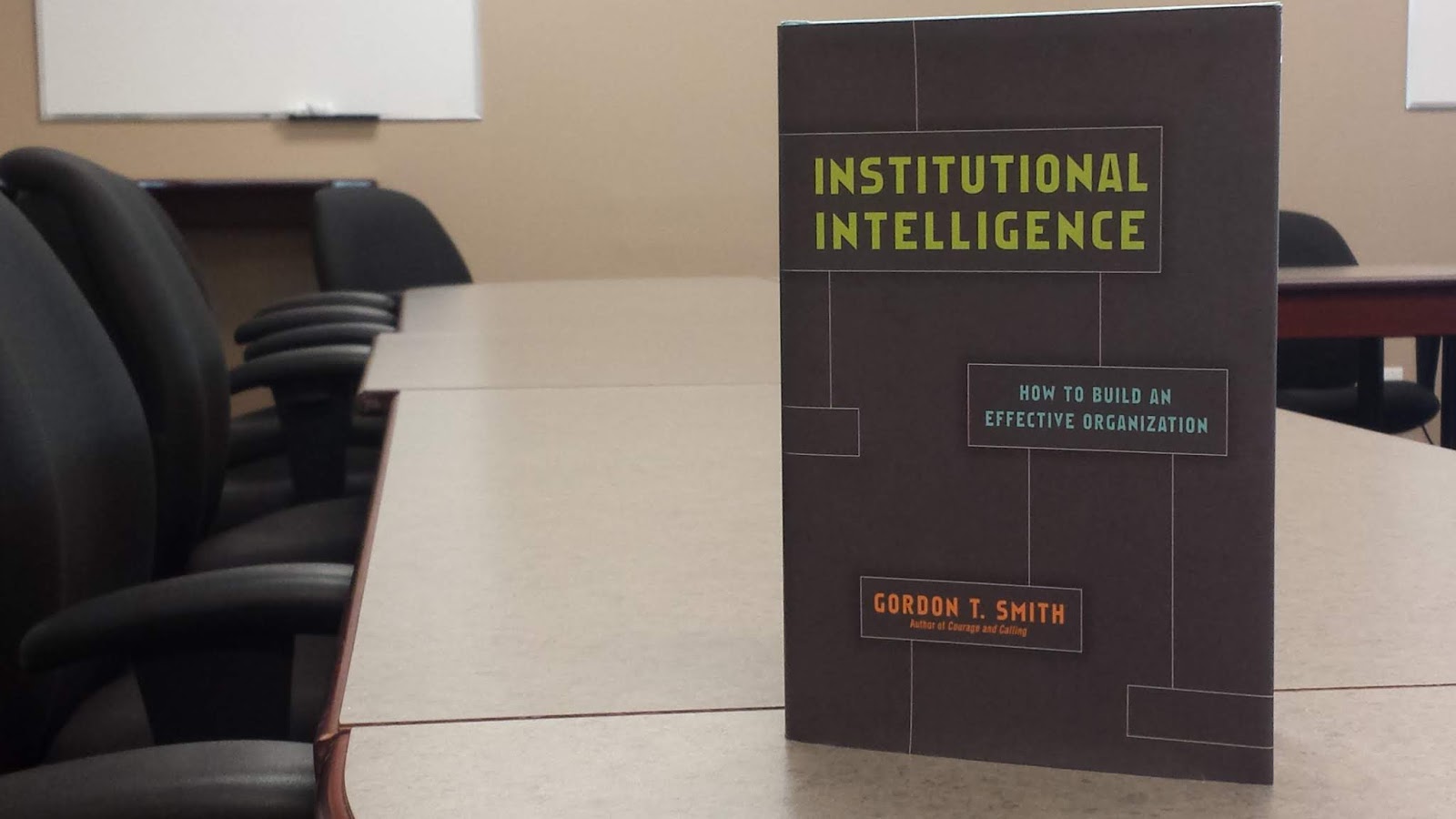
Gordon Smith puts it even more strongly. In his latest book, entitled Institutional Intelligence: How To Build an Effective Organization, Smith claims that “institutions are essential to human flourishing” (3). Essential to flourishing? That’s a strong claim.

But without institutions, this world spirals into a free-for-all reminiscent of Lord of the Flies. Driven by whims or personal passions, under the constraints of our own energy levels, our positive intentions don’t last long. And without the checks and balances and combined wisdom of a group of like-minded colleagues, we run the risk of steering in the wrong direction. For lasting change, we need structures in place — structures that harness and manage resources in service of a common mission.

The Billy Graham Center at Wheaton College,
an institution with a long history of training Christian leaders.
(Photo: C Imes)
I've been gradually realizing this as I invest in our 96-year old college. It may sound dull, but we need institutions the way we need a roof over our heads. We can last without shelter for a few days, maybe, but for long-term flourishing, we need a sturdy place to live. So do our ideas, our energies, and our talents.

You can increase your IIQ (Institutional Intelligence Quotient -- I just made that up) by reading the rest of my article over at The WellBy reading Smith's book, you can become even more institution-savvy.

What are you waiting for? The world needs what you have to offer.

Sunday, January 14, 2018

Navigating the Valley of Disappointment

May 11, 2017

When I arrived on campus two days ago, the door to the faculty lounge was closed. On it a sign was posted, "Interview in progress. Do not disturb." 

A punch to the gut.

I retreated to my shared office and closed the door. Most days I am gregarious, eager to connect with colleagues. But not today. Not the day of closed doors. I had planned to join others for lunch, but instead I sit alone at my desk. I am not safe today. I cannot predict what I might say. I cannot produce a genuine smile. My love for these colleagues is no less than before. I am not angry. I am bereft.

I should be on the other side of that closed door being interviewed, but instead I am here, burying this dream in the valley of disappointment.

Sorrow is a strange companion.

Just last week, when I learned the news that silenced hope, a great heaviness fell over me that I could not shake for a whole day and then some.

But then, just as suddenly, the heaviness flew away and I was flooded with a joy I could not explain. I remembered then that sorrow and joy are not opposites. They walk hand in hand. Grief opens up the deepest parts of us, but the raw ache that takes our breath away also expands our capacity for joy.

Disappointment strips us, laying bare our vulnerable selves. As the chimera of what might have been fades, the solid reality of what is comes into view.

I am loved.
God is working out all things for good.
The door my Lord opens, no one can shut.
Jesus has good works planned for me to do.
I am called and equipped.
I am not alone.

Why do I tell you this? Why hang my innermost thoughts in plain view for all to see and read and know? Because you, too, have walked the valley of disappointment, and you will walk it again. This way we can walk it together.

Ruth Haley Barton says "what is most personal is, indeed, most universal" (Strengthening the Soul of Your Leadership, 223). The more honestly I share my own journey, the more we both stand to gain. 

I shared my disappointment with my students last week. They grieved with me. And one wrote me the next morning, thanking me for my words. He, too, is in the valley of disappointment, but my story gave him the strength to carry on.

We do not grieve as those who have no hope.
But we do grieve, friends.
We do grieve.

Just yesterday I read these words, penned by Paul Pastor, but spoken as God's word to every one of us: "Give me your heart today, and again tomorrow—your whole heart, beating and full" (The Listening Day, 10).

Whether my heart is aching with hurt or swelling with hope, I am invited—you are invited—to offer it up in prayer. And here I offer it to you, too.

-------------------

January 14, 2018: Today I discovered this unpublished draft in my blog archives. I wrote it 8 months ago, but apparently thought better of posting it right away (or was I going to take a picture first of the sign on the door?). It still brings tears to my eyes to re-live this major disappointment, but that sorrow lives alongside the deep joy I have found in the door that God opened for me just weeks after that disappointment. Our heavenly Father does not promise that all our dreams will come true, but he promises to be with us all the way. What more could we possibly need?

Thursday, October 13, 2016

coming up for air

I've learned something about myself.

When I'm in the middle of a semester, I feel less compulsion to write blog posts because I already have an outlet. My students — like it or not — get to hear what I'm thinking about.

Add to that three women's retreats in the space of a single month, and you'll understand why a month has passed since my latest post. I haven't run out of things to say. It's just that I've already said them. In person. It's been a rich season, full of the joy of rekindled friendships and growing momentum in the classroom, but rather breathless.

Last night I turned a corner. After the big push to get three kids settled in three different schools (elementary, middle, and high school), get into the groove with my own classes, and meet a publishing deadline, I'm coming up for air. Yesterday I had lunch with a student and felt the freedom to stop and chat with colleagues. Last night I ordered a magazine, did a load of dishes, dusted our bedroom, and looked for a new medical provider online. I caught up on old emails and started strategizing about the next major thing on my calendar: a trip to San Antonio for academic meetings (IBR and SBL). I can't even tell you how good that feels.

They say that class prep will take as much time as you give it. And that's true. My pattern has been to start with prep and let the rest of my to-do list fill in the cracks. But I'm learning that I might be better off doing things the other way around. At the very least, I need to get better at self-care. It's been over 5 years since I've seen a doctor (my kids are all in the same boat!). There's just never enough time. That needs to change.

Breathing feels good. I hope to keep doing so regularly.

Sunday, September 11, 2016

9/11 and Biblical Prophecy

Fifteen years ago today I woke up in Aurora, Oregon to the phone ringing. Oma was down for a brief visit on her way to California. Eliana was less than 6 months old.

It was Dad. "Turn on the TV," he said. "A plane just hit a building."

I was puzzled. Planes crash several times a year, but this was the first time Dad had called us to turn on the news. I was thinking, "That's sad, but is it sad enough to wake me up early?"

Then, gathered around the TV, we saw that it wasn't just any building. To see the New York skyline like that, with billows of smoke pouring out, we began to wonder. "Could this have been an accident?" It seemed that to hit the World Trade Center one would have to be . . . trying. We shuddered at the thought.

The minutes ticked by and we watched live footage of the panic, as everyone but first responders raced away from the scene.

Hijacked United Airlines Flight 175, which departed from Boston en route for Los Angeles, is shown in a flight path for the South Tower of the World Trade Towers Sept, 11, 2001. The North Tower burns after American Airlines Flight 11 crashed into the tower at 8:45 a.m. (AP Photo/Aurora, Robert Clark)...A...NEW YORK...NY...USA
9/11 Photo (Source: https://metro.co.uk/2015/11/21/man-shot-in-paris-attacks-
had-also-survived-911-5517199/
Then, the unthinkable. We watched on live television as the second plane hit the second tower. We gasped. A sickening feeling gripped us. Horror hung in the air like the smoke now billowing from both towers. It was obvious now:

This was deliberate.
This was coordinated.
Whoever it was was attacking America.
Where would they strike next?

The answer came as the morning unfolded. Long minutes stretched by as we sat, our eyes glued to the screen.

Within 30 minutes, a plane crashes into the side of the Pentagon in Washington, D.C. Danny's mom is there in D.C. for work. We call her. She's close enough to see the smoke from her hotel window.

Another 20 minutes pass. Suddenly, the already unthinkable tragedy grows sickeningly worse: the South Tower of the World Trade Center is swallowed up by the ground before our very eyes. We watch live as it simply vanishes, leaving great billows of grey smoke.

Less than 10 minutes later Flight 93 crashes into a Pennsylvania field, killing everyone on board. While the story takes time to decipher, it is clear that this plane was headed to the White House.

Twenty minutes later the North Tower collapses into itself, leaving an aching emptiness in the New York skyline and in the hearts of every American.

"The worst day" was a barrage on our senses. It stretched credulity. We were living an apocalyptic nightmare. Oma was supposed to leave that morning to drive herself to southern California. I remember our fear -- where will they strike next? We urged her to stay another day, to wait things out and see whether it was safe. She opted to go. At 81, she had lived through WW2 and felt it was no good to sit around, anxiously waiting. She had a life to live. And so she went.

9/11 shaped us as a nation. Far from defeat, we rallied as a country and experienced unity and a singleness of purpose like never before in my lifetime. Prayer services were packed. All of us cried out to God with our grief, our questions, our hopes. Our national resolve was strong to prevent future terror attacks and eliminate their sources.

This reminds me of the Old Testament prophets.

Many people find it hard to connect with the biblical prophets because of the great gaps that separate us -- geographically, chronologically, and culturally. We're a long way from ancient Israel and Judah. We understand little about the historical and political challenges they faced. Our respective cultures are vastly different.

However, we have something in common that can help us bridge that gap. We have 9/11.

The Old Testament prophets were God's spokesmen to their own generation. They pointed out the failure of the covenant people of Israel and Judah to walk faithfully with their God, Yahweh. They announced the judgement that God had planned. And they spoke of the restoration, God's vision for a future in which divine blessings would again flow through the land.

How does this relate to 9/11? The devastation felt by the people of the northern kingdom of Israel in the exile of 722 BC and the southern kingdom of Judah in the exile of 586 BC mirrors the devastation of Ground Zero, only worse. For the people of Israel and Judah, Palestine was not only home, but it was the only home possible. God had promised it to them. It was the physical proof of their covenant relationship. When the Assyrians bore down on the Northern Kingdom and dragged the Israelites into exile, those ten tribes dissolved into the sands of history. Like the South Tower, at least 500 years of national history was swallowed alive. When the Babylonians gained the upper hand and attacked Judah in 586 BC, they decimated the temple in which God had promised to be present and the city in which God had appointed David and his descendants to rule. Exile brought an abrupt end to proper worship, legitimate kingship, and to the nationhood of God's people.

Where was God anyway? 
How could God have allowed these things to happen to his own people?
Have God's promises been annihilated? 
Has the covenant come to an end? 
What does it look like to be God's faithful followers when everything we know has changed?
How can we sing the songs of Zion in a foreign land? (Ps 137)

If we can remember how we felt on 9/11, how we were shaken as a nation and how we grieved and feared and raged and sat stunned, then we're in a position to identify with the ancient people of Israel and Judah. The prophets addressed them shortly before, during, and after the exile, when they were wrestling deeply with the meaning of the events that played out around them.

God's word to them continues to speak powerfully today — to any of us who identify ourselves as disciples of Jesus, and who are therefore members of the (re)new(ed) covenant. The prophets reveal to us the devastating consequences of unfaithfulness and God's glorious vision for restoration.

My children do not remember 9/11. Our oldest was just a baby, and the others were just a gleam in my eye. This morning we watched a video together so that they could see what I saw on that fateful morning, and so that we could wrestle together with the way it shaped our nation. My children may not have experienced 9/11, but they cannot afford to ignore it. It's part of who we are.

The same is true with all of us who claim allegiance to Jesus. We can't afford to neglect the message of the prophets, because they address the people of God at one of the most devastating and pivotal times in our history. Their story is our story. We must listen and learn.

Monday, July 4, 2016

perspective on cape perpetua

We had clamored over the volcanic rocks along with many others, their skin tones a wide range of hues and their languages sharply distinct — Spanish, French, Arabic, Russian, Japanese. Surely others, too. We were united in our fascination with the coastline and our awe as the pounding surf was thrown back by the sharp black rocks on which we stood.

Cape Perpetua (Phtoto: C Imes)
Every dozen yards or so the water had prevailed, with its persistent pounding, slicing a trench that progressively narrowed into stubborn rock. Here the waves picked up speed with a kind of focused frenzy, hurling themselves at the obsidian walls that taunted and restricted their progress.

The surge, the deep boom, the spray, and then the clatter of droplets, thrown helpless on the solid barrier, only to slide back down and drip into the churning sea.


Innumerable mussels clung fast to the hardened lava, daring the waves to pry them free, depending on the moisture and food delivered with each flailing attempt to carve stone.

Emma on the edge (Photo: C Imes)
We—my family and I, along with at least a dozen others—took our places around a deep bowl, hollowed out by the sea, which rushed to fill it through some unseen tunnel. Again and again the water would flood the enormous bowl and then be sucked out, leaving a gaping chasm encrusted with dripping mussels. Then, just as suddenly it would swell again with seawater, splashing and churning, lapping at the toes of the most foolhardy among us, eliciting gasps and shouts from all. Flush, fill, flush, fill. We watched, awestruck, as the sun slipped toward the horizon.

A few hours in the presence of such raw, unbridled power and my life feels very small indeed.
Cape Perpetua (Photo: C Imes)

Then, like the rapidly receding ocean water, we hurried to retrace our steps and climb the path to our parked car. We had just a few minutes to make it to the top of the cape for a birds' eye view of the sunset. The road wound up and up and up for two full miles, ending at the top of a coastal mountain. We rushed to the edge of the trail to look out across the expanse. I was dumbstruck.

View of the Coastline from Cape Perpetua (Photo: C Imes)
The powerful, churning waves were so far below us now that their pounding produced little more than a whisper. The sharp black rocks that held the waves at bay—merely a fringe for the heaped blanket of coastal mountains that towered above. The endless sea lay quiet and glistening beneath us as the sun slipped at last beyond the horizon.

The lesson in the crashing surf was merely a foretaste. If my life shrank beside the surge of seawater, it nearly vanished from the tip of Cape Perpetua.

And yet—

the incomprehensible mystery—

I, though infinitesimally small, have been invited to contribute, to partner with the One who designed all this.

Cape Perpetua 2016 (Photo: C Imes)
I am to cherish and share this creation with others. Still more—I get to participate in its ongoing development. I get to speak to it, engage with it, and shape it (for good or for ill).

The Creator shares with me the joy of co-creation, the dignity of service, the delight of influence.

And so I write, hoping to capture the brilliancy of a single evening in typed words so you can join me there on the cape, awestruck. You, too, are changing the world.

Sunday, April 17, 2016

now what? (and other questions): life after dissertation

It's the inevitable question that follows the celebratory congratulations. Since I've been blessed with a wide-ranging support network, it's a question I'm asked just about every day by people who care.

So, yes, it feels amazing to be (almost) done!
Yes, it's a huge load off our shoulders, and the whole family is relieved.
Yes, I have a bit more freedom and flexibility now.

But no, I will not have a lot more free time. Here's why:

A Ph.D. is not the type of degree people earn for personal enrichment. As a matter of stewardship, the huge investment of time, mentoring, and other resources are designed to prepare the student for a lifetime of scholarship. Career-wise, like most of my colleagues, my hope is to be a college professor. I have already begun teaching at two schools, George Fox University in Newberg, Oregon, and Multnomah University in Portland. I love what I do. I'm very grateful for open doors. However, these "jobs" are a bit like being a "temp" worker (minus the agency). They pay very little (last spring my pay worked out to about $5/hour), with no benefits, and no guarantee of employment beyond the current semester. Semester by semester, each school will let me know if they need me to teach for them again. So while I love my work, I do not actually have a job yet.

In order to get a permanent position, I must demonstrate that I will be a contributing member of the campus as well as the scholarly community by staying abreast of current research, participating in campus events, investing in students outside of class, and achieving excellence in teaching (as measured by student evaluations). Diploma aside, without several scholarly publications and stellar teaching evaluations, no school is likely to consider hiring me. In today's educational environment, very few schools are hiring permanent ("tenure-track") faculty. Schools that do post positions are flooded with qualified applicants. To walk away from the library now would spell the end of my career.

Getting a PhD is a bit like becoming an MD. Your medical doctor did not stop studying when she graduated from medical school (thank goodness!). She reads medical journals, attends medical conferences, and even collaborates with other doctors to ensure quality care and accurate diagnoses for patients. Likewise, I cannot stop studying and writing. A professor who ceases to learn, ceases to teach.

And so my days are still full. These days I'm revising my dissertation (almost done!), prepping for class, grading student papers, and preparing for upcoming gigs:

In May I'll be presenting a paper at an academic meeting in Idaho (Northwest Regional Meeting of the Society of Biblical Literature) and serving as a respondent for a colleague's paper.
In June I'll be teaching a one-week intensive course on the Old Testament Prophets at Multnomah University.
In July I'll be filming brief lectures for an online course on the Prophets at Multnomah, to be offered beginning in October.
In late August I'll begin teaching 2 new courses on campus at George Fox (Exodus and Psalms) and another section of Prophets at Multnomah.

On top of this are the opportunities to invest in the church—speaking at a women's event in May in Dallas, Oregon, helping with VBS, and speaking at a women's retreat in September in Wisconsin—as well as finding a publisher for my dissertation and beginning work on my next research project.

All of these great opportunities require long, quiet, focused hours of preparation. Studying the Word, crafting a message or a lecture, preparing visual aids, and coordinating logistics. In fact, with 4 classes this fall (3 on two campuses and one online), I'll be teaching the equivalent of a full-time load. I expect to be just as busy as ever. But I'm not complaining.

That was the whole point of all this schooling.

From everyone who has been given much, much will be demanded;
and from the one who has been entrusted with much, much more will be asked.
(Luke 12:48 NIV)
Now it is required that those who have been given a trust must prove faithful. 
(1 Corinthians 4:2 NIV) 
At the end of the race, may I be found faithful!

Monday, April 4, 2016

learning how to celebrate

Eat, drink, and be merry, says Qohelet.*
And yet—
I have spent a lifetime avoiding excess, choosing moderation, working weekends, and feeling guilty when I'm unproductive.
Qohelet would have words with me.

It's not that our work doesn't matter, but he urges us to slow down, to stop taking ourselves so seriously, to spend time enjoying the fruits of our labor.
Eat, drink, and be merry.
Celebrate together.
Don't store it all up for "Someday." You may die before you can enjoy what you've earned.

This is not what I expected.
I would rather hear him say, "Give it away. Be generous with those in need. Save for the future." (Other parts of the Bible say these things. And we should listen to them, too. I'm most comfortable with these parts.)
But Qohelet says, Loosen your belt buckle and eat another helping of dessert. 
Relish what God has given.
Life.
Work—this, too, is a gift.

Do what you love and love what you do. But then stop and play. Work isn't everything.

Recognize that God has things in hand. He's in charge. You are not.
Rest in that.

Life won't always make sense. It will feel like things go round and round without progress, or those who don't deserve it get the lucky break and those who do lose everything. But don't panic.
As meaningless as it seems, God hasn't stopped ruling the world. He'll work it out eventually.
In the meantime, work, love, and . . . party.
No need to be more pious than God. He wants you to accept His gifts.

For this Dutch girl, the whole thing sounds suspicious, like a coupon that will turn out to be expired once I've driven across town and stood in line for 20 minutes ("I knew it was too good to be true"). Or like an advertisement for a beach house that looks much better on screen than in person ("You get what you pay for.").

Is this a trap? or a test of my motives? Is celebration a slippery slope that will land me in a self-indulgent mess?

I decide that frugality, taken to an extreme, is a failure to demonstrate gratitude for what God has provided. I must learn to think differently, enlarging my capacity for celebration.

I start small. We're on a date—the first in months—and I order Duck Curry instead of the usual chicken. The extra $2 tastes delicious.

Then I head to Wheaton for my dissertation defense. The weekend goes so incredibly well that I know it's just the sort of occasion Qohelet is talking about—a time to celebrate. At a dinner with friends I stay up late and "taste my first champagne" (not bad, actually!). But the real surprise, the real opportunity to test drive Qohelet's philosophy comes when I arrive home.

It's midnight, thanks to a delayed flight out of Chicago, and I am exhausted. But as we pull up to the house my jaw drops. Parked in the driveway with an enormous red bow is a car, a new car, just for me!

We'd been talking about "Someday," that time when I have a full-time job with a real salary and we can afford a newer car for my commute. But it appears that my parents have been reading Ecclesiastes, too. They felt that it was time to celebrate—that someday was now. And so they dug deep and orchestrated a surprise I will never forget. Though this extravagance cost me nothing, it will be a daily reminder of God's lavish love for me, a love  not limited by "what's on sale" or "what's practical."

He's teaching this Dutch girl how to celebrate.


------

*Qohelet is the name some scholars use to refer to the "Teacher" in Ecclesiastes, since it's hard to know exactly what the translation would be. It's simply his Hebrew title rendered in English letters.

Saturday, April 2, 2016

in retrospect—what else is a dissertation defense?

It is an honor.

My dissertation committee (L-R): Richard Averbeck,
Daniel Block, Karen Jobes, Carmen Imes, Sandra Richter,
Marc Cortez (Photo: Michelle Knight)
Brilliant scholars take time out of their already overloaded schedules to read what you've written and to think about what it means and how it matters. They give up an afternoon to sit with you and ask you what you think and give you good advice. They push you (which means they think you can handle it) and they offer their best critique (proving that they stayed awake while reading your work) and they listen and even concede (when you've changed their minds). Dozens of students drop their own work to come and watch. Wow.

It is surreal.

My dissertation defense. (Photo: Daniel Lanz)
As a student observing the defenses of others, I assumed that it would be a nerve-wracking experience. Years worth of effort are channeled into one afternoon. Everything is on the line. But yesterday I felt entirely calm. I knew it was time. I had given my best effort with the time I had. I also knew that even a difficult defense would not mean the end of my career. It would simply mean a longer list of revisions before the diploma arrives by mail. I even expected this. Here's what I did not expect:

It is fun (sometimes).

My doctoral advisor, Daniel Block, and me (Photo: M Knight)
Ten years in seminary and graduate school have prepared me for scholarly discourse. I'm not afraid of disagreements. I'm aware of my own limited perspective and need for others' critique. I also know that I've studied this topic more than just about anyone in the world, and that I have good reasons for laying things out the way I did. I came in hoping to learn from my readers and was delighted to discover that my readers actually liked my work and learned from me. Our time together was collaborative, encouraging, and productive. We laughed together and left as friends.

I found that a dissertation defense on April Fool's Day was strangely appropriate. It reminded me of Paul's words:
"Brothers and sisters, think of what you were when you were called. Not many of you were wise by human standards; not many were influential; not many were of noble birth. But God chose the foolish things of the world to shame the wise; God chose the weak things of the world to shame the strong. God chose the lowly things of this world and the despised things—and the things that are not—to nullify the things that are, so that no one may boast before him. It is because of him that you are in Christ Jesus, who has become for us wisdom from God — that is, our righteousness, holiness and redemption. Therefore, as it is written: 'Let the one who boasts boast in the Lord.'" (1 Corinthians 1:26–31)
I began this journey as a stay-at-home mom with very few connections in the scholarly world. I had spent my time networking among Muslim street vendors in the Philippines while my books were boxed in storage. I learned Hebrew (for the second time) while breastfeeding and read book reviews in the preschool pick-up line. With a great deal of effort, I finished my 2-year masters degree in 5 years. By the world's standards, I was not the ideal candidate for an advanced degree. But God does not choose us because we already have what it takes. He chooses empty and willing vessels who are ready to be filled. He called me, and I simply said 'yes.'

The dissertation defense was the culmination of this chapter of of my journey, but it is only the beginning of my 'yes' to God.

For Christ and His Kingdom!

Sunday, March 6, 2016

the gift and cost of social media

Perhaps you've noticed. (More likely not.)
I haven't blogged much lately.

At first, it was because I finally joined Facebook. That took up much of my discretionary time. Finding and "friending" friends from all the places we've lived was quite an undertaking. Looking at their family photos and reading their walls and checking my newsfeed filled more hours. Within a week I had 300 friends. Within a month 500. Now two months have passed and I have over 600 friends, though I haven't been actively looking for more and have yet to scour my contacts for those I've missed. It all happened too fast to properly "catch up" on each one's journey. I told myself it was a "training" period, and that life would get back to normal. That I would find a new and sustainable rhythm. That I would get back to blogging. But weeks passed.

Other factors interfered.

Mere days after I joined Facebook, George Fox asked me to teach a class for them immediately. I scrambled to put together a syllabus, fill out all the paperwork, and get ready for classes to start. With less than 2 weeks' notice to prepare, this left little time for blogging.

Then there was Danny's 10-day trip to Thailand and my looming dissertation deadline (now past), the girls' theatre performance (see Facebook for details :)), my parents' visit from out of town, a series of meetings at church, etc, etc.

Life has been busy enough that my virtual disappearance from this blog is justifiable. But what's been nagging at me is that time itself cannot explain my silence. On many a quiet evening I could have been blogging, but I didn't. Why not?

My swirling thoughts have coalesced around two reasons. The first is personal, but the second may point to issues more universal.

First, I am teaching. I find that having a regular "outlet" -- real people with whom I can speak about deeper issues -- brings enough satisfaction that I feel less compelled to write. I found this to be true last spring as well, while teaching at Multnomah. I am still speaking, thinking, teaching, but the venue has shifted from blog to classroom. ("Carmen, you mean to say that you blog because you need to write, not because we need to read?" "Um, yes. If you benefit, too, that's a bonus.")

The second issue is deeply ironic. A big reason that I joined Facebook was to have a naturally wider network with which to share my blog posts. I had noticed that whenever a friend re-posted one of my blog posts on Facebook I had a LOT more readers. I figured if I was going to take the time to write, all my real-life friends should know about it, not just the few who think to check my blog. However, Facebook has not only swallowed up time that I could be blogging, but it's sapped the reflective impulse as well. These days, if I have a share-able thought I can release it to the world in a matter of moments -- a few sentences and I'm done. This preempts the deeper reflection and harder work of developing a blog post worth reading. This one, for example, has already taken me more than 30 minutes took me over an hour. I could have made the same point on Facebook in a matter of seconds:

"I joined Facebook so that I could share my blog with all of you. But now I have no time to blog, so all you get is a picture of what I ate for dinner."

Facebook can also leave me feeling scattered. Between birthday parties and memes and videos mocking Donald Trump and articles about ADHD and funny pet stories, I lack the singularity of focus that writing a blog post requires.

It's not all bad. I've done a lot more "listening" over the past 2 months. Facebook has become a virtual reunion, as I've reconnected with friends from all the places where I've lived -- Colorado, Oregon, the Philippines, North Carolina, Illinois -- who are themselves scattered the world over. That is such a gift.

What I didn't expect was deeper connections with people right here in my own community. After all, I was mostly joining Facebook for the far away folks that I won't see in church on Sunday. But pretty quickly I found "friends" from church as well, and we're still new enough here that it's helping me keep names and faces straight and enhancing conversations at fellowship time between services. ("Congrats on your new . . . "; "I was sorry to see that . . . "; "How was your big meeting this week?")

Another fun surprise has been the professional networking. Instead of seeing colleagues once a year an academic conference, I am glimpsing the rhythm of their life and work the whole year through, and I'm seeing them more holistically -- as real people with families and birthdays and ministry involvement and vacations. In the long run, I think this is a win-win.

In the meantime, I still need to find a sustainable rhythm for Facebook and Blogger that will help me stay connected without disrupting deeper reflection. If anyone out there has ideas, message me or leave a comment below. I'm going to post this post on Facebook and call it a day...

Tuesday, December 8, 2015

a beautiful thing

Photo: Aviva by Kameel
The line wound its way out of the Mediterranean restaurant and wrapped around the corner. We took it as a good sign, and so we attached ourselves to the end and waited along with everyone else. The clientele were not just conference attendees, but locals, and no one seemed the least bit disturbed about the wait. Another good sign. Soon we found out why. A smiling hostess with a tray of samples worked her way down the line. "Lentil soup," she offered. "Try it. You'll see. It's good." The lilt of her accent told me that she would know, and her obvious joy in working there boded well. It was good.

Kameel Srouji (Photo: Aviva by Kameel)
Still, nothing could have prepared me for the personna behind the counter. A tastefully decorated wall had shielded our view of the food line until we rounded a corner just steps away. "Hello! Welcome to Aviva. How can I make you happy?" His booming voice filled the atmosphere with life, enthusiasm. His tall frame matched his voice. His sweeping movements made food service an art form. "Excellent choice. It's natural. It's fresh. It's delicious." The customer two ahead of us smiled his thanks and moved down the line. Again the voice boomed, "Welcome to Aviva. You're beautiful. I love you. I need a hug."

A hug? Doesn't that break some kind of food service code? Nevertheless, the businessman in front of us in line ducked around the counter into the kitchen area to hug the man who was larger than life. The chef's eyes twinkled. He lost no time in filling another plate. "Thank you. God bless you. Have a beautiful weekend."

I'm afraid I was a bit thrown, wondering if this was for real. (Is he saying "God bless you" because he heard that the Evangelical Theological Society is meeting next door? Did some study show that enthusiasm is good for business?) When I got to the cashier, I asked, "Is he always like this?" A big smile spread across her face. "Every day!"

Photo: Aviva by Kameel
The energy was palpable.
The food was delectable.

And so the next day, with another friend, I did my time in line again. Brittany had her kids along with her at the conference, and her mom came to watch them. So the five of us waited, tasted falafel, and rounded the corner.

The booming voice. "You came back! How can I make you happy today?" (How can he possibly remember me when he serves hundreds of customers every day? Is it because he looks every one of us in the eye and recognizes that we are made in the image of God?) I suspect so.

Brittany asked if there was something less spicy for her kids. "Ah! For the little ones. This one is on me. No charge. Tell me -- what do they like to eat?" He proceeded to pile a plate with falafel, shwarma, grilled vegetables, and hummus. "Your children are beautiful. Thank you for feeding them real food!"

Kameel's passion for food is obvious!
Photo: Aviva by Kameel
It is not every day that you meet someone who is happy at work, someone energized by their labor who does it with excellence. Kameel is one of those. And the entire restaurant pulsed with this life. It occurred to me then that people come to his restaurant for more than just calories. They pay for lunch and get love, kindness, affirmation. His passion for eating well and living well is contagious.

When I arrived home from Atlanta I was still thinking about Kameel. We found him online, smiling just the way I remembered. I also learned the source of his joy. Kameel is a Catholic believer from Nazareth, eager to share God's love with everyone he meets.

When we have the privilege of meeting someone who has "found their calling" in life it's a beautiful thing. In that moment we get a glimpse of God's creative and redeeming power at work in our midst. Kameel's passion rekindled my own passion to serve God wholeheartedly in my own corner of the world. Whether restaurant or classroom, office or farm, retail outlet or machine shop, when we're doing what we were born to do, and doing it well, He gets the glory.

"And whatever you do, whether in word or deed, do it all in the name of the Lord Jesus, giving thanks to God the Father through him." (Colossians 3:17)


Wednesday, July 29, 2015

an open letter to Multnomah students

Last fall, one of my college professors, Ray Lubeck, invited me back to speak to his Bible Study Methods class. Ray was more than just a professor to me. He became my mentor, boss, and friend, even performing our wedding in Colorado! It was an honor to visit his class again. I just came across my notes from the message I gave that morning, and I thought I'd share it with you as well.

------

18 years ago I sat where you are sitting.
I soaked in every word that Ray taught.
I poured myself into lab assignments.
And it changed my life.
Seriously, I couldn't figure out why no one had ever taught me this stuff before.
The Scriptures were opened up in a whole new way for me and the Bible came to life.

17 years ago I stood where I'm standing now, as a [Bible Study Methods] lab instructor.
It was the single most fulfilling thing I had ever done.
I kept coming back, teaching a total of 5 semesters.

12 years ago my husband Danny and I sold most of our things, packed up the rest, and headed to the Philippines as missionaries. We were more than ready. We had 4 years of the best Bible training on the planet tucked under our belts, teaching and church ministry experience, a strong team of prayer and financial supporters, a set of gifts that were a perfect match for the needs our mission advertised, and a commitment to reach Filipino Muslims with the gospel.

Weeks stretched into months as our initial enthusiasm wore off. We floundered. Ministry opportunities were not unfolding the way we had anticipated. Life in Manila was really tough. It was hot. We wilted. It was smoggy. We could hardly breathe. Language school was brutal. We were so homesick.

One day I was walking to the market to see my Muslim friends. I thought about their lives. They were immigrants from another island, far from home and trying to get along in a new language. Squatters by day and squatters by night, they sold pirated goods along the street without a permit and lived in makeshift homes on property they did not own. At any moment the police could show up and drag them off to jail for any number of infractions. The women sat pregnant in the hot sun for hour after hour selling combs and batteries and cell phone covers. After their babies were born they left them home with an older sibling and return to the market to sell again so the family could eat.

On my way to the market that day I felt so, so empty. What did I have that these friends really needed? I had come prepared to teach Bible study methods, but they could hardly read or write. We were here to reach them with the gospel, but what tangible benefit did the gospel offer them? A stable income? Reliable housing? What I knew to offer was a far cry from what they needed. As for godly character, I was depressed and discouraged, cranky and selfish, homesick and tired. I had come armed with colored pencils and an inductive Bible study method. I felt a little silly.

It was around this time that I got an email from Dr. Karl Kutz [another of my professors from Multnomah]. He was conducting a survey of graduates from the biblical languages program to find out our greatest accomplishments post-graduation. My Greek and Hebrew Bibles had made the trek across the ocean with me, but frankly, they sat untouched on my shelves getting moldy from the humidity. My greatest accomplishment? Umm… at first I groaned. There was nothing much that belonged on a resume. After some thought I decided that my most noteworthy accomplishment was that I could walk unannounced into a Muslim neighborhood climb the cement stairs of a 3-story building onto the rooftop where two families lived -- my friends from the market. Salma and Aisah and their husbands were raising their small children on that rooftop with no railings. Two lean-to shelters stood side by side, with corrugated metal roofs and walls with scrap linoleum floors. Their only furniture was a table on which the TV and a small gas stove were kept, powered with illegal gas and electricity. We sat on the floor as the pouring rain seeped through the holes in the floor and soaked our clothes. We talked and laughed, and I prayed in Filipino for Aisah's new baby, whom she had named Ishmael, or for Salma's whom she had named Eliana, after my own daughter. I longed for these friends to meet the Savior. I loved them, and I knew they loved me.

They had no pencil between them, and they could not read their copy of the Qur'an which was carefully wrapped and tucked between the wooden post and metal walls of their home. I would never have an opportunity to teach them inductive Bible study methods. That's not what they needed anyway. We all cried when Danny and I were called to move back to the US.

Yes, I've accumulated more degrees since then, and my Greek and Hebrew are not as rusty as they were in 2003. But if Dr. Kutz sent me that email again today I'm not sure that my answer should be any different. Allow me some liberties with 1 Cor 13:1–2:

If I read fluently in the languages of the ancient near east, but do not have love,
I have become a noisy gong or a clanging cymbal.
If I have impressive intellectual powers, advanced degrees,
and an exegetical method than can unlock all mysteries and all knowledge, 
and if I have a faith that can move mountains, but do not have love, I am nothing.


Soak in all you can this semester. It is valuable training, and it will shape you in profound ways. But know this: without love, we are nothing.

Saturday, July 18, 2015

on being finite

As a child, life stretched out interminably before me, holding an endless array of choices and possibilities. What do you want to be when you grow up? was the question that punctuated a long and happy childhood. No career was out of the question. My dreams held no bounds. My pint-sized mind was pregnant with possibility. Missionary-scientist-teacher? Bible translator-orphanage director? At one point I decided to become a missionary-astronaut-famous singer. I had my schedule all worked out in advance: I would spend several years overseas doing mission work, and then during furlough I would squeeze in a space mission and a concert tour before resuming my work in Africa.

How could I have anticipated the exhausting pace of what is erroneously called "furlough," or the rigorous preparation required for a trip to outer space, or the endless hours of practice and coordination to schedule a road show? My dreams were good ones, but I had yet to discover my own finitude.

We are given only so many hours, only so many days, and only so many years. Chances are that we will not be able to pursue every hobby that tickles our fancy, or learn every skill that would be handy to know, or volunteer for every worthwhile activity. Even as an adult, I have far more visionary ideas than I do energy to carry out those ideas. (I should bring a meal to so-and-so, or help with such-and-such, or start making my own this-and-that.) That leads to overpromising, overcommittment, pressure, guilt, and stress. Just because I can do something (in theory), does not mean that I should, even if it's commendable or I would be good at it.

Perhaps in days gone by one could aspire to be a 'renaissance man,' mastering knowledge in a wide range of subjects. That age has expired, and with it my dreams of being an astronaut or scientist or Bible translator or famous singer or counselor or midwife. I've given up on quilting and canning (at least for now), writing children's books, learning to paint, or taking an active role in the PTSO of my children's school or our neighborhood association. I cannot do everything. I have limits. For the time being, I study and write. When time allows, I read fiction and go camping and play games and take pictures. Once a year I even work on the family photo album. But mostly I dissertate. When that is done I will teach. And that will leave precious little time for anything else.


Almost-38-years old seems a strange time in life to start slashing my list of ambitions. I am interested in more things than ever before -- languages, geology, travel, world economics, traditional arts, gardening -- but I'm also more aware of my limitations. I am not a machine, I am a human being. That means I need balance, margins, rest. I can't do everything. Neither can you.

It's freeing to know that although God invites our active participation in his work, he does not expect us (in particular) to do it all. We invest what we can, when we can, as he provides the means. The rest is up to him. Our finitude drives us to depend on the infinite God for the strength to do what he has called us to do -- nothing more, nothing less.

Tuesday, August 12, 2014

culinary adventures

Easton helping with homemade cinnamon rolls. Yum!
If it's true that "you are what you eat," then our family has been getting a total makeover this summer! We've been trying to eat healthy for a long time now, but our move to Oregon has given us the time and space to take things to the next level. Perhaps all the upheaval of moving (again!) is balanced out by measurable changes in our diet. I've discovered a couple of phenomenal blogs that have given me the courage to embark on culinary adventures. So, if you're wondering where I am these days ... think KITCHEN and Farmer's Market. Yes, it's absorbed a lot of my time, but we're busy learning new skills and developing new habits that will get easier with practice. The kids have been totally intrigued with the process and totally on board with trying new foods (well, mostly :)).

Here's a list of 10 changes we've made. The first 5 have been part of our routine for a couple years or more. You may remember my blog posts from Wheaton about brain food - here and here - and about once-a-month baking. The next 5 changes are new for us this summer, prompted by close proximity to Bob's Red Mill and a great Farmer's Market and a "chance" encounter with a couple of great blogs: www.100daysofrealfood.com and www.kitchenstewardship.com. Before I say more, a quick word about why I bother blogging about this when I'm not a nutrition expert and this is not a food blog. I'm convinced that we are called to honor God with our whole selves, mind and body. What we eat affects our worship and our testimony. It's also a matter of stewardship -- of our time, money, our body, and this planet's resources. This post is designed to inspire you to take the next step toward healthy eating, whatever that means for you. Eating real food is possible, even on a budget or a tight schedule. Where there's a will, there's a way, one step at a time.

 1. Avoiding artificial colors, flavors, hydrogenated oils, and sweeteners
 2. Limiting sugar (we're now switching to natural cane sugar, honey, and pure maple syrup)
 3. Eating whole grains whenever possible
 4. Baking our own bread
 5. Making our own baked goods

 6. Grinding our own grain
 7. Buying fresh and local produce
 8. Switching to olive and coconut oil
 9. Experimenting with green smoothies
10. "Stock"ing up on the basics

I have many other aspirations - making our own yogurt, cutting out chemically-laden cleaning supplies, growing a garden, and maybe even canning - but these things take time. We can only do so much in a day (usually less), so we'll just try to keep moving in healthier directions. So far it's been a fun and delicious adventure!