Showing posts with label teaching. Show all posts

Wednesday, July 7, 2021

A Personal Announcement: My Biola Story

Choosing which college to attend is a big decision. I remember back in high school as I was wrestling through my options, the guidance counselor at my Christian school went on a trip to California to visit several schools. When she returned, she sought me out to say that she had found the perfect place for me: Biola University.

That was 1994.

I was stubborn. I had already made up my mind to go to Multnomah Bible College in Portland, where I planned to study Greek and Missions so I could become a Bible translator. I had my future all planned out.

Fast forward to 2021. 

I've finally come around. I've accepted a job offer from Biola University. I'll be joining their faculty this fall as Associate Professor of Old Testament. This summer we're moving from Alberta, Canada to Southern California. It's a wee bit warmer and a whole lot more crowded. We're in for quite a change!

We have loved living in Canada. Three Hills is a friendly town with a lot of charm. Prairie College is a harmonious place to work, with eager students, devoted colleagues, and a solid mission. We've loved our church and our kids' school. But by the time you read this, we'll have said our tearful goodbyes and headed south. We're feeling drawn into this new work. In so many ways, the timing is right.

You see, I left out the middle of the story.

In 2013, I was on the home stretch of my doctoral program. Biola was looking for a professor of OT for the graduate school division of Talbot School of Theology. They specifically wanted someone to teach Hebrew. They urged me to apply. I did, and made it all the way through the process to the campus interview, but felt unsettled about it. Hebrew is not where I shine. I love teaching English Bible classes. And I'm especially fond of freshmen. We also weren't sure about living in California. Our hearts were in Oregon. Precisely then, my dissertation hit a brick wall. I had more work to do than I could possibly finish in time, so I pulled out of the process. But Biola didn't forget about me.

That was seven years ago. Since then I finished my dissertation, taught at two of my favorite schools in Oregon (neither of which offered me full-time work), and spent four years investing at Prairie College. When Biola approached me last year about a possible tenure-track position in Old Testament teaching undergraduates, we were ready. Friends, I'll be the first woman in Biola's 113-year history to hold a full-time faculty position in Old Testament. I thoroughly enjoyed getting to know my new colleagues during the lengthy application process, and I'm excited to join the team. 

Biola is a world-class institution offering a robust liberal arts education. Biola says this about its academic reputation:
U.S. News & World Report ranks Biola as a first-tier national university and on its selective list of universities with “Best Undergraduate Teaching.” The Princeton Review includes Biola on its list of “Best Western Colleges.”
I am thrilled to get to participate in their mission of providing "biblically centered education, scholarship and service -- equipping men and women in mind and character to impact the world for the Lord Jesus Christ."

Other fun facts: 
  • Biola (1908), Prairie (1923), and Multnomah (1922) were all birthed as part of the Bible College movement. Did you know that BIOLA started as an acronym? It used to stand for Bible Institute of Los Angeles. Biola still offers a strong 30-credit Bible core for every student.
  • Biola has nearly as many faculty (200) as Prairie College has students (250), and Biola has more undergraduate students (4000) than Three Hills has residents (3400). In fact, California has more residents (39.5 million) than all of Canada put together (37.5 million)! Quite a change of pace!
  • Biola is farther from "home" (Portland, OR) than Prairie is. In case your Canadian geography is rusty, Alberta is directly east of British Colombia and north of Montana. Three Hills, Alberta, is 14.5 hours northeast of Portland, while LA is about 16 hours south. However, we no longer have an international border to cross.
  • Because of the pandemic, both of my "campus visits" were online. Biola is very thorough, and there were more than 15 steps to the process, including lots of interviews on Zoom. Thankfully, I spoke in chapel at Biola 18 months ago, before the pandemic hit. I also took our oldest daughter there for a college visit 4 years ago, so I have a pretty good idea what the campus and surrounding area are like.
  • Half of my teaching load (two classes each semester) will be BBST 209: History and Literature of the Old Testament. The rest of my classes will be electives, which will allow me to teach in my areas of current research.
  • Our home in Three Hills sold in less than 24 hours, with no realtor, no listing, no sign, and only one showing. The new owners had been praying for us for months and felt called to come to Three Hills to work with young adults.
  • God provided a condo for us to rent month-to-month while we look for a house to buy. It's in Cerritos, which means "Little Hills" -- so we're moving from Three Hills to Little Hills! This condo will be our 12th address in 23 years of marriage.
  • We are STILL eating cherries from our 2017 bumper crop. I wonder what kind of fruit God will provide in our next home? (Update: lemons and tangerines!)

Friday, January 1, 2021

ICYMI: Articles Around the Web in 2020


Normally at the end of the year I post a list of top blog posts of the year from my own blog (and I might still do that), but if you're a regular reader, you might have noticed that my blog has been quieter this year. In that relative silence, I was busy writing for other websites. I keep a complete list of articles here, but that page doesn't notify subscribers when I update it, so here's a handy list of the 15 articles I published elsewhere in 2020. 

From reflecting on Exodus to COVID, and from teaching and writing to Deuteronomy, these are the things that have been on my mind this year. I've starred a few of my personal favorites.

The Art of Taleh

* “Telling the Old, Old Story (Deut 26:5-10),” April 20, 2020.
The Biblical Mind
* "Freedom Fighters of the Exodus," November 17, 2020.

Canadian Society of Biblical Studies

"Misunderstanding Sinai? Author Interview with Carmen Imes," March 24, 2020.

Cateclesia

Re-Interpreting the Name Command (Exodus 20:7)” May 6, 2020.

Christianity Today

"Connections that Count," Jesus Creed, Dec 30, 2020. 

* "What God Sees" and "Peace in the Storm," Advent Devotional, Dec 2020.  

* "Church after COVID--Why bother going back?," Jesus Creed, Sept 28, 2020. Reblogged at ChurchLeaders.com, Oct 13, 2020. 

"2020: The Gift Nobody Wanted," Jesus Creed, June 23, 2020. 
"Finding Life in Limbo," Jesus Creed, March 19, 2020.

Political Theology Network

Prairie College

 "How Do You Know if a 'Bible College' is Right For You?" Prairie blog, February 2020.

The Well (InterVarsity's blog for Women in the Academy and Professions)

"Pursuing Tough Conversations with Students," September 3, 2020. 

"A Prayer for Writers," April 15, 2020. 
"Notes from the Pandemic: Social Distancing and the Presence of God," March 23, 2020. 

Sunday, January 27, 2019

Full Circle: My Denver Story

Who knows what will become of us?

As children, we dream our dreams -- astronaut, famous singer, missionary, scientist. Our parents are wise enough to let us imagine the future without the wet blanket of reality. They may have ideas of their own, but no one can be sure how things will turn out. They watch and wait with us.

Denver, Colorado, was the cradle of my childhood, the fertile ground for growing up and dreaming dreams. I spent the first 18 years of my life in the same zip code, longing to travel to the ends of the earth. I remember the children's sermon one Sunday morning. Rev. Kok asked us what we wanted to be when we grew up. I don't remember what I wanted to be at that age. I just remember how his offhand comment hit me. "Of course, none of you want to have my job when you grow up." I was floored. Was he serious? Who wouldn't want his job?! I knew no female pastors then, and I don't think I even dared to imagine myself in his shoes, but I couldn't think of a better job in the whole wide world than to preach the Word of God.

I probably said I wanted to be a missionary. In fact, I imagined I could be a missionary-astronaut-famous singer all at once, with space missions and singing tours during furlough. What I didn't want to be was a teacher, which seemed way too boring. Where I didn't want to live was America, because people already had plenty of opportunities to hear the gospel in English.

In the decades since my childhood I've changed zip codes so often I would be hard pressed to come up with a list of them all. West Coast, Southeast Asia, East Coast, Midwest, West Coast, and now the True North. In November, I boarded a plane in Calgary bound for Denver. Usually, going home means stepping away from my work, embracing rest with family. This time my parents picked me up from the airport in my suit jacket with a conference name badge ready to wear. I was home to work.

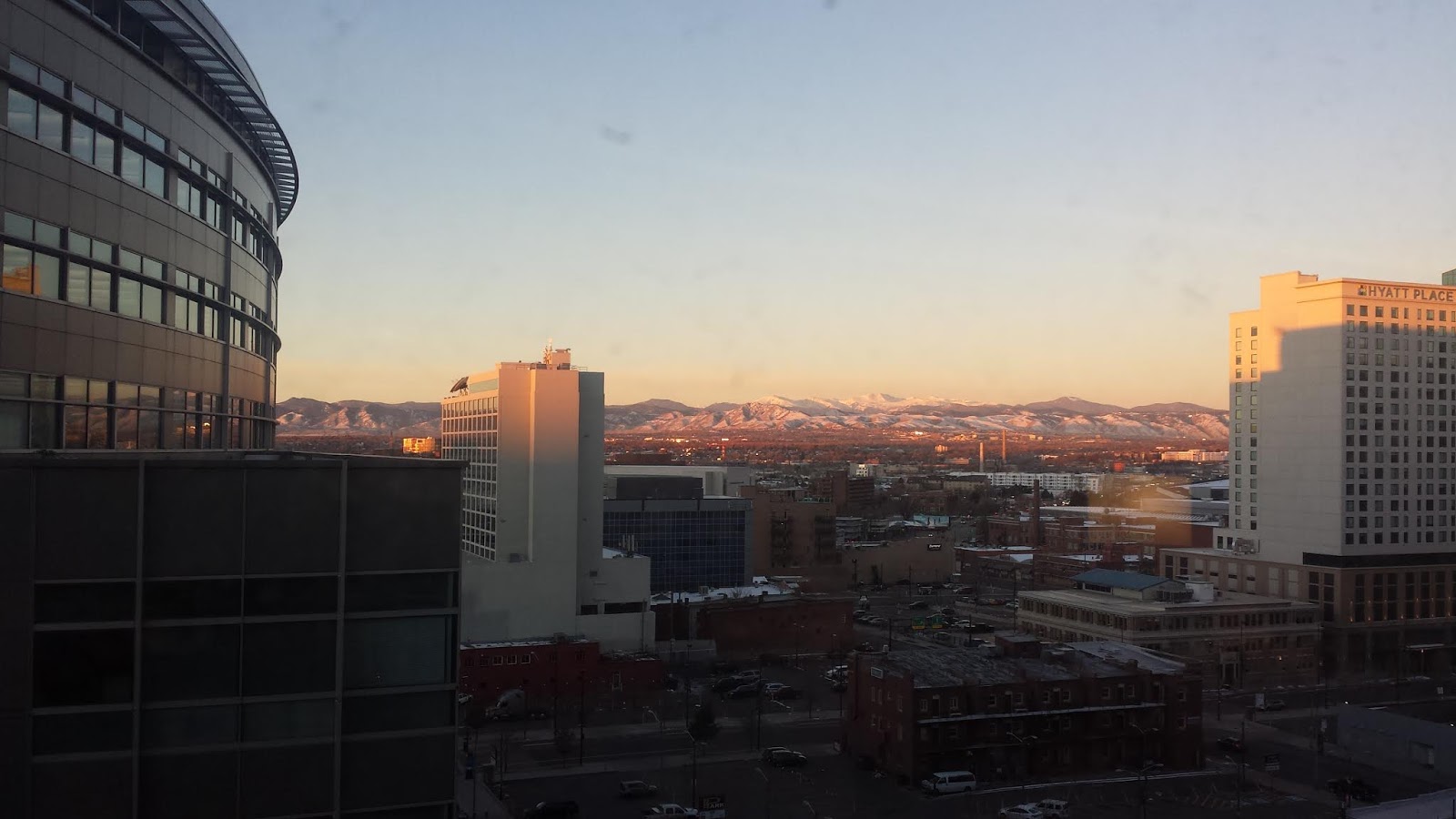
View of the Mountains from Downtown Denver, 2018
(Photo: C Imes)
It was my 10th year of academic meetings, but the first to be held in my home town. First item on the agenda? Family time. We headed to the retirement home in my old neighborhood to visit my grandparents. On our way to grandma's room, we bumped into Rev. Kok. He's long retired now and driving a motorized wheelchair, but there is nothing wrong "upstairs." We found him in the library studying for his Sunday School class on the Psalms. (A kindred spirit!)

His face lit up when he saw us, incredulous to see me after nearly 30 years -- elementary school student turned college professor. I lost no time in reminding him of his children's sermon and how I had aspired to be like him.

"Do you ever preach?" he asked, eyebrows raised in expectation. Time stood still as I considered the irony of his question and what might be at stake in my reply. Women didn't preach in our church growing up. It wasn't allowed. For most of my childhood, they couldn't even collect the offering. I realized in that moment that church practices are complicated, and that I probably didn't know Rev. Kok as well as I thought, or that he might have changed while I was changing, too.

"Yes!" I replied, the clock ticking again. "A few times a year in local churches or in chapel."

His response was immediate, affirming, "Good for you!"

It's a mystery how old aches can heal or unfinished chapters can be written in a moment's time. That conversation was balm to my soul. There he was, my childhood pastor, looking at the grown up me and saying, "well done!" All these years I had imagined his displeasure at the ways I'd come to disagree with him on theology or on church polity -- especially on the topic of women in ministry. And here we were, colleagues. He made sure I knew that.

Map of Palestine in Jesus' Day
from the NIV Study Bible
Photo: C Imes
I reminded Rev. Kok of another conversation we had some 33 years ago. At the time, it may have seemed insignificant. But in retrospect, it likely shaped who I've become. It was a Sunday morning. The sermon failed to capture my interest, so I was studying the maps in the back of the pew Bible. I might have been 8 or 9 years old. I was looking at the map labeled "New Testament in the Time of Jesus." But something was wrong with that map! Jericho should not have been there. The Old Testament said the walls fell down! I was puzzled (and, if I'm honest, probably felt a bit smug about finding a typo in the Bible).

I brought the Bible with me to the back of the sanctuary afterward, where Rev. Kok was shaking hands with everyone as they filed out. When he was finished, he turned to hear my question. I remember his giant frame bending down to look at the map. He didn't know the answer, but said he would investigate. (I had stumped the pastor!) One week later I could hardly wait for the sermon to finish. I was nervous that he had forgotten my question, but also eager to know if he'd found an answer. He asked me to wait until he was done shaking hands. Then he bent down beside me to explain.

His answer matters less than the fact that he had an answer. He had taken my question seriously, researched it, and brought me a response. A whole book on Jericho?! A reason for its re-appearance on the NT map?! I came away with a healthy respect for scholarship and an appreciation for libraries and the confidence to keep asking questions. Is it any wonder I ended up as an Old Testament professor?

The next day I headed downtown for six days of professional development, networking, academic papers, board meetings, and conversations with publishers. But the most significant work had already been accomplished at the retirement home. I'd come full circle.

And so I went home. Home to my roots. Home to the people who shaped my future. Home as the grown-up me, so grateful for the grace of God that takes our dreams and makes them something better than we knew to wish for. A missionary? Yes, but not in the way I'd imagined. A teacher, which was a much better fit for my personality than an astronaut. A ministry that includes preaching as well as writing the sorts of books that address Bible questions shared by children and adults.

It truly is the #bestjobintheworld, because it's what I was born (in Denver) to do. Who knew?

Tuesday, August 7, 2018

Bridging the Gap between Academy and Church

A bridge is a powerful metaphor for the ministry of teaching.

Suspension Bridge at Bowl &
Pitcher State Park, Spokane, WA
(photo: C Imes)
I'm no civil engineer, but I'm certain that a stable suspension bridge must have a firm foundation on both sides of whatever chasm it's designed to cross. For me, that means having a solid grasp of the material I'm teaching from a rigorous, scholarly perspective but being able to explain what I've discovered in ordinary language.

Getting a PhD helped me to drill down deep into bedrock. I left no stone unturned in my quest to understand my central passage. I also thought about implications for a range of other issues.

But my Freshman students would glaze over if I waxed eloquent about the obscure sources I consulted in doing my work. They need to hear how the Scriptures matter for their own lives using words they (mostly) already know. They need something more accessible.

And so I build a bridge. Using stories, I tell them what I've learned and why it matters, bringing scholarship across to the shore where they live. Using their questions, I lead them back over the bridge to access scholarly sources for themselves.

Crossing Bridges
Bowl & Pitcher State Park
(photo: C Imes)
Being a "popularizer" doesn't usually earn one points in academia. Sometimes it undermines credibility or arouses suspicion. Thankfully, that's not the case at my institution.

I feel a strong passion to communicate with those who want to understand the Bible but will never enroll in seminary. It's why I'm writing a book with InterVarsity Press that will tell the big, wide world what I learned in grad school. It's also why I keep blogging.

I once heard Lauren Winner speak at an academic conference on writing for general audiences. She recommended that academics publish their scholarly work first and then produce down-to-earth books. This ensures that they are taken seriously by the academy, while remaining helpful to the wider culture. I'm following her advice. My dissertation came out in print in March. Another scholarly essay is nearing publication. Most of my attention this summer has been on my new down-to-earth book.

I don't think every academic is called to build bridges. Some are uniquely wired to spend longer hours in their "ivory towers," away from the tyranny of the urgent, producing good work that will benefit other academics over the long haul. This, too, is an important calling. (See Jen Pollock Michel's great article on this topic in Christianity Today). We must carefully discern our own gifts and our own limits, investing our time where it makes the most sense.

We need ivory towers. Each generation must wrestle anew with truth and beauty and meaning.
But we also need bridges, lest the insights of careful study fail to meet people where they live.

Sunday, April 17, 2016

now what? (and other questions): life after dissertation

It's the inevitable question that follows the celebratory congratulations. Since I've been blessed with a wide-ranging support network, it's a question I'm asked just about every day by people who care.

So, yes, it feels amazing to be (almost) done!
Yes, it's a huge load off our shoulders, and the whole family is relieved.
Yes, I have a bit more freedom and flexibility now.

But no, I will not have a lot more free time. Here's why:

A Ph.D. is not the type of degree people earn for personal enrichment. As a matter of stewardship, the huge investment of time, mentoring, and other resources are designed to prepare the student for a lifetime of scholarship. Career-wise, like most of my colleagues, my hope is to be a college professor. I have already begun teaching at two schools, George Fox University in Newberg, Oregon, and Multnomah University in Portland. I love what I do. I'm very grateful for open doors. However, these "jobs" are a bit like being a "temp" worker (minus the agency). They pay very little (last spring my pay worked out to about $5/hour), with no benefits, and no guarantee of employment beyond the current semester. Semester by semester, each school will let me know if they need me to teach for them again. So while I love my work, I do not actually have a job yet.

In order to get a permanent position, I must demonstrate that I will be a contributing member of the campus as well as the scholarly community by staying abreast of current research, participating in campus events, investing in students outside of class, and achieving excellence in teaching (as measured by student evaluations). Diploma aside, without several scholarly publications and stellar teaching evaluations, no school is likely to consider hiring me. In today's educational environment, very few schools are hiring permanent ("tenure-track") faculty. Schools that do post positions are flooded with qualified applicants. To walk away from the library now would spell the end of my career.

Getting a PhD is a bit like becoming an MD. Your medical doctor did not stop studying when she graduated from medical school (thank goodness!). She reads medical journals, attends medical conferences, and even collaborates with other doctors to ensure quality care and accurate diagnoses for patients. Likewise, I cannot stop studying and writing. A professor who ceases to learn, ceases to teach.

And so my days are still full. These days I'm revising my dissertation (almost done!), prepping for class, grading student papers, and preparing for upcoming gigs:

In May I'll be presenting a paper at an academic meeting in Idaho (Northwest Regional Meeting of the Society of Biblical Literature) and serving as a respondent for a colleague's paper.
In June I'll be teaching a one-week intensive course on the Old Testament Prophets at Multnomah University.
In July I'll be filming brief lectures for an online course on the Prophets at Multnomah, to be offered beginning in October.
In late August I'll begin teaching 2 new courses on campus at George Fox (Exodus and Psalms) and another section of Prophets at Multnomah.

On top of this are the opportunities to invest in the church—speaking at a women's event in May in Dallas, Oregon, helping with VBS, and speaking at a women's retreat in September in Wisconsin—as well as finding a publisher for my dissertation and beginning work on my next research project.

All of these great opportunities require long, quiet, focused hours of preparation. Studying the Word, crafting a message or a lecture, preparing visual aids, and coordinating logistics. In fact, with 4 classes this fall (3 on two campuses and one online), I'll be teaching the equivalent of a full-time load. I expect to be just as busy as ever. But I'm not complaining.

That was the whole point of all this schooling.

From everyone who has been given much, much will be demanded;
and from the one who has been entrusted with much, much more will be asked.
(Luke 12:48 NIV)
Now it is required that those who have been given a trust must prove faithful. 
(1 Corinthians 4:2 NIV) 
At the end of the race, may I be found faithful!

Sunday, March 6, 2016

the gift and cost of social media

Perhaps you've noticed. (More likely not.)
I haven't blogged much lately.

At first, it was because I finally joined Facebook. That took up much of my discretionary time. Finding and "friending" friends from all the places we've lived was quite an undertaking. Looking at their family photos and reading their walls and checking my newsfeed filled more hours. Within a week I had 300 friends. Within a month 500. Now two months have passed and I have over 600 friends, though I haven't been actively looking for more and have yet to scour my contacts for those I've missed. It all happened too fast to properly "catch up" on each one's journey. I told myself it was a "training" period, and that life would get back to normal. That I would find a new and sustainable rhythm. That I would get back to blogging. But weeks passed.

Other factors interfered.

Mere days after I joined Facebook, George Fox asked me to teach a class for them immediately. I scrambled to put together a syllabus, fill out all the paperwork, and get ready for classes to start. With less than 2 weeks' notice to prepare, this left little time for blogging.

Then there was Danny's 10-day trip to Thailand and my looming dissertation deadline (now past), the girls' theatre performance (see Facebook for details :)), my parents' visit from out of town, a series of meetings at church, etc, etc.

Life has been busy enough that my virtual disappearance from this blog is justifiable. But what's been nagging at me is that time itself cannot explain my silence. On many a quiet evening I could have been blogging, but I didn't. Why not?

My swirling thoughts have coalesced around two reasons. The first is personal, but the second may point to issues more universal.

First, I am teaching. I find that having a regular "outlet" -- real people with whom I can speak about deeper issues -- brings enough satisfaction that I feel less compelled to write. I found this to be true last spring as well, while teaching at Multnomah. I am still speaking, thinking, teaching, but the venue has shifted from blog to classroom. ("Carmen, you mean to say that you blog because you need to write, not because we need to read?" "Um, yes. If you benefit, too, that's a bonus.")

The second issue is deeply ironic. A big reason that I joined Facebook was to have a naturally wider network with which to share my blog posts. I had noticed that whenever a friend re-posted one of my blog posts on Facebook I had a LOT more readers. I figured if I was going to take the time to write, all my real-life friends should know about it, not just the few who think to check my blog. However, Facebook has not only swallowed up time that I could be blogging, but it's sapped the reflective impulse as well. These days, if I have a share-able thought I can release it to the world in a matter of moments -- a few sentences and I'm done. This preempts the deeper reflection and harder work of developing a blog post worth reading. This one, for example, has already taken me more than 30 minutes took me over an hour. I could have made the same point on Facebook in a matter of seconds:

"I joined Facebook so that I could share my blog with all of you. But now I have no time to blog, so all you get is a picture of what I ate for dinner."

Facebook can also leave me feeling scattered. Between birthday parties and memes and videos mocking Donald Trump and articles about ADHD and funny pet stories, I lack the singularity of focus that writing a blog post requires.

It's not all bad. I've done a lot more "listening" over the past 2 months. Facebook has become a virtual reunion, as I've reconnected with friends from all the places where I've lived -- Colorado, Oregon, the Philippines, North Carolina, Illinois -- who are themselves scattered the world over. That is such a gift.

What I didn't expect was deeper connections with people right here in my own community. After all, I was mostly joining Facebook for the far away folks that I won't see in church on Sunday. But pretty quickly I found "friends" from church as well, and we're still new enough here that it's helping me keep names and faces straight and enhancing conversations at fellowship time between services. ("Congrats on your new . . . "; "I was sorry to see that . . . "; "How was your big meeting this week?")

Another fun surprise has been the professional networking. Instead of seeing colleagues once a year an academic conference, I am glimpsing the rhythm of their life and work the whole year through, and I'm seeing them more holistically -- as real people with families and birthdays and ministry involvement and vacations. In the long run, I think this is a win-win.

In the meantime, I still need to find a sustainable rhythm for Facebook and Blogger that will help me stay connected without disrupting deeper reflection. If anyone out there has ideas, message me or leave a comment below. I'm going to post this post on Facebook and call it a day...

Friday, August 7, 2015

how I've failed my kids

I still have not forgotten the talk our principal gave us on the first day of high school. It was the strangest "pep talk" I have ever heard. He told us we would all fail. He was confident that every one of us in the room would make a mess of something that year—a test, a report, a relationship, a job. Failure is guaranteed because all of us are human. It's only a matter of time.

But failure is only the beginning. When we respond well to failure, it becomes the foundation for success. That's what our high school principal had in mind. Recent studies show that we learn more from failure than anything else. Kids who are told they are intelligent struggle the most to learn new things. Why? They begin to assume that brain power is something that you wake up with in the morning. If a "smart" kid encounters something difficult, they often throw in the towel and decide they don't have what it takes.

The fact is, I have failed my children by telling them that they are smart. Here's how it has played out more times that I can count:

"Mom, I can't get this. It doesn't make any sense."
"I know you can do it. You're a smart kid. Your teacher wouldn't give you an unsolvable problem."
"No, I really can't get it. I've tried and tried. It's impossible. I'm not smart enough."
"That's nonsense. God gave you a good brain and you know it. Just keep trying."

Educational psychologists are now saying that we need to praise kids for their problem-solving skills, their ideas, and their strategies, rather than for their intelligence. These are the tools that have served them well, and will continue to do so when they face harder challenges.

I'm imagining new conversations with my kids:

"Mom, I can't get this. It doesn't make any sense."
"I wonder if there's another way to look at it. What are all the different ways we could try to solve it? What have you tried so far?"
"The problem isn't giving me enough information. I don't even know where to start."
"Let's read it together and brainstorm. I'd love to hear your ideas. Then we can try to break it down step by step. Imagine it's a mystery and we're looking for clues!"

This research is helpful for me, too. In academics it's awfully tempting to think that you don't have what it takes—that your brain is not capable of doing what needs to be done. If your best doesn't seem good enough, don't despair. Intelligence is not fixed. To have tried and failed is to mentally "level-up," unlocking the door for greater growth. If at first you don't succeed . . .

Several years ago I submitted an article for publication in an academic journal. Receiving that first rejection letter felt like a rite of passage. The second journal was kind enough to include a list of constructive criticism with their rejection letter. Most authors have a file full of letters like this. Come to think of it, no one is born writing symphonies or making 3-pointers or solving equations or designing bridges or interceding faithfully or balancing spreadsheets. Everything we know is learned. We all start at zero. And we have to make a lot of mistakes to get from here to where we want to be.

Still not convinced? Check out these videos from Khan Academy. They were my wake-up call today.


Saturday, July 25, 2015

bored by Leviticus or lost in Numbers? don't miss this

I've already mentioned this resource last year, but it's getting better all the time as more videos are released, and I'm guessing that some of you blew me off the first time, so I'm going to say it again, LOUDER.

This is quite simply the BEST COLLECTION OF BIBLE VIDEOS I have ever seen. The content is solid. The graphics are impressive. The cost is affordable (It's FREE!). In just minutes you'll begin to understand how the books of the Bible fit together, and how each one contributes to the Bible's overall message.

There's a reason why over 42,000 people have already subscribed to these videos on YouTube (Genesis is nearing 200,000 views).

There's a reason why I used class time to show these videos to seminary students earlier this year.

And there's a reason why all three of my kids were captivated this afternoon watching them. After watching Genesis, Exodus, Leviticus, Numbers, and Hebrews, Eliana (age 14) announced that she was going to head to her room and watch them all again. Emma (age 10) said, "That was amazing!" And Easton (age 7) declared that he wanted to send some of his own money to help fund more videos.

They're that good.

Think the Bible is boring? or confusing? Or do you love it and want a way to share that love with others? Look no further! Watch it come to life at www.jointhebibleproject.com or get started right here:


Is the video you want to see not available yet? Keep checking back. The team is upping production speed so that all the biblical book videos will be out as soon as next year!

Thursday, July 9, 2015

why bother writing a dissertation?

Who even cares? And what difference does it make, really?

Pacific City, Oregon (Photo: C Imes)

Sometimes when I come face to face with an awe-inspiring panorama of natural beauty, I get to feeling very, very small. And I think about the hours I spend every day fiddling with footnotes, massaging sentences until they sound exactly right, poking my theories from every angle to make sure they stand up under scrutiny . . . In those moments my work seems so pedantic. 

Does any of this actually matter?

But when I turn back from a breathtaking view and stand squarely facing the church, I remember why this work must be done. I don't mean the church historic, anchored by creed, weathering the test of time. I mean the church in its messiest and most particular forms—the local church, my local church. Individuals of various ages and backgrounds and careers who share geographic proximity and have chosen to worship together on Sunday mornings at 9:00 or 10:45, coffee in hand, trying to shake off the spiritual lethargy of their week and tune in to what really matters. This church, my church, needs steady footing in the shifting sands of cliché and trend and platitude; they need to be guided to what is real and true and rock solid, what is profoundly biblical and yet fresh and relevant. People are weary of what they've already heard and tried and found wanting. They are tired of getting nowhere.

To speak with authority into the malaise of superficiality that confronts any local church, I must do my homework. I must wrestle each word to the ground, refusing to let it go until I understand, refusing to quit until I have clearly expressed what I see.

On any given day I consult books written by patient scholars who have done exactly this. Their insights have stood the test of time, like the majestic cliffs on the Oregon coast. I am grateful for their work—glad they didn't give up when things took longer than they planned—and inspired to contribute in some small way. 

And so I press on. 

Stay tuned. The best is yet to come.


Monday, October 27, 2014

Dear Professor Imes

A few days ago I shared the happy news that I have been asked to teach a course on the Gospels and Acts at Multnomah University in the Spring. {insert happy dance} One way to tell that you're doing what you were born to do is that you completely lose track of time while doing it. Last night I stayed up far past my normal bedtime, devouring the stack of books that arrived yesterday from Zondervan. Publishers are eager to share their latest publications with professors, in hopes that they will require students to buy and read their books. (I've already received several emails addressed to "Dear Professor Imes" -- music to my ears!) Here are the latest additions to my library, complements of Zondervan, InterVarsity, and Bible Places:

Since I've focused almost entirely on the Old Testament for the past 3 years at Wheaton, my New Testament library is a bit thin. This will go a long way toward equipping me to equip students with the tools they need to understand the Gospels and Acts.

I can hardly wait to get started teaching. But first I need to craft a syllabus, which entails choosing which books will be most helpful to my students. That means I must spend many happy hours reading. {insert long, satisfied sigh}