Showing posts with label Christianity Today. Show all posts

Friday, February 11, 2022

Becoming Human: My Visit to an SBC Seminary

It was an unlikely invitation. 

Would I travel to Wake Forest, NC to speak on personhood at Southeastern Baptist Theological Seminary? 

I, who am neither a member of the SBC nor the daughter of a member of the SBC. 

I, a woman who teaches Bible and even preaches on occasion.

It was not my first SBC connection. First, my book appeared in the book store at The Southern Baptist Theological Seminary in Louisville, where Al Mohler is president back in early 2020. (Unexpected!) Then, the same book was a finalist for an award from Midwestern Baptist Theological Seminary in Kansas City. (Who knew?!) The next thing I knew, Lifeway Publishing asked me to contribute to a women's study Bible. (Huh.) And then Southern invited me to present my research to their PhD students and faculty over Zoom in 2021. (!!)

And then this. A plenary address at an SBC seminary. What did I have to lose? Plenty, actually.

As I said, I'm not a member of the SBC. But I am SBC-adjacent. I'm close enough to the movement to know that all is not well. I watched Beth Moore walk away (gulp!). I watched Russell Moore make his exit (wow.). I saw the troubling statement released by the six white SBC seminary presidents on Critical Race Theory -- a statement crafted without the input of any people of color or anyone who had even studied CRT (um...). I watched talented African American leaders cut ties with the denomination. I waited on pins and needles while the delegates voted for a new president at last year's convention, and while they decided how to handle allegations of sexual abuse and how to care for survivors. I groaned a few months later when the Executive Committee waffled over whether to submit to outside investigation.

I care very much where things go in the SBC because the denomination wields enormous influence. People's faith and health are at stake. And so is the witness of the church at large.

Here was my conundrum: attending the conference would allow me to learn from the other presenters and work on issues related to my current book project and get feedback. But would taking the stage at an SBC seminary somehow align me with the denomination and its problems? Would it make me complicit? (If you think I'm overreacting, consider that the invitation was issued from a building named after Paige and Dorothy Patterson, the seminary's notorious former president and his wife.)

I concluded that I could not participate without addressing the problems as I see them. I refuse to pretend that all is well. It would be irresponsible to talk about the biblical doctrine of the image of God without pointing to the myriads of ways that evangelicals as a whole and the SBC in particular have failed to live these truths. That would compromise my integrity.

So I took a deep breath, said yes, and submitted this title:

The Rise and Fall of the Imago Dei?: Assessing Evangelical Theology and Practice

My title intentionally evoked the long-form journalistic podcast produced by Christianity Today that investigated a particularly egregious form of "evangelical" ministry with a narcissistic leader. I took my cues from Mike Cosper, who demonstrated the value of evangelical self-critique. Here is my abstract:

Evangelicals all agree that human identity and vocation are rooted in the creation accounts of Genesis, but the particulars are often a matter of debate. We’ll consider the recent work of several evangelical scholars on the imago Dei—Ryan Peterson, John Kilner, Catherine McDowell, and Richard Middleton—each of whom has clarified Old Testament teaching in profound ways. Building on their work, we will reassess the priorities of the contemporary evangelical church and suggest ways of embodying practices that align with Scripture’s clear teaching on the imago Dei.

Carmen Imes speaking at the Exploring
Personhood Conference sponsored by
the Bush Center for Faith and Culture
(Photo: Chip Hardy)
The first half of my presentation drew out insights from the four scholars named above, with a bit of extra nuance from me in the area of gender. But then came the scary part -- I addressed head on the ways that evangelicals have failed in three broad areas: sanctity of human life (ahem, after birth), partnership of men and women, and creation care.

My talk will be posted soon on the Bush Center for Faith and Culture's website, so there's no need for me to repeat the litany here. It's enough to say that I pointed to examples of racism, ableism, sexism, LGBTQ-related issues, inhospitality to singles, failure to protect and advocate for victims of abuse, and neglect of creation care. I hit all these hot topics, issued a clear call for change, and cast a vision for a different way of living out what we say we believe. With my integrity intact, the question became 'would I lose my voice?' Would this be the first and last opportunity to speak on this campus?

I've been mulling over all of this for months, reading widely, and imagining how this might go. I asked people to pray and I prayed about it myself. I sought advice and wondered if this was career suicide. In the end, I said what I felt I must be said with as much love and empathy as I could muster. One thing is true -- of all the possible reactions I imagined, a standing ovation was not one of them. Everyone clapped, and more than half a dozen stood in solidarity.

Conference Panel Discussion
(Photo: Bush Center for Faith and Culture) 
This message struck a chord with so many, who thanked me with tears in their eyes. Faculty, students, and guests alike shook my hand and new friendships were born. To be clear, the warm reception is not a sign that all is well, of course. It's a sign that the problems I listed truly are problems. On that we agree.

And this is what gives me hope.

Because agreeing on the problem is the first essential step toward finding solutions.

So now the real work begins. Now we must invest our energies into the work of listening to new voices, reexamining how we do things, building new alliances, and prayerfully finding new ways forward. Change takes time, but the road is not so lonely as it seemed.

This conference taught me something about human personhood that was not on the stated agenda: Caricatures are difficult to maintain in person. I'm under no illusion that 48 hours on campus gave me an accurate picture of the SBC as a whole, or even SEBTS in particular. But it reminded me of the value of embodied community and courageous conversations. It showed me that the loudest voices on Twitter do not always (or even usually?) represent the majority. I found far more allies than I dared to hope. I'm relieved that a bridge has been built, rather than burned.

As we learned from Dr. Justin Barrett, compared to animals, humans are immensely social creatures capable of shared attention, mental space, expertise, and cooperation across a remarkably large group of unrelated humans. I saw this in action at Southeastern. 

Father John Behr and Dr. Jeff Schloss both talked about the telos of love, helping us think about the uniquely human capability of self-sacrifice for another. According to Behr, it is in laying down our lives for another that we truly become human. I felt this in the way people thanked me for saying hard things, and in the way Dr. John Hammett offered loving pushback to each of us.

If Behr is right, then all of us who participated in this exchange became a bit more human this week.

For that I am profoundly grateful.

Sunday, November 14, 2021

Reflections on The Rise and Fall of Mars Hill

It's likely that I'll remember 2021 in part as the year in which Mike Cosper narrated my solo drives and weekend walks. Often I wondered if I could take yet another heart-sickening story of the abuse of power in the church, but I kept coming back, like a moth to the flame. 

If you're not familiar with it, The Rise and Fall of Mars Hill is an audio documentary sponsored by Christianity Today about the Seattle mega-Church called Mars Hill pastored by Mark Driscoll -- its origins, rapid growth, M.O., and the toxic culture of leadership that lead to its messy end. 

I have never met Mark Driscoll, never listened to one of his sermons, and never read one of his books, so why did I invest over a dozen hours listening to this podcast?

In the first place, it's well produced and well articulated. The sound design is fantastic and the stories are compelling. Christianity Today set a high bar with this one.

More importantly, it helps to explain a movement I could not understand at the time -- among other things, how a conservative pastor could say such crass things about sex, gender roles, and manhood from the pulpit and get away with it. Like most evangelicals with an ear to the ground, I had seen and heard clips of inflammatory things that Mark Driscoll said from the stage (around 2012), and I was deeply concerned. I later learned about his highly unethical ploy to get one of his books on the New York Times bestseller list. It was hard to miss the news about the raft of plaigiarism found in his books. And I knew that in spite of his church elders' attempt to lead him through a disciplinary process, Mark had resigned and headed to Arizona . . . where he planted a new church.

The Rise and Fall of Mars Hill shines a spotlight on abusive power dynamics that are too-often operative in Christian churches and institutions. Cosper traces various threads to help us see the origins of unhealthy ideas and the ways that they hurt people. At the same time, he highlights the stories of those who experienced radical transformation in their lives in the early days of Mars Hill. 

I believe God calls the church to bear his name with honor. In the case of Mars Hill, the quest for growth-at-all-costs was paired with Mark Driscoll's growing refusal to be accountable to seasoned leaders in his church network or even to his own board of elders. We can learn a lot from this story. It stands as a modern day parable of sorts, warning of the dangers associated with a leader having too much power, too fast, without godly character and life experience to prevent that leader from going off the rails. Unlike a parable, this one has real collatoral damage. So many former members are still trying to pick up the pieces and make sense of what happened.


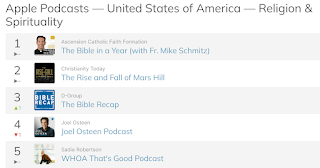
Ironically, the podcast has been a sensation of its own. Today it's ranked #2 in religion podcasts in the US. This probably says something about our our collective desire to hear grizzly tales of others' demise. It probably also points to how widespread these problems are in the church. I'm guessing it appeals to a lot of people who would like to understand a conservative brand of Christianity that prides itself on fidelity to Scripture but puts up with a bully in the pulpit. Probably all of these reasons. (As a side note, it's in very interesting company on the top 5!)

I've listened to The Rise and Fall in part because of its popularity. As an educator and lover of the church, I want to be in the loop about what people are hearing and how they are processing. If you've listened to at least part of the series, how has it personally challenged you? Leave me a note in the comments below.

Personally, I've been sobered by what well-meaning people will tolerate when a strong personality is at the helm. The podcast has given us much to lament. It renews my appreciation for institutional structures that have rigorous checks and balances in place. It's also a reminder that character matters a whole lot. For Driscoll, his popularity became the "proof" of his effectiveness and the "fruit" of "his ministry" -- but how many of those metrics could be traced to people who tuned in because they were incredulous? Just because people are listening, that doesn't mean the teaching is sound. The Old Testament prophet Jeremiah warned against false prophets who told people what their itching ears wanted to hear (Jeremiah 6:14).

If the podcast series has left you disillusioned about the church, a good next step might be to read Scot McKnight and Laura Barringer's book, A Church Called Tov (tov is the Hebrew word for "good"). It's on my short list of books to read next. McKnight and Barringer write about how to cultivate a healthy church culture where stories like this one will not keep happening. May the overwhelming popularity of this podcast awaken the church to stop tolerating abuses of power and instead cultivate communities marked by faithful and humble service!

Friday, January 1, 2021

ICYMI: Articles Around the Web in 2020


Normally at the end of the year I post a list of top blog posts of the year from my own blog (and I might still do that), but if you're a regular reader, you might have noticed that my blog has been quieter this year. In that relative silence, I was busy writing for other websites. I keep a complete list of articles here, but that page doesn't notify subscribers when I update it, so here's a handy list of the 15 articles I published elsewhere in 2020. 

From reflecting on Exodus to COVID, and from teaching and writing to Deuteronomy, these are the things that have been on my mind this year. I've starred a few of my personal favorites.

The Art of Taleh

* “Telling the Old, Old Story (Deut 26:5-10),” April 20, 2020.
The Biblical Mind
* "Freedom Fighters of the Exodus," November 17, 2020.

Canadian Society of Biblical Studies

"Misunderstanding Sinai? Author Interview with Carmen Imes," March 24, 2020.

Cateclesia

Re-Interpreting the Name Command (Exodus 20:7)” May 6, 2020.

Christianity Today

"Connections that Count," Jesus Creed, Dec 30, 2020. 

* "What God Sees" and "Peace in the Storm," Advent Devotional, Dec 2020.  

* "Church after COVID--Why bother going back?," Jesus Creed, Sept 28, 2020. Reblogged at ChurchLeaders.com, Oct 13, 2020. 

"2020: The Gift Nobody Wanted," Jesus Creed, June 23, 2020. 
"Finding Life in Limbo," Jesus Creed, March 19, 2020.

Political Theology Network

Prairie College

 "How Do You Know if a 'Bible College' is Right For You?" Prairie blog, February 2020.

The Well (InterVarsity's blog for Women in the Academy and Professions)

"Pursuing Tough Conversations with Students," September 3, 2020. 

"A Prayer for Writers," April 15, 2020. 
"Notes from the Pandemic: Social Distancing and the Presence of God," March 23, 2020. 

Saturday, November 28, 2020

Pandemic Advent: Restoring Hope

Advent begins tomorrow. 

Usually this weekend marks a transition to the bustle of holiday events -- school parties, work parties, family parties, neighborhood parties, concerts, dramatic productions, travel, shopping. For most of us, the 2020 advent season will be much lower key. Concerts are cancelled. Many stores are closed. Parties are limited or not allowed. Travel is complicated.

Perhaps this year, we will finally catch the spirit of Advent.

As one devotional resource puts it, "Advent is a season of expectant waiting, tapping into the sense we have that all is not well, the longing for the world to be made right again. It's a season for restless hearts and people weary of a broken world who want, with all our being, to know there's more than this." (Seeking God's Face: Praying with the Bible Through the Year, 23)

If ever there was a time when we were collectively aware that all is not well, it's now. We long to break free from the dark clouds of the pandemic that shadow every empty square on the calendar.

This year I had the honor of contributing to an Advent devotional for Christianity Today, along with John Goldingay, Fleming Rutledge, Vincent Bacote, Ken Shigamatsu, Thabiti Anyabwile, Rich Villodas, Marlena Graves, and others. You can access it freely using the links below. Join us as we consider together the HOPE of Jesus' coming and of God's transformative power.


This year, more than ever, we know how much our world needs this.

If your year has been like mine, then you are acutely aware of your own need for transformation. The fallout of disrupted plans and routines this year has exposed places in our hearts where we have clung to the wrong things for security.

At minimum we are tasting the bitter tears of grief mixed with anticipation of Christmas. This year won't be the same. There are empty seats at the table, unfulfilled hopes, lonely hearts, and cancelled plans. May our disappointments turn our collective gaze to the author of hope. In him alone will we find strength for a new year that offers little certainty.

Week 1

Week 2

Week 3

Week 4

May the first coming of our king bolster our hope in his imminent return to make all things new!

Saturday, December 7, 2019

Blog Tour: Bearing God's Name: Why Sinai Still Matters

Interview for Christianity Today with 
Jen Pollock Michel (Dec 2019)
Bearing God's Name: Why Sinai Still Matters
(IVP) releases December 10, 2019, but it's already had a second printing! This is due in large part to those who have have helped me get the word out by interviewing me for their blog or magazine, and for those who have spread the news on social media.

Below are links to blog and magazine interviews about the book. I'll keep adding to this post as new opportunities arise, so check back later for more!


Magazine Interview 

Jen Pollock Michel for Christianity Today


Blog Interviews
Carmen Imes and Jennifer Brown Jones
with the recently released Bearing God's Name

Ian Paul for Psephizo

Jennifer Brown Jones for Life Beyond #Blessed

Andrea Bridges for The Well, InterVarsity's blog for Women in the Academy

Kelley Maranto Mathews for Patheos

Sandra Glahn for Aspire2 

Canadian Society of Biblical Studies (about Bearing YHWH's Name at Sinai, my published dissertation on which Bearing God's Name is based)


Guest Blog Posts

Cateclesia Institute

Reviews

Library Journal

Goodreads

Amazon

Robert Mayer for Only Visiting This Planet

Michael Philliber for Deus Misereatur

Kenson Gonzalez for Viviendo Para Su Gloria


Bible Study Magazine

Faith Today

Bible Today

Themelios 


Sunday, July 28, 2019

Book Review: Richard Mouw's "Restless Faith"

Do you wrestle with your evangelical identity? Do you ever wonder whether it's time to throw in the towel and walk away?

If so, this book is for you.

As president of Fuller Seminary and former professor at Calvin College, Richard J. Mouw has spent many decades as an evangelical. All of them, he says, were restless years. This book is his explanation of why he's choosing to stay.

These are trying times for evangelicals. Cultural pressures from the outside and deep disagreements on the inside make evangelicalism an uncomfortable place for many Christians. The most recent national election in the US, to cite just one example, threatened to split families right down the middle.

Mouw takes us behind the scenes in the institutions where he has served to demonstrate that evangelicalism has always been this way. He reminds us of the core tenets that hold such a diverse group together, suggesting that these central values -- belief in the need for conversion, the authority of the Bible, the centrality of the cross, and an emphasis on daily discipleship -- cannot be found in this combination anywhere else.

He talks about Billy Graham, Christianity Today, Ann Voskamp, World Vision, and the National Association for Evangelicals on the one hand, as well as Norman Vincent Peale, Robert Schuller, Rob Bell, and the National Council of Churches on the other. We learn about his efforts to promote Mormon-Evangelical and other types of inter-faith dialogue without watering down his own Evangelical commitments. We read of his lonely engagement in the civil rights movement and politics during the 1960s when many Evangelicals' only concern was to "save souls." He wrestles with the individual and communal aspects of salvation and considers the value of both hymns and contemporary worship songs. In the end, he advocates "holding on while staying restless" as an Evangelical.

Speaking as an academic, I did not find the book to be heavy reading, but rather patchwork autobiography in accessible prose. Yet one does not have to know Richard Mouw to appreciate his reflections -- his wisdom shines through on every page and offers hope for Evangelicals who are feeling squirmy in today's politicized climate. He concludes,
"For me, the only way to be a properly functioning evangelical is to keep arguing about what it means to be an evangelical. Restlessness in claiming that label has long been the way I have kept moving. I hope that many of us can stay restless as we hold on while exploring together whether the best way to remain faithful to the legacy is to let go of the label. . . . For the present, I am inclined to go with the second option -- working for evangelical renewal, rather than simply allowing the movement's label to be co-opted by leaders who have departed from the best of the legacy." (174)
If you share his restlessness, this book may be just the thing you need to refresh your perspective and refuel your evangelical commitment. Mouw does not suggest that we hold doggedly to the label "evangelical," but he offers good reasons to keep it for the time being.

Saturday, March 3, 2018

My Tribute: Snapshots of Billy Graham

At Billy Graham's funeral yesterday, his daughter Ruth said this: "One thing I've learned this week is that everyone has a Billy Graham story."

I am no exception. Mine is a series of snapshots that double as a memoir.

Billy Graham at Mile High Stadium
(Photo: AP/Aaron E. Tomlinson)
5th grade. Mile High Stadium, Denver, 1987. I sat beside my Dad in the choir section and listened to Graham preach to thousands. I remember that I wanted to go forward in response to the altar call and Dad wouldn't let me. It's true, I had already been a Christian for more than a handful of years, and I had prayed the sinner's prayer with regularity. Dad said the altar call was for those who were responding for the first time. I remember thinking that by responding, we'd be letting the world know that this Jesus was worth following publicly, that this Jesus made it worth getting lost in a stadium. I wanted those going forward to know it was a decision worth making, and that they were not alone.

High school. Babysitting. I was totally absorbed in a televised crusade. In the corner of the screen was a woman interpreting Graham's message into sign language. By this point I knew some sign language, and I was trying to follow along. Trying, that is, until the little boy I was supposed to be watching said, "Carmen, look!" While I was absorbed in the crusade he had become a pirate, complete with a permanent-black-marker patch colored in around his eye. I gasped, but soon learned that permanent marker can be scrubbed off skin if you do it right away. After that I focused on what I was being paid to do.

College. Dating. I will never forget my shock when my boyfriend (not Danny) said, "Who's Billy Graham?" Was it possible to come into adulthood in the 90's without knowing him? It was, apparently, though I couldn't imagine how.

Billy Graham Library, 2008
Missions Training. We flew into Charlotte, NC from Portland, OR, stunned to see Bible verses adorning the concourses. Stunned again to see that the main street leaving the airport was Billy Graham Parkway. Welcome to the Bible Belt! Later, after 2 1/2 years of ministry in the Philippines with SIM, we were transferred to Charlotte. It felt odd to be missionaries in a city with a street named Billy Graham. In 2007, the Billy Graham Library opened, a museum where one could experience his years of ministry and hear the gospel message. If you watched Graham's funeral, you saw its iconic barn in the background. We visited several times, but I most remember going with my grandparents, because after the tour we scoured the archives to find evidence that Graham had preached in the Netherlands when my Oma was a young woman, just after WW2. We found no record, but she remembers.

Seminary. Gordon-Conwell. Billy Graham co-founded my school -- the same Graham who said if he had it all to do over again, he'd study more. He spoke so frequently that there was little time for learning. I wonder which impact will prove greater in the long run -- the millions who "met Jesus" after hearing his simple gospel message or the thousands who have been and are still being deeply trained for pastoral and academic ministries in the seminary he started? Deep and wide, deep and wide, there's a fountain flowing deep and wide . . .

Billy Graham Center, Wheaton College (Photo: C Imes)
Graduate School. Wheaton College. My classes were held in the Billy Graham Center, just a few floors above the Billy Graham Museum. I defended my dissertation on the fourth floor. Graham and I are both alumni of this flagship of evangelicalism. He once said, "The years that Ruth and I spent at Wheaton College were among the most important of our lives." Mine, too.

Publishing. The magazine I find most consistently thoughtful and substantive for a general audience is Christianity Today, a magazine founded by Billy Graham. Within hours of his death, a special commemorative issue went to press. While his preaching was simple, the magazine is not. Deep and wide . . .

Prairie College. Our school President and his wife were invited to attend the funeral yesterday. My colleague, Ron Nickel, Professor of Digital Media, was head photographer for the event, which was also live-streamed on our campus. Graham's influence reaches even to our little school on the Alberta prairies. We are linked by a common purpose: the ministry of the gospel.

Graham's passing prompts all of us to look back and remember. What is your Billy Graham story? It also prompts us to consider how we can carry on his legacy. Yesterday his daughter Ann Graham Lotz so eloquently pledged to devote herself to the work of sharing the good news of Jesus.

Billy Graham Center at Night (Photo: C Imes)
Graham is most known for his preaching to millions. He took the simple gospel message far and wide. But these snapshots point to another dimension of his ministry: the founding of institutions that will have a lasting impact by going deep. I carry on his legacy by teaching Bible classes in a Christian college, training others to serve wherever the need is greatest, and by investing in the institutional health of my school. I carry on his legacy when I have occasion to preach. I carry on his legacy by writing for Christian publishers. I carry on his legacy by investing financially in mission work. By teaching, speaking, writing, and giving, I hope to carry on what Graham started: a ministry of the gospel that is both deep and wide.

Monday, February 1, 2016

refugees and religious extremists -- what to do?

Did you hear the story about the Christian man from Syria? To protect his identity, let's call him "Hanan." Unlike most of his neighbors, Hanan is a follower of Jesus. I don't know a lot about his life, but I know that being a Christian is dangerous in his part of the world. It's a volatile place, with various factions vying for control. Hanan is respected by his neighbors, even those of other faiths, but still he has to be careful. You never know who can really be trusted. One day Hanan had a vision. The Lord directed him to go into Syria's capital to a specific house and ask for a man by name. When Hanan heard the name, he shuddered. The man he was to seek out was a religious extremist, bent on destroying the Christian faith. He had made a name for himself capturing Christians, imprisoning them, and torturing them to the death. Would the Lord really ask Hanan to go into harm's way? This didn't make sense! He protested, but Jesus reassured him and so he obeyed. He went to the house he had seen in his vision, asked for the terrorist by name, and prayed for him, inviting him to surrender his life to Jesus.

Are you curious how the story ends?

Actually, I don't know how things turned out for Hanan. What I do know is that the terrorist he met that day was a transformed man. He went on to spread Jesus' teachings all over Syria, Turkey, Greece, and then Rome. He corresponded with those who came to Christ, and those letters were collected in the New Testament. We call him Paul. The man I called "Hanan" is Hananias, or Ananias, and we meet him in Acts 9. Did you recognize his story?

Acts 9 is a key chapter in the study of Paul and his writings, but we don't typically spend much time thinking about Ananias. All we know about him is that when Jesus called, he obeyed, even at risk to himself. That single act of obedience changed the course of history.

Our obedience does not guarantee our safety, but it gives us a front-row seat to watch God transform lives.

In the words of Jim Elliot, "The will of God is always a bigger thing than we bargain for, but we must believe that whatever it involves, it is good, acceptable, and perfect." Or in the words of the popular song, "Spirit lead me where my trust is without borders, let me walk upon the water, wherever you would call me." (c. Hillsong United, 2013)

Ananias was a peacemaker. He walked into danger at God's command and extended Christian love to a dangerous man named Paul. Because Paul had not yet encountered Jesus, his religious zeal was misplaced.

Syrian Refugees (Photo: Angelos Tzortzinis/Getty)
Even today, across the Muslim world, the risen Lord is appearing in dreams and visions to our monotheistic cousins. Some of them — driven by war or propelled by opportunity — will cross oceans and arrive on our own shores. Many are zealous for the faith of their parents. Will we meet them with scowls and tell them to go somewhere else? Or will we welcome them warmly, building bridges so that in this place of religious freedom and physical safety they can openly pursue a relationship with him? In other words, will we view this as a problem or as an opportunity?

A friend of ours who has lived and worked closely with Muslims in the Middle East and Asia for many years explained to me that Muslim extremism thrives wherever Muslims experience rejection and hatred from others. One of the best ways to prevent Muslims from radicalizing is to offer them a warm welcome and a place to call home. It's much harder to hate those who reach out in love. Muslims who encounter suspicion, fear, and rejection become vulnerable to the clever recruitment tactics of radical Islam.

Last month, Evangelical leaders gathered to pen a declaration of Christian response to the refugee crisis. They remind us, "the refugees fleeing this violence are not our enemies; they are victims." The statistics of this burgeoning humanitarian crisis are staggering: "Never have so many people been recorded as being displaced, put in danger, and sent on the move. In Syria alone, more than 13 million children and their parents need humanitarian aid. Nearly 4.4 million have been forced to flee to neighboring countries for safety."

I am not writing as a politician, or even as a politically active citizen. Our nation's leaders will decide how to handle the refugee crisis. Beginning today, American citizens can cast their vote to decide who is best equipped to make those decisions. My challenge relates to the 'now what?' If and when the refugees arrive in our own communities, what would a Christian response look like? Are we willing to welcome them in the name of Jesus?

Our obedience does not guarantee our safety, but it gives us a front-row seat to watch God transform lives.

Perhaps among the throngs of refugees there is another Paul, one whose determination to destroy Christianity is fueled by deep devotion to Allah and a desire to purge the world of untruth. At any moment, Jesus could reveal himself to one such as this as the Lord of all the earth. And when he does, would we be as responsive as Ananias? When Jesus calls, are we ready to step out in obedient faith?

Our single act of obedience could change the course of history.