Showing posts with label Mike Cosper. Show all posts

Friday, February 11, 2022

Becoming Human: My Visit to an SBC Seminary

It was an unlikely invitation. 

Would I travel to Wake Forest, NC to speak on personhood at Southeastern Baptist Theological Seminary? 

I, who am neither a member of the SBC nor the daughter of a member of the SBC. 

I, a woman who teaches Bible and even preaches on occasion.

It was not my first SBC connection. First, my book appeared in the book store at The Southern Baptist Theological Seminary in Louisville, where Al Mohler is president back in early 2020. (Unexpected!) Then, the same book was a finalist for an award from Midwestern Baptist Theological Seminary in Kansas City. (Who knew?!) The next thing I knew, Lifeway Publishing asked me to contribute to a women's study Bible. (Huh.) And then Southern invited me to present my research to their PhD students and faculty over Zoom in 2021. (!!)

And then this. A plenary address at an SBC seminary. What did I have to lose? Plenty, actually.

As I said, I'm not a member of the SBC. But I am SBC-adjacent. I'm close enough to the movement to know that all is not well. I watched Beth Moore walk away (gulp!). I watched Russell Moore make his exit (wow.). I saw the troubling statement released by the six white SBC seminary presidents on Critical Race Theory -- a statement crafted without the input of any people of color or anyone who had even studied CRT (um...). I watched talented African American leaders cut ties with the denomination. I waited on pins and needles while the delegates voted for a new president at last year's convention, and while they decided how to handle allegations of sexual abuse and how to care for survivors. I groaned a few months later when the Executive Committee waffled over whether to submit to outside investigation.

I care very much where things go in the SBC because the denomination wields enormous influence. People's faith and health are at stake. And so is the witness of the church at large.

Here was my conundrum: attending the conference would allow me to learn from the other presenters and work on issues related to my current book project and get feedback. But would taking the stage at an SBC seminary somehow align me with the denomination and its problems? Would it make me complicit? (If you think I'm overreacting, consider that the invitation was issued from a building named after Paige and Dorothy Patterson, the seminary's notorious former president and his wife.)

I concluded that I could not participate without addressing the problems as I see them. I refuse to pretend that all is well. It would be irresponsible to talk about the biblical doctrine of the image of God without pointing to the myriads of ways that evangelicals as a whole and the SBC in particular have failed to live these truths. That would compromise my integrity.

So I took a deep breath, said yes, and submitted this title:

The Rise and Fall of the Imago Dei?: Assessing Evangelical Theology and Practice

My title intentionally evoked the long-form journalistic podcast produced by Christianity Today that investigated a particularly egregious form of "evangelical" ministry with a narcissistic leader. I took my cues from Mike Cosper, who demonstrated the value of evangelical self-critique. Here is my abstract:

Evangelicals all agree that human identity and vocation are rooted in the creation accounts of Genesis, but the particulars are often a matter of debate. We’ll consider the recent work of several evangelical scholars on the imago Dei—Ryan Peterson, John Kilner, Catherine McDowell, and Richard Middleton—each of whom has clarified Old Testament teaching in profound ways. Building on their work, we will reassess the priorities of the contemporary evangelical church and suggest ways of embodying practices that align with Scripture’s clear teaching on the imago Dei.

Carmen Imes speaking at the Exploring
Personhood Conference sponsored by
the Bush Center for Faith and Culture
(Photo: Chip Hardy)
The first half of my presentation drew out insights from the four scholars named above, with a bit of extra nuance from me in the area of gender. But then came the scary part -- I addressed head on the ways that evangelicals have failed in three broad areas: sanctity of human life (ahem, after birth), partnership of men and women, and creation care.

My talk will be posted soon on the Bush Center for Faith and Culture's website, so there's no need for me to repeat the litany here. It's enough to say that I pointed to examples of racism, ableism, sexism, LGBTQ-related issues, inhospitality to singles, failure to protect and advocate for victims of abuse, and neglect of creation care. I hit all these hot topics, issued a clear call for change, and cast a vision for a different way of living out what we say we believe. With my integrity intact, the question became 'would I lose my voice?' Would this be the first and last opportunity to speak on this campus?

I've been mulling over all of this for months, reading widely, and imagining how this might go. I asked people to pray and I prayed about it myself. I sought advice and wondered if this was career suicide. In the end, I said what I felt I must be said with as much love and empathy as I could muster. One thing is true -- of all the possible reactions I imagined, a standing ovation was not one of them. Everyone clapped, and more than half a dozen stood in solidarity.

Conference Panel Discussion
(Photo: Bush Center for Faith and Culture) 
This message struck a chord with so many, who thanked me with tears in their eyes. Faculty, students, and guests alike shook my hand and new friendships were born. To be clear, the warm reception is not a sign that all is well, of course. It's a sign that the problems I listed truly are problems. On that we agree.

And this is what gives me hope.

Because agreeing on the problem is the first essential step toward finding solutions.

So now the real work begins. Now we must invest our energies into the work of listening to new voices, reexamining how we do things, building new alliances, and prayerfully finding new ways forward. Change takes time, but the road is not so lonely as it seemed.

This conference taught me something about human personhood that was not on the stated agenda: Caricatures are difficult to maintain in person. I'm under no illusion that 48 hours on campus gave me an accurate picture of the SBC as a whole, or even SEBTS in particular. But it reminded me of the value of embodied community and courageous conversations. It showed me that the loudest voices on Twitter do not always (or even usually?) represent the majority. I found far more allies than I dared to hope. I'm relieved that a bridge has been built, rather than burned.

As we learned from Dr. Justin Barrett, compared to animals, humans are immensely social creatures capable of shared attention, mental space, expertise, and cooperation across a remarkably large group of unrelated humans. I saw this in action at Southeastern. 

Father John Behr and Dr. Jeff Schloss both talked about the telos of love, helping us think about the uniquely human capability of self-sacrifice for another. According to Behr, it is in laying down our lives for another that we truly become human. I felt this in the way people thanked me for saying hard things, and in the way Dr. John Hammett offered loving pushback to each of us.

If Behr is right, then all of us who participated in this exchange became a bit more human this week.

For that I am profoundly grateful.

Sunday, November 14, 2021

Reflections on The Rise and Fall of Mars Hill

It's likely that I'll remember 2021 in part as the year in which Mike Cosper narrated my solo drives and weekend walks. Often I wondered if I could take yet another heart-sickening story of the abuse of power in the church, but I kept coming back, like a moth to the flame. 

If you're not familiar with it, The Rise and Fall of Mars Hill is an audio documentary sponsored by Christianity Today about the Seattle mega-Church called Mars Hill pastored by Mark Driscoll -- its origins, rapid growth, M.O., and the toxic culture of leadership that lead to its messy end. 

I have never met Mark Driscoll, never listened to one of his sermons, and never read one of his books, so why did I invest over a dozen hours listening to this podcast?

In the first place, it's well produced and well articulated. The sound design is fantastic and the stories are compelling. Christianity Today set a high bar with this one.

More importantly, it helps to explain a movement I could not understand at the time -- among other things, how a conservative pastor could say such crass things about sex, gender roles, and manhood from the pulpit and get away with it. Like most evangelicals with an ear to the ground, I had seen and heard clips of inflammatory things that Mark Driscoll said from the stage (around 2012), and I was deeply concerned. I later learned about his highly unethical ploy to get one of his books on the New York Times bestseller list. It was hard to miss the news about the raft of plaigiarism found in his books. And I knew that in spite of his church elders' attempt to lead him through a disciplinary process, Mark had resigned and headed to Arizona . . . where he planted a new church.

The Rise and Fall of Mars Hill shines a spotlight on abusive power dynamics that are too-often operative in Christian churches and institutions. Cosper traces various threads to help us see the origins of unhealthy ideas and the ways that they hurt people. At the same time, he highlights the stories of those who experienced radical transformation in their lives in the early days of Mars Hill. 

I believe God calls the church to bear his name with honor. In the case of Mars Hill, the quest for growth-at-all-costs was paired with Mark Driscoll's growing refusal to be accountable to seasoned leaders in his church network or even to his own board of elders. We can learn a lot from this story. It stands as a modern day parable of sorts, warning of the dangers associated with a leader having too much power, too fast, without godly character and life experience to prevent that leader from going off the rails. Unlike a parable, this one has real collatoral damage. So many former members are still trying to pick up the pieces and make sense of what happened.


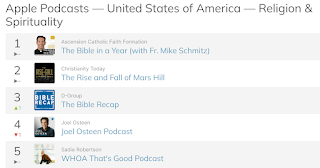
Ironically, the podcast has been a sensation of its own. Today it's ranked #2 in religion podcasts in the US. This probably says something about our our collective desire to hear grizzly tales of others' demise. It probably also points to how widespread these problems are in the church. I'm guessing it appeals to a lot of people who would like to understand a conservative brand of Christianity that prides itself on fidelity to Scripture but puts up with a bully in the pulpit. Probably all of these reasons. (As a side note, it's in very interesting company on the top 5!)

I've listened to The Rise and Fall in part because of its popularity. As an educator and lover of the church, I want to be in the loop about what people are hearing and how they are processing. If you've listened to at least part of the series, how has it personally challenged you? Leave me a note in the comments below.

Personally, I've been sobered by what well-meaning people will tolerate when a strong personality is at the helm. The podcast has given us much to lament. It renews my appreciation for institutional structures that have rigorous checks and balances in place. It's also a reminder that character matters a whole lot. For Driscoll, his popularity became the "proof" of his effectiveness and the "fruit" of "his ministry" -- but how many of those metrics could be traced to people who tuned in because they were incredulous? Just because people are listening, that doesn't mean the teaching is sound. The Old Testament prophet Jeremiah warned against false prophets who told people what their itching ears wanted to hear (Jeremiah 6:14).

If the podcast series has left you disillusioned about the church, a good next step might be to read Scot McKnight and Laura Barringer's book, A Church Called Tov (tov is the Hebrew word for "good"). It's on my short list of books to read next. McKnight and Barringer write about how to cultivate a healthy church culture where stories like this one will not keep happening. May the overwhelming popularity of this podcast awaken the church to stop tolerating abuses of power and instead cultivate communities marked by faithful and humble service!