Tuesday, July 31, 2012

gearing up for Christmas . . . in July?


Do you remember the series of posts I wrote on Advent in 2011? Perhaps you liked the idea of making an Advent Tree for your family, but lacked the time to make one during a busy holiday season. Don't let Christmas sneak up on you this year! Here's a friendly nudge to start getting ready now. I originally made ours in July . . . maybe you can make yours in August!


Click HERE to see all of my Advent Tree posts (including pictures, Scriptures, and devotions). If you decide to try it I'd love to hear how it goes!

Thursday, July 26, 2012

giants in disguise

One of our favorite parts of being missionaries is meeting godly men and women with deep faith and big hearts for what God is doing around the world. Remarkably, some of them have begun praying for us and supporting us without having met us! That’s true of three women from different time zones who (I’m convinced) are giants in the kingdom of God. They may prefer to be anonymous, so I've used pseudonyms here, but God knows who they are and their rewards are waiting in heaven!

Laverne heard about us from her son, our dear friend and mentor. She had a big heart for missions and a thriving business, left to her by her late husband. When she heard about our ministry she began supporting us right away. She was our biggest giver for several years before we finally had a chance to meet her. Her community service and hospitality matches her generosity. What a blessing to know her!

Charlene heard about us from a mutual friend in SIM. She began praying for us regularly when we lived in the Philippines, and has answered every one of our prayer letters with a hand-written letter. Recently her husband passed away and she moved to a retirement home. She took the time to tell us her new address, and it just happened to be right on my way home from Notre Dame. What a blessing to finally meet her and thank her for her faithful prayer support!

Anna Mae took her niece’s word for it that she should support us. When we first met we were struck by her gracious and cheerful spirit. Like Laverne and Charlene, Anna Mae had aged with grace and looked for ways to share joy with those around her. We’ve seen her several times, and always her selfless joy shines through.

Just after my visit with Charlene several weeks ago, I was in a minor car accident. Though I wasn’t hurt at all, our van was totaled. Our neighbors generously offered us the use of one of their cars until we found a replacement. Saturday we finally found it: the exact same van in excellent condition, one year newer and with 32,000 fewer miles. The price was much lower than we expected. Already confident that God had provided this van for us, we had no idea that he had another surprise up his sleeve. While we were out looking, he was silently arranging to help us pay for the van behind our backs. Imagine our shock when we found a check in our mailbox on Monday morning from Anna Mae. We can now pay for our van, taxes, fees, new tires and trailer hitch, with money left over!  Anna Mae simply saw a need and decided to meet it.

The giants in God’s kingdom are not who we might expect. They don’t necessarily live in major cities, hold positions of power, have a large following, or command attention. Some of them live quiet lives of faithfulness in small town America, praying fervently, giving generously, and letting the joy of the Lord splash on everyone they meet. Their noiseless acts of service are changing the world, one radiant smile at a time.

Thursday, July 19, 2012

Review of BibleWorks 9 (part 3): not your grandma’s textual criticism


For all you scholars out there, here is the third installment of my BibleWorks 9 review.

I’m listening to an old Michael Card CD (The Word) at the moment (yes, I know that dates me). He’s singing, “so many books, so little time,” and I couldn’t think of a better excuse for this very belated third installment of my BibleWorks review. The folks over at BibleWorks were so generous to provide me with an upgrade to version 9 free of charge in exchange for a series of reviews. In addition to being generous, they have proved very patient with a busy doctoral student. You can find my first two installments here and here.
Are you sitting down? On the floor? Ok, good.
If you’re wondering whether the upgrade is worth it, prepare to be blown away by what BibleWorks 9 can do. But first, think back to your first Greek exegesis course, the one where your professor showed you how to do textual criticism. If your experience was like mine, you felt like you had entered a foreign land. Greek seemed easy compared to the steep learning curve as you tried to make sense of the apparatus. Every little symbol referred to something else that also seemed obscure, with its own date, provenance, and stylistic tendencies. And your task was to take all these numbers, letters, symbols, and dates and produce a chart showing which reading had the strongest support. Think of how long it took to flip through your Greek New Testament trying to find the key to all those symbols.
Now imagine that your professor offered to follow you around for the rest of your career, reading the apparatus for you and loaning you all the charts he or she had painstakingly made of textual variants. Imagine that you could spend your time thinking about which reading was the best reading and what theological difference it made rather than trying to decipher codes.
You can stop imagining, because it’s true. BibleWorks 9 includes two complete textual apparatuses for the entire Greek New Testament (CNNTS and Tischendorf). Each and every symbol is hyperlinked to its description, and each and every variant in the CNNTS  includes a chart of all the manuscript evidence for that variant. It’s a Bible scholar’s dream.
But that’s not all. Say that you’re working on a particular problem and you notice that one prominent manuscript has a surprising reading. You want to investigate more closely, because the reading seems suspicious to you. Now, from the comfort of your own study, you can look at high resolution images of some of the major NT manuscripts right in BibleWorks (including Sinaiticus, Alexandrinus, Vaticanus and others). You can zoom in and out, change the lighting or the contrast, despeckle the image or adjust the sharpness. You can even view a photographic negative of the image to look for erasures, a change in handwriting, or help in deciphering ambiguous letters. The manuscripts are overlaid with hyperlinked verse references to the passages in any translation you choose, making navigation much easier. Learning how to use these new features is simple; detailed video tutorials are included.
I admit that part of me is tempted to tuck away what I now know in a dark corner somewhere, so that my students have to struggle as much as I did. But I’ve decided to be a hero and show them how to use these power tools. I’ll be sure to pepper my demonstration with stories of how rough the rest of us had it (“back in my day . . . “). Students will, of course, still need to learn how to decide between the strength of various witnesses. They will need to be aware of how geographical distribution of manuscripts affects textual decisions. And they will need to understand the principles of textual criticism and get practice applying them to particular cases. But all the ingredients for the text-critical cake have been assembled for them (and you!) in one easy-to-use location so they can focus on baking, not shopping for ingredients.
I have only one disappointment, but it is significant. Neither the text critical apparatuses nor the digital manuscript images are available for the OldTestament, and I’m told that it will be a good, long time (20 years?) before the gap is filled. (Perhaps I should have chosen a degree in New Testament!) But really these features are just the icing on the cake. BibleWorks is indispensable for rigorous study of the entire Bible, with or without these new power tools.

Tuesday, July 17, 2012

Review of BibleWorks 9 (part 2): spotlight on searching


BibleWorks 9
Last semester I learned how to do a search that is proving incredibly powerful (I wish I had taken the time to figure out how to do this a long time ago). I can now search in Hebrew or Greek for a key word in a certain tense or person (or whatever morphological tag I choose), occurring in a specified proximity to another word of my choosing. For example, in class Dr. Block was curious if the Hebrew Bible ever used the expression “walk after Yahweh” the way it talks about walking after other gods in Deut 8:19. He suspected it did, but didn’t remember where.
Since “walk” occurs 1349 times, “after” occurs 812 times, and “Yahweh” occurs 5195 times in the Hebrew Bible, it would be enormously time-consuming to scan through each reference to find where they occur together. Thanks to BibleWorks, within a minute I had the answer. I simply typed the Hebrew root letters for “walk” + “after” + “Yahweh”, with the symbol *3 to indicate that I only wanted to see those passages where these words occurred within the space of  3 words. Immediately BibleWorks gave us the answer we were looking for. The Bible does indeed use this expression to refer to Yahweh. It is found in only 2 places: 2 Kings 23:3 and 2 Chr 34:31 (parallel passages!). There, Josiah is renewing Israel’s covenant with Yahweh (after reading Deuteronomy!) and affirming that he will not follow other gods, but Yahweh alone — a very interesting correlation.
For the sake of being thorough, I should add that this search did not bring up passages where Yahweh is talked about in the first person or as “he” (without using his personal name). Thanks to Moshe Weinfeld’s ‘Deuteronomy and the Deuteronomic School’ (332) I have discovered there are several more passages where this idiom is used referring to Yahweh: 1 Kgs 14:8; 18:21; Hos 11:10; and Jer 2:2. It would have taken a bit more time for me to come up with these using a BibleWorks search. I could have first narrowed by search to “walk” + “after” and then manually checked the results, or I could have tried a number of more specific searches such as “walk” + “after” + “me” and then checked the context of each. In most cases my initial search would suffice to help me find examples. 
I’ve said it before, but I simply can’t imagine attempting an MA or PhD in Biblical Studies without BibleWorks!

For Part One of my review, go here.

Sunday, July 15, 2012

Review of Bibleworks 9 (part 1): a few of my favorite things

BibleWorks 9
is Now Available!

At Gordon-Conwell my professors recommended that I purchase BibleWorks software to help me study the Bible in Hebrew and Greek. I've been using BibleWorks now since 2007, and honestly, I can't imagine trying to study the Bible without it. I've used versions 7, 8, and now 9, and it just keeps getting better. I was glad to discover that my doctoral supervisor, Daniel Block, uses it as well for his own research. Here are the principal ways I use it:
  • I have BibleWorks open on my laptop in all of my Bible classes. In a matter of seconds I can look up any passage the professor mentions and see it for myself in dozens of translations. I can do a quick search to find related passages and know that I’m looking at every passage that matches my search criteria.
  • I have not opened the NIV Exhaustive Concordance in the past 5 years. It’s much faster to check BibleWorks. I can search in English, Greek, Hebrew, or any of the major modern languages such as Spanish, French, or German (not Tagalog, unfortunately). I can search by exact word or phrase in any language, or by root word in Hebrew, Greek, or Aramaic.
  • I rarely use a Hebrew or Greek lexicon (is it ok to admit that?), unless I’m performing an exhaustive word study for which I need to consult both Bible Dictionaries and Lexicons. Just by rolling my mouse over any word in the Bible, I have immediate access to lexical entries from Holladay (for Hebrew) or Gingrich (for Greek). BibleWorks speeds my translation process without using an English translation as a crutch. I can work directly from Hebrew to see the definitions of any word I don’t already know. If I come across a strange grammatical construction, I can instantly compare all my favorite translations to see how they handle the passage.
  • I have used BibleWorks to learn both Hebrew and Greek vocabulary, and I plan to use it for Aramaic. The BibleWorks flashcards are the best I’ve seen anywhere. I can sort words alphabetically or by occurrence, work on words that occur in a particular passage, time myself, hear them pronounced, and print review lists to have in front of me in class. Best of all, BibleWorks keeps track of the words I know and don’t know, so that my review time focuses only on the words I have yet to learn.
The folks over at BibleWorks were kind enough to provide me with a free upgrade to their latest version in exchange for a detailed 3-part review in both of my blogging venues (both here and at the Wheaton blog: www.wheatonblog.wordpress.com). Like any new program, it takes some time to learn how to use, but BibleWorks 9 provides plenty of training videos and helpful instructions, as well as occasional seminars on site at schools around the country. I do not consider myself technologically gifted (blogging is about as savvy as I get), yet I couldn’t get along without BibleWorks.

Thursday, July 12, 2012

penance, indulgences, and the treasury of merit: modes of restoration in the Catholic Church


"The Confession" by Pietro Longhi

In my final post on Catholic teaching, I’d like to focus on a collection of related issues that have puzzled Protestants since the Reformation: Penance, Indulgences, and the Treasury of Merit. These are foreign concepts to those outside Catholicism, but the Catechism of the Catholic Church helped me understand them more fully.

The first thing to know about Penance is that it is considered a sacrament of healing for those who are already members of the Church. Catholics count seven sacraments, all of them instituted by Jesus in some way. Baptism, Confirmation, and the Eucharist are sacraments of initiation into the faith; Penance and Anointing the Sick are sacraments of healing for believers; and Holy Orders and Matrimony relate to communion and mission (§1211). The place of Penance in this list is very important to note. Penance is not a means of salvation, but plays a restorative role for believers who have committed sin. It can be called many things: conversion, confession, forgiveness, and Reconciliation (§1423–1424). While Baptism ushers us into new life in Christ, it does not erase our propensity to sin. The sacrament of Penance recognizes that ongoing struggle against sin and provides a means by which a sinner can be restored (§1426).

The CCC takes sin seriously, and calls for heartfelt repentance in response to God’s great mercy (§1428). But Catholics don’t stop there. Penance addresses both the internal and external aspects of sin: “interior conversion urges expression in visible signs, gestures and works of penance” (§1430). Internally, we renounce our sin and turn back towards God, cultivating once again our love for him. Love for him is the purest defense against sin (§1431–1432). Externally, Penance can take any number of forms: “fasting, prayer, and almsgiving” (§1434), “gestures of reconciliation, concern for the poor, the exercise and defense of justice and right, by the admission of faults to one’s brethren, . . . acceptance of suffering” (§1435), Eucharist (§1436), or reading Scripture (§1437), among other things. Each of these actions orients the heart of the sinner to God’s mercy and prepares them for his forgiveness.

A modern-day confession
Protestants often think of sin in personal terms, and view repentance as a private thing. This is not, however, a biblical notion. In keeping with Scripture, Catholics recognize a two-fold dimension to sin. Not only is our relationship with God disrupted, but so is our relationship to the Church. For that reason, restoration involves a renewed submission to the Church via confession to a priest (§1440). Ultimately, the forgiveness comes from God, but priests serve as his authorized representatives. Priests absolve sinners, or declare them “not guilty” based on the clear delegation of this authority to Jesus’ disciples in Matthew 16:19 and John 20:21–23 (§1441–1445; 1462–1467). The CCC insists “Reconciliation with the Church is inseparable from reconciliation with God” (§1445). Penance is usually “performed in secret between penitent and priest” (§1447), who promises confidentiality (§1467), and involves three steps: contrition (sorrow over the sin), confession (full acknowledgment of wrongdoing), and satisfaction (making restitution for wrongs committed) [§1450–1460]. I love what the CCC says about confession: “Through such an admission man looks squarely at the sins he is guilty of, takes responsibility for them, and thereby opens himself again to God and to the communion of the Church in order to make a new future possible” (§1455).

Why does restitution need to be made? The CCC explains, “Absolution takes away sin, but it does not remedy all the disorders sin has caused. Raised up from sin, the sinner must still recover his full spiritual health by doing something more to make amends for the sin” (§1459). Our kids have a favorite radio program that illustrates the need for restitution. It’s part of the series produced by Focus on the Family called Adventures in Odyssey. In one episode, Rodney Rathbone (a consummate troublemaker), climbs a neighbor’s fence and steals some apples. In the process he breaks the fence. When he is caught, he thinks that saying “sorry” will be enough. But time shows that Rodney has failed to learn his lesson from the experience (he beats up another kid who owes him a dollar, forgetting the mercy that he had just been shown). The local police pick him up and bring him back to his neighbor’s house, where he learns what the word “restitution” means. He is asked to either pay the homeowner the cost of repairing his fence or repair it himself. In the Catholic Church, the ‘action step’ required is assigned by the priest, who carefully considers what act of penance will bring about spiritual fruit in the confessor (§1460).

Penance, then, is not trying to earn God’s grace or forgiveness, but is seeking to restore/repair the broken relationship with God and with the Church (§1468–1469). It is an act that “anticipates in a certain way the judgment to which he will be subjected at the end of his earthly life” when God judges the works of all people (§1470, emphasis original). You might think of it like a therapy undertaken to infuse spiritual strength. A broken shoulder doesn’t just need a cast. One the bone has been healed (=forgiveness), the person goes through therapy to build up the muscles and tissues that will allow for full movement again (=penance).

Included within the sacrament of Penance is the concept of Indulgences. The abuse of Indulgences was one thing that sparked the Protestant Reformation. Dr. Cavadini explained to me, "Indulgences are easily prone to abuse. The Church doesn't talk about them all that much nowadays, although they are still available for pious practices that are designed to help us put into practice the grace of repentance (e.g. practices of prayer and, sometimes, almsgiving to the poor)." The CCC explains what the Church today believes about Indulgences. First, a definition:

"An indulgence is a remission before God of the temporal punishment due to sins whose guilt has already been forgiven, which the faithful Christian who is duly disposed gains under certain prescribed conditions through the action of the Church which, as the minister of redemption, dispenses and applies with authority the treasury of the satisfactions of Christ and the saints" (§1471).

A few things about this definition should be noted. Indulgences do not offer forgiveness. Forgiveness has already been given by God. Instead, Indulgences cover the punishment or natural consequence that remains (the same punishment that Penance is designed to address). This remaining punishment (mediated through Penance) purifies sinners from the “unhealthy attachment to creatures” (§1472–1473). But this is not a lonely, individual purification. Believers share in the “communion of saints,” about which the CCC says, “In this wonderful exchange, the holiness of one profits others, well beyond the harm that the sin of one could cause others. Thus recourse to the communion of saints lets the contrite sinner be more promptly and efficaciously purified of the punishments for sin” (§1475).

We must remember that these sins are not those committed by unbelievers, but by those who have already been baptized into the Church and have since fallen. And though the doctrine can include minor, everyday sins, it is designed to address major sins such as adultery and murder. For these sinners, the Catholic Church identifies the rich storehouse of merits laid up by Christ, Mary, and other saints (§1476–1477). Just as believers share their possessions and so meet one another’s needs, so the Catholic Church believes that these spiritual treasures can be shared with those in need. Based on the authority that God granted to the apostles (noted above), the Church dispenses Indulgences, not to simply excuse sin, but “to spur [fallen Christians] to works of devotion, penance, and charity” (§1478). This undeserved grace evokes gratitude and service. Indulgences may also be applied to those who have already died and are in the process of purification in Purgatory (§1479, 1498).

This is all very unfamiliar territory for Protestants, so perhaps it will help to get a picture of how the process of Penance actually works. The CCC describes it this way:

The elements of the celebration [of Penance] are ordinarily these: a greeting and blessing from the priest, reading the word of God to illuminate the conscience and elicit contrition, and an exhortation to repentance; the confession, which acknowledges sins and makes them known to the priest; the imposition and acceptance of a penance; the priest’s absolution; a prayer of thanksgiving and praise and dismissal with the blessing of the priest. (§1480)

Though even Catholics resist the idea of Confession,
the Church encourages the practice at least yearly
The confession of sins is a very biblical concept, one that Protestants could practice more often (James 5:16). And, strange as it may sound to our ears, Jesus clearly does grant authority to his disciples to proclaim forgiveness of sins (John 20:19–23). Based on the Catholic idea of apostolic succession (the passing down of authority for church leadership from the apostles to present-day priests), it makes sense that priests would be the ones granting absolution from sin. Second Corinthians 5:21 describes how Jesus’ merits benefit us: “For our sake he made him to be sin who knew no sin, so that in him we might become the righteousness of God” (NRSV). Protestants believe, too, that we are recipients of God’s great grace in Jesus Christ. While our understanding of the mode of its application to us may differ, we can stand side-by-side with Catholics in praising God for the work of redemption in Christ. And from Catholics we can be reminded of the need to repent of our sins and work for the restoration of relationships broken by our sin.

Wednesday, July 11, 2012

of Popes and Bishops: Catholic Ecclesiology


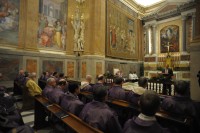
Dr. John Cavadini offers a reading at Mass with Pope Benedict XVI
and the other members of the International Theological Commission
on the occasion of his appointment to the Commission in 2009.
Click here for the full story.

One of the most obvious differences between Protestants and Catholics is church structure. Hierarchy of any kind is not at all in vogue in our culture. In American Protestant churches, especially among Evangelicals, the democratic ideal has won the day. Congregational meetings include voting, elder and deacon boards reign in the authority of the Pastor, and if people don’t like how things are going, they find another place to worship. For Evangelicals the hierarchy of the Catholic Church seems foreign. But before we talk about the structure of the Church, we need to say a few words about what the Church actually is.

The Catechism of the Catholic Church (CCC) describes the Church as a mystery, created by Christ, into which he brings people by setting them free from sin and death. The Church is not a club or voluntary organization. It is ordained by God to carry out his mission in the world by preserving and teaching the true faith. The Catholic Church recognizes the diversity of gifts that make up the body of Christ. In no way are those with organizational and leadership gifts exalted over those with “charismatic” gifts. Both are needed for a healthy Church to function. The Church is not perfect, but in the process of becoming what God has designed it to be.

The CCC teaches that the Church is the people of God, made up of those who have been baptized and therefore have taken on Christ’s mission (§871). Believers enjoy “a true equality with regard to dignity” and all participate in the work of the Church by exercising their spiritual gifts (§872). However, the offices of “teaching, sanctifying, and governing” the Church have been entrusted “to the apostles and their successors” (§873). This authority for bishops, priests, and deacons is derived from Christ himself (§874–875), who modeled servant leadership (§876). Bishops do not wield authority on their own, but as members of the collective group of bishops (called the “episcopal college”) under the leadership of the bishop of Rome, who is thought to be St. Peter’s successor (§877). Each bishop personally bears witness to the gospel as they serve the Church (§878–879).

The idea of the episcopal college is modeled after the 12 disciples of Jesus, and Peter’s headship over the 12 is based on his profession of faith, to which Jesus responded “on this rock I will build my Church” (§880–881; Matt 16:18–19). The Bishop of Rome, who succeeds Peter in authority, is called the “Pope” (§882; cf. 869, 936). He unifies the Church, and “as pastor of the entire church has full, supreme, and universal power over the whole Church, a power which he can always exercise unhindered” (§882; cf. 937). Whenever the episcopal college agrees with the Pope, they, too, exercise this authority through universal and ecumenical councils (§883–884).

However, lest we think of this “power” exercised by the Pope and Bishops from a worldly point of view, it’s important to understand that their “power” is a responsibility to serve the Church and to protect her from error. Their service is one of great personal sacrifice. Each is committed to lifelong celibacy, modeling, in a sense, Christ’s marriage to the Church.

Pope Benedict XVI greets Dr. John Cavadini
of Notre Dame, congratulating him on his appointment
to the International Theological Commission
Like the Pope, bishops are the symbol of unity for their own diocese. They care for their members and meet with larger groups of bishops (“ecclesiastical provinces,” “patriarchates,” or “regions”; §887; cf. 938). A bishop’s primary responsibility is preaching, ensuring that the congregation clings to the faith “under the guidance of the Church’s living Magisterium” (§888–889).* The other responsibilities of a bishop include “sanctifying” the Church through providing Holy Communion, praying, and serving (§893). Priests or deacons may be involved in service, but ultimately the bishops are responsible for what takes place (§1369; 939). Bishops also exercise governing authority to the degree that they are “in communion with the whole Church under the guidance of the Pope” (§894–895). In other words, the authority of the bishops is a communal authority. A bishop cannot strike out on his own and expect to be obeyed. His compassionate (and submissive) leadership guides his congregation in the way of truth (§896).

One controversial teaching of the Catholic Church is the “infallibility” of the Pope and the bishops when they agree together on doctrine. It may be helpful to know that only twice in church history has the Pope pronounced a doctrine as infallible (the Immaculate Conception and the Assumption of Mary). This “infallibility” cannot extend beyond the teaching of Scripture (§891–892), though it may be related typologically to it (as it is in both of the above cases). The Pope’s infallibility is derived from the infallibility of Scripture. Like a plumb line for the Church at large, the Church in Rome sets the standard to which all Catholic Churches must adhere (§834; again based on Matt 16:18–19).

For Catholics this hierarchy is very biblical. Based on Jesus’ choice of 12 apostles and his exaltation of Peter, Catholics recognize an unbroken succession of authority that has been passed down to the present day and now resides in the Pope (bishop of Rome) and the episcopal college (bishops around the world). The appointment of bishops, priests and deacons corresponds to New Testament guidelines for bishops, elders (or presbyters), and deacons. Catholics take seriously the unity of the Church and the accountability required to preserve true teaching. All authority is derived from Christ and used in service of the Church, not for personal gain. To the extent that this ideal is realized, one can say that the structure is biblically-derived.

Pope Benedict XVI
Even the most egalitarian and congregational Protestant Church has some authority structure. We may use different titles for those invested with authority in the Church, but we share the concern for unity, sound teaching, compassionate ministry, and purity of example. Authority and submission are biblical concepts, when exercised properly. No system is perfect, of course, but the diversity of models for Church governance should make us hesitant to condemn any one model as inadequate. Whether particular doctrines thought to be pure by the Magisterium truly are biblical is another question, but the structure itself need not be rejected out of hand.

* Dr. Cavadini explained it to me this way: “The Magisterium is the teaching authority of the Church. It first and foremost belongs to the whole Church, but it is exercised on behalf of the Church by the successors of the apostles (i.e. the bishops) in communion with and in union with the successor of Peter (i.e. the pope). The Magisterium makes decisions about what is authentic Christian teaching when necessary.” The CCC says that the bishops responsible for teaching must “preserve God’s people from deviations and defections and to guarantee them the objective possibility of professing the true faith without error” (§890).