Showing posts with label gender. Show all posts

Thursday, December 29, 2022

Best Books of 2022

Many books that cross my desk are aimed at students or laypeople, rather than biblical scholars. I read and enjoy many of them in order to be able to recommend them to students and others interested in biblical studies. I leave at least a brief review of all the books I read on GoodReads. Of the 40 books I read this year, I'm limiting my "best books" list to those that were game-changers for me personally. 

Each of the following six books is not only beautifully written and impeccably researched, but opened up new vistas in how I think about God, Scripture, and the life of faith. I'm so grateful for the hard work that went into writing each one and to all those who were involved in releasing these to the world.

Women and the Gender of God, by Amy Beverage Peeler

This is a daring book. Amy Peeler tackles a controversial issue: the gender of God and its implications for women. For some, to raise these questions at all is objectionable. For others, Peeler's high view of Scripture will suggest that she herself is captive to patriarchy. However, readers who take the time to engage her argument will find that neither critique has merit.

Like it or not, many people today reject the Christian faith because of their perception that the Bible portrays God as masculine/male. Is the Bible even good for women? Peeler patiently shows why these questions are worth asking and how the Bible itself offers a robust response that both affirms women and glorifies God, without making God male. Part of her answer is to help Protestants recover the biblical portrait of Mary.

Peeler's grasp of the secondary literature is impressive. Her arguments are sophisticated and theologically astute. She is attentive to nuance in Scripture, and her faithful reading yields an illuminating vision of a good God who invites women to be full participants in God's work in the world. I'm so grateful for her work. I expect it will be an essential resource for years to come.
 

Cursing with God: The Imprecatory Psalms and the Ethics of Christian Prayer, by Trevor Laurence

A remarkable work--lyrically inspiring and imaginatively compelling. For many, it will represent a paradigm shift. Laurence not only rehabilitates the imprecatory psalms for use by the church, but he demonstrates their compatibility with Jesus' call to love our enemies. This is more than a treatise on imprecation; Laurence offers a profound work of biblical theology in service of the church. He draws our attention to imprecation hiding in plain sight in the New Testament, and he charts a path for churches who are ready to recover this neglected aspect of the whole counsel of God. In a world plagued by injustice, this book is a gift we urgently need.

One of my favorite things about this book is the sample liturgy in the appendix. Although this is the published version of Laurence's dissertation, he offers such practical help for church leaders who want to shepherd their congregations in praying the imprecatory psalms.

Paul and Gender: Reclaiming the Apostle's Vision for Men and Women in Christ, by Cindy Westfall

In the stuffy room marked "Paul's Views on Women," where a weary debate has been at an impasse for centuries, Westfall raises the blinds and throws open the windows, letting in light and fresh air.
With my three degrees in theology and four-and-a-half decades in the church, I thought I had heard it all. But just ask my husband (at home) if he's ever seen me gasp so many times while reading in bed, and if I've ever interrupted him so many times to read him a sentence or a paragraph.

Westfall's conclusions are carefully researched and well argued. She has a way of turning things inside out to help readers see what was right there in the Bible all along. Her book simultaneously delighted and depressed me. If she's right -- and I think she is -- then some corners of the church have unnecessarily missed out on hearing the Spirit-empowered voices of women for a very long time.

Church leaders, I beg you to read this book. You can't afford not to.

Abuelita Faith: What Women on the Margins Teach Us about Wisdom, Persistence, and Strength, by Kat Armas 

Magnificent!

Kat's exegesis is impeccable and her stories are captivating. She weaves personal and international stories with stories of women in the Bible. The result is a compelling invitation to reconsider what counts as theology and to (re)discover the voices of those hiding in plain sight. An absolute must read. I devoured it in one day!


Disability and the Way of Jesus: Holistic Healing in the Gospels and in the Church
, by Bethany McKinney Fox

Fox's book is such a gift to the church. The opening chapter was worth the price of the book! It shifted the way I think about disability. Each chapter addressed Jesus' healing ministry from a different angle--first century context, medical perspective, disabled persons' perspective, and pastors' perspective--followed by chapters on the seven marks of healing in the way of Jesus and the seven ways this can be lived out in the church. 

Although the first six chapters focus primarily on physical disabilities, the final chapter offers many ideas on how to include people with intellectual disabilities in the church. One of Fox's big ideas is that inclusion of people with disabilities is not simply an act of compassion modeled after Jesus, but that people with disabilities have so much to offer the church. She advocates for full inclusion of people with disabilities in the decision-making and ministries of the church and challenges us to re-think our services so that they are less reliant on verbal proclamation and more holistic and multi-sensory. I'm grateful for her careful thinking and clear vision. It's usefulness goes beyond the church -- this book has given me much to think about with regard to college classroom instruction and campus life. It was well worth the read!


Jesus and the Forces of Death: The Gospels' Portrayal of Ritual Impurity within First-Century Judaism, by Matthew Thiessen

An excellent reexamination of Jesus' healing narratives, demonstrating that Jesus did not disregard Jewish law. Several of his healings focused on those suffering from ritual impurity caused by lepra (a skin disease sometimes erroneously translated "leprosy"), genital discharges, and death. Rather than set aside the ritual purity system, Jesus removed the sources of ritual impurity, showing that his power was even greater than the temple.

Theissen includes a chapter on exorcisms and on Jesus' Sabbath "violations" as well as an appendix on dietary laws. These contribute to the overall picture that Jesus upheld Jewish law.
 

So much of what Thiessen points out is evident to those reading closely, but somehow with all my years reading and studying the Bible I had missed it. An illuminating book!

----

What's the best book you read this year? I'd love to hear about it in the comments below!


Sunday, September 4, 2022

Review of Cynthia Long Westfall, 'Paul and Gender'

Photo of Cynthia Long Westfall's book, Paul and Gender
Photo: C Imes
Cynthia Long Westfall's Paul and Gender: Reclaiming the Apostle's Vision for Men and Women in Christ is a tour de force. 

It's not a new book (c. 2016), but I finally took the time to read it, and I'm so glad I did.

Dr. Westfall is a graduate of Biola (where I teach), and currently serves as Associate Professor of New Testament at McMaster Divinity College in Hamilton, Ontario, Canada.

In the stuffy room marked "Paul's Views on Women," where a weary debate has been at an impasse for centuries, Westfall raises the blinds and throws open the windows, letting in light and fresh air. With my three degrees in theology and four-and-a-half decades in the church, I thought I had heard it all. But just ask my husband (at home) if he's ever seen me gasp so many times while reading, and if I've ever interrupted him so many times to read him a sentence or a paragraph.

Here are a few nuggets:

  • "Pauline theology of ministry was based on metaphors of slavery and service so that any believer (gentile, slave, or female) could assume any function in the house church without violating the hierarchy of the Greco-Roman culture" (6; cf. 266). Later she explains that words like "pastor" and "deacon" were not technical terms until long after the New Testament. We associate them with prestige and authority, but they would not have had that connotation to Paul's recipients.
  • Westfall problematizes the simplistic views of Greco-Roman authority, showing the many men were under women's authority (as children, slaves, or clients to wealthy women) and that most women had some measure of authority in the domestic sphere (e.g., pages 23, 267).
  • She notes in that context a woman's "unveiled head signified sexual availability, so that a woman slave or a freedwoman was prohibited from veiling" (29). Therefore, "Paul's support of all women veiling equalized the social relationships in the community . . . [and] he secured respect, honor, and sexual purity for women in the church who were denied that status in the culture" (33-34).
  • Paul regularly used male metaphors for all believers and female metaphors for those in church leadership. "Paul's use of maternal imagery for pastoral care illustrates a compatibility of pastoral care with feminine commitment and the female role of nurture" (53).
  • Westfall argues cogently that "head" in Paul is a metaphor that relates to source rather than to authority. While she is not the first to contend for this reading, I found her explanation particularly insightful. "Christ is the source of man's life because he is the creator who formed man in Genesis 2:4-9. Man is the source of woman's life because she was created out of man in Genesis 2:18-23" (86).
  • She demonstrates from Paul's own letters that Paul does not believe women are more prone to deception than men. "Women as well as men in the Christian community are in danger of deception, but the same remedies are available: biblical correction and teaching" (116).
  • Westfall explains the historical background that likely prompted Paul's strange statement about women being "saved through childbearing" (1 Tim 2:15). "Artemis was the patron goddess of the city of Ephesus, and she was literally the savior to whom the women went for safety and protection in childbirth" (136). It is very likely that in 1 Timothy 2, Paul is addressing false teaching in Ephesus and urging women to trust God to watch over them during their vulnerable experience of childbirth.
  • On eschatology, she writes, "According to Paul, there is no differentiation in humanity's destiny on the basis of gender, race, or status. Women, as well as gentiles and slaves, have a shared destiny of authority and rule... Women cannot have a final destiny that was not their intended purpose of function at creation. Rather, it is a transcendent norm for men and women to share dominion" (147).
  • Paul is counter-cultural. "Christianity undercut essential patriarchal rights by requiring men to be faithful in the same way that the culture had required women to be faithful" (203).
  • She explains that in Greek, "Masculine is the default gender, and it cannot be assumed that women are excluded as referents form masculine nouns, pronouns, and so forth, particularly in catchphrases, unless they are excluded by the context" (270).
  • Westfall notes that Paul's letter to Timothy was personal, addressing specific problems in the congregation in Ephesus. "A document like Paul's Epistle to the Romans would have been a more logical place to make a clear prohibition on women teaching and in ministry" (297).

I cannot do justice to this rigorous book with a list of bullet points, but I wanted to give you a taste of the sorts of claims she is making. Westfall's conclusions are carefully researched and well argued. She has a way of turning things inside out to help readers see what has been hiding in plain sight. Her book simultaneously delighted and depressed me. If she's right -- and I think she is -- then this book offers good news for women who have long felt called to ministry in the church. But at the same time, Paul and Gender saddens me. I feel the weight of the fact that some corners of the church have unnecessarily missed out on hearing the Spirit-empowered voices of women for a very long time.

Church leaders, I beg you to read this book. You can't afford not to.


Friday, February 11, 2022

Becoming Human: My Visit to an SBC Seminary

It was an unlikely invitation. 

Would I travel to Wake Forest, NC to speak on personhood at Southeastern Baptist Theological Seminary? 

I, who am neither a member of the SBC nor the daughter of a member of the SBC. 

I, a woman who teaches Bible and even preaches on occasion.

It was not my first SBC connection. First, my book appeared in the book store at The Southern Baptist Theological Seminary in Louisville, where Al Mohler is president back in early 2020. (Unexpected!) Then, the same book was a finalist for an award from Midwestern Baptist Theological Seminary in Kansas City. (Who knew?!) The next thing I knew, Lifeway Publishing asked me to contribute to a women's study Bible. (Huh.) And then Southern invited me to present my research to their PhD students and faculty over Zoom in 2021. (!!)

And then this. A plenary address at an SBC seminary. What did I have to lose? Plenty, actually.

As I said, I'm not a member of the SBC. But I am SBC-adjacent. I'm close enough to the movement to know that all is not well. I watched Beth Moore walk away (gulp!). I watched Russell Moore make his exit (wow.). I saw the troubling statement released by the six white SBC seminary presidents on Critical Race Theory -- a statement crafted without the input of any people of color or anyone who had even studied CRT (um...). I watched talented African American leaders cut ties with the denomination. I waited on pins and needles while the delegates voted for a new president at last year's convention, and while they decided how to handle allegations of sexual abuse and how to care for survivors. I groaned a few months later when the Executive Committee waffled over whether to submit to outside investigation.

I care very much where things go in the SBC because the denomination wields enormous influence. People's faith and health are at stake. And so is the witness of the church at large.

Here was my conundrum: attending the conference would allow me to learn from the other presenters and work on issues related to my current book project and get feedback. But would taking the stage at an SBC seminary somehow align me with the denomination and its problems? Would it make me complicit? (If you think I'm overreacting, consider that the invitation was issued from a building named after Paige and Dorothy Patterson, the seminary's notorious former president and his wife.)

I concluded that I could not participate without addressing the problems as I see them. I refuse to pretend that all is well. It would be irresponsible to talk about the biblical doctrine of the image of God without pointing to the myriads of ways that evangelicals as a whole and the SBC in particular have failed to live these truths. That would compromise my integrity.

So I took a deep breath, said yes, and submitted this title:

The Rise and Fall of the Imago Dei?: Assessing Evangelical Theology and Practice

My title intentionally evoked the long-form journalistic podcast produced by Christianity Today that investigated a particularly egregious form of "evangelical" ministry with a narcissistic leader. I took my cues from Mike Cosper, who demonstrated the value of evangelical self-critique. Here is my abstract:

Evangelicals all agree that human identity and vocation are rooted in the creation accounts of Genesis, but the particulars are often a matter of debate. We’ll consider the recent work of several evangelical scholars on the imago Dei—Ryan Peterson, John Kilner, Catherine McDowell, and Richard Middleton—each of whom has clarified Old Testament teaching in profound ways. Building on their work, we will reassess the priorities of the contemporary evangelical church and suggest ways of embodying practices that align with Scripture’s clear teaching on the imago Dei.

Carmen Imes speaking at the Exploring
Personhood Conference sponsored by
the Bush Center for Faith and Culture
(Photo: Chip Hardy)
The first half of my presentation drew out insights from the four scholars named above, with a bit of extra nuance from me in the area of gender. But then came the scary part -- I addressed head on the ways that evangelicals have failed in three broad areas: sanctity of human life (ahem, after birth), partnership of men and women, and creation care.

My talk will be posted soon on the Bush Center for Faith and Culture's website, so there's no need for me to repeat the litany here. It's enough to say that I pointed to examples of racism, ableism, sexism, LGBTQ-related issues, inhospitality to singles, failure to protect and advocate for victims of abuse, and neglect of creation care. I hit all these hot topics, issued a clear call for change, and cast a vision for a different way of living out what we say we believe. With my integrity intact, the question became 'would I lose my voice?' Would this be the first and last opportunity to speak on this campus?

I've been mulling over all of this for months, reading widely, and imagining how this might go. I asked people to pray and I prayed about it myself. I sought advice and wondered if this was career suicide. In the end, I said what I felt I must be said with as much love and empathy as I could muster. One thing is true -- of all the possible reactions I imagined, a standing ovation was not one of them. Everyone clapped, and more than half a dozen stood in solidarity.

Conference Panel Discussion
(Photo: Bush Center for Faith and Culture) 
This message struck a chord with so many, who thanked me with tears in their eyes. Faculty, students, and guests alike shook my hand and new friendships were born. To be clear, the warm reception is not a sign that all is well, of course. It's a sign that the problems I listed truly are problems. On that we agree.

And this is what gives me hope.

Because agreeing on the problem is the first essential step toward finding solutions.

So now the real work begins. Now we must invest our energies into the work of listening to new voices, reexamining how we do things, building new alliances, and prayerfully finding new ways forward. Change takes time, but the road is not so lonely as it seemed.

This conference taught me something about human personhood that was not on the stated agenda: Caricatures are difficult to maintain in person. I'm under no illusion that 48 hours on campus gave me an accurate picture of the SBC as a whole, or even SEBTS in particular. But it reminded me of the value of embodied community and courageous conversations. It showed me that the loudest voices on Twitter do not always (or even usually?) represent the majority. I found far more allies than I dared to hope. I'm relieved that a bridge has been built, rather than burned.

As we learned from Dr. Justin Barrett, compared to animals, humans are immensely social creatures capable of shared attention, mental space, expertise, and cooperation across a remarkably large group of unrelated humans. I saw this in action at Southeastern. 

Father John Behr and Dr. Jeff Schloss both talked about the telos of love, helping us think about the uniquely human capability of self-sacrifice for another. According to Behr, it is in laying down our lives for another that we truly become human. I felt this in the way people thanked me for saying hard things, and in the way Dr. John Hammett offered loving pushback to each of us.

If Behr is right, then all of us who participated in this exchange became a bit more human this week.

For that I am profoundly grateful.

Tuesday, January 21, 2020

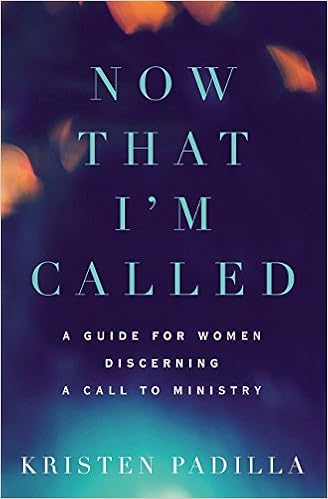
Author Interview: Kristen Padilla, "Now That I'm Called"


Image result for now that i'm called kristen padilla
Today I had the privilege of interviewing Kristen Padilla about her book entitled Now That I'm Called: A Guide for Women Discerning a Call for Ministry (IVP 2018). I have already recommended her book to students multiple times, so it was great to hear the backstory of the book.

Since the particular roles open to women differ from one denomination to another, Kristen explores ways that women from all kinds of churches can walk in obedience to God's call to participate in his mission. In her book, she says, "I want people, especially women, to understand that receiving this kind of call does not mean that they must hold a church office -- the role of a pastor, elder, or deacon, for example. The Holy Spirit gives gifts to the people of God, and these gifts can be exercised outside of a particular office in the church" (13). Her approach makes this book suitable for women from churches across the theological spectrum.

What inspired you to write this book? I was inspired to write this book for several reasons. First, I wrote this book because I saw a need for it. When I was a young woman sensing a call to vocational ministry, I had no one and no resource to guide me through the discernment process, the questions pertaining to being a woman in ministry, and next steps. As I say in my book, I felt like I was in a dark room with my arms outstretched trying to find my way to the door. By the time I was in seminary and had conversations with other women my age or younger called to ministry, I realized my story was not unique—it was the story of many women called to ministry. Thus, God put the idea and passion for this book in my heart, and ten years later it finally came to fruition. Second, I wrote this book out of a deeply held biblical conviction that God calls women to gospel ministry and that the Church of Jesus Christ needs women who are called by God to engage in gospel ministry in the church and world. I wanted to write a book that would encourage and aid these women in the journeys of discernment for the purpose of equipping future generations of female ministers of the gospel.

What was the most difficult aspect of the project? The most difficult aspect of writing was perhaps the most obvious one: writing a chapter on 1 Timothy 2:11-15. As many know, this passage has been used to silence and forbid women from many avenues of gospel ministry. It is the battleground where most of the fighting regarding women in ministry takes place. In my mind, I could not write a book for women called to ministry without addressing this passage of Scripture. However, I wanted to demonstrate a fidelity to the authority of Scripture and a humble and generous interpretative posture and tone. I also wanted to address head-on problematic and false interpretations that have held many women from pursuing ministry, namely that the female gender is by nature more easily deceived and that a certain “creation order” is a fail-proof guard against false teaching.

Author Kristen Padilla
What do you want readers to take away from your book? I want readers to walk away with a theological and biblical vision for women in ministry. I want them to see in Scripture that God’s plan has always included women and that women play an equally vital and important role in gospel ministry. My prayer is that women who read the book walk away with confidence grounded in Scripture and theology to follow God’s call to serve him in whatever role he has called them in obedience and humility.

Your book occupies the unpopular middle ground between the debate over women in ministry–not progressive enough to satisfy those who ordain women and too progressive for those who don't. What was your heart behind writing for those in this middle space? This is a great question. One of the first responses I received from the book was told to a friend of mine, “I wasn’t sure if she was complementarian or egalitarian.” A compliment or a criticism? I made the decision early on to write a book from that neither-complementarian-nor-egalitarian space or the in-between space for two reasons. First, I wanted the book to meet women in churches and traditions on both sides of this interpretive divide. My goal is to address the beginning of one’s call to vocational ministry—to lay the groundwork, if you will. Therefore, secondly, I did not see the need to talk from a strictly complementarian or egalitarian perspective, whatever that means today, since my goal wasn’t to talk about ordination or roles per se. I believe these two approaches have more in common than is often acknowledged. Most women in these so-called camps are tired of the debate and want to focus on the question: does God call women like me to serve him in ministry? I actually believe that this “in-between” space includes many women. This does not mean I do not have a particular interpretation of 1 Timothy 2:11-15 nor does it mean I am somehow theologically neutral when it comes to the roles of women in ministry. However, I did not believe it would be helpful to advocate from one perspective or another given the purpose of this book. Some will “blacklist” books if they are written from the other “side.” Even though I tried to stay in that middle space, I knew that for some my book would not be complementarian or egalitarian enough and would therefore be censored. This is indeed what has happened. In spite of this, I strongly believe that there is a strong middle and ecumenical ground where conversations about women in ministry can and should take place. I pray the posture and position I take in the book draws people together rather than exclude them.

In the year since your book has released, you've undoubtedly heard from many readers. What would you like to say to those who haven't read it yet? Or what would you want to add to what you've said in the book? Yes, I have been very fortunate and blessed to have heard from readers around the world, namely women for whom the book came at a time in their life when they needed biblical encouragement and guidance concerning the next steps in ministry. Hearing personal testimonies from readers is an author’s great reward. To those who haven’t read the book yet, I would of course say, “Read it!” On a more serious note, I try to bring out from Scripture stories of women called by God to proclaim the word of God for the people of God. There are many examples of women in Scripture doing just that—proclaiming a message from God to edify people in their day, and, by God’s design as Holy Scripture, edifying us today! In my book, I put the stories of these women next to stories of well-known men in Scripture to show a common pattern in how he calls and uses both men and women for his purposes. It would be a shame if the discussion about women’s place in God’s kingdom was limited to a few verses from the New Testament and did not take into account all of Scripture. If I could revise the book today, I would add more examples of women God uses in Scripture whose words are included for our edification today, such as the wise woman of 2 Samuel 20 and the Queen of Sheba. I want to continue to shine a light on the ways in which God is using women in his kingdom, which is why I am glad to say that I am writing a second book with Dr. Timothy George on women of the Reformation. My prayer is that the Church would be filled with God-called, theologically trained spiritual mothers who, alongside spiritual fathers, are equipping the saints for the work of ministry.

Thanks, Kristen, for writing this book and giving us a glimpse of your journey!

Thursday, September 12, 2019

The Body of Christ, Broken for You: What Communion Taught Me About Church

It may not seem like such a big deal to stand there holding a tray of bread squares. Don't be fooled. It's a very big deal.

Let me back up. Two years ago I arrived at Prairie College as professor of Old Testament. I was ready to teach and ready to serve. In my first couple of weeks here, a colleague approached me to see if I'd be willing to help serve communion at our convocation chapel. I was surprised at how much this meant to me. Forty years old at the time, I couldn't recall having ever been asked to serve communion before. I've attended church my entire life -- not casually, but devotedly. If there is such a thing, I'm a professional Christian. I've dedicated my life to this faith, to this message. I've been to Bible college and seminary. I spent 15 years as a missionary. But I'm a woman. Perhaps that's why I had never been asked to pass out bread squares and tiny cups of juice to fellow believers.

For chapel we passed the trays down long rows. Somehow I messed up the every-other rhythm or sent the wrong tray first down the row, which meant that people were trying to hold a cup while passing a tray and taking bread. That didn't work very well (these things take practice, of which I had none!). In the end, everyone was served and our job was done. I felt mostly like an imperfect cog in a machine. Happy to help, but nervous and clumsy.

The body of Christ, broken for you (Photo: C Imes)
This year was different. This year at our convocation chapel those of us serving stood at the front of the auditorium. Everyone came forward to receive communion. I held the tray of bread as people passed in front of me. I looked each one in the eye and told them, "The body of Christ, broken for you."

The music was a bit loud. I'm not sure whether most of them even heard me. But something powerful happened as I said over and over, "The body of Christ, broken for you." I knew most of these people by name. I knew many of their stories. Some of them I loved deeply. Others -- to be frank -- not so much. In context of these relationships, those simple words became profound as my heart silently completed each sentence:

"The body of Christ, broken for you . . . whose body is also broken."
"The body of Christ, broken for you . . . whose spirit is crushed."
"The body of Christ, broken for you . . . whose mental health is tenuous."
"The body of Christ, broken for you . . . whose family is estranged."
"The body of Christ, broken for you . . . whose sin is still hidden."
"The body of Christ, broken for you . . . who is growing in grace."

A few people approached who I've never really clicked with. People who annoy me. They've never seemed to like me, either, but they had no choice but to come to me for bread.

"The body of Christ, broken for you."

My words to them were the same as to all the others, and this time the Spirit gently convicted me. Would you withhold love from one I love enough to die for?

I felt ugly places in my heart close over with forgiving love as I silently repented.

I heard a still small voice say to me, "The body of Christ, broken for you . . . who have failed to love." I needed as much grace as every other person I served. The ground is level at the foot of the cross.

This story didn't take place in church. It was in a college chapel. But it illustrates one reason why listening to a sermon via podcast can never replace church attendance. Sunday morning is not primarily an intellectual transaction, nor is it primarily concerned with my vertical relationship with God, though it includes both of those dimensions. When we show up together at the foot of the cross, divisions are healed, grace is conveyed from one person to another, and we become just a little bit more like the family of faith God intended. As Kevin Peters said in his message that day,
"Our God is radically relational. . . . God designed us to be connected to him and to each other."
Mark Jonah had introduced communion with Hebrews 12:1-2, focusing particularly on the words, "Jesus . . . for the joy set before him, endured the cross." Mark always assumed that this joy was the joy of heaven awaiting Jesus, an eternal reward for faithfulness. Lately, though, he has been discovering a new dimension of Jesus' joy -- the joy of restored relationships now. Jesus knew that his death would have an immediate effect on relationships here. That joy made his suffering worth it. That joy is the reason we bother with church.

Yes, the body of Christ is broken. But it's brokenness brings life to you . . . and to me.

Tuesday, July 16, 2019

Book Review: Ben Witherington's "Priscilla" and Paula Gooder's "Phoebe"

Two of the most recent contributions to the burgeoning collection of novels written by biblical scholars are worth reading. Historical fiction about the Bible is not a new genre. What's new is that reputable scholars, with PhD's in New Testament and an impressive array of other academic publications, are harnessing their training for this unique genre and publishing these works with academic publishers (in this case IVP Academic).

Ben Witherington III fills out the story of the biblical Priscilla, or Prisca, mentioned in Acts 18 and Romans 16. The New Testament does not tell us much about her -- she's a tentmaker and church leader with her husband Aquila, both of whom work with the apostle Paul, and mentor the young evangelist named Apollos. Witherington weaves these facts about Priscilla into a coherent narrative in which the aging church leader tells her story to her adopted daughter, who is coming of age.

Witherington's story is well researched and loaded with historical and theological insight. Each chapter begins with an excerpt from a historical document (e.g. Pliny the Younger). And yes, this novel has footnotes. Historical fiction is an enjoyable way to learn about life and culture in the first century, making history more accessible to students and laypeople. The chapters are short. The plot is believable. His interpretation of scripture and its context is plausible.

We're introduced to the apostles Peter and Paul as well as Apollos, the emperors Nero, Claudius, and Domitianus, seasons of persecution and pressure for the young church, the tension between Jewish and Gentile followers of Jesus, the gladiatorial games, and even the eruption of Mt. Vesuvius. We're given Witherington's conjecture about Paul's mission to Spain, his return to Rome, and his death -- none of which are recorded in the New Testament but are matters of great curiosity for biblical scholars. 

If I have one complaint, it is near the end of the book, as Priscilla and her daughter discuss the relationship between Jews and Gentiles. Their re-reading of Paul's letter to the Romans (chapters 9-11) is surprisingly flat. I've not read much of Witherington's voluminous contribution to New Testament scholarship, so perhaps his interpretation here is in keeping with what he has said elsewhere. For a stronger reading of that passage, see N. T. Wright's work. Still, my disappointment with this one chapter should not detract from the overall quality of the book. It remains a solid introduction to the contributions of women in the earliest churches.

Witherington's other books of this genre include A Week in the Fall of Jerusalem (IVP, 2017) and A Week in the Life of Corinth (IVP, 2012).  

Another outstanding book in this genre is Phoebe, by Paula Gooder (IVP, 2018) which reconstructs the life of the female deacon who delivered Paul's letter to the Romans. It's a page-turner and well worth reading!

How does a woman with a slave name end up delivering Paul's letter to the Romans? How does she have the means to undertake such a journey? How was she educated to the point that Paul chooses her to explain his letter? What did she think of the church in Rome? Gooder answers all these questions in a compelling way. She kept my attention from beginning to end. Friends who are not biblical scholars have enjoyed the book, too. Highly recommended. 

One of these days, biblical scholars need to start writing historical fiction on the Old Testament . . .

Monday, June 11, 2018

#readwomen: Taking the Challenge

Last month, InterVarsity Press launched a new campaign that piqued my interest: #readwomen.

IVP (and its parent organization, InterVarsity Christian Fellowship) has long been a champion of women authors. So why did this campaign grab my attention?

Two reasons:

(1) Because I was about to submit a book proposal to IVP. Here was a publisher that not only seemed interested in my work, but was making a concerted effort to market books by women authors.

(2) Because I know from experience that books by women in the areas of Bible and Theology are few and far between. Don't believe me?

My Personal Biblical Studies Library. Books with their spines showing
were written (all or in part) by women. (Photo: C Imes)
Here is a photo of my personal library in Biblical Studies and Theology. After I heard about #readwomen I wanted a visual illustration of how few women publish books on the Bible and Christian Theology. I turned backwards every book written by men so that only the spines of those written by women are showing.

During my doctoral studies at Wheaton College, we were required to read and write reviews on 35 key books in the field of Old Testament. None of these were written by women. We were also to become familiar with the contents of another 193 books in preparation for our comprehensive exam. Only 9 were written, co-written, or edited by women. I did the math for you. That's under 4%.

My dissertation is published by Eisenbrauns in the Bulletin for Biblical Research Supplement Series. Though it is the 19th volume in the series, mine is the first written by a woman. That's 5%.

My (mostly) New Testament shelves
with books by women showing.
(Photo: C Imes)
After a tour of my office, a colleague asked why I think so few books in Bible and Theology have been written by women. The answer is undoubtedly complex, but I suspect that the primary reason is the decades-long prohibition in many denominations of the ordination of women. Ministry roles open to women have not typically required seminary education, so women have often not been encouraged to pursue learning. This has resulted in very few female role models for women who feel drawn to biblical and theological studies. Without the training to write academic works, these women have invested their many talents elsewhere. 

It should be clear from this photo that I owe most of what I know about the Bible to men. I am immensely grateful for all the men who have trained me through their writings. I do not for a moment wish that these men would stop writing. Keep on, brothers!

Nor do I wish for any of these books by men to disappear. Now that I've taken photos for you, all the books by men are turned back in their rightful direction, where I can continue to refer to them often. Still, I'm thankful for the #readwomen campaign because if we only read books by men, we're not getting the full picture of what there is to know. If we only read books by white authors, or by North Americans, our view of things is still partial.

According to PhD research by IVP senior editor Al Hsu, "women read fairly evenly between male and female authors (54% / 46%), but . . . men read 90% male authors and only 10% female authors. That’s why the #ReadWomen campaign is needed, to highlight how we all benefit from reading women’s voices and hearing perspectives from the whole body of Christ."

Men and women are different. God made us different. And for that reason, we need to listen to one another. We bring unique perspectives and life experiences to the table.

Two summers ago I wrote about my compulsion to write (it's okay to laugh at the redundancy). Every one of us has something we must do. Something without which we feel out of sorts. Writing is one of those things for me. Seeing my bookshelves with so few spines showing was a powerful motivation to get busy. I've had a sign on my office door since school got out: 

Summer Schedule
WRITING LOCKDOWN
UNTIL NOON
Please email with anything urgent.

It's working.
Every day, writing comes first.

And I have good news -- 

InterVarsity Press has just offered me a contract for my new book!

This one will unpack the research from my MA thesis and PhD dissertation for a wider audience. I discovered so many things that every Christian should know, but at the moment all that learning is hiding behind a lot of academic jargon and other languages. Most people would find it a frustrating read. In the words of my grandma, who kindly bought a copy of my published dissertation and attempted to read it, "It's not just the Hebrew that's a problem. I can't even understand the English." In contrast, my new book is written like a series of blog posts in plain English so anyone can read it.

Meanwhile, what's on your summer reading list?
Here are a few of my absolute favorite books by women:

Ruth Haley Barton, Strengthening the Soul of Your Leadership
and Sacred Rhythms: Arranging Our Lives for Spiritual Transformation
Sandra Richter, The Epic of Eden: A Christian Entry into the Old Testament
Karen H. Jobes, Letters to the Church: A Survey of Hebrews and the Catholic Epistles
Carolyn Custis James, Half the Church: Recovering God's Global Vision for Women
Lynn Cohick (co-author), The New Testament in Antiquity
And if you haven't read the Sensible Shoes series yet by Sharon Garlough Brown, don't waste another minute. Brown blends fiction and Christian formation in a captivating way!

Will you take the challenge? Which one will you read?

Or maybe, like me, you'll take up the challenge to write a book this summer. 
What have you learned that others could benefit from hearing?

Wednesday, March 14, 2018

Naming My Champions

Another tribute -- this one to the many men who have shared the platform with me over the years.

Meet Our Champions: August Konkel, Dan Block, and Rick Hess
with Jen Jones and me at the IBR Emerging Scholars Session
in Boston, November 2017
As a society, we’re at an important crossroads where women and men who have been victimized are speaking out against the abuse of power. I commend their courage. I am grateful for their message. With each one, I cry out for the end of abuse, assault, and harassment. But the danger with momentum like this is that we begin to wonder if any man in power can be trusted, if any are “on our team.” In the wake of these gut-wrenching stories, I cannot help but feel profound gratitude for the influential men who have treated me with dignity, shared their platform, given me leadership opportunities, and mentored me well. So while in France, women are “naming their pig,” I thought I’d name a few of my champions — those who have spurred me on and opened doors of opportunity.

My high school pastor was the first. In 1993 I returned from a summer youth mission trip to Panama all fired up. But re-entry was difficult. I had glimpsed something worth dying for and I didn’t want to return to life-as-normal. At the time our family was attending a cozy Foursquare church in Denver, Colorado. Pastor Jim Hammond had the wisdom to harness my fervor by putting me to work in an official capacity. At 16 years of age, I’m sure I was the youngest volunteer “missions coordinator” our church had ever seen. I began presenting monthly missions updates during the Sunday morning service, telling about needs and opportunities around the world. Pastor Jim generously shared his microphone and his platform with a young woman who had no credentials and very little life experience. I don’t know if my words-from-up-front inspired anyone else, but they galvanized me for a life of service, helping me bridge the gap from my mountaintop experience overseas to life back home.

After my high school graduation, the congregation sent me off to Bible college with their enthusiastic blessing. My freshman year was everything I hoped it would be and more. I grew spiritually and academically. Critical for my development was a course taught by Professor Ray Lubeck, “Understanding Worldviews.” I came home that summer bursting to share what I had learned. Our generous pastor again shared his platform, this time by inviting me to teach an adult Sunday school class on worldviews. Then my pastor did something that still stuns me: he required all the church elders to attend. And he and his wife came, too. 


With Dan Block after I successfully defended my
doctoral dissertation in April 2016 
You can read the rest of my story over at The Well. My champions have been too many to name in one article. I'm so grateful for all who have shared the platform with me.

Thursday, January 25, 2018

What John Piper Said . . .

. . . has sent shockwaves through the blogosphere, the twittersphere, and every other sphere. My Facebook feed has been punctuated by alarm, by groaning, by reasoned responses, and by all-out debate. Did you miss it? You can listen here.

But I am not surprised.

John Piper has been saying it long and loud in a myriad of ways. In his universe, where Christianity is essentially masculine and God has appointed only men to leadership both inside and outside the church, and has appointed women to the joyful task of following, it is only logical that women should not be seminary professors. He clarifies,
"Just to be clear, the issue is not whether women should attend seminary in one of its programs and get the best biblical grounding possible. The issue is whether women should be models, mentors, and teachers for those preparing for a role that is biblically designed for spiritual men." 
In other words, women can attend seminary, but since seminaries are designed for training men for pastoral ministry, all the professors should be men. He goes on to say,
"If it is unbiblical to have women as pastors, how can it be biblical to have women who function in formal teaching and mentoring capacities to train and fit pastors for the very calling from which the mentors themselves are excluded? I don’t think that works."
I appreciate Piper's logical consistency. But is he right? All three of his premises deserve comment.

1. Is Christianity Essentially Masculine?

I can't get away from passages that compare Yahweh to a nursing mother (Isa 45:19) or say that God has given birth (Deut 32:18). Notice how fluidly the prophet moves between masculine and feminine imagery for God in Isaiah 42:13-14. Even Jesus compares himself to a mother hen protecting her chicks (Matt 23:27). These are metaphors, of course, so they don't make God female any more than speaking of him using masculine pronouns makes him male. But even Paul is not above using feminine metaphors for his own ministry! See 1 Thess 2:7. Why, then, must Piper privilege masculine modes of talking about the spiritual life? Are the passages that use feminine imagery for the life of faith somehow less accurate? I think not.

2. Is It Unbiblical to Have Women Pastors?

I used to think so. Thanks to male college and seminary professors who patiently showed me the biblical and theological case for women in pastoral ministry, I changed my mind. I feel no need to reproduce here the excellent arguments for why women can teach and preach in the church and can exercise their pastoral and leadership gifts. A good starting place is Alice Mathews' new book, Gender Roles and the People of God. She deals with all the key passages well. You might also appreciate the autobiographical approach of How I Changed My Mind about Women in Leadership. For those of you who are getting nervous, consider this: To conclude that women can teach and preach does not necessitate the abandonment of conservative exegesis. I teach at a 95-year-old Canadian institution that has been unabashedly conservative since it's founding, but which has also had women teaching Bible to men since 1923.

3. Should Women Be Seminary Professors?

This question follows closely on the heels of the previous one. If women may serve in church leadership, or at least as teachers, then my answer is yes. Michael Bird has made a good case for why women in seminary need women professors, as role models, as advocates, as encouragers. He has listened well to the women in his circles, and I am grateful. But he left something crucial unsaid:

Men need women as seminary professors, too.

Female students are not the only ones who benefit from having female professors (in seminary or at any level). Male students benefit. Male colleagues benefit. I believe it is critically important for men to hear a women's perspective in the classroom. Having an intelligent woman at the podium calls into question the ill-formed assumptions of students -- both male and female -- who might have thought that anything and everything worth knowing about comes from men. Young male pastors who meet brilliant and articulate women in seminary will be far less likely to overlook them in their churches. They will be far more likely to encourage young women to cultivate their gifts of leadership and invest in education.

Several years ago I watched a powerful documentary that argued this thesis: if we want to break the cycle of poverty, the key is to educate women. In developing nations all over the world, the education of women is a game changer. Educated women make sure their own children -- both sons and daughters -- know how to read. Sons of educated mothers don't fall prey to the lie that women are only useful in the kitchen or in the bedroom. The same is true in seminary.

It seems to me that having female professors goes a long way toward breaking a cycle of gender disparity in church leadership. Not only does it model for female students that female leadership is possible (which in itself is critically important), but it models this for men as well.

Saturday, January 28, 2017

Hidden Figures: America's Pathway to Greatness

Imagine if your best work went unnoticed.
Imagine if you wrote a report but someone else's name went on the cover.
Imagine if that same someone else was paid a great deal more than you were.
Imagine if they resented your presence in the office.
Imagine if everyone else in the office shared that opinion and made it obvious.
Imagine if you couldn't speak up about it because this was normal.

If you were an African American woman working at NASA in the early 1960s, you would not need any imagination. This would be your life.

Hidden Figures is a movie that will take you into the world of three women who walked in these shoes. Given the segregated times during which these brilliant women lived, I suspect that their experience was widely shared by people of color.

A lot of progress has been made since the 60s, but friends of color tell me that we still have a long ways to go. Assumptions and stereotypes about aptitude, motivation, or immigration status plague these brothers and sisters. Guarded suspicion is more readily extended than friendship.

We are much closer now than we were then to equity and equality, but let's not imagine there is no work left to be done. 2016 made that painfully obvious. Perhaps President Trump's most lasting legacy will be bringing the blatantly racist attitudes that persist in America into the light of public discourse. As troubling as this was, we might as well know the truth about where we are as a nation. Maybe this truth will compel us to seek justice.

The flurry of executive actions in Donald Trump's first week as President underscores the urgent need for private citizens, churches, and non-profit organizations to champion the cause of justice. If in the past we have relied on governmental agencies to ensure a just society, we know now that such an approach is inadequate. This has always been true. But now it's undeniable.

In Soong-Chan Rah's Prophetic Lament: A Call for Justice in Troubled Times, Rah urges his readers to cultivate "a personal connection to the corporate sin that has entered our culture." He says, "We must move from 'let's just get over it' to 'how do I personally continue to perpetuate systems of privilege?' Justice must move from the third person to the first person, from the abstract to the personal" (125–26). This is such timely advice.

Just this morning I heard about an African American PhD student in Chicago who was pulled over in 2015 and accosted harshly by police for suspected auto theft in spite of his respectful compliance with law enforcement officers. Friends, the man was beaten for driving his own car. Examples like these can be readily multiplied. As long as we live in a world where this can happen, we cannot rest.

The only great America will be the America where every human being — no matter their race or gender — is treated with dignity, compensated fairly, given credit for their work, and given a voice and a place at the table. If this is the America we want, we need to create it. Let's get to work!

Thursday, December 29, 2016

Top 12 Posts of 2016

2016 has been deeply satisfying for me personally. This is ironic, considering the tumultuous waters we have traveled as a nation and the looming crises internationally. By the grace of God, the collective lament and angst and fear has opened doors for me to write, teach, and speak in ways that are more culturally connected than ever before. This is evident on my blog, as I've come out of my academic cave and touched on issues of race, immigration, social media, vocation, politics, death, and tough questions of the faith.

Perhaps you haven't read it regularly, and you'd like to catch the highlights. In case you blinked, my blog changed titles this year, and so did I! Here are the posts that have (mostly) generated the most hits this year. I've skipped a couple and added one of my own favorites.

On race, immigration, and politics
2/1   refugees and religious extremists -- what to do?
7/12 an open letter to people who think they're white
7/14 so you think you're white
11/7 election day encouragement

On living life fully in God's presence
4/4   learning how to celebrate
5/18 a simple path to joy, part 1 and part 2
11/2 the surprising beauty of unanswered prayer
12/7 undone by the Psalms

On finding our vocation
1/3   leaning in
4/12 lasting impressions and do-overs
7/4   perspective on cape perpetua
7/26 quilted hearts: mentoring for the long haul


Sunday, January 3, 2016

leaning in

I had heard about the book a while back. All good things. It seemed like the kind of book that could illuminate my journey as a woman in academia. But the dissertation didn't leave much time for extra reading, so I tucked away the idea for a rainy day.

Months elapsed. A year or two, maybe.

In December, after turning in another revised draft of my dissertation, I decided it was time. Thanks to its popularity, it was easy to find Lean In at the public library. Some of you will chuckle that I found time to read a book by the COO of Facebook before I found time to actually join Facebook. I know. That's so like me. (However, I did finally join Facebook last week, so feel free to send me a friend request if you'd like!)

It's not supposed to be a self-help book, but I found it tremendously helpful. It's not exactly Sandberg's autobiography either, but she opens up the windows of her life and lets us all look in. How does a woman lead well? How can she balance family and career? How can she navigate a man's world without losing her femininity? (It turns out that Evangelicals are not the only ones wondering about this!) Sandberg's big idea, the one she comes back to again and again, is that women need to lean in to the opportunities in front of them. Yes, sometimes women are overlooked, at a disadvantage because of our gender, hitting glass ceilings. But Sandberg says women often sabotage our own success by holding back. We are hesitant to walk through an open door because we aren't sure how we'll manage everything on the other side. Women regularly turn down opportunities well before it's necessary (e.g., a single woman avoiding a promotion because she imagines it will interfere with her future role as wife and mother). At Google and Facebook, Sandberg has observed this time and again.

There is certainly a time for "no." But saying "no" enables us to say "yes" when the time is right.

That time came for me sooner than we expected. I was ready to lean inActively praying about how God would have me serve now that I'm coming to the end of my PhD. Circling that topic in prayer. But my spring semester was still relatively open. On a fluke, Multnomah didn't need me. Aside from putting the finishing touches on my dissertation and defending it, I thought I might try to publish an article or two. Maybe paint some interior trim or catch up on the family scrapbook.

Then the phone rang.

The department chair from George Fox. Wondering if I could possibly teach a class . . . immediately. One of their adjunct instructors had backed out at the last minute, leaving him with a slot to fill. School starts next week. It's not an accident that he thought of me. I've been in touch with him for over 2 years, hoping that someday something like this would develop. It didn't take us long to decide. Danny and I had both been feeling that now was the time for "yes." I was eager to lean in. For four long days I crafted a syllabus, putting on the finishing touches yesterday.

Then, this morning in church, we sang a song that harnessed Sandberg's thesis in service of our ultimate purpose as believers: worship. The lyrics jumped off the screen. Written just for me. Exquisitely timed.


Spirit of the Living God
We only want to hear your voice
We're hanging on every word. 

Spirit of the Living God
We're leaning in to who you are
Everything else can wait.

After all, it's possible to lean in to the wrong thing, at the wrong time, for the wrong reasons. Leaning in will only bring life when our deepest desires are shaped by worship.

Yes, lean in. But not just in any direction. Lean in to HIM. Let him transform your desires until the thing you want is the thing He wants.
"Take delight in the LORD, and he will give you the desires of your heart." (Psalm 37:4)
The song continues . . .
When you come in the room
When you do what only you can do
It changes what we see and what we seek.*

This week I'm soaking in the grace of fulfilled desires. The "thing" itself pales in comparison to the presence of the Living God who has acted, and continues to act, on my behalf. 

May 2016 be a year of leaning in. Not to earthly success. But leaning in to the presence of God and embracing all He has planned. Everything else can wait.

*Vertical Church Band c.2015

Monday, November 9, 2015

does the new NIV distort the Scriptures? - part 7

In a time where questions of gender, identity, and sexual orientation are at the forefront of public policy and public discourse, it's understandable that gendered language would be a sore spot for Evangelicals. In this last post of the series, I'd like to share the two reasons why I applaud the NIV translation committee for their decision about gender inclusive language. Both are a matter of mission.
(1) One principle that guided the CBT (for the NIV) in their revisions is the international nature of the English language. It is no longer adequate to consider only patterns of English language usage here in the United States when deciding what best communicates the meaning of the Hebrew and Greek. People all over the world are speaking English and will be using our best-selling translation. Therefore it is imperative that we consider international patterns of English use when translating the Word of God. Some of the changes in the new NIV were made in this spirit.  
While the average American over the age of 40 might be comfortable with masculine pronouns in gender neutral situations, this is not the case worldwide, as people’s first languages exhibit a variety of grammatical norms. We dare not put stumbling blocks in the way of those around the world who are encountering Christianity for the first time. If a passage is directed to everybody, not just men, then it is increasingly important that we make that clear in our translation using gender neutral pronouns.
(2) The second factor to consider is (for me) closer to home. I am raising three children in a country where it has become bad taste to use masculine pronouns to address mixed groups. In most academic institutions, Wheaton College included, the use of masculine pronouns in written assignments to refer to humankind or a person in general is actually against school policy. People are certainly entitled to their own opinions about whether this is a good thing. Every generation brings changes to the English language that grammatical sticklers will not appreciate. But the point is that this is the reality in which we live. Our children are being educated in a context where they are not hearing masculine pronouns used generically. As a result, it does not sound natural to them—instead the Bible sounds archaic or misleading. Do we want to persist in using Bible translations that are confusing to them? We are losing young people in droves because they perceive that the church is out of touch. This is one simple adjustment we can make for the sake of mission.
If I thought that the Committee on Bible Translation had sold the farm, I would not embrace the new NIV. If I thought that they had capitulated to a liberal agenda, I would not encourage individuals and churches to "upgrade" their pew Bibles. That is not the case here.

Several years ago Wheaton College created a policy on gender inclusive language. It reads,
"For academic discourse, spoken and written, the faculty expects students to use gender inclusive language for human beings."
School administrators go on to explain the missional motivation for this policy:
"The college seeks to equip students for service in the world for Christ. Students need to be ready to communicate in that world. We want our students to succeed in graduate school, in the corporate world, and in public communication, all settings in which gender inclusive language for human beings is expected and where the inability to use such language may well be harmful to the Christian witness."
For me that's the bottom line. A good English translation of the Bible must be based on solid biblical scholarship and able to communicate that biblical truth effectively to the wider culture. In my opinion, the new NIV fits the bill.