Showing posts with label vocation. Show all posts

Wednesday, July 7, 2021

A Personal Announcement: My Biola Story

Choosing which college to attend is a big decision. I remember back in high school as I was wrestling through my options, the guidance counselor at my Christian school went on a trip to California to visit several schools. When she returned, she sought me out to say that she had found the perfect place for me: Biola University.

That was 1994.

I was stubborn. I had already made up my mind to go to Multnomah Bible College in Portland, where I planned to study Greek and Missions so I could become a Bible translator. I had my future all planned out.

Fast forward to 2021. 

I've finally come around. I've accepted a job offer from Biola University. I'll be joining their faculty this fall as Associate Professor of Old Testament. This summer we're moving from Alberta, Canada to Southern California. It's a wee bit warmer and a whole lot more crowded. We're in for quite a change!

We have loved living in Canada. Three Hills is a friendly town with a lot of charm. Prairie College is a harmonious place to work, with eager students, devoted colleagues, and a solid mission. We've loved our church and our kids' school. But by the time you read this, we'll have said our tearful goodbyes and headed south. We're feeling drawn into this new work. In so many ways, the timing is right.

You see, I left out the middle of the story.

In 2013, I was on the home stretch of my doctoral program. Biola was looking for a professor of OT for the graduate school division of Talbot School of Theology. They specifically wanted someone to teach Hebrew. They urged me to apply. I did, and made it all the way through the process to the campus interview, but felt unsettled about it. Hebrew is not where I shine. I love teaching English Bible classes. And I'm especially fond of freshmen. We also weren't sure about living in California. Our hearts were in Oregon. Precisely then, my dissertation hit a brick wall. I had more work to do than I could possibly finish in time, so I pulled out of the process. But Biola didn't forget about me.

That was seven years ago. Since then I finished my dissertation, taught at two of my favorite schools in Oregon (neither of which offered me full-time work), and spent four years investing at Prairie College. When Biola approached me last year about a possible tenure-track position in Old Testament teaching undergraduates, we were ready. Friends, I'll be the first woman in Biola's 113-year history to hold a full-time faculty position in Old Testament. I thoroughly enjoyed getting to know my new colleagues during the lengthy application process, and I'm excited to join the team. 

Biola is a world-class institution offering a robust liberal arts education. Biola says this about its academic reputation:
U.S. News & World Report ranks Biola as a first-tier national university and on its selective list of universities with “Best Undergraduate Teaching.” The Princeton Review includes Biola on its list of “Best Western Colleges.”
I am thrilled to get to participate in their mission of providing "biblically centered education, scholarship and service -- equipping men and women in mind and character to impact the world for the Lord Jesus Christ."

Other fun facts: 
  • Biola (1908), Prairie (1923), and Multnomah (1922) were all birthed as part of the Bible College movement. Did you know that BIOLA started as an acronym? It used to stand for Bible Institute of Los Angeles. Biola still offers a strong 30-credit Bible core for every student.
  • Biola has nearly as many faculty (200) as Prairie College has students (250), and Biola has more undergraduate students (4000) than Three Hills has residents (3400). In fact, California has more residents (39.5 million) than all of Canada put together (37.5 million)! Quite a change of pace!
  • Biola is farther from "home" (Portland, OR) than Prairie is. In case your Canadian geography is rusty, Alberta is directly east of British Colombia and north of Montana. Three Hills, Alberta, is 14.5 hours northeast of Portland, while LA is about 16 hours south. However, we no longer have an international border to cross.
  • Because of the pandemic, both of my "campus visits" were online. Biola is very thorough, and there were more than 15 steps to the process, including lots of interviews on Zoom. Thankfully, I spoke in chapel at Biola 18 months ago, before the pandemic hit. I also took our oldest daughter there for a college visit 4 years ago, so I have a pretty good idea what the campus and surrounding area are like.
  • Half of my teaching load (two classes each semester) will be BBST 209: History and Literature of the Old Testament. The rest of my classes will be electives, which will allow me to teach in my areas of current research.
  • Our home in Three Hills sold in less than 24 hours, with no realtor, no listing, no sign, and only one showing. The new owners had been praying for us for months and felt called to come to Three Hills to work with young adults.
  • God provided a condo for us to rent month-to-month while we look for a house to buy. It's in Cerritos, which means "Little Hills" -- so we're moving from Three Hills to Little Hills! This condo will be our 12th address in 23 years of marriage.
  • We are STILL eating cherries from our 2017 bumper crop. I wonder what kind of fruit God will provide in our next home? (Update: lemons and tangerines!)

Wednesday, May 27, 2020

The Danger of Success

It's been an incredible six months for me as a writer.
  • Bearing God's Name is on its 5th printing in under 6 months. (And while the average print size is only 1000 copies, the need for multiple printings clearly indicates that it has repeatedly exceeded the publisher's expectations.) 
  • It's received rave reviews and generated a spate of podcast interviews. 
  • This week InterVarsity Press offered me a second book contract. 
  • I've been invited to write for Cambridge University Press as well as Bloomsbury.
  • Two other essays and two book projects are in various stages of preparation for printing. 
Most importantly, I hear from grateful readers almost every day. It's been fun and really gratifying to see people respond so positively to my work. I'll be honest -- sales stats and accolades can be intoxicating! How do I stay grounded?

A couple of months ago I listened to an episode of the Disrupters podcast in which Esau McCaulley interviewed his doctoral advisor, N. T. Wright. One moment in their conversation grabbed my attention. Wright was speaking of a semester he spent in Jerusalem on Sabbatical in which he was working on his massive book Jesus and the Victory of God. He explains, "I was trying to write the introduction to the Jesus book . . . and I remember one day as I was saying my prayers, kneeling down at the prayer desk in my little room in Jerusalem and prayed 'Oh, dear Lord, am I really supposed to be doing one volume of introduction, and then a book about Jesus, and another volume about Paul?'" Although he does not regularly hear the audible voice of God, Wright received an unmistakable reply: "Well, yes, except it won't just be three."

I love this. Academics so rarely talk about the spiritual side of their work. I treasure this window into Tom Wright's prayer life as it relates to his writing. I have always seen writing as an act of worship, alongside teaching and mentoring and leading. On the front end, prayer fuels my brainstorming, proposing, and beginning. As I write, I pray all the more -- for clarity, insight, and clear communication. As the work is published, I pray that others will find benefit in it. When God answers these prayers and I begin to see fruit from it -- that is, when the work meets success -- it is essential that I continue to see it as an act of worship.

This weekend I re-read a classic: C. S. Lewis' The Great Divorce. It's helping me recalibrate my heart in the midst of these heady days. Lewis' warning comes by way of an imaginative story in which people from hell visit heaven and decide whether or not they want to stay. Many of the characters in his story are so committed to their illusions of a meaningful life that they literally choose to go back to hell rather than give them up to live in heaven.

Some refuse heaven because it would mean forgiving people who hurt them. Others are so preoccupied with themselves that they cannot imagine a world that does not revolve around them. One man is utterly horrified to learn that in the few years since his death his artistic genius has been wholly forgotten. He sets out to return to hell straightaway so that he can drum up more interest in his work.

How could someone who produced such great works of art or music or literature on earth be so sadly uninterested in heaven? I found the mentor's words a sober warning:
Ink and catgut and paint . . . are dangerous stimulants. Every poet and musician and artist, but for Grace, is drawn away from love of the thing he tells, to love of the telling till, down in Deep Hell, they cannot be interested in God at all but only in what they say about him. For it doesn't stop at being interested in paint, you know. They sink lower--become interested in their own personalities and then in nothing but their own reputations. - C.S. Lewis, The Great Divorce, 81
Contrasting this, in Lewis' vision of heaven, people are utterly uninterested in themselves and instead deeply interested in others. They are so captivated by knowing Christ that they have let go of every accolade and ambition of their own.

The mentor tells of a fountain higher in the hills which "when you have drunk of it you forget forever all proprietorship in your own works. You enjoy them just as if they were someone else's: without pride and without modesty" (82). No one is distinguished. "The glory flows into everyone."

This thought gripped me. I was compelled to write Bearing God's Name because I believed with all my heart that the church at large needed to rediscover the value of the Old Testament and meet the God of Grace in its pages. But the success of this book presents the very real danger that I'd begin to enjoy the writing more than the reality to which it points, becoming fixated on sales and reviews and accolades to the extent that I lose sight of the message. If my "ownership" of this book will be lost in the the new creation, can I begin even now to let go of it? Can I view it without pride or modesty, but just as if it belongs to someone else? I must at least try.

The alternative is terrifying.

Tuesday, January 21, 2020

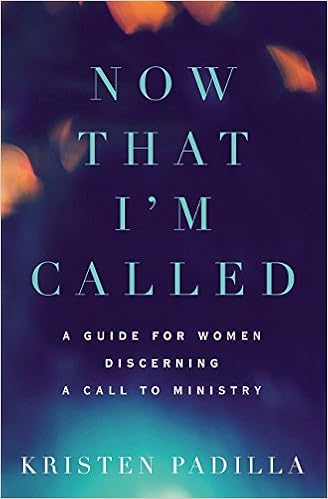
Author Interview: Kristen Padilla, "Now That I'm Called"


Image result for now that i'm called kristen padilla
Today I had the privilege of interviewing Kristen Padilla about her book entitled Now That I'm Called: A Guide for Women Discerning a Call for Ministry (IVP 2018). I have already recommended her book to students multiple times, so it was great to hear the backstory of the book.

Since the particular roles open to women differ from one denomination to another, Kristen explores ways that women from all kinds of churches can walk in obedience to God's call to participate in his mission. In her book, she says, "I want people, especially women, to understand that receiving this kind of call does not mean that they must hold a church office -- the role of a pastor, elder, or deacon, for example. The Holy Spirit gives gifts to the people of God, and these gifts can be exercised outside of a particular office in the church" (13). Her approach makes this book suitable for women from churches across the theological spectrum.

What inspired you to write this book? I was inspired to write this book for several reasons. First, I wrote this book because I saw a need for it. When I was a young woman sensing a call to vocational ministry, I had no one and no resource to guide me through the discernment process, the questions pertaining to being a woman in ministry, and next steps. As I say in my book, I felt like I was in a dark room with my arms outstretched trying to find my way to the door. By the time I was in seminary and had conversations with other women my age or younger called to ministry, I realized my story was not unique—it was the story of many women called to ministry. Thus, God put the idea and passion for this book in my heart, and ten years later it finally came to fruition. Second, I wrote this book out of a deeply held biblical conviction that God calls women to gospel ministry and that the Church of Jesus Christ needs women who are called by God to engage in gospel ministry in the church and world. I wanted to write a book that would encourage and aid these women in the journeys of discernment for the purpose of equipping future generations of female ministers of the gospel.

What was the most difficult aspect of the project? The most difficult aspect of writing was perhaps the most obvious one: writing a chapter on 1 Timothy 2:11-15. As many know, this passage has been used to silence and forbid women from many avenues of gospel ministry. It is the battleground where most of the fighting regarding women in ministry takes place. In my mind, I could not write a book for women called to ministry without addressing this passage of Scripture. However, I wanted to demonstrate a fidelity to the authority of Scripture and a humble and generous interpretative posture and tone. I also wanted to address head-on problematic and false interpretations that have held many women from pursuing ministry, namely that the female gender is by nature more easily deceived and that a certain “creation order” is a fail-proof guard against false teaching.

Author Kristen Padilla
What do you want readers to take away from your book? I want readers to walk away with a theological and biblical vision for women in ministry. I want them to see in Scripture that God’s plan has always included women and that women play an equally vital and important role in gospel ministry. My prayer is that women who read the book walk away with confidence grounded in Scripture and theology to follow God’s call to serve him in whatever role he has called them in obedience and humility.

Your book occupies the unpopular middle ground between the debate over women in ministry–not progressive enough to satisfy those who ordain women and too progressive for those who don't. What was your heart behind writing for those in this middle space? This is a great question. One of the first responses I received from the book was told to a friend of mine, “I wasn’t sure if she was complementarian or egalitarian.” A compliment or a criticism? I made the decision early on to write a book from that neither-complementarian-nor-egalitarian space or the in-between space for two reasons. First, I wanted the book to meet women in churches and traditions on both sides of this interpretive divide. My goal is to address the beginning of one’s call to vocational ministry—to lay the groundwork, if you will. Therefore, secondly, I did not see the need to talk from a strictly complementarian or egalitarian perspective, whatever that means today, since my goal wasn’t to talk about ordination or roles per se. I believe these two approaches have more in common than is often acknowledged. Most women in these so-called camps are tired of the debate and want to focus on the question: does God call women like me to serve him in ministry? I actually believe that this “in-between” space includes many women. This does not mean I do not have a particular interpretation of 1 Timothy 2:11-15 nor does it mean I am somehow theologically neutral when it comes to the roles of women in ministry. However, I did not believe it would be helpful to advocate from one perspective or another given the purpose of this book. Some will “blacklist” books if they are written from the other “side.” Even though I tried to stay in that middle space, I knew that for some my book would not be complementarian or egalitarian enough and would therefore be censored. This is indeed what has happened. In spite of this, I strongly believe that there is a strong middle and ecumenical ground where conversations about women in ministry can and should take place. I pray the posture and position I take in the book draws people together rather than exclude them.

In the year since your book has released, you've undoubtedly heard from many readers. What would you like to say to those who haven't read it yet? Or what would you want to add to what you've said in the book? Yes, I have been very fortunate and blessed to have heard from readers around the world, namely women for whom the book came at a time in their life when they needed biblical encouragement and guidance concerning the next steps in ministry. Hearing personal testimonies from readers is an author’s great reward. To those who haven’t read the book yet, I would of course say, “Read it!” On a more serious note, I try to bring out from Scripture stories of women called by God to proclaim the word of God for the people of God. There are many examples of women in Scripture doing just that—proclaiming a message from God to edify people in their day, and, by God’s design as Holy Scripture, edifying us today! In my book, I put the stories of these women next to stories of well-known men in Scripture to show a common pattern in how he calls and uses both men and women for his purposes. It would be a shame if the discussion about women’s place in God’s kingdom was limited to a few verses from the New Testament and did not take into account all of Scripture. If I could revise the book today, I would add more examples of women God uses in Scripture whose words are included for our edification today, such as the wise woman of 2 Samuel 20 and the Queen of Sheba. I want to continue to shine a light on the ways in which God is using women in his kingdom, which is why I am glad to say that I am writing a second book with Dr. Timothy George on women of the Reformation. My prayer is that the Church would be filled with God-called, theologically trained spiritual mothers who, alongside spiritual fathers, are equipping the saints for the work of ministry.

Thanks, Kristen, for writing this book and giving us a glimpse of your journey!

Sunday, January 27, 2019

Full Circle: My Denver Story

Who knows what will become of us?

As children, we dream our dreams -- astronaut, famous singer, missionary, scientist. Our parents are wise enough to let us imagine the future without the wet blanket of reality. They may have ideas of their own, but no one can be sure how things will turn out. They watch and wait with us.

Denver, Colorado, was the cradle of my childhood, the fertile ground for growing up and dreaming dreams. I spent the first 18 years of my life in the same zip code, longing to travel to the ends of the earth. I remember the children's sermon one Sunday morning. Rev. Kok asked us what we wanted to be when we grew up. I don't remember what I wanted to be at that age. I just remember how his offhand comment hit me. "Of course, none of you want to have my job when you grow up." I was floored. Was he serious? Who wouldn't want his job?! I knew no female pastors then, and I don't think I even dared to imagine myself in his shoes, but I couldn't think of a better job in the whole wide world than to preach the Word of God.

I probably said I wanted to be a missionary. In fact, I imagined I could be a missionary-astronaut-famous singer all at once, with space missions and singing tours during furlough. What I didn't want to be was a teacher, which seemed way too boring. Where I didn't want to live was America, because people already had plenty of opportunities to hear the gospel in English.

In the decades since my childhood I've changed zip codes so often I would be hard pressed to come up with a list of them all. West Coast, Southeast Asia, East Coast, Midwest, West Coast, and now the True North. In November, I boarded a plane in Calgary bound for Denver. Usually, going home means stepping away from my work, embracing rest with family. This time my parents picked me up from the airport in my suit jacket with a conference name badge ready to wear. I was home to work.

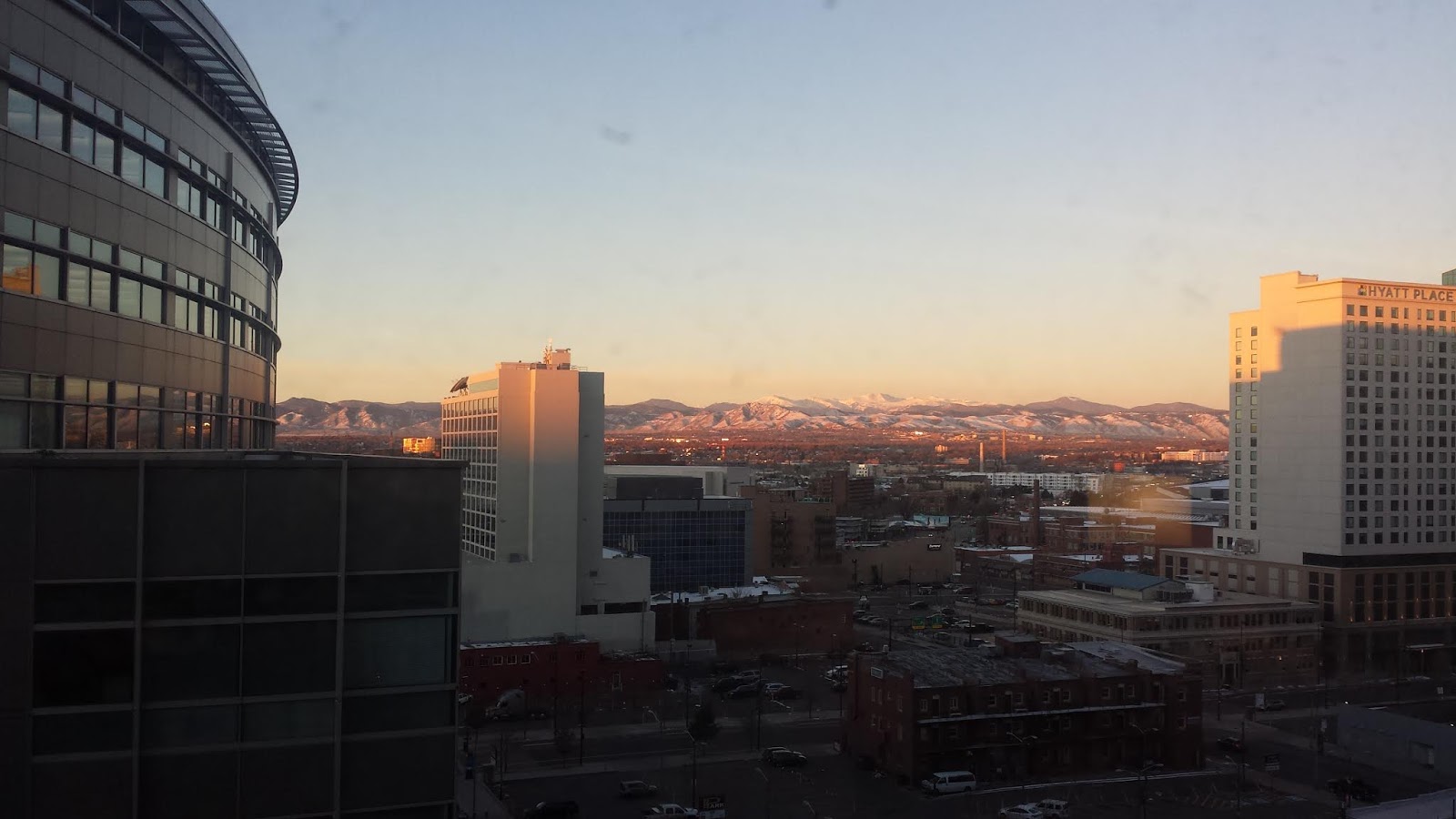
View of the Mountains from Downtown Denver, 2018
(Photo: C Imes)
It was my 10th year of academic meetings, but the first to be held in my home town. First item on the agenda? Family time. We headed to the retirement home in my old neighborhood to visit my grandparents. On our way to grandma's room, we bumped into Rev. Kok. He's long retired now and driving a motorized wheelchair, but there is nothing wrong "upstairs." We found him in the library studying for his Sunday School class on the Psalms. (A kindred spirit!)

His face lit up when he saw us, incredulous to see me after nearly 30 years -- elementary school student turned college professor. I lost no time in reminding him of his children's sermon and how I had aspired to be like him.

"Do you ever preach?" he asked, eyebrows raised in expectation. Time stood still as I considered the irony of his question and what might be at stake in my reply. Women didn't preach in our church growing up. It wasn't allowed. For most of my childhood, they couldn't even collect the offering. I realized in that moment that church practices are complicated, and that I probably didn't know Rev. Kok as well as I thought, or that he might have changed while I was changing, too.

"Yes!" I replied, the clock ticking again. "A few times a year in local churches or in chapel."

His response was immediate, affirming, "Good for you!"

It's a mystery how old aches can heal or unfinished chapters can be written in a moment's time. That conversation was balm to my soul. There he was, my childhood pastor, looking at the grown up me and saying, "well done!" All these years I had imagined his displeasure at the ways I'd come to disagree with him on theology or on church polity -- especially on the topic of women in ministry. And here we were, colleagues. He made sure I knew that.

Map of Palestine in Jesus' Day
from the NIV Study Bible
Photo: C Imes
I reminded Rev. Kok of another conversation we had some 33 years ago. At the time, it may have seemed insignificant. But in retrospect, it likely shaped who I've become. It was a Sunday morning. The sermon failed to capture my interest, so I was studying the maps in the back of the pew Bible. I might have been 8 or 9 years old. I was looking at the map labeled "New Testament in the Time of Jesus." But something was wrong with that map! Jericho should not have been there. The Old Testament said the walls fell down! I was puzzled (and, if I'm honest, probably felt a bit smug about finding a typo in the Bible).

I brought the Bible with me to the back of the sanctuary afterward, where Rev. Kok was shaking hands with everyone as they filed out. When he was finished, he turned to hear my question. I remember his giant frame bending down to look at the map. He didn't know the answer, but said he would investigate. (I had stumped the pastor!) One week later I could hardly wait for the sermon to finish. I was nervous that he had forgotten my question, but also eager to know if he'd found an answer. He asked me to wait until he was done shaking hands. Then he bent down beside me to explain.

His answer matters less than the fact that he had an answer. He had taken my question seriously, researched it, and brought me a response. A whole book on Jericho?! A reason for its re-appearance on the NT map?! I came away with a healthy respect for scholarship and an appreciation for libraries and the confidence to keep asking questions. Is it any wonder I ended up as an Old Testament professor?

The next day I headed downtown for six days of professional development, networking, academic papers, board meetings, and conversations with publishers. But the most significant work had already been accomplished at the retirement home. I'd come full circle.

And so I went home. Home to my roots. Home to the people who shaped my future. Home as the grown-up me, so grateful for the grace of God that takes our dreams and makes them something better than we knew to wish for. A missionary? Yes, but not in the way I'd imagined. A teacher, which was a much better fit for my personality than an astronaut. A ministry that includes preaching as well as writing the sorts of books that address Bible questions shared by children and adults.

It truly is the #bestjobintheworld, because it's what I was born (in Denver) to do. Who knew?

Sunday, January 14, 2018

Navigating the Valley of Disappointment

May 11, 2017

When I arrived on campus two days ago, the door to the faculty lounge was closed. On it a sign was posted, "Interview in progress. Do not disturb." 

A punch to the gut.

I retreated to my shared office and closed the door. Most days I am gregarious, eager to connect with colleagues. But not today. Not the day of closed doors. I had planned to join others for lunch, but instead I sit alone at my desk. I am not safe today. I cannot predict what I might say. I cannot produce a genuine smile. My love for these colleagues is no less than before. I am not angry. I am bereft.

I should be on the other side of that closed door being interviewed, but instead I am here, burying this dream in the valley of disappointment.

Sorrow is a strange companion.

Just last week, when I learned the news that silenced hope, a great heaviness fell over me that I could not shake for a whole day and then some.

But then, just as suddenly, the heaviness flew away and I was flooded with a joy I could not explain. I remembered then that sorrow and joy are not opposites. They walk hand in hand. Grief opens up the deepest parts of us, but the raw ache that takes our breath away also expands our capacity for joy.

Disappointment strips us, laying bare our vulnerable selves. As the chimera of what might have been fades, the solid reality of what is comes into view.

I am loved.
God is working out all things for good.
The door my Lord opens, no one can shut.
Jesus has good works planned for me to do.
I am called and equipped.
I am not alone.

Why do I tell you this? Why hang my innermost thoughts in plain view for all to see and read and know? Because you, too, have walked the valley of disappointment, and you will walk it again. This way we can walk it together.

Ruth Haley Barton says "what is most personal is, indeed, most universal" (Strengthening the Soul of Your Leadership, 223). The more honestly I share my own journey, the more we both stand to gain. 

I shared my disappointment with my students last week. They grieved with me. And one wrote me the next morning, thanking me for my words. He, too, is in the valley of disappointment, but my story gave him the strength to carry on.

We do not grieve as those who have no hope.
But we do grieve, friends.
We do grieve.

Just yesterday I read these words, penned by Paul Pastor, but spoken as God's word to every one of us: "Give me your heart today, and again tomorrow—your whole heart, beating and full" (The Listening Day, 10).

Whether my heart is aching with hurt or swelling with hope, I am invited—you are invited—to offer it up in prayer. And here I offer it to you, too.

-------------------

January 14, 2018: Today I discovered this unpublished draft in my blog archives. I wrote it 8 months ago, but apparently thought better of posting it right away (or was I going to take a picture first of the sign on the door?). It still brings tears to my eyes to re-live this major disappointment, but that sorrow lives alongside the deep joy I have found in the door that God opened for me just weeks after that disappointment. Our heavenly Father does not promise that all our dreams will come true, but he promises to be with us all the way. What more could we possibly need?

Tuesday, January 31, 2017

Leaning In: One Year Later

Just over one year ago, I decided to read Sheryl Sandberg's Lean In: Women, Work, and the Will to Lead. Now I'm looking back and taking stock of what I've learned. I reworked last year's blog post into an updated article for The Well, published today on InterVarsity's blog for Women in the Academy and Professions. 
. . . By the time I got my dissertation back, dripping with red ink, I was already a month into teaching. I had less than two weeks to cut dozens of pages and tighten my arguments. During those two weeks I didn’t use impressive PowerPoints in class, didn’t grade anything, and didn’t meet with students outside of class or attend any special events on campus. But then my defense draft was submitted, and my teaching rhythm returned to normal.
And I learned that Sheryl Sandberg was right. I had almost said no because it didn’t seem convenient or practical, because I might end up too busy. But saying yes worked out fine. My students survived, even though they weren’t the center of my universe for a couple of weeks in February. Most importantly, I finished my degree and finished out the spring semester, gaining a wealth of practical experience in the process.
You can find the whole article here.  I hope my journey inspires you to lean in, too!

Monday, July 4, 2016

perspective on cape perpetua

We had clamored over the volcanic rocks along with many others, their skin tones a wide range of hues and their languages sharply distinct — Spanish, French, Arabic, Russian, Japanese. Surely others, too. We were united in our fascination with the coastline and our awe as the pounding surf was thrown back by the sharp black rocks on which we stood.

Cape Perpetua (Phtoto: C Imes)
Every dozen yards or so the water had prevailed, with its persistent pounding, slicing a trench that progressively narrowed into stubborn rock. Here the waves picked up speed with a kind of focused frenzy, hurling themselves at the obsidian walls that taunted and restricted their progress.

The surge, the deep boom, the spray, and then the clatter of droplets, thrown helpless on the solid barrier, only to slide back down and drip into the churning sea.


Innumerable mussels clung fast to the hardened lava, daring the waves to pry them free, depending on the moisture and food delivered with each flailing attempt to carve stone.

Emma on the edge (Photo: C Imes)
We—my family and I, along with at least a dozen others—took our places around a deep bowl, hollowed out by the sea, which rushed to fill it through some unseen tunnel. Again and again the water would flood the enormous bowl and then be sucked out, leaving a gaping chasm encrusted with dripping mussels. Then, just as suddenly it would swell again with seawater, splashing and churning, lapping at the toes of the most foolhardy among us, eliciting gasps and shouts from all. Flush, fill, flush, fill. We watched, awestruck, as the sun slipped toward the horizon.

A few hours in the presence of such raw, unbridled power and my life feels very small indeed.
Cape Perpetua (Photo: C Imes)

Then, like the rapidly receding ocean water, we hurried to retrace our steps and climb the path to our parked car. We had just a few minutes to make it to the top of the cape for a birds' eye view of the sunset. The road wound up and up and up for two full miles, ending at the top of a coastal mountain. We rushed to the edge of the trail to look out across the expanse. I was dumbstruck.

View of the Coastline from Cape Perpetua (Photo: C Imes)
The powerful, churning waves were so far below us now that their pounding produced little more than a whisper. The sharp black rocks that held the waves at bay—merely a fringe for the heaped blanket of coastal mountains that towered above. The endless sea lay quiet and glistening beneath us as the sun slipped at last beyond the horizon.

The lesson in the crashing surf was merely a foretaste. If my life shrank beside the surge of seawater, it nearly vanished from the tip of Cape Perpetua.

And yet—

the incomprehensible mystery—

I, though infinitesimally small, have been invited to contribute, to partner with the One who designed all this.

Cape Perpetua 2016 (Photo: C Imes)
I am to cherish and share this creation with others. Still more—I get to participate in its ongoing development. I get to speak to it, engage with it, and shape it (for good or for ill).

The Creator shares with me the joy of co-creation, the dignity of service, the delight of influence.

And so I write, hoping to capture the brilliancy of a single evening in typed words so you can join me there on the cape, awestruck. You, too, are changing the world.

Tuesday, December 8, 2015

a beautiful thing

Photo: Aviva by Kameel
The line wound its way out of the Mediterranean restaurant and wrapped around the corner. We took it as a good sign, and so we attached ourselves to the end and waited along with everyone else. The clientele were not just conference attendees, but locals, and no one seemed the least bit disturbed about the wait. Another good sign. Soon we found out why. A smiling hostess with a tray of samples worked her way down the line. "Lentil soup," she offered. "Try it. You'll see. It's good." The lilt of her accent told me that she would know, and her obvious joy in working there boded well. It was good.

Kameel Srouji (Photo: Aviva by Kameel)
Still, nothing could have prepared me for the personna behind the counter. A tastefully decorated wall had shielded our view of the food line until we rounded a corner just steps away. "Hello! Welcome to Aviva. How can I make you happy?" His booming voice filled the atmosphere with life, enthusiasm. His tall frame matched his voice. His sweeping movements made food service an art form. "Excellent choice. It's natural. It's fresh. It's delicious." The customer two ahead of us smiled his thanks and moved down the line. Again the voice boomed, "Welcome to Aviva. You're beautiful. I love you. I need a hug."

A hug? Doesn't that break some kind of food service code? Nevertheless, the businessman in front of us in line ducked around the counter into the kitchen area to hug the man who was larger than life. The chef's eyes twinkled. He lost no time in filling another plate. "Thank you. God bless you. Have a beautiful weekend."

I'm afraid I was a bit thrown, wondering if this was for real. (Is he saying "God bless you" because he heard that the Evangelical Theological Society is meeting next door? Did some study show that enthusiasm is good for business?) When I got to the cashier, I asked, "Is he always like this?" A big smile spread across her face. "Every day!"

Photo: Aviva by Kameel
The energy was palpable.
The food was delectable.

And so the next day, with another friend, I did my time in line again. Brittany had her kids along with her at the conference, and her mom came to watch them. So the five of us waited, tasted falafel, and rounded the corner.

The booming voice. "You came back! How can I make you happy today?" (How can he possibly remember me when he serves hundreds of customers every day? Is it because he looks every one of us in the eye and recognizes that we are made in the image of God?) I suspect so.

Brittany asked if there was something less spicy for her kids. "Ah! For the little ones. This one is on me. No charge. Tell me -- what do they like to eat?" He proceeded to pile a plate with falafel, shwarma, grilled vegetables, and hummus. "Your children are beautiful. Thank you for feeding them real food!"

Kameel's passion for food is obvious!
Photo: Aviva by Kameel
It is not every day that you meet someone who is happy at work, someone energized by their labor who does it with excellence. Kameel is one of those. And the entire restaurant pulsed with this life. It occurred to me then that people come to his restaurant for more than just calories. They pay for lunch and get love, kindness, affirmation. His passion for eating well and living well is contagious.

When I arrived home from Atlanta I was still thinking about Kameel. We found him online, smiling just the way I remembered. I also learned the source of his joy. Kameel is a Catholic believer from Nazareth, eager to share God's love with everyone he meets.

When we have the privilege of meeting someone who has "found their calling" in life it's a beautiful thing. In that moment we get a glimpse of God's creative and redeeming power at work in our midst. Kameel's passion rekindled my own passion to serve God wholeheartedly in my own corner of the world. Whether restaurant or classroom, office or farm, retail outlet or machine shop, when we're doing what we were born to do, and doing it well, He gets the glory.

"And whatever you do, whether in word or deed, do it all in the name of the Lord Jesus, giving thanks to God the Father through him." (Colossians 3:17)