Showing posts with label dissertation. Show all posts

Wednesday, May 23, 2018

Shattered: Top Ten Myths about the Ten Commandments (Part 3)

In the first two posts of this series, I identified 9 myths about the Ten Commandments that are pervasive today. You can read those posts here and here. But I've saved the best for last. Today I'm tackling the myth that sent me on a 5-year quest for answers, resulting in a PhD and a published book. I've been waiting 7 years to share this with you!

Myth #10. The Ten Commandments prohibit the use of Yahweh's name as a swear word or in false oaths.

Exodus 20:7 reads: "You shall not take the name of the LORD, your God, in vain, for the LORD will not hold guiltless one who takes his name in vain."

I've asked a lot of people what they think this verse means (we'll call it the "Name Command"). Most people assume that the Name Command teaches that we're not supposed to use God's name as a swear word (as in the flippant, "Oh, my God!" or the harsher "God dammit"). Instead, we should use it reverently. I agree that we should honor God's name by using it reverently, but I do not think swear words are the problem that the Name Command seeks to address. 


Photo: Banner of Truth Trust
Others suggest that the Name Command prohibits false oaths. This interpretation has a very long history. To cite just one example, consider Question and Answer 93 from the Heidelberg Catechism:
Q. What is the aim of the third commandment? 
A. That we neither blaspheme nor misuse the name of God by cursing, perjury, or unnecessary oaths, nor share in such horrible sins by being silent bystanders. In summary, we should use the holy name of God only with reverence and awe, so that we may properly confess God, pray to God, and glorify God in all our words and works.
However, the Name Command says nothing about oaths or cursing. In fact, there are no speech-related words at all. Translated simply, it says, "You shall not bear the name of Yahweh, your God, in vain." Perhaps this is why I've been able to count 23 distinctly different interpretations of the Name Command. It seems like an odd statement -- how does one "bear" God's name? It's no wonder that interpreters have often gone to other passages (either inside or outside of the Bible) hoping for clarification.  Most assume that "bear the name" is short-hand for something like "bear the name on your lips," which would be to say the name, or "lift your hand to the name," which would mean to swear an oath.

But there's a much simpler explanation. We miss it because it involves a metaphor that's unfamiliar to us. Shortly after the giving of the Ten Commandments at Sinai, God gave instructions to Moses regarding the construction of the tabernacle, which will house the two stone tablets, and the official vestments of the high priest, who will officiate. The article of clothing that is of central importance to Aaron's position as high priest is a cloth chest apron studded with 12 precious stones. These stones are to be inscribed, each with the name of one of the 12 tribes of Israel. Yahweh instructs Aaron to "bear the names of the sons of Israel" whenever he enters the sacred tent (Exodus 28:12, 29). Aaron literally bears their names. He carries them on his person as he goes about his official duties. He serves as the people's authorized representative before God. He also bears Yahweh's name on his forehead, setting him apart as God's representative to the people.

As special as he is, Aaron is a visual model of what the entire covenant community is called to be and do. At Sinai, Yahweh selected Israel as his treasured possession, kingdom of priests, and holy nation (Exodus 19:5-6). All three titles designate Israel as Yahweh's official representative, set apart to mediate his blessing to all nations. By selecting the Israelites, Yahweh has claimed them as his own, in effect, branding them with his name as a claim of ownership. Because they bear his name, they are charged to represent him well. That is, they must not bear that name in vain. This goes far beyond oaths or pronunciation of God's name. It extends to their behavior in every area of life. In everything, they represent him. They are his public relations department. The nations are watching the Israelites to find out what Yahweh is like.

Not convinced yet? Look at Aaron's blessing in Numbers 6:24-27. After Aaron's ordination  as high priest (where he was clothed with the special garments) and the consecration of the tabernacle and people, his first official act was to pronounce this blessing over the people (see Leviticus 9:22). It's very likely that you've heard the blessing before. It's often used in churches and synagogues:
"May Yahweh bless you and keep you;
May Yahweh smile on you and be gracious to you; 
May Yahweh show you his favor and give you peace." 
But have you ever read the following verse? "So they will put my name on the Israelites, and I will bless them."

You see? It's quite explicit. God put his name on the Israelites as a claim of ownership. They wore an invisible tattoo. They were not to bear it in vain.

Prairie College, Three Hills, AB (Photo: C Imes)
Perhaps an illustration will help. Imagine a group of students from Prairie College (the Bible college where I teach) who drive to Calgary on a Friday night wearing their Prairie College swag. They go to a bar, get totally hammered, and begin to pick fights with the other customers. Soon, they are kicked out and stagger off to their cars to drive home. On the way home, their car swerves over the center line and crashes head on into oncoming traffic, killing both drivers instantly and injuring several others. When this story hits the news, what sort of impression will it leave about Prairie College? These students may not think of themselves as representatives of the college, but by enrolling as students and wearing the name, they identify with the school. Like it or not, people's impressions of Prairie are largely formed by the behavior of its students.

So, too, with the people of God. Drawn into a covenant with Yahweh at Sinai, like it or not, they have become his representatives. At the top of the list of covenant stipulations inscribed on the stone tablets are two commands that set the stage for all the others: Worship only Yahweh, and don't bear his name in vain. These two echo the covenant formula repeated throughout the Old Testament: "I will be your God, and you will be my people." The rest of the 613 commands in the Torah flesh these out in more detail.

And that is what I think the Name Command is all about.

-----

Much more could be said, but this is a blog post, not a book. If you have more questions, you'll find a 186-page justification for this interpretation in my book, Bearing YHWH's Name at Sinai: A Reexamination of the Name Command of the Decalogue. After a brief introductory chapter, chapter 2 engages with other interpretations throughout history, chapter 3 provides extensive word studies of each of the key words in the Name Command, chapter 4 explores the literary context, and chapter 5 delves into conceptual metaphor theory, connecting the Name Command with the high priest and the wider biblical theme of "bearing Yahweh's name."

In the meantime, watch for the biblical theme of "bearing Yahweh's name" as you read the Bible. It's all over the place, once you have eyes to see! You can start with 2 Chronicles 7:14 or Ezekiel 36:20-21 in the Old Testament, and 1 Peter 4:16 or Revelation 14:1 in the New Testament.

Saturday, April 28, 2018

Shattered: Top Ten Myths about the Ten Commandments (Part 2)

In my previous post, I addressed 5 myths people commonly believe about the Ten Commandments. Now we're ready to tackle the next 4 myths.


Three Primary Ways the Decalogue Has Been Numbered,
from Jason S. DeRouchie, "Counting the Ten: An
Investigation into the Numbering of the Decalogue,"
in For Our Good Always: Studies on the Message and
Influence of Deuteronomy in Honor of Daniel I. Block 

(Winona Lake, IN: Eisenbruans, 2013), page 102.
Myth #6. The Ten Commandments are easy to count. Counting the Ten is not as straightforward as you might think. We know there are ten because Exodus 34:28 and Deuteronomy 4:13 both say so. The cantillation marks on the Hebrew text preserve two possible ways of counting them. The history of interpretation has introduced still others. Differences in how to count them revolve around how to handle the first several and the last two verses. Among Christians today there are two main approaches: the Reformed and the Catholic/Lutheran. For the Reformed view, "No other gods" and "No idols" are the first two commands, whereas Catholics and Lutherans take these together as the first command. They still end up with ten commands because "Do not covet" is split in two (note the two verbs). Jewish interpreters often consider the Preamble (Exodus 20:2) as the first "Word" (the Bible never refers to these as "Ten Commandments," but rather "Ten Words," so this is plausible).


Chiasm in the First Command of the Decalogue (Deut 5).
From Carmen Joy Imes, Bearing YHWH's Name at Sinai,
(Eisenbrauns, 2018), page 133. 
Mainly to be difficult, I advocate for a modified Catholic/Lutheran view in my book, taking the Preamble as part of the first command. I see a chiasm (or literary "sandwich" pattern) in Exodus 20:2-6 (or Deuteronomy 5:6-10, pictured left) that reinforces it. If this passage is split into two commands, the phrase "serve them" in Deuteronomy 5:9a has no suitable plural antecedent ("carved-image" is singular). For ancient Israelites, worshipping other gods would necessarily include images of those gods. The prohibition of images is a way of underscoring the seriousness of the command to worship only Yahweh. Whether you agree with my numbering or not, the main point here is that counting the ten is rather complicated.

Myth #7. The Ten Commandments teach that there is only one God. On the contrary, the Ten Commandments make no effort to convince the Israelites that Yahweh is the only God. Instead, they call Israel to worship only Yahweh. In a sea of options, Yahweh is the only legitimate deity deserving of worship. Rather than monotheism (the existence of one God), the Ten Commandments teach monolatry (the worship of one God). This is not to say that there are other gods, but the Israelites  and their neighbors would have assumed so. The uniqueness of Yahweh is that he calls for exclusive worship.

Myth #8. The Sabbath Command is the one command Christians no longer have to keep. This myth is very unfortunate. It results (I think) from the notion that whichever commands are not explicitly repeated in the New Testament do not apply to Christians. However, Jesus made no effort to set aside this command. True, he was not in favor of legalism. He went about doing good on the Sabbath, even when that activity came close to what some defined as "work." But he was clearly a Torah-observant Jew and did not discourage obedience to Jewish law. 

It's worth noting that Sabbath observance begins before Sinai and is not specifically connected to temple worship. Even before any commands are given, God trains his people to adopt this day of rest by providing twice as much manna on the sixth day of each week. The Sabbath is Israel's way of declaring that they trust God to provide for their needs. God's people need not scramble to provide for themselves; they can rest in God's gracious provision. For a people freed from slavery in Egypt, the Sabbath was good news indeed. Yahweh is, in effect, telling them that they no longer need to live as slaves, toiling 24-7 to build someone else's empire. Now that they belong to Yahweh, they can enjoy a healthier rhythm of work and rest. The entire household gets a day off every week.

No, the Sabbath command is not one we have to keep, it's one we are blessed to enjoy. Why would we want to do away with such a gracious gift? We have not outgrown the need to rest and trust God.


Myth #9. The Ten Commandments prohibit lying. The specific prohibition in Exodus 20:16 is "false testimony against your neighbor." One would not be hard pressed to think of occasions in which lying would have nothing to do with one's neighbor's reputation, or in which the neighbor actually benefits. Would it be appropriate to lie to Nazi soldiers about hiding Jews? To lie to your child about the cake in the refrigerator in order to preserve a birthday surprise? 

What this command actually concerns is slander -- harming someone else's reputation by saying untrue things about them. To do so would unravel the network of trust necessary for the flourishing of the covenant community.

It may seem like a slippery slope to allow for any dishonesty. How can we determine whether a given lie is appropriate? Does the end justify the means? Matthew Newkirk's 2015 book, Just Deceivers, is helpful. He examines 28 examples of deception from the David narratives. In the foreward, Daniel Block summarizes the book's conclusion: "deception was evaluated negatively [by the narrator] when the goal of the deceit was to cause unjust harm or death to someone else, or when deceivers were only looking out for their own interest. By contrast, when the intent of the deception was to prevent unjust harm or death, and when the deception was intended to benefit someone else, it was assessed positively" (page x). Another helpful plumb line is to consider whether our words reflect the character of God. Lie to your teacher about the reason your classmate is absent? Ultimately, this is neither helpful to your teacher or to the student in question, and since God "does not leave the guilty unpunished," it is a rebellious delay of inevitable consequences.

I'm saving the tenth myth for a separate post because it deserves longer justification. You can read it here.

Sunday, April 22, 2018

Shattered: Top Ten Myths about the Ten Commandments (Part 1)

"The Ten Commandments" are among the most well-known passages of the Old Testament. Even those who do not attend church have at least a vague idea of what they contain. However, the most familiar passages are often encrusted with the thickest layers of distortion because of their long interpretive history. This is certainly the case with the Ten Commandments. How many of these myths have you believed?

Myth #1. The Ten Commandments embody a timeless, universal ethic. People often assume that because the Ten Commandments were written in stone, they apply to everyone throughout history, unlike the myriad of other specific laws in the Torah, which were intended for ancient Israel. But this line of thinking doesn't work. The Ten Commandments are prefaced with a clear statement of their specific audience: "I am the LORD your God who brought you out of the land of Egypt, out of the house of slaves" (Exodus 20:2). The commands contain language very specific to that ancient culture ("Do not covet your neighbor's ox"). And they are never communicated to Israel's neighbors. When the prophets pronounce judgment on Israel's neighbors, they are not measured against the Ten Commandments. Instead, they are measured against a standard of basic human decency. Are they arrogant jerks? Have they taken advantage of other nations' misfortune or been unduly violent? None of these assessments clearly arises from the Ten Commandments. To me the most striking example of the specific audience of the Ten Commandments is the "Name Command" (Exodus 20:7). See Myth #10, in part 2 of this series.

Myth #2. The Ten Commandments were Israel's way of earning salvation. No, no, no! I have often heard this mis-characterization of Old Testament law: "The Israelites had to earn their salvation, but we have grace because of Jesus." This could not be farther from the truth. God did not send Moses to Egypt to tell the people, "Hey, I can get you all out of here, I just need you to sign on the dotted line saying that you agree to keep all these commandments." No, the commandments were given after they were already rescued, showing them how to live in freedom. They are the conditions of ongoing freedom. "Do you want to remain free? Here's a recipe for success." They are also a gracious gift from a God who makes himself accessible and calls Israel his "treasured possession" (Exodus 19:5-6). The Israelites did not have a different means of salvation in the Old Testament. Reconciliation with God has always been available to those who respond to his grace by trusting his promise and accepting his means of forgiveness for sin. 

Myth #3. The Ten Commandments are a summary of Israel's laws. It would be more accurate to say that they are the seed or source of Israel's laws. Other instructions flesh out specific ways of living faithfully to what God commands, but they also contain other domains of instruction that do not relate directly to any of the Ten Commandments, such as agricultural laws, injunctions to care for widows and orphans, or instructions for Israel's future king.

Two Stone Tablets (Photo: C Imes)
Myth #4. The Ten Commandments are divided into two groups: laws that pertain to God and laws that pertain to others. This unfortunate misunderstanding goes back many centuries and is deeply entrenched. To cite just one example, the Heidelberg Catechism states:
Q. How are these commandments divided? 
A. Into two tables. The first has four commandments, teaching us how we ought to live in relation to God. The second has six commandments, teaching us what we owe our neighbor. (Q&A 93)
But this approach betrays an inadequate view of how covenants work. These "Ten Words" are the stipulations of the covenant God made with the Israelites at Sinai (see Myth #5). In the covenant community, all of life is an expression of worship and loyalty to the God who has committed himself to these people. After David sins by lusting after his neighbor's wife, committing adultery with her, and then murdering her husband, he responds to the prophet Nathan's confrontation by saying, "I have sinned against the LORD." Later he prays to the LORD, "Against you, you only, have I sinned and done what is evil in your sight" (Psalm 51:4a). Conversely, if just one Israelite rebels against the LORD, it puts the entire community at risk of God's judgment. An obvious example is Achan, who kept some of the plunder of Jericho in spite of God's clear instruction not to do so, resulting in Israel's defeat at Ai (Joshua 7). All ten of these commandments reflect a proper disposition toward God, and all ten affect the entire covenant community. By keeping them, the Israelites not only honored God, but also ensured that the community of faith could flourish. 


Detail of Painting by Javi G
(Photo: C Imes)
Myth #5. The Ten Commandments did not all fit on one stone tablet. This may be the most popular misconception of all. The vast majority of artistic representations of Moses and the two tablets presume that he's holding "volume 1" and "volume 2." However, we know from the biblical text that the commands were written on both sides of the tablets: 

         “And Moses turned and he went down from the mountain, and the two tablets of the [covenant] document (×¢ֵדוּת) [were] in his hand, tablets inscribed on both sides, inscribed on front and back.” (Exodus 32:15)
The words could easily fit on two sides of a single stone tablet, even if that tablet was not much larger than Moses' hand. So why make two? For the answer we must turn to other ancient Near Eastern treaty documents. What we find is that it was standard practice to make duplicate copies of a treaty document, etched in stone. One copy belonged to each party. Each copy was customarily placed in that community's most important temple, so that their respective gods could see the terms of the treaty and watch to ensure that they remained faithful. Here's a Hittite example from a treaty between Suppiluliuma and Shattiwaza:

“A duplicate of this tablet has been deposited before the sun-goddess of Arinna, because the sun-goddess of Arinna regulates kingship and queenship. In Mitanni land [a duplicate] has been deposited before Teshub, the lord of the [sanctuary] of Kahat. At regular [intervals] shall they read it in the presence of the king of the Mitanni land and in the presence of the sons of the Hurri country.” (Kitchen and Lawrence, Treaty, Law and Covenant in the Ancient Near East, No. 56A)
In the case of Yahweh's covenant with Israel, there was only one temple (or tabernacle), and therefore Yahweh was the only deity who could ensure Israel's covenant faithfulness. Because there is no higher power who can hold Yahweh accountable, he ensured his own faithfulness as well.


I'll address 5 more myths about the Ten Commandments in my next two posts (part 2 and part 3). In the meantime, if you're looking for a more in-depth discussion of these matters, you can read more in chapter 4 of my book, Bearing YHWH's Name at Sinai: A Reexamination of the Name Command of the Decalogue (Eisenbrauns, 2018). 

Wednesday, March 14, 2018

Naming My Champions

Another tribute -- this one to the many men who have shared the platform with me over the years.

Meet Our Champions: August Konkel, Dan Block, and Rick Hess
with Jen Jones and me at the IBR Emerging Scholars Session
in Boston, November 2017
As a society, we’re at an important crossroads where women and men who have been victimized are speaking out against the abuse of power. I commend their courage. I am grateful for their message. With each one, I cry out for the end of abuse, assault, and harassment. But the danger with momentum like this is that we begin to wonder if any man in power can be trusted, if any are “on our team.” In the wake of these gut-wrenching stories, I cannot help but feel profound gratitude for the influential men who have treated me with dignity, shared their platform, given me leadership opportunities, and mentored me well. So while in France, women are “naming their pig,” I thought I’d name a few of my champions — those who have spurred me on and opened doors of opportunity.

My high school pastor was the first. In 1993 I returned from a summer youth mission trip to Panama all fired up. But re-entry was difficult. I had glimpsed something worth dying for and I didn’t want to return to life-as-normal. At the time our family was attending a cozy Foursquare church in Denver, Colorado. Pastor Jim Hammond had the wisdom to harness my fervor by putting me to work in an official capacity. At 16 years of age, I’m sure I was the youngest volunteer “missions coordinator” our church had ever seen. I began presenting monthly missions updates during the Sunday morning service, telling about needs and opportunities around the world. Pastor Jim generously shared his microphone and his platform with a young woman who had no credentials and very little life experience. I don’t know if my words-from-up-front inspired anyone else, but they galvanized me for a life of service, helping me bridge the gap from my mountaintop experience overseas to life back home.

After my high school graduation, the congregation sent me off to Bible college with their enthusiastic blessing. My freshman year was everything I hoped it would be and more. I grew spiritually and academically. Critical for my development was a course taught by Professor Ray Lubeck, “Understanding Worldviews.” I came home that summer bursting to share what I had learned. Our generous pastor again shared his platform, this time by inviting me to teach an adult Sunday school class on worldviews. Then my pastor did something that still stuns me: he required all the church elders to attend. And he and his wife came, too. 


With Dan Block after I successfully defended my
doctoral dissertation in April 2016 
You can read the rest of my story over at The Well. My champions have been too many to name in one article. I'm so grateful for all who have shared the platform with me.

Friday, November 24, 2017

Practicing Biblical Hebrew the Fun Way

I'm excited to introduce you to a new set of resources from GlossaHouse publishers: The Illustrated Hebrew Bible and The Illustrated Greek Bible.

Each volume includes the unabridged Hebrew or Greek text of Scripture embedded in lively illustrations by Keith Neely. At the bottom of each page is a fresh English translation that follows the word order of the original text as closely as possible so that readers can easily locate a gloss for unfamiliar words.

To date, the published volumes include Genesis, Exodus, Mark, and a single volume that includes the Hebrew short stories of Ruth, Jonah, and Esther.


I'm personally invested in this project, having spent dozens of hours preparing the Exodus volume. It was a tangible way for me to commemorate 6 years working on the Decalogue (a.k.a. Ten Commandments). I believe my GlossaHouse English translation is the first to reflect the natural reading of the Hebrew in Exodus 20:7 that recognizes its metaphorical underpinnings: "You shall not bear the name of YHWH, your God, in vain." For the 200-page justification of this translation, you can pre-order my published dissertation. But in the meantime you can get your hands on this beautiful volume with my English translation for yourself.

These volumes would make fantastic Christmas gifts for the Language nerds in your life. They would also work well for . . .

  • Hebrew or Greek Reading Courses - Professors could require or encourage students to buy these editions to more rapidly increase fluency. Visual cues make reading more natural.
  • Hebrew or Greek Exegesis Courses - Students can opt to use these instead of BHS for class because they include the entire Hebrew or Greek text of Scripture.
  • Individuals wanting to retain biblical languages or increase reading fluency - A page or more a day would be a great way to keep up your languages!
  • Homeschool families - Children studying biblical languages at home will love these books!
  • Jewish families raising their children to read and speak Hebrew and know the Hebrew Bible.
Other volumes currently in production include Judges, Samuel, Job, John, and 1,2,3 John, plus Latin versions of Genesis and Mark. All the copies at the GlossaHouse booth at SBL sold out by the second day, so you'll want to order your copies before they disappear!

Friday, December 23, 2016

Naked Bible Podcast Interview

While I was in San Antonio for the Society of Biblical Literature meetings in November, Dr. Michael Heiser interviewed me for his "Naked Bible Podcast." The Naked Bible is among the top 25 Christian podcasts today, and I was honored to contribute to it. Dr. Heiser, a specialist in Hebrew Bible and Semitics, is known for his work on the 'Divine Council' in the Old Testament and his podcast is making biblical scholarship accessible to laypeople. (I highly recommend his introductory podcasts on the Divine Council!)

In the last 20 minutes or so of Episode 131, Dr. Heiser and I discuss my dissertation, which will come out in print in the BBR Supplement Series, published by Eisenbrauns. I have not yet blogged about my dissertation, so if you're curious about my academic work, this podcast is a great way to find out more. As a special bonus, the beginning of the podcast features Dr. Heiser's interview with Dr. N. T. Wright about his recent book entitled, The Day the Revolution Began: Reconsidering the Meaning of Jesus' Crucifixion. Reverend Wright's work has been profoundly helpful to me personally and is setting the trajectory for the direction of scholarship for decades to come.

I hope you find it helpful!

Thursday, November 24, 2016

Remembering the Alamo: A Thanksgiving Homily


The crumbling facade of a stone building is missing its roof and part of its second floor. A pile of stone rubble sits in the courtyard. In front of the building are a horse-drawn carriage and several people in 1850s-style clothing: women in long dresses with full skirts and men in fancy suits with top hats.
By Unknown - Frank Thompson, The Alamo (2005),
p. 106, Public Domain 
"Remember the Alamo!"

The cry, unbidden, echoed through my mind the moment I saw it. I was staring at Google Maps, locating my hotel in relation to the rest of the conference venues. And there it was: "The Alamo." Right across the street from my "home base" in San Antonio.

I paused, 5th grade history lessons distant and faded.

"Remember the Alamo?"

What exactly was I supposed to remember? Something about Texas, I think. An old fort, maybe? But that's as far as I got. Whatever happened there had long ago had been discarded as one of those "useless" facts that would not help me in real life.

Israel was also called to "Remember!" Remembering was not just the means to an "A" in history class. It was the key to the survival of their faith. Without memory, faith fades.

And here's where the Alamo comes in. Why don't I remember the Alamo? Because I only heard about it once, in a history class. In order to truly remember, in order for it to matter, the story must be consciously inscribed on my memory through recital. I don't remember the Alamo because the story has not become part of my story. I ceased to tell it as soon as the childhood test was turned in.

Psalm 135 and 136 are psalms of remembrance. They walk through Israel's history, retelling what God has done and thereby keeping those memories alive for each new generation. Psalm 136 sounds the rhythmic refrain, "his love endures forever."
Give thanks to the LORD, for he is good.
His love endures forever...who by his understanding made the heavens,
His love endures forever...to him who led his people through the wilderness;
His love endures forever...and freed us from our enemies.
His love endures forever. (Psalm 136:1, 5, 16, 24)
For Israel to cultivate a faith that endured, they knew they must keep telling the story.

My quick weekend trip to San Antonio left no time for sightseeing. I attended three breakfasts, two receptions, ten paper presentations, a council meeting, seven meetings reconnecting with friends and mentors, a podcast interview, and two publisher meetings. In between all this I wove my way through the book displays, hunting for spring textbooks, pitching book ideas, and buying the books on my list.

I was told it only took a half hour to see the Alamo, but since my hotel was a 10-minute walk from the conference venue, and I was going strong from 7am to 10:45pm each day, I missed the opportunity to see it.

The Alamo (Photo: Rex Koivisto)
Ironically, though, I will always remember the Alamo. I will remember it as the place where God came through in a dramatic way for me. I arrived in San Antonio with a "hole" on my resumé. I was (essentially) unpublished. Sure, I had written several book reviews, and I had a small contribution in a student resource on the Septuagint, and I had been blogging for years, but in order to get a permanent job, I would need a book contract. This was the next crucial step in my transition from "student" to "professor"—to demonstrate that I could and would make an ongoing contribution to scholarship.

I went to San Antonio with one prayer and one goal: a book contract.

And I came home with two!

It was a miracle weekend, and we will always be grateful.

Wikipedia tells me that the Alamo was an important battle in the fight for Texan independence. It was not a victory, but a battle the Texans lost to the army of Santa Anna. That defeat became a rallying cry for Texans to join the cause and take back territory. In a sense, then, my Alamo was years ago, when I stared failure in the face and considered giving up.

I am so glad I didn't. God has carried us through thick and thin.
His love endures forever!

What has God done in your life this year? Today is the day of remembering. Tell the story as you gather with family and friends. Only in the retelling will we "remember the Alamo."

Wednesday, November 23, 2016

the best news since graduation

It's been a really big year for the Imes family.

  • First, there was the last-minute call from the department chair at George Fox University, inviting me to teach a spring course . . . immediately. Of course I said yes.
  • Then there was my successful dissertation defense on April 1 -- an event that was actually fun!
  • I came home to a brand new car (my first ever), a surprise from my parents.
  • All of us returned to Wheaton for my graduation in May and reconnected with so many dear friends.

And it felt like the whole world was celebrating with us.

In the intervening months I have had speaking engagements, dissertation revisions, a summer intensive, a fantastic week of VBS, a publishing project for Zondervan, and a new semester with three great classes -- Exodus and Psalms at George Fox University, and Prophets (online) at Multnomah University.

But this . . . this is the best news since graduation. Last week I descended on San Antonio with thousands of other scholars for the annual meetings of the Institute for Biblical Research and the Society of Biblical Literature. My hope was to return home with a book contract. I got two!

My dissertation has been accepted for publication in the Bulletin for Biblical Research Supplement Series with Eisenbrauns. The title is Bearing YHWH's Name at Sinai: A Re-Examination of the Name Command of the Decalogue. I hope it will be available by this time next year! It's especially gratifying to have my work appear in this series alongside two of my "Blockhead" brothers (a.k.a. students of Daniel Block), Matthew Patton and Austin Surls. Both men have been stellar examples of solid scholarship paired with a servant's heart and commitment to the church. It's an honor to be in print together. Soli deo gloria!

A peek at the Illustrated Genesis in Hebrew, by Timothy McNinch
I also come home from San Antonio with a surprise contract to produce an Illustrated Exodus in Hebrew for GlossaHouse. It will include the entire Hebrew text of Exodus with an English translation. The illustrations were done by Keith Neely. I will create the text boxes and speech bubbles, insert the text, adapt the pictures as needed, and provide an English translation. It will be a great resource for Hebrew Reading classes or students who want to keep practicing their reading skills.

I also had a very positive conversation with another publisher about writing a book for laypeople that includes insights from my MA thesis and doctoral dissertation. I'll submit a formal proposal for that project in the next few weeks.

It was "The Year of the Publisher" for me at SBL. I'm so grateful for these opportunities to contribute to the scholarly community as well as build resources for students and laypeople to enhance their understanding of Scripture. I've got my work cut out for me in 2017!

Monday, May 23, 2016

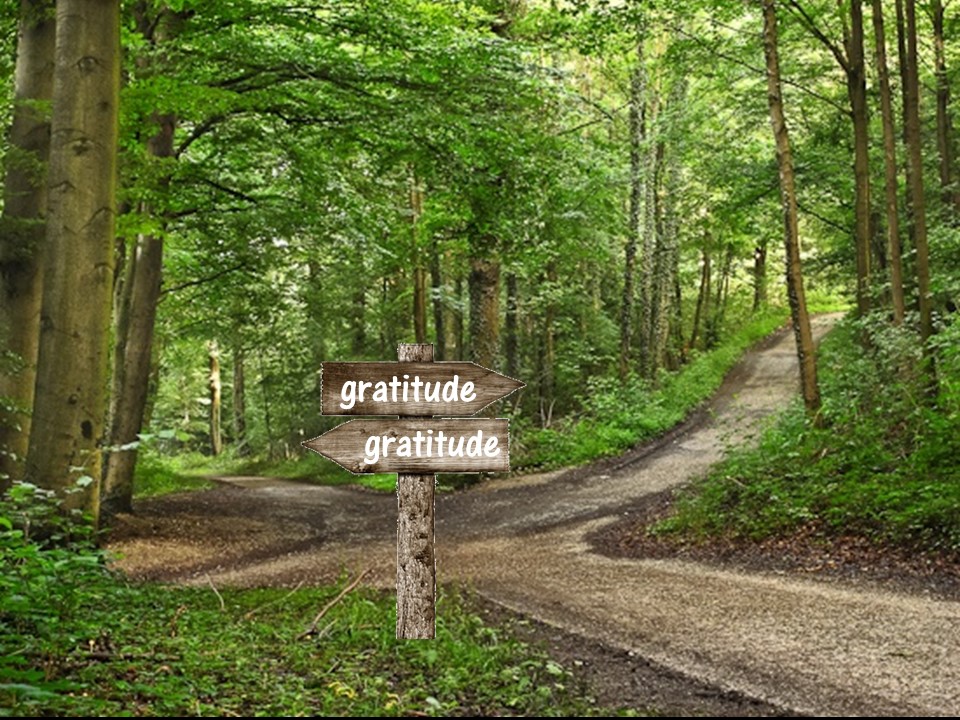
a simple path to joy (part 2): the intersection of gratitude

In my first post in this series, I claimed that true joy is impossible to find when we are living in denial. We begin our journey to joy by facing life's messes head on and choosing to be honest. That's how we enter the gateway on the path to joy.

Next we come to an intersection, and we have to make our second choice: gratitude. We cannot be everything we might have been, have everything that can be had, go everywhere there is to go. We can only be and do and have this. Once we have faced our disappointments with brutal honesty, we are free to move on with gratitude for what our life actually holds.

Our world is full of constant reminders of what we don't have. Ads surround us incessantly, telling us all day long about the products and services that will make life easier, or sweeter, or more successful. But joy depends not on what we have but on our disposition towards what we have. The Greek philosopher Epicurus warned, "Do not spoil what you have by desiring what you have not." Put another way, "Happy is the woman who wants what she has." In fact, sometimes we uncover joy by having less, by simplifying our lives -- clearing out our closets and giving things away. Every item we own gets a piece of our care and attention until we have no energy left to care for the things that really matter. It is freeing to declutter, to downsize, to keep only what we actively use.

But this intersection on the pathway to joy isn't only about what we have. It's also about where we are and who we've become. There are more possibilities in life than we have time to try, more opportunities than we can pursue. When we cultivate the habit of thankfulness, our hearts are positioned for joy. We cannot take every path, but we did take this one. To spend our time wondering about all the other paths we could have taken robs us of joy. I am not an astronaut. I am not a midwife. I am not a famous singer. I am not a jungle missionary. I am not even one of those amazing stay-at-home moms who actively volunteers at the elementary school and whose kids have really creative birthday parties every year. Saying 'yes' to one path has meant saying 'no' to others.


About a year ago we realized that I would probably never finish my doctoral degree unless I started to say 'no' to good opportunities. I resolved not to say 'yes' to anything but family until I was finished. At first it was painfully difficult. The things I was asked to do were right up my alley. They were things that would energize me. Ways to plug into my church and my community for which I was uniquely suited -- lead a small group, speak in chapel, teach a college class. But after half a dozen difficult 'no's' my schedule was completely open for the task I dreaded -- revising my dissertation. And I discovered that when I had complete focus, I did much better work and enjoyed it far more than before! I relished the gift of concentration. We shoot ourselves in the foot when we try to do it all or have it all, or spend our energy wondering what would have happened or what could have been. Those things are not. This is what is. Here is where we are. So let's embrace it and move forward with gratitude. 

This is a sure way to begin to find joy. But what about the uncertainties ahead? In my next post, I'll talk about what to do when we can't see around the bend in the road.

Sunday, April 17, 2016

now what? (and other questions): life after dissertation

It's the inevitable question that follows the celebratory congratulations. Since I've been blessed with a wide-ranging support network, it's a question I'm asked just about every day by people who care.

So, yes, it feels amazing to be (almost) done!
Yes, it's a huge load off our shoulders, and the whole family is relieved.
Yes, I have a bit more freedom and flexibility now.

But no, I will not have a lot more free time. Here's why:

A Ph.D. is not the type of degree people earn for personal enrichment. As a matter of stewardship, the huge investment of time, mentoring, and other resources are designed to prepare the student for a lifetime of scholarship. Career-wise, like most of my colleagues, my hope is to be a college professor. I have already begun teaching at two schools, George Fox University in Newberg, Oregon, and Multnomah University in Portland. I love what I do. I'm very grateful for open doors. However, these "jobs" are a bit like being a "temp" worker (minus the agency). They pay very little (last spring my pay worked out to about $5/hour), with no benefits, and no guarantee of employment beyond the current semester. Semester by semester, each school will let me know if they need me to teach for them again. So while I love my work, I do not actually have a job yet.

In order to get a permanent position, I must demonstrate that I will be a contributing member of the campus as well as the scholarly community by staying abreast of current research, participating in campus events, investing in students outside of class, and achieving excellence in teaching (as measured by student evaluations). Diploma aside, without several scholarly publications and stellar teaching evaluations, no school is likely to consider hiring me. In today's educational environment, very few schools are hiring permanent ("tenure-track") faculty. Schools that do post positions are flooded with qualified applicants. To walk away from the library now would spell the end of my career.

Getting a PhD is a bit like becoming an MD. Your medical doctor did not stop studying when she graduated from medical school (thank goodness!). She reads medical journals, attends medical conferences, and even collaborates with other doctors to ensure quality care and accurate diagnoses for patients. Likewise, I cannot stop studying and writing. A professor who ceases to learn, ceases to teach.

And so my days are still full. These days I'm revising my dissertation (almost done!), prepping for class, grading student papers, and preparing for upcoming gigs:

In May I'll be presenting a paper at an academic meeting in Idaho (Northwest Regional Meeting of the Society of Biblical Literature) and serving as a respondent for a colleague's paper.
In June I'll be teaching a one-week intensive course on the Old Testament Prophets at Multnomah University.
In July I'll be filming brief lectures for an online course on the Prophets at Multnomah, to be offered beginning in October.
In late August I'll begin teaching 2 new courses on campus at George Fox (Exodus and Psalms) and another section of Prophets at Multnomah.

On top of this are the opportunities to invest in the church—speaking at a women's event in May in Dallas, Oregon, helping with VBS, and speaking at a women's retreat in September in Wisconsin—as well as finding a publisher for my dissertation and beginning work on my next research project.

All of these great opportunities require long, quiet, focused hours of preparation. Studying the Word, crafting a message or a lecture, preparing visual aids, and coordinating logistics. In fact, with 4 classes this fall (3 on two campuses and one online), I'll be teaching the equivalent of a full-time load. I expect to be just as busy as ever. But I'm not complaining.

That was the whole point of all this schooling.

From everyone who has been given much, much will be demanded;
and from the one who has been entrusted with much, much more will be asked.
(Luke 12:48 NIV)
Now it is required that those who have been given a trust must prove faithful. 
(1 Corinthians 4:2 NIV) 
At the end of the race, may I be found faithful!

Monday, March 28, 2016

what is a dissertation defense?

As my big day approaches (April 1st! No joke!), friends are asking, "What does it mean to defend your dissertation? You're done, right? Aren't you graduating in May?"

Yes and no and maybe.

In short, I'll find out on Friday afternoon if I'm graduating this year. It depends on how my defense goes.

Every school handles this a bit differently. Here's how it works at Wheaton:

First we think up an idea that needs further research. It has to be a project that hasn't been done yet. We write up a 20-page proposal for the project, plus another 10 pages of bibliography for sources we plan to read to get us started. When our day comes, we have a "proposal defense" or "proposal hearing," in which all the PhD faculty and students gather. They will have read our proposals beforehand. After a brief introduction, members of the faculty ask questions and make suggestions for how to improve our research agenda. Usually this involves narrowing the project considerably so that we're not biting off more than we can chew. At Wheaton this happens during the spring of our first year in the program, while we're in the middle of taking classes. If we pass, we're cleared to begin work on it. I passed my proposal defense on April 11, 2012.

We spend YEARS researching and writing a dissertation (in my case, four years). In the end, the body of the project needs to be under 100,000 words long (roughly 300 pages), plus bibliography. (Yes, I know. That's long enough to be a book. It is a book, and most of them get published.) While we're researching and writing, we work closely with our doctoral adviser and our "second reader," another member of Wheaton's faculty who agrees to read and respond to our work. When the project is complete and both readers are satisfied that it's ready to "defend," we turn in a "defense draft." I submitted mine last month.

While that's a major milestone, it is not the end of the process.

Copies of the defense draft are sent to all the committee members: the doctoral advisor, the committee chair, the second reader, and an "external reader" from outside the Wheaton community who agrees to travel to Wheaton for the defense. Another copy of the defense draft is placed in the PhD seminar room for students and faculty to read (in all their spare time). Forty-five days later, all the PhD students and faculty gather on campus for the defense (no visitors allowed, including family). Except for the doctoral advisor, who must remain silent, the student's committee members are seated in the front of the room with the student, facing each other. They are given 90 minutes to ask questions and offer critique of the student's dissertation. The student "defends" his or her work by offering explanation, clarification, push back, etc, or in some cases, agrees that something needs to be changed. After 90 minutes, the students are all dismissed to wait outside while the faculty deliberate and decide if the student's work is rigorous enough to earn a doctoral degree.

Most students who make it this far in the process pass, but many are required to do more revisions before they turn in a final copy. So even if my defense on Friday is successful, it won't be the end of the process. I'll need to take the feedback I receive and incorporate it into my project until the committee members are satisfied. Then I'll need to send it on to a "technical reader" who carefully checks for compliance with the style guide and identifies typos. All that back-and-forth can take months, after which I'll finally receive my diploma.

If I pass on Friday, I can walk in the May graduation even if I have more revisions to do, but I won't get a real diploma until the revisions are completely finished and I've submitted a final copy.

Who are my readers?

Daniel Block - my doctoral advisor (or doktorvater)
Karen Jobes - my (former) second reader, now retired, but still planning to attend the defense
Sandra Richter - my (new) second reader
Richard Averbeck - my external reader
Marc Cortez - my committee chair

Why is it such a long and complicated process?

If a PhD were easy to get, it wouldn't be worth much. Extreme pressure yields more learning, and it helps to ensure that anyone who has those three letters behind their name has truly earned the right to teach adult students. If I could turn back the clock and someone offered me the credentials without having to go through a program like this first I would say "NO WAY." This has been a really important (long) season of growth and learning. I've come to know and love the scholarly community that I am joining, and I'm so grateful for the journey!

So how do I feel about the defense?

Really grateful to be so close to the end. I feel like I'm pregnant and just days away from my due date. I fully expect the next part of the process will be painful (defenses usually are, at some level), but in a matter of days, I'll have my baby and I can be done with this pregnancy and leave the pain behind. Let's do this!

Thursday, December 31, 2015

15 best blog posts of 2015

Are you counting down 'til midnight? Wondering how to stay awake for the rest of the evening?
Join me in re-living this year's highlights by re-reading some of my best blog posts from 2015.
Some of these had the most hits, while others are simply my favorites. It's been a good year.
Thanks for giving me over 13,000 reasons to write in 2015!

on the academic journey (and life in general)
Feb 20 - now is the time for no
July 18 - on being finite
July 9 - why bother writing a dissertation?

on finding beauty in the ordinary
Aug 23 - unforgettable day
Dec 8 - a beautiful thing

on life and ministry
May 19 - an unlikely blessing
Sept 15 - life in the middle of nowhere
Nov 16 - when you don't (think) you have what it takes

on parenting
May 11 - Best. Mother's Day. Ever.
Aug 7 - how I've failed my kids
Dec 11 - another beautiful thing

on the Bible
July 25 - bored by Leviticus or lost in Numbers? don't miss this
Oct–Nov - does the new NIV distort the Scriptures? (a 7-part series)

in loving memory
Mar 13 - a giant has fallen (tribute to Dr. Harry Hoffner)
Sept 7 - four things I inherited from Oma

Monday, November 16, 2015

when you don't (think you) have what it takes

A friend said it so beautifully, I couldn't help but share. She is beyond busy, faced with overwhelming needs and not enough hours in the day to respond. Myrto writes,

"It is always a sling and a few stones. It is always trumpets and a few ram horns. Let's face it, you have to get a bit ridiculous, a bit pitiful, a bit pathetic to fight the Lord's battles. Chariots, armors, weapons, anything that screams 'success' won't do. Only 'losers' recruited."
"The ministry is always small, weak, unpromising, always standing in the desert before the great giants in the land. Every year we have to take hold of our slings, pick up a few stones."

In ourselves, we lack. Whether time or money or education or creativity or courage, when we measure ourselves against the task that must be done, the deficit is painfully obvious.

But into this vacuum, the Spirit of God shows up, ready to work. He delights in our weakness, so he can demonstrate his strength. But still we must act. The stone doesn't sling itself, the wall doesn't build itself, the dissertation doesn't write itself, the children don't raise themselves...

Our part is to simply obey. To give our best. And then to watch as God transforms our feeble offering so that it becomes more than enough.

With Him you do have what it takes. You can count on that.

-------

p.s. I wrote this post weeks ago, before my NIV series was finished, and so I scheduled it to appear later. Now, on the night before it's set to go "live," I'm re-reading it . . . absolutely delighted at how God has done it again. He took my feeble offering, the fully revised dissertation that I submitted two weeks ago, and made something beautiful of it. I had given my best effort, honestly not knowing if it would be good enough. In the words of Dr. Block, "Congratulations on getting it to this stage. You have worked very hard, and it has paid off magnificently. Go out and celebrate." Needless to say, WE DID!


Friday, September 11, 2015

a scholar's prayer


My Desk (Photo: C Imes)
For those whose desks, like mine, have been swallowed by dissertation research . . .
For those in the throes of writing a book or an essay . . .
For those laboring over a new language or a new discipline . . .
For students just starting out in academia . . .

I invite you to pray this prayer with me. You can find it in full at InterVarsity's blog for Women in the Academy and Professions, but it applies just as well to men.

May He be glorified by the works of our minds!
Lord, 
as a new day dawns,
I offer thanks for the privilege of learning —
For the time, the mental acuity, and the resources at my disposal. 
Thank you for the delight of discovery. 
These are precious gifts... 
Let me love the truth 
more than I love what I have thought or said or written. 
Grant me the courage to confront falsehood, even in myself, 
to defend an unpopular position, 
or to surrender a cherished opinion found wanting...
For the rest, click here.

Saturday, July 18, 2015

on being finite

As a child, life stretched out interminably before me, holding an endless array of choices and possibilities. What do you want to be when you grow up? was the question that punctuated a long and happy childhood. No career was out of the question. My dreams held no bounds. My pint-sized mind was pregnant with possibility. Missionary-scientist-teacher? Bible translator-orphanage director? At one point I decided to become a missionary-astronaut-famous singer. I had my schedule all worked out in advance: I would spend several years overseas doing mission work, and then during furlough I would squeeze in a space mission and a concert tour before resuming my work in Africa.

How could I have anticipated the exhausting pace of what is erroneously called "furlough," or the rigorous preparation required for a trip to outer space, or the endless hours of practice and coordination to schedule a road show? My dreams were good ones, but I had yet to discover my own finitude.

We are given only so many hours, only so many days, and only so many years. Chances are that we will not be able to pursue every hobby that tickles our fancy, or learn every skill that would be handy to know, or volunteer for every worthwhile activity. Even as an adult, I have far more visionary ideas than I do energy to carry out those ideas. (I should bring a meal to so-and-so, or help with such-and-such, or start making my own this-and-that.) That leads to overpromising, overcommittment, pressure, guilt, and stress. Just because I can do something (in theory), does not mean that I should, even if it's commendable or I would be good at it.

Perhaps in days gone by one could aspire to be a 'renaissance man,' mastering knowledge in a wide range of subjects. That age has expired, and with it my dreams of being an astronaut or scientist or Bible translator or famous singer or counselor or midwife. I've given up on quilting and canning (at least for now), writing children's books, learning to paint, or taking an active role in the PTSO of my children's school or our neighborhood association. I cannot do everything. I have limits. For the time being, I study and write. When time allows, I read fiction and go camping and play games and take pictures. Once a year I even work on the family photo album. But mostly I dissertate. When that is done I will teach. And that will leave precious little time for anything else.


Almost-38-years old seems a strange time in life to start slashing my list of ambitions. I am interested in more things than ever before -- languages, geology, travel, world economics, traditional arts, gardening -- but I'm also more aware of my limitations. I am not a machine, I am a human being. That means I need balance, margins, rest. I can't do everything. Neither can you.

It's freeing to know that although God invites our active participation in his work, he does not expect us (in particular) to do it all. We invest what we can, when we can, as he provides the means. The rest is up to him. Our finitude drives us to depend on the infinite God for the strength to do what he has called us to do -- nothing more, nothing less.

Thursday, July 9, 2015

why bother writing a dissertation?

Who even cares? And what difference does it make, really?

Pacific City, Oregon (Photo: C Imes)

Sometimes when I come face to face with an awe-inspiring panorama of natural beauty, I get to feeling very, very small. And I think about the hours I spend every day fiddling with footnotes, massaging sentences until they sound exactly right, poking my theories from every angle to make sure they stand up under scrutiny . . . In those moments my work seems so pedantic. 

Does any of this actually matter?

But when I turn back from a breathtaking view and stand squarely facing the church, I remember why this work must be done. I don't mean the church historic, anchored by creed, weathering the test of time. I mean the church in its messiest and most particular forms—the local church, my local church. Individuals of various ages and backgrounds and careers who share geographic proximity and have chosen to worship together on Sunday mornings at 9:00 or 10:45, coffee in hand, trying to shake off the spiritual lethargy of their week and tune in to what really matters. This church, my church, needs steady footing in the shifting sands of cliché and trend and platitude; they need to be guided to what is real and true and rock solid, what is profoundly biblical and yet fresh and relevant. People are weary of what they've already heard and tried and found wanting. They are tired of getting nowhere.

To speak with authority into the malaise of superficiality that confronts any local church, I must do my homework. I must wrestle each word to the ground, refusing to let it go until I understand, refusing to quit until I have clearly expressed what I see.

On any given day I consult books written by patient scholars who have done exactly this. Their insights have stood the test of time, like the majestic cliffs on the Oregon coast. I am grateful for their work—glad they didn't give up when things took longer than they planned—and inspired to contribute in some small way. 

And so I press on. 

Stay tuned. The best is yet to come.


Friday, February 20, 2015

now is the time for no

I'm coming up on the one-year anniversary of some of the hardest news I've ever received: my dissertation was inadequate. After 3 years of pouring my heart and soul into graduate school, giving it everything I had, this was really disappointing. For a year now I've been processing that news and trying to find my footing so that I can attack the project again and win this time. It's hard to do that when you're exhausted. And even harder when the little voice inside says you don't have what it takes.

Add to the mix a two-week trip to Israel, a cross-country move with a family of five, settling in to a new community, and beginning to teach adjunct for the first time . . . and it will make sense why my blog has lain fallow lately. All five of us have had challenges adjusting to life in Oregon (and frankly, recovering from Wheaton). And while the external pressures on our schedule are less than what we faced in Wheaton, we find ourselves more stretched and more exhausted than we've ever been. Day after day the hours erode while the to-do swells and grows more impossible.

That's why I found this post over at The Well so encouraging this morning. Like me, Kindra has discovered that she's not superwoman. She can't do it all. And like me, she's learning to be okay with that. (Ironically, two of my own posts at The Well came up as "related articles." I guess that makes sense.)

In this twilight zone where we live -- not yet finished with what we started in Wheaton but trying to put down roots in a new community -- I have spread myself too thin. I have said "yes" to lots of good, small things, things I believe are worth doing, which have crowded my calendar until I have nothing left to give to the one thing I need to do -- finish the dissertation.

My good friend Anna Moseley Gissing is giving up "yes" for Lent. She writes,

"Saying 'no' requires trust. Saying no to more commitments, more responsibilities, and more busyness means trusting that other opportunities will come at other times. There is a time for everything, and now is the time for no. Now is the time to remember that God made me with limits, and these limits remind me that I’m the creature, not the Creator. God knows my desires, my passions, and my anxiety.
Saying no creates space for God here and now. When I clear out some space in my mind and my life, I am more present to God and to those around me. And the commitments I have already made get the better part of me.
For the record, I'm glad I said yes to teaching at Multnomah University this semester. It's taken every ounce of my energy, but I have loved every minute. Still, I don't have what it takes to finish the dissertation when I'm spread this thin. My dissertation needs the better part of me. And that makes this the time for "no."