Showing posts with label ecclesiology. Show all posts

Sunday, March 9, 2025

Foreword by Esau McCaulley

 I've been keeping a fun secret for several months, and I finally get to tell you!

My good friend Esau McCaulley agreed to write the foreword to my new book for IVP Academic. Both of us love the church with all of our hearts. To love something is not to pretend that it's perfect, but to help it become what it was always meant to be. I respect Esau as a biblical scholar and author, but also as someone who has been willing to call attention to abuse in the church while investing deeply and personally in its flourishing.
Esau is the Jonathan Blanchard Associate Professor of New Testament and Public Theology at Wheaton College, but we knew each other before either of us had a PhD. He has published his dissertation, a stirring memoir, an insightful book on reading Scripture as an African American, a book on Lent, and several children's books--a wide breadth of writing! He was the lead editor on the recent book, New Testament in Color and edits the 'Fullness of Time' series for IVP on the church calendar. He's working on two New Testament commentaries. He writes for the New York Times and travels to speak regularly. He has his own podcast and has been on many others. I'm grateful for the way he is serving the church with the gifts God gave him. And I'm thankful that he took the time to read and recommend my book to you!
Check out Esau's books here.
My new book, Becoming God's Family: Why the Church Still Matters, is a biblical theology of the presence of God in the community of faith. It's a trek through Scripture to see the sometimes surprising ways that God works among (and despite) his people. The book is peppered with personal stories and other illustrations to help you understand and apply what you're reading.

Esau says this about it: "Readers will find that Dr. Imes has the rare gift of being a biblical scholar that can speak to the academy, clergy, and people in the pews at the same time. In this book she demonstrated the ability to translate a lifetime of learning into accessible writing without being simplistic or assuming that her audience cannot handle complex ideas."

This book is for four types of people:

1. Those on the verge of leaving the church. Maybe you're the one saying, "Give me one good reason to stay."
2. Those who've already left the church and wonder what they're missing or if they made the right decision.
3. Ministers who want a more robust ecclesiology based on the narrative of Scripture.
4. People who loved Bearing God's Name and Being God's Image and want more biblical theology that's accessible.

Which one are you?
If you enjoyed Bearing God's Name and Being God's Image, this book completes the trilogy. Please consider preordering it! Amazon has a price guarantee for preorders, so if the price drops between now and the book release, you'll be charged the lower amount. Preorders are a significant factor in whether bookstores decide to stock a book and whether Amazon promotes it, so it's a helpful way to support the project. If you aren't able to buy it now, you can add it to your wish list on Amazon. That helps, too.
Preorder here or wherever you buy books.
Thanks, friends, for your enthusiastic support!

Thursday, January 23, 2025

Cover Reveal for Becoming God's Family!

I'm thrilled to share the cover of my forthcoming book! Becoming God's Family: Why the Church Still Matters releases October 28, 2025 from IVP Academic. 

Church isn't obvious anymore. Perhaps you're among the 40 million Americans who have lost the habit of attending weekly services. Or maybe you're on the fence about whether its worth your time or energy to stay connected. After all, you can listen to a sermon online, crank up your favorite worship artist, and skip the hassle of showing up. Right?

But what if there's more to church than a sermon and a few songs? What if something powerful but invisible is happening when we gather that can't fully happen any other way? Do we get any glimpses of this on the pages of Scripture? Do I have any stories that show you what I mean?

Yes and yes!

Like the other two books I've written for IVP, Becoming God's Family traces a theme through the entire Bible. This time the theme is the presence of God in the community of God's people. We'll explore how God shows up in our midst as we make time with others to wait for God. Along the way, I share the stories of how I and others have experienced God knitting together an intergenerational, multiethnic family of believers.

I can't wait to share this book with you. It was a joy to write and it comes straight from my gut. The book went live online TODAY, so it's available for preorder wherever books are sold. I hope you will order a copy for yourself. Who else do you know who's wrestling with disillusionment or questioning whether to bother with church? Could you pre-order a copy for them as well and plan to read it together? October will be here before we know it!

In a few weeks, I'll be able to share with you who's writing the foreword to the book. So delighted to have his name on the cover! Hint: It's a fellow academic who LOVES the church as much as I do and is pouring himself into it week after week.

Tuesday, July 2, 2019

Book Review: Oden's Hope for the Oppressor

You are part of the problem. So am I. But there's hope for us.

In this daring book, Patrick Oden invites us to step outside of the systems we've relied on for our identity and enter a different kind of community.

To cite just one example of oppressive systems among many, the world of white privilege is waking up one person at a time. That's a good thing. But often those who benefit from systemic injustice are left feeling awkwardly helpless. What can be done? Is everything I attempt just another iteration of oppression or paternalism? Oden opens the door and lets in a fresh breeze, inviting us to another way of doing life together. He draws on the diverse voices of men and women from around the globe as he makes his case.


I had the opportunity to read this book before it went to print. I'm so glad I did. Here's my official endorsement:
Hope for the Oppressor is a brave undertaking. Patrick Oden suggests that efforts to liberate the oppressed will never be successful until oppressors experience liberation, too. Without true liberation of all parties, new cycles of coercion result. But there's hope. He locates that hope in Christian community, where our notion of selfhood can be reconceived and our fractured selves healed in light of God's holy love. Oden's thesis is grounded in theologically rich readings of biblical texts and skillful engagement with historical and systematic theology. His book issues a life-giving invitation for all of us — those with privilege and those without — to participate in a different kind of kingdom. His book has the potential to fuel a revolution for those who dare to reexamine their lives in light of his claims.
Much more could be said about Oden's book than what could be fit on the back cover. The following synopsis of each chapter will give you a sense of his breadth of engagement, from classic theologians to systems theory, from spiritual psychology to lived experience, from the Bible to the early church to pastoral theology -- there's something for everyone!

Chapter 1: The Crisis of Social Identity
Oden introduces Luhmann's systems theory, showing how systems seek to define everything, but in the process they anonymize participants who depend on them. This chapter is illuminating.
Chapter 2: The Crisis of Self-Existence
Here he introduces Kierkegaard's concept of sin, namely, an expression of our anxiety in seeking selfhood as part of these systems.
Chapter 3: The Crisis of Becoming
Loder's spiritual psychology argues that oppressive behavior develops from a false notion of self tied to systems that perpetuate false intimacy. The solution is a reconstituted self in relation with other whole selves.
Chapter 4: The Liberating Way of God
Oden looks at biblical selfhood in the Old Testament to illustrate how oppression has always been the result of a selfish quest for self-fulfillment apart from community. The creation pattern and the exodus narrative hold out the possibility of a different way.
Chapter 5: The Liberating Way of Christ
The New Testament contributes a vision of a new way of life opened up by Christ, one defined by self-giving love in community.
Chapter 6: The Way of the Early Church
Oden introduces the writings of Clement as a window on early Christian communities. They understood that Jesus redefines personhood, calling the wealthy to radical generosity rather than participation in oppressive economic systems.
Chapter 7: The Liberating Way of the Desert
The desert fathers and mothers, such as Anthony, taught that we become who we were meant to be when we participate in the life of God and see ourselves in him.
Chapter 8: Hope from God
World War II-era theologians help us reconsider the classic attributes of God, showing their relevance for the Christian vision of the good life. Pannenburg demonstrates that only God provides a coherent basis of identity. As we're drawn into God's holy love, we become coherent, loving beings. Moltmann teaches that Trinitarian relationality opens up a liberated way of life, free from coercion.
Chapter 9: Hope with God
Jean Vanier models the relinquishment of systemic power. He embraced his own brokenness by living with the disabled, and he suggests that we become fully ourselves in messy and loving community characterized by mutuality. Sarah Coakley broadens the notion of systematic theology to include the arts and to insist on the value of contemplation and the primacy of desire as a signal of our true theology. 
Chapter 10: Hope for Transformation
Oden considers how the resurrection introduces a powerful hope for transformation that is grounded in this life. It rightly orders our passions for participation in the mission of Jesus.
Chapter 11: Hope in the Kingdom
Participation in God's kingdom requires vulnerability and the relinquishment of our need to derive identity from others. Honest prayer, love that flows from holiness, cultivation of belonging, exercise of forgiveness -- all these make possible the re-orientation of our disordered loves.
Chapter 12: Hope among Community
Participation in loving community provides a way forward. Self-denial, forgiveness, and openness to others makes possible a new kind of life. We can only be our true selves in this kind of community.
Chapter 13: Conclusion
Oden's concluding chapter gives a retrospect of the book's argument, weaknesses, and challenges. 
Patrick Oden deserves our thanks for his careful scholarship, pastoral sensitivity, and illuminating vision of Christian community. You can pre-order his book here. If your personal budget is strained at the moment, encourage your school's library to purchase a copy.

Tuesday, December 12, 2017

Church -- Why Bother?

Alberta Sunrise (Photo: C Imes)
It's Sunday morning. I sit by the gas fireplace snuggled up in a warm blanket, relishing the quiet. Before long, the rest of the family will stir. The sleepy house will bustle with activity as we get ready to go to church. But why bother? Why not enjoy a leisurely morning at home, letting the kids sleep as long as they will? Why shatter the peace of the weekend by entering a crowded building, exchanging shallow greetings, singing muffled songs, and being told what to think and what to do? Why clutter the rest of the week with small groups and committee meetings and rehearsals?

No doubt you've seen the classic Christmas movie, It's a Wonderful Life. Jimmy Stewart plays the lead character, George Bailey, a decent guy who leads an average life and tries to be a good neighbor to those in his small town of Bedford Falls and prevent the greedy Mr. Potter from gobbling up their land. On one particularly dark day, George faces the loss of everything he's worked to achieve. He wishes he had never been born. That's when the magic happens: an angel appears and accompanies George on a virtual tour of Bedford-Falls-without-George-Bailey. He has the chance to see what life would be like if he did not exist. It's a sobering picture. Bedford Falls is now Pottersville; its main street lined with clubs, its neighborhoods crowded with cheap rental houses, its residents suspicious and snarky.

What if the church, like George Bailey in his suicidal funk, did not exist? What if we could have a George-Bailey-style personal tour of a churchless world? What would we see? What if faith was purely a personal matter and we ceased gathering weekly for worship?

We need to look no further than a recent sociological study for such a tour. In groundbreaking research at the University of North Carolina, Robert Woodberry made the following discovery, under the direction of his doctoral supervisor, Christian Smith:
"Areas where Protestant missionaries had a significant presence in the past are on average more economically developed today, with comparatively better health, lower infant mortality, lower corruption, greater literacy, higher educational attainment (especially for women), and more robust membership in nongovernmental associations." (For the full article in Christianity Today, click here.)
It is one of the great mysteries of the faith how a rag-tag gathering of individuals can have such a transformative effect on the world. But according to Robert Woodberry and his team of researchers, the results are quantifiable.

But what about me? Why not let the church do its thing and opt out myself? My fireplace is warm and cozy. I'm a well-educated, theologically grounded individual. It's unlikely that I'll learn anything new at church this morning. I could crank up the worship tunes at home and sing solo. Sure the church makes a difference for others but that doesn't obligate me to go, right?

Here's the deal: I am not my own, but belong body and soul, both in life and in death, to my faithful Savior Jesus Christ (Heidelberg Catechism, Answer 1). I belong not only to him, but to his means of grace in the world, the church. My absence diminishes what Christ can accomplish in and through the church, while my presence is a tangible means of participation in the kingdom. Ultimately, it's not about "what I get out of it." It's an act of surrender.

St. Barnabas Anglican Church at Sunrise (Photo: C Imes)
According to James K. A. Smith in his recent book, You Are What You Love (Brazos, 2016), this act of surrender has consequences that may be imperceptible now, but add up to something significant. Our habitual acts shape our loves and therefore who we become. Smith says that in order to cultivate virtue we must immerse ourselves in practices that inscribe them in our heart over time. He insists, "counterformative Christian worship doesn't just dispense information; rather, it is a Christ-centered imagination station where we regularly undergo a ritual cleansing of the symbolic universes we absorb elsewhere. Christian worship doesn't just teach us how to think; it teaches us how to love, and it does so by inviting us into the biblical story and implanting that story in our bones" (You Are What You Love, 85).

With this in mind, here are four reasons I choose to keep going to church:

1. Weekly fellowship in a church body orients my loves.

Of course, if I'm not vigilant, it can breed bitterness as well. No church is perfect, and there will always be things that merit complaint. In rare cases, the damage inflicted by a particular local church may even outweigh its benefit. But when I invest weekly in corporate worship with a relatively healthy community, I join with others in declaring where ultimate truth and value lie. Each week my heart is re-calibrated in tiny ways that keep me facing Jesus rather than drifting in another direction.

2. Weekly fellowship in a church body recognizes that following Jesus means joining God's family.

When I signed on as a Christian, it was not a transaction designed primarily to secure my eternal destiny. Becoming a Christian means becoming part of God's family and changing how I live here and now. Spending week after week with these people, sharing this experience, eventually adds up to a network of caring relationships. It doesn't happen overnight, but as we do life together, we lend support to each other on our faith journeys.

3. Weekly fellowship in a church body enables me to participate in God's work of grace in others.

The fact that I show up affirms the value of corporate worship for all those in attendance. It upholds the ministry of my church leaders. My smile and my handshake and my voice lifted in praise manifest the Spirit's presence to others who have come. I am not my own. I am a member of something bigger than myself -- Christ's body on earth.

4. Weekly fellowship in a church body is a means of declaring allegiance to the kingdom of God.

On the outside, the church may not seem like the "going thing." It may seem weak. But the truth is that the church is a visible witness to the unseen reality of God's kingdom. Being present each week testifies to this. It acknowledges that God's invisible kingdom is more substantial and more lasting than the other concrete institutions in my community. It will outlast the postal service, local businesses, schools, and politicians and their offices. My participation ensures this. It testifies to that greater and lasting kingdom.

So, for these and other reasons, I keep going. Whether I feel excited about it or not (and usually I do!), the church is my family, and I cannot be who I am meant to be without it

Sunday, September 4, 2016

encountering the light of Christ

When you enter the doors of a new church, anything could happen. Churches with dwindling numbers are often surprised to see a new face, as the greeters were this morning to see me. But their warmth made me feel right at home.

A single ring of chairs stood empty around the center microphone on the circular platform, expectant. A Steinway occupied the far end of the circle, its melodies soaring to fill the sanctuary and encircling all of us.

Pews faced the middle. I sat in the second row, waiting, observing. I was early. In time, others came and found seats in the first few rows. I knew no one. I had been invited by the son-in-law of a member to speak during the Sunday school hour. That was my only earthly connection.

A pamphlet in the pew back explained how a Quaker-style service works. Quakers embrace silence as they embrace each other, welcoming the opportunity to listen and learn from the spirit of Christ in their midst. The unprogrammed quiet is a soothing balm in a hurried life.

A man rolled in on a motorized wheelchair, making his way to the front to greet another worshipper, and then me. Jerry refused to let his disability cripple his contribution to the warmth of the community. (I learned later that he was relatively new himself, and that the man he greeted was there for only the second time. Signs of life.)

As the service unfolded, I gathered that this was a grieving community, searching for direction, wondering how to respond faithfully to a series of events that left most of their pews empty. I wondered, then, if I should scrap my seminar on 'Understanding Biblical Prophecy' and speak instead about lament, or about how to be rooted in the face of life's storms (Psalm 1–2). How does one walk into a community and speak without first listening long? first loving and hearing?

In those quiet moments, I asked the Lord to guide me. By the time I reached the classroom after the service, I knew I should stick with my original topic and trust that God had guided my preparation. I suspected (rightly, I'm told) that Quakers typically camp out in the Gospels. That was my bridge to the prophets. How can one possibly understand the richness of the Gospels without an understanding of the Old Testament prophets? Spontaneously, I began in John 9, linking Jesus' miracle to Isaiah's commission in chapter 6. Then we moved into Isaiah 7 to examine verse 14, always a Christmas favorite. Both passages illustrate the value of reading the text closely for its historical, literary, and theological dimensions. They also illustrate the inherent dangers when we don't.

The hour flew by, followed by several follow-up conversations and a long lunch. I returned home with a full heart, grateful for the privilege of fellowship with other Christ-followers and grateful that I have the most wonderful subject matter in the world to teach -- God's Word -- which truly does not return void.

Encounters like this one are not accidental. God uses each personal connection in some way as we spur one another on to love and good deeds. A Quaker might say that the light of Christ within each of us illuminates the community as we gather. I'd say that pretty well sums up what happened today!

Wednesday, August 17, 2016

faith in search of lament

If our picture of the Christian life is primarily shaped by the evangelical church service, what is missing? How might it be skewed?

This is the question I posed to myself after a campfire chat with a faculty colleague.

The Scriptures contain the full range of expression that animates the life of faith, and we develop the capacity to live faith-fully by patterning our own expressions after these.

Lord, teach us to pray. 

But for our church services we typically take a select few of these elements and canonize them, leaving others nearly untouched.

We sing praise.
We greet one another.
We preach the Word.
We exhort.
We take up an offering for those in need.
We pronounce a blessing.
We remember the Lord's death by celebrating communion.
Occasionally we baptize.
We pray for the sick.
Now and then we pray for our nation's leaders.

What's missing?

We generally don't confess our sin (at least not out loud, to each other).
We don't seek refuge.
We don't complain.
We don't wrestle out loud over what's wrong and broken in our world.
We don't lament.

That is a problem.

It's a problem because the lack of confession and lament leaves us with a monotone, anemic faith. We miss out on the richness available to us in the Scriptures, and we lose touch with reality. Our faith becomes compartmentalized rather than a fully integrated part of our selves.

Put another way, Job and Jeremiah and David and Habakkuk and many other biblical writers model for us the language of lament. Do we think we no longer need these vehicles of expression?

What would it look like to incorporate the language of the Psalms -- not just the praise psalms, but the laments, too -- into our services? How can we create a reverent space where the groans of the human heart may be articulated?

How might it feel to leave things unresolved -- to refuse to tie a neat bow on it all at the end of the service because we as a community have become accustomed to letting God do the answering and not to answer for him?

Here I'm thinking of Elihu, the "friend" who shows up out of nowhere in the book of Job. After Job's complaint is laid out before God, Elihu rushes in to answer on God's behalf. Like the other three "friends" who respond to Job, Elihu is angered by Job's words (Job 32:1-5). He feels a strong need to defend God and put Job in his place, rushing in to fill the silence with correction. But when the Almighty does reply, Elihu's words are swallowed up in the storm with everyone else's. Literarily, the lesson is clear: God doesn't need us to answer on his behalf. God can speak for himself.

When we rush to the answer we lose the depth that comes through sustained waiting. To brood over our grief -- to articulate our deepest longings for God to do something -- positions us to experience God's answer more profoundly. Ignoring our wound, we miss out on the opportunity for healing.

Lord, teach us to pray. 

Sure, now and then we're brave enough to complain to God on our own. Why did you let this happen? God do something! But communal lament -- lament as a body -- is a lost art. If we could find the voice of corporate lament it would open up new avenues to enter into one another's journey. Rather than fixing each other, we could join each other side-by-side in articulating the heart's cry.

Why should we be scared of lament when the Scriptures devote so much time and space to it? Why do we feel it's irreverent to complain when complaint is the backbone of books like Psalms, Lamentations, Habakkuk, and Job?

Life hurts. Missionaries get stabbed. Cancer returns. ISIS prevails. Lives are lost in meaningless altercations. Believers are falsely accused. When grief, complaint, longing, sorrow, and confession are kept to ourselves, out of sight, the muscles of our faith atrophy, and we lose the art of responding faithfully to our trials. It's a missed opportunity for our community to grow together in love.

One of my students, Beth Erickson, created this beautiful graphic poster of Habakkuk's lament in light of the recent racial tensions in America. I share it here with her permission. This poster is an example of one way we can begin to incorporate lament into our worship.

Every year, Jewish communities read the entire book of Lamentations aloud together. When I did this with my class on the Old Testament Prophets this summer, the effect was powerful.

Lord, teach us to pray.

Thursday, July 9, 2015

why bother writing a dissertation?

Who even cares? And what difference does it make, really?

Pacific City, Oregon (Photo: C Imes)

Sometimes when I come face to face with an awe-inspiring panorama of natural beauty, I get to feeling very, very small. And I think about the hours I spend every day fiddling with footnotes, massaging sentences until they sound exactly right, poking my theories from every angle to make sure they stand up under scrutiny . . . In those moments my work seems so pedantic. 

Does any of this actually matter?

But when I turn back from a breathtaking view and stand squarely facing the church, I remember why this work must be done. I don't mean the church historic, anchored by creed, weathering the test of time. I mean the church in its messiest and most particular forms—the local church, my local church. Individuals of various ages and backgrounds and careers who share geographic proximity and have chosen to worship together on Sunday mornings at 9:00 or 10:45, coffee in hand, trying to shake off the spiritual lethargy of their week and tune in to what really matters. This church, my church, needs steady footing in the shifting sands of cliché and trend and platitude; they need to be guided to what is real and true and rock solid, what is profoundly biblical and yet fresh and relevant. People are weary of what they've already heard and tried and found wanting. They are tired of getting nowhere.

To speak with authority into the malaise of superficiality that confronts any local church, I must do my homework. I must wrestle each word to the ground, refusing to let it go until I understand, refusing to quit until I have clearly expressed what I see.

On any given day I consult books written by patient scholars who have done exactly this. Their insights have stood the test of time, like the majestic cliffs on the Oregon coast. I am grateful for their work—glad they didn't give up when things took longer than they planned—and inspired to contribute in some small way. 

And so I press on. 

Stay tuned. The best is yet to come.


Tuesday, August 19, 2014

one ordinary life

The trail along the Salmon River offered cool shade that August afternoon. Countless trees, some of them wider than I am tall, others just fledglings, flanked both sides of the river. My eyes landed on a massive trunk and I craned my neck to see its towering top. If that one tree wasn't here, how different this stretch of trail would be! You could almost miss it, the expanse of dull brown bark beside the trail. But it's absence would change everything. Beside the path on either side, leafy ferns crowded together in the shade of the tallest tree, safe from the sun's scorching rays.

Salmon River, Oregon. Photo: C Imes
I climbed down the bank and walked on the stones, worn smooth by centuries of melting snow. Glancing across the water, I noticed a fallen tree. The steep bank where it once stood proudly had been washed downstream, lacking roots to trap topsoil. I stood there, pondering. You could certainly take a tree like that for granted, one of many, until it is gone. The refreshment of a hike through the woods depends on a great number of ordinary trees, growing up side by side, steadily reaching heavenward and shading the earth with their spreading limbs. (Just outside the national forest, on the drive home, lay evidence of mass destruction, several acres hacked to the ground all at once, with their bloody stumps baking in the summer sun.)

Who are the shade-givers in my life -- the ordinary people whose faithfulness makes this world a place worth living? Good neighbors blend in with their surroundings, seeming ordinary enough. But if we pause to imagine life without their stability -- their day-in-and-day-out caring for their corner of the world -- we discover what a difference they make. Subtract one tree and you have a hole in the sky, fewer branches for nesting, the topsoil washes downstream. A bleak landscape gradually replaces the forest. The exposed branches of neighboring trees grow dry and brittle...

My mind drifts back to Hudson Street, the place I called home for the first 9 years of my life. I can still smell it -- the wholesome aroma of Suzie's bread wafting across the street. It's been almost 30 years, but I can still taste the soft buttered slice, fresh from her oven on baking day. Suzie's hands and face and apron smudged with white flour as she answered the door bell. Warm lumps rising in the oven. Then punching and pulling and rolling the dough until it was just right for braiding.

I can still hear her voice, strong and warm, with its European lilt. Swiss neighbors, like swiss chocolate and swiss bread, are hard to forget.

Is that why I've always felt a part of me come alive at the smell of fresh bread baking? It takes me back to those innocent days -- sandboxes and swings, gardens and neighbors who cared. There were others who didn't -- who were more likely to be drunk and yelling than pulling out their knee-high weeds, but Suzie and Marion made up for the whole lot. They were the stately oaks across my Hudson who kept the rich topsoil from washing away. It was their shade under which I flourished and grew. I know Suzie prayed for us then and still does.

I braided my first loaf the other day and thought of Suzie. Her steady demeanor, her no nonsense, no drama way of life. Her long, black (now white) tresses that I only rarely saw loose, when she brushed them. Every day she braided and twisted them into a bun on the back of her head. Suzie and Marion were nosy in the kindest way. "Mare" used to let himself into our backyard each day to check our thermometer and our vegetable garden, as if he didn't have enough of his own garden, bursting with produce. My brother, John, used to stand with his toes right up to the tippy edge of the sidewalk and call for him, "Mare! Mare!"

I'm guessing Suzie canned lots of things and cooked up a storm. But all I remember is her braided bread, for me one of the most delicious smells of childhood. (I wonder -- is her kitchen valance still hanging? -- the one stuck to the wall with the chewing gum I chewed just for her?)

A cherished visit with Suzie and Marion in 2005
I realize now that some of the houses I've imagined while reading books are really Suzie's house, with its galley kitchen looking out over the back yard, its family-sized table off the living room where her children ate their meals growing up, and where John and I sat after they were grown and gone, to fill our mouths with bread still hot from the oven. The piano with a hymnal close at hand. The living room with its inviting circle of couch and chairs. The box of children's books waiting to be read.

My world was a better place because of Suzie. She may be ordinary, but without her my life would have had an empty place. Suzie sheltered us on Hudson Street, providing a safe haven in a broken world. Her bread nourished the body and her company nourished the soul.

Never underestimate the power of an ordinary life well-lived.

Wednesday, November 20, 2013

silver linings

Some seasons of life we'd rather not endure. Heavy black clouds dampen everything and choke out joy. We long to turn the corner, to pack up and move on. But there are graces even on the darkest day, graces we cannot see in the sunshine. If we have the courage to stare into the blackness with our eyes wide open, looking for Him, we'll discover untold riches.

When trials are more than we can bear alone, we discover that we are not alone. Hugs are longer. Prayers are deeper. And the Scriptures come alive in fresh ways. We realize anew that He knows what we're going through, and He made provision for us long before we entered this valley. What's more, our eyes are opened to the sufferings of others. We recognize the burdens they carry, because we've carried them, too.

When things look bleak, we discover the power of gratitude. Each hour not saturated in trouble becomes a gift. Each good night's sleep a blessing. Each friend who knows and cares a boon to the soul. Each part of life not touched by trouble carries a new sparkle that we once missed. When our appetite returns and our stomach behaves normally, we receive it with thanks.

When perspective is hard to gain and harder to keep, we discover the urgency of spiritual disciplines. We no longer read the Scriptures because we should, but because we must just to make it through the day.  Confession and forgiveness have immediate bearing on our ability to cope. It no longer seems like a stretch to pray without ceasing.

Spiritual hunger is one of the gifts God grants us when life is hard. So are gratitude and deeper community.
Though I don't suggest that we wish for suffering, when it comes (and it will) we can open our arms to receive what God has to give us in that season. The black clouds of suffering always come with the silver linings of his grace. We can't necessarily discern it right away, but if we keep staring, we'll learn to see what's there.

Saturday, April 6, 2013

Wheaton Theology Conference 2013: Christian Political Witness

The annual Wheaton Theology Conference has just come to a close. This year's topic was Christian Political Witness. I enjoyed stimulating lectures by Peter Leithart, Stanley Hauerwas, Mark Noll, and David Gushee and a lunch discussion with retired Anglican Archbishop of Kenya, Rev. David Gitari (in conjunction with our monthly Global Theological Education Discussion Group meeting).

Leithart's message was provocative: God is never violent and never condones violence. The key to his message was learning to define violence the way the Scriptures do: "Violence is unjust and sinful use of force." Leithart called the church the "one true polity and God's main instrument against violence."

Hauerwas made us laugh, groan, and gasp with his profound analysis of the problems facing the church in America (and, yes, with his colorful language). He imagines an ecclesial alternative to power, that is, a church so convinced that "Jesus is Lord" that peaceful non-resistance is the only option. His provocative lecture concluded with these words: "I believe Christendom is finally coming to an end. . . . Let's make the most of it."

Noll spoke about the use of Scripture by Christians in politics, cautioning us that the use of Scripture does not guarantee the "Christianness" of a political endeavor. He called us to a way of reading Scripture marked by comprehensive discernment of biblical theology that takes into account cultural, contextual, and theological issues (as opposed to proof-texting). My fuller report of his lecture may be found on the Wheaton Blog.

Gushee had the delightful task of getting into the "nitty-gritty" of Christian political witness by speaking prophetically on the issues that confront the church today. He took this job seriously, addressing a whopping 10 hot issues in 45 minutes: abortion, creation care, the death penalty, modern capitalism, gay rights, guns, immigration, torture, war-making, and women's issues. His exhortation to us was clear and unequivocal: "We must remain calm and steady in engaging public and political issues, believing that the kingdom of this world will become the kingdom of our Lord and of his Christ."

These lectures should be available for viewing on the conference website in the near future, and they will be released in print by IVP later this year. In the meantime, summaries of many of the lectures will be available on the Wheaton Blog (written by Wheaton PhD students). I've just posted my notes on Mark Noll's lecture here. You can read about Gitari's lecture here. Check back for more lecture notes written by other Wheaton students. It's been a lively conversation!

Saturday, March 9, 2013

need doctrinal counseling? join the club.

Five years ago, D. A. Carson critiqued H. Richard Niebuhr's classic typology of ways to relate Christ and culture. (For a PhD seminar this semester I've read Niebuhr along with primary sources that more or less illustrate his various categories.) Carson claims Niebuhr's categories are not mutually exclusive, and that no one model can stand on its own.
"[E]ven the most intellectually robust theory of how things work, or ought to work, falters in practice within a generation or two, because human beings falter: we overlook something, or we distort the balance of things, or, because this is a fallen and broken world, our well-intentioned actions invite a nasty reaction on the part of unbelievers, and the tension between Christ and culture spins off in some new direction." (D. A. Carson, Christ & Culture Revisited, 224–25, emphasis mine)

This is not just true of the "Christ and culture" question, but also of Christian theology in general. I've had a wonderfully diverse Christian experience, partly because Danny and I have moved 11 times in our 14 years of marriage. This has forced us to rethink "church" again, and again, and again. At times, it's been confusing.

I was baptized as an infant in the Christian Reformed Church, where our family stayed until I made public profession of faith at age 11. Not long afterwards, we left the CRC to join a vibrant charismatic community, where we experienced spiritual growth, healing, and a new appreciation for the work of the Holy Spirit and the love of Christian community. When that church disbanded, we helped start a non-denominational church. Unfortunately, that also ended badly, so we sought refuge in a Foursquare church. Four years later I headed off to a progressive dispensationalist Bible College, where my church attendance depended on available transportation: Baptist, non-denominational elder-led, and finally Mennonite, after I met and married Danny. We served first in the elder-led church, and then in the Mennonite church until we moved to the Philippines as missionaries, where we attended a non-denominational Tagalog-speaking and a charismatic English-speaking church. When we moved to Charlotte, NC, we attended an Evangelical Free church until a move across town brought us to Good Shepherd United Methodist Church, where we became members. We're currently attending a Baptist church during our sojourn in Wheaton, but we're still receiving financial support from our Mennonite sending church in Oregon, and our UMC church in Charlotte. Are you dizzy yet?

I am. Last week I scheduled an appointment for "doctrinal counseling" with one of my professors to try to find out how to keep the best parts of each of these church traditions without being theologically schizophrenic. I have a deep appreciation for certain aspects of each of the churches I have called home. Each has strengths and weaknesses, making it difficult to choose just one. My conversation with Dr. Treier was helpful in sorting through various doctrinal positions to see which can be fruitfully combined.

Reading Carson's book has also helped. His closing words urge us to listen to the whole witness of Scripture in our development of doctrine. He says,
"To pursue with a passion the robust and nourishing wholeness of biblical theology as the controlling matrix for our reflection on the relations between Christ and culture will, ironically, help us to be far more flexible than the inflexible grids that are often made to stand in the Bible's place. Scripture will mandate that we think holistically and subtly, wisely and penetratingly, under the Lordship of Christ — utterly dissatisfied with the anesthetic of culture. The complexity will mandate our service, without insisting that things turn out a certain way: we learn to trust and obey and leave the results to God, for we learn from both Scripture and history that sometimes faithfulness leads to awakening and reformation, sometimes to persecution and violence, and sometimes to both. Because creation gave us embodied existence, and because our ultimate hope is resurrection life in the new heaven and the new earth, we will understand that being reconciled to God and bowing to the Lordship of King Jesus cannot possibly be reduced to privatized religion or a form of ostensible spirituality abstracted from full-orbed bodily existence now." (227–28, emphasis mine)
Flexibility is a hallmark of the emerging generation, and it, too, can be a weakness if by flexible we mean spineless or infinitely "open." Truth matters, and so does our expression of that truth. But I'm glad that there is more than one way to "do church," and that we can all learn from one another. Our response to the truth of Scripture is not scripted in advance or limited by our cultural context. That's beautiful.

Sunday, October 28, 2012

John Piper on interracial marriage

John Piper and I don't always see eye to eye. But I, like many others, have learned a lot from him, and I'm grateful for his ministry. His has, time after time, pointed the church to the vision of God's Glory.

Today I simply want to share a link to a wonderful chapel message he gave at Wheaton on October 3rd on interracial marriage. Piper was honest about his own racism while he was an undergraduate student at Wheaton, and during his growing-up years in the 50s and 60s. But his story includes several key moments where that racism was challenged. Now he insists that the Bible does not condemn interracial marriage, and neither should we. In his words:

"Our oneness in Christ is profound and transforms racial barriers into blessings."

"Few things - I think - are more beautiful than when a Christian couple across racial lines, overcomes every racial prejudice, every ethnic slur, every gospel-contradicting fear, and then display in a marriage the covenant-keeping commitment and love of Christ for his church. That's what marriage is for."

"Marriage is mainly displaying to the world the covenant keeping love of God between Christ and this church and this church and Christ (Ephesians 5). Dream that dream, and it will profoundly affect whom you marry."

"Christians are people who move towards justice, who move towards beauty. They don't move towards security at every point."

"Don't underestimate the challenges of marriage. . . .When it comes to interracial marriage, celebrate the beauty of it."

In the end, Piper called interracial marriage "good for the church, good for the world, and good for the glory of God."

Amen to that!


Thursday, July 12, 2012

penance, indulgences, and the treasury of merit: modes of restoration in the Catholic Church


"The Confession" by Pietro Longhi

In my final post on Catholic teaching, I’d like to focus on a collection of related issues that have puzzled Protestants since the Reformation: Penance, Indulgences, and the Treasury of Merit. These are foreign concepts to those outside Catholicism, but the Catechism of the Catholic Church helped me understand them more fully.

The first thing to know about Penance is that it is considered a sacrament of healing for those who are already members of the Church. Catholics count seven sacraments, all of them instituted by Jesus in some way. Baptism, Confirmation, and the Eucharist are sacraments of initiation into the faith; Penance and Anointing the Sick are sacraments of healing for believers; and Holy Orders and Matrimony relate to communion and mission (§1211). The place of Penance in this list is very important to note. Penance is not a means of salvation, but plays a restorative role for believers who have committed sin. It can be called many things: conversion, confession, forgiveness, and Reconciliation (§1423–1424). While Baptism ushers us into new life in Christ, it does not erase our propensity to sin. The sacrament of Penance recognizes that ongoing struggle against sin and provides a means by which a sinner can be restored (§1426).

The CCC takes sin seriously, and calls for heartfelt repentance in response to God’s great mercy (§1428). But Catholics don’t stop there. Penance addresses both the internal and external aspects of sin: “interior conversion urges expression in visible signs, gestures and works of penance” (§1430). Internally, we renounce our sin and turn back towards God, cultivating once again our love for him. Love for him is the purest defense against sin (§1431–1432). Externally, Penance can take any number of forms: “fasting, prayer, and almsgiving” (§1434), “gestures of reconciliation, concern for the poor, the exercise and defense of justice and right, by the admission of faults to one’s brethren, . . . acceptance of suffering” (§1435), Eucharist (§1436), or reading Scripture (§1437), among other things. Each of these actions orients the heart of the sinner to God’s mercy and prepares them for his forgiveness.

A modern-day confession
Protestants often think of sin in personal terms, and view repentance as a private thing. This is not, however, a biblical notion. In keeping with Scripture, Catholics recognize a two-fold dimension to sin. Not only is our relationship with God disrupted, but so is our relationship to the Church. For that reason, restoration involves a renewed submission to the Church via confession to a priest (§1440). Ultimately, the forgiveness comes from God, but priests serve as his authorized representatives. Priests absolve sinners, or declare them “not guilty” based on the clear delegation of this authority to Jesus’ disciples in Matthew 16:19 and John 20:21–23 (§1441–1445; 1462–1467). The CCC insists “Reconciliation with the Church is inseparable from reconciliation with God” (§1445). Penance is usually “performed in secret between penitent and priest” (§1447), who promises confidentiality (§1467), and involves three steps: contrition (sorrow over the sin), confession (full acknowledgment of wrongdoing), and satisfaction (making restitution for wrongs committed) [§1450–1460]. I love what the CCC says about confession: “Through such an admission man looks squarely at the sins he is guilty of, takes responsibility for them, and thereby opens himself again to God and to the communion of the Church in order to make a new future possible” (§1455).

Why does restitution need to be made? The CCC explains, “Absolution takes away sin, but it does not remedy all the disorders sin has caused. Raised up from sin, the sinner must still recover his full spiritual health by doing something more to make amends for the sin” (§1459). Our kids have a favorite radio program that illustrates the need for restitution. It’s part of the series produced by Focus on the Family called Adventures in Odyssey. In one episode, Rodney Rathbone (a consummate troublemaker), climbs a neighbor’s fence and steals some apples. In the process he breaks the fence. When he is caught, he thinks that saying “sorry” will be enough. But time shows that Rodney has failed to learn his lesson from the experience (he beats up another kid who owes him a dollar, forgetting the mercy that he had just been shown). The local police pick him up and bring him back to his neighbor’s house, where he learns what the word “restitution” means. He is asked to either pay the homeowner the cost of repairing his fence or repair it himself. In the Catholic Church, the ‘action step’ required is assigned by the priest, who carefully considers what act of penance will bring about spiritual fruit in the confessor (§1460).

Penance, then, is not trying to earn God’s grace or forgiveness, but is seeking to restore/repair the broken relationship with God and with the Church (§1468–1469). It is an act that “anticipates in a certain way the judgment to which he will be subjected at the end of his earthly life” when God judges the works of all people (§1470, emphasis original). You might think of it like a therapy undertaken to infuse spiritual strength. A broken shoulder doesn’t just need a cast. One the bone has been healed (=forgiveness), the person goes through therapy to build up the muscles and tissues that will allow for full movement again (=penance).

Included within the sacrament of Penance is the concept of Indulgences. The abuse of Indulgences was one thing that sparked the Protestant Reformation. Dr. Cavadini explained to me, "Indulgences are easily prone to abuse. The Church doesn't talk about them all that much nowadays, although they are still available for pious practices that are designed to help us put into practice the grace of repentance (e.g. practices of prayer and, sometimes, almsgiving to the poor)." The CCC explains what the Church today believes about Indulgences. First, a definition:

"An indulgence is a remission before God of the temporal punishment due to sins whose guilt has already been forgiven, which the faithful Christian who is duly disposed gains under certain prescribed conditions through the action of the Church which, as the minister of redemption, dispenses and applies with authority the treasury of the satisfactions of Christ and the saints" (§1471).

A few things about this definition should be noted. Indulgences do not offer forgiveness. Forgiveness has already been given by God. Instead, Indulgences cover the punishment or natural consequence that remains (the same punishment that Penance is designed to address). This remaining punishment (mediated through Penance) purifies sinners from the “unhealthy attachment to creatures” (§1472–1473). But this is not a lonely, individual purification. Believers share in the “communion of saints,” about which the CCC says, “In this wonderful exchange, the holiness of one profits others, well beyond the harm that the sin of one could cause others. Thus recourse to the communion of saints lets the contrite sinner be more promptly and efficaciously purified of the punishments for sin” (§1475).

We must remember that these sins are not those committed by unbelievers, but by those who have already been baptized into the Church and have since fallen. And though the doctrine can include minor, everyday sins, it is designed to address major sins such as adultery and murder. For these sinners, the Catholic Church identifies the rich storehouse of merits laid up by Christ, Mary, and other saints (§1476–1477). Just as believers share their possessions and so meet one another’s needs, so the Catholic Church believes that these spiritual treasures can be shared with those in need. Based on the authority that God granted to the apostles (noted above), the Church dispenses Indulgences, not to simply excuse sin, but “to spur [fallen Christians] to works of devotion, penance, and charity” (§1478). This undeserved grace evokes gratitude and service. Indulgences may also be applied to those who have already died and are in the process of purification in Purgatory (§1479, 1498).

This is all very unfamiliar territory for Protestants, so perhaps it will help to get a picture of how the process of Penance actually works. The CCC describes it this way:

The elements of the celebration [of Penance] are ordinarily these: a greeting and blessing from the priest, reading the word of God to illuminate the conscience and elicit contrition, and an exhortation to repentance; the confession, which acknowledges sins and makes them known to the priest; the imposition and acceptance of a penance; the priest’s absolution; a prayer of thanksgiving and praise and dismissal with the blessing of the priest. (§1480)

Though even Catholics resist the idea of Confession,
the Church encourages the practice at least yearly
The confession of sins is a very biblical concept, one that Protestants could practice more often (James 5:16). And, strange as it may sound to our ears, Jesus clearly does grant authority to his disciples to proclaim forgiveness of sins (John 20:19–23). Based on the Catholic idea of apostolic succession (the passing down of authority for church leadership from the apostles to present-day priests), it makes sense that priests would be the ones granting absolution from sin. Second Corinthians 5:21 describes how Jesus’ merits benefit us: “For our sake he made him to be sin who knew no sin, so that in him we might become the righteousness of God” (NRSV). Protestants believe, too, that we are recipients of God’s great grace in Jesus Christ. While our understanding of the mode of its application to us may differ, we can stand side-by-side with Catholics in praising God for the work of redemption in Christ. And from Catholics we can be reminded of the need to repent of our sins and work for the restoration of relationships broken by our sin.

Wednesday, July 11, 2012

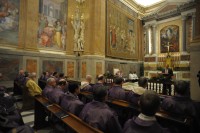
of Popes and Bishops: Catholic Ecclesiology


Dr. John Cavadini offers a reading at Mass with Pope Benedict XVI
and the other members of the International Theological Commission
on the occasion of his appointment to the Commission in 2009.
Click here for the full story.

One of the most obvious differences between Protestants and Catholics is church structure. Hierarchy of any kind is not at all in vogue in our culture. In American Protestant churches, especially among Evangelicals, the democratic ideal has won the day. Congregational meetings include voting, elder and deacon boards reign in the authority of the Pastor, and if people don’t like how things are going, they find another place to worship. For Evangelicals the hierarchy of the Catholic Church seems foreign. But before we talk about the structure of the Church, we need to say a few words about what the Church actually is.

The Catechism of the Catholic Church (CCC) describes the Church as a mystery, created by Christ, into which he brings people by setting them free from sin and death. The Church is not a club or voluntary organization. It is ordained by God to carry out his mission in the world by preserving and teaching the true faith. The Catholic Church recognizes the diversity of gifts that make up the body of Christ. In no way are those with organizational and leadership gifts exalted over those with “charismatic” gifts. Both are needed for a healthy Church to function. The Church is not perfect, but in the process of becoming what God has designed it to be.

The CCC teaches that the Church is the people of God, made up of those who have been baptized and therefore have taken on Christ’s mission (§871). Believers enjoy “a true equality with regard to dignity” and all participate in the work of the Church by exercising their spiritual gifts (§872). However, the offices of “teaching, sanctifying, and governing” the Church have been entrusted “to the apostles and their successors” (§873). This authority for bishops, priests, and deacons is derived from Christ himself (§874–875), who modeled servant leadership (§876). Bishops do not wield authority on their own, but as members of the collective group of bishops (called the “episcopal college”) under the leadership of the bishop of Rome, who is thought to be St. Peter’s successor (§877). Each bishop personally bears witness to the gospel as they serve the Church (§878–879).

The idea of the episcopal college is modeled after the 12 disciples of Jesus, and Peter’s headship over the 12 is based on his profession of faith, to which Jesus responded “on this rock I will build my Church” (§880–881; Matt 16:18–19). The Bishop of Rome, who succeeds Peter in authority, is called the “Pope” (§882; cf. 869, 936). He unifies the Church, and “as pastor of the entire church has full, supreme, and universal power over the whole Church, a power which he can always exercise unhindered” (§882; cf. 937). Whenever the episcopal college agrees with the Pope, they, too, exercise this authority through universal and ecumenical councils (§883–884).

However, lest we think of this “power” exercised by the Pope and Bishops from a worldly point of view, it’s important to understand that their “power” is a responsibility to serve the Church and to protect her from error. Their service is one of great personal sacrifice. Each is committed to lifelong celibacy, modeling, in a sense, Christ’s marriage to the Church.

Pope Benedict XVI greets Dr. John Cavadini
of Notre Dame, congratulating him on his appointment
to the International Theological Commission
Like the Pope, bishops are the symbol of unity for their own diocese. They care for their members and meet with larger groups of bishops (“ecclesiastical provinces,” “patriarchates,” or “regions”; §887; cf. 938). A bishop’s primary responsibility is preaching, ensuring that the congregation clings to the faith “under the guidance of the Church’s living Magisterium” (§888–889).* The other responsibilities of a bishop include “sanctifying” the Church through providing Holy Communion, praying, and serving (§893). Priests or deacons may be involved in service, but ultimately the bishops are responsible for what takes place (§1369; 939). Bishops also exercise governing authority to the degree that they are “in communion with the whole Church under the guidance of the Pope” (§894–895). In other words, the authority of the bishops is a communal authority. A bishop cannot strike out on his own and expect to be obeyed. His compassionate (and submissive) leadership guides his congregation in the way of truth (§896).

One controversial teaching of the Catholic Church is the “infallibility” of the Pope and the bishops when they agree together on doctrine. It may be helpful to know that only twice in church history has the Pope pronounced a doctrine as infallible (the Immaculate Conception and the Assumption of Mary). This “infallibility” cannot extend beyond the teaching of Scripture (§891–892), though it may be related typologically to it (as it is in both of the above cases). The Pope’s infallibility is derived from the infallibility of Scripture. Like a plumb line for the Church at large, the Church in Rome sets the standard to which all Catholic Churches must adhere (§834; again based on Matt 16:18–19).

For Catholics this hierarchy is very biblical. Based on Jesus’ choice of 12 apostles and his exaltation of Peter, Catholics recognize an unbroken succession of authority that has been passed down to the present day and now resides in the Pope (bishop of Rome) and the episcopal college (bishops around the world). The appointment of bishops, priests and deacons corresponds to New Testament guidelines for bishops, elders (or presbyters), and deacons. Catholics take seriously the unity of the Church and the accountability required to preserve true teaching. All authority is derived from Christ and used in service of the Church, not for personal gain. To the extent that this ideal is realized, one can say that the structure is biblically-derived.

Pope Benedict XVI
Even the most egalitarian and congregational Protestant Church has some authority structure. We may use different titles for those invested with authority in the Church, but we share the concern for unity, sound teaching, compassionate ministry, and purity of example. Authority and submission are biblical concepts, when exercised properly. No system is perfect, of course, but the diversity of models for Church governance should make us hesitant to condemn any one model as inadequate. Whether particular doctrines thought to be pure by the Magisterium truly are biblical is another question, but the structure itself need not be rejected out of hand.

* Dr. Cavadini explained it to me this way: “The Magisterium is the teaching authority of the Church. It first and foremost belongs to the whole Church, but it is exercised on behalf of the Church by the successors of the apostles (i.e. the bishops) in communion with and in union with the successor of Peter (i.e. the pope). The Magisterium makes decisions about what is authentic Christian teaching when necessary.” The CCC says that the bishops responsible for teaching must “preserve God’s people from deviations and defections and to guarantee them the objective possibility of professing the true faith without error” (§890).