Showing posts with label McCaulley. Show all posts

Sunday, March 9, 2025

Foreword by Esau McCaulley

 I've been keeping a fun secret for several months, and I finally get to tell you!

My good friend Esau McCaulley agreed to write the foreword to my new book for IVP Academic. Both of us love the church with all of our hearts. To love something is not to pretend that it's perfect, but to help it become what it was always meant to be. I respect Esau as a biblical scholar and author, but also as someone who has been willing to call attention to abuse in the church while investing deeply and personally in its flourishing.
Esau is the Jonathan Blanchard Associate Professor of New Testament and Public Theology at Wheaton College, but we knew each other before either of us had a PhD. He has published his dissertation, a stirring memoir, an insightful book on reading Scripture as an African American, a book on Lent, and several children's books--a wide breadth of writing! He was the lead editor on the recent book, New Testament in Color and edits the 'Fullness of Time' series for IVP on the church calendar. He's working on two New Testament commentaries. He writes for the New York Times and travels to speak regularly. He has his own podcast and has been on many others. I'm grateful for the way he is serving the church with the gifts God gave him. And I'm thankful that he took the time to read and recommend my book to you!
Check out Esau's books here.
My new book, Becoming God's Family: Why the Church Still Matters, is a biblical theology of the presence of God in the community of faith. It's a trek through Scripture to see the sometimes surprising ways that God works among (and despite) his people. The book is peppered with personal stories and other illustrations to help you understand and apply what you're reading.

Esau says this about it: "Readers will find that Dr. Imes has the rare gift of being a biblical scholar that can speak to the academy, clergy, and people in the pews at the same time. In this book she demonstrated the ability to translate a lifetime of learning into accessible writing without being simplistic or assuming that her audience cannot handle complex ideas."

This book is for four types of people:

1. Those on the verge of leaving the church. Maybe you're the one saying, "Give me one good reason to stay."
2. Those who've already left the church and wonder what they're missing or if they made the right decision.
3. Ministers who want a more robust ecclesiology based on the narrative of Scripture.
4. People who loved Bearing God's Name and Being God's Image and want more biblical theology that's accessible.

Which one are you?
If you enjoyed Bearing God's Name and Being God's Image, this book completes the trilogy. Please consider preordering it! Amazon has a price guarantee for preorders, so if the price drops between now and the book release, you'll be charged the lower amount. Preorders are a significant factor in whether bookstores decide to stock a book and whether Amazon promotes it, so it's a helpful way to support the project. If you aren't able to buy it now, you can add it to your wish list on Amazon. That helps, too.
Preorder here or wherever you buy books.
Thanks, friends, for your enthusiastic support!

Saturday, December 26, 2020

Best Books of 2020

As is my custom, I'm writing to tell you about the most important books I read this year. The only criteria are that I read them in full and found them well written, helpful, and worth sharing. I read 45 books this year, ranging from youth fiction to published dissertations. Many of them were very good! These are the books I hope you will read, too.

Best Books Every Christian Should Read:

These first two are tied for best overall book I read in 2020. Both issue a timely and illuminating message for the church, and both are written in such a way that non-academics will be able to read and appreciate them. I blogged about both of them earlier this year, so I won't repeat myself here, except to say that both of them show us what's in plain sight in the biblical text that the church has often missed.

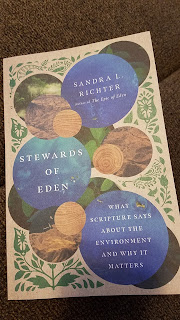
Stewards of Eden by Sandra Richter weaves solid biblical exposition with current case studies in environmental stewardship. It's a challenging and illuminating book.

Reading While Black by Esau McCaulley demonstrates the tremendous value of reading the Bible with and for the Black church. His book cuts to the heart of issues facing society today and calls us to a faithful, faith-filled response. Reading While Black is the Christianity Today best book of the year 2021 for Beautiful Orthodoxy.


Best Academic Books:

The Liberating Image 
by J. Richard Middleton is a consistently careful and thought-provoking explication of Scripture. Middleton never feels cliché or shallow, and even where you disagree, you'll find him thought-provoking. I'm grateful for his insight.

Exclusion and Embrace by Miroslav Volf came highly recommended by several friends. It is a dense read that took me a few months to finish, but his penetrating analysis was worth the effort. Volf issues a powerful call to self-giving love and charts a path for reconciliation and restoration of relationships.


Best Books for those who Write and Teach:

Adorning the Dark
by Andrew Peterson is a beautiful book about the creative process. Peterson is a songwriter whose music I discovered during quarantine, and fantasy novelist whose stories carried us through this dark year (see below). Although I don't write songs or novels, Adorning the Dark expressed powerfully the challenges and joys of any type of creative work shared with the public (including visual art and writing books of any kind). I loved it.

From Research to Teaching by Michael Kibbe releases in 2021, but I jumped at the chance to read it early and couldn't put it down. It would make the perfect gift for a recent PhD graduate -- seasoned with wisdom and practical help for navigating the transition to teaching. 


Best Books for those who Preach:

A second edition of The Art of Preaching Old Testament Narrative by Steve Mathewson is releasing in April 2021. Steve is a good writer, but more importantly an able interpreter of biblical narrative who offers practical suggestions for engaging your audience. I expect I'll turn to this again and again, not just for preaching advice, but for illuminating exegesis.

Simplify the Message, Multiply the Impact by Talbot Davis distills his many years of preaching experience into a focused model for sermon preparation. Talbot is an expert at connecting with people where they are. He preaches engaging and clear messages without notes, and he will show you how to do the same. Whether you're preaching to a full house or to a camera lens, Talbot will help you get your audience and get the message across.


Best Fiction:


The Wingfeather Saga 
by Andrew Peterson was a gift in this brutal year. My 12-year-old and I spent long evenings at home listening to Peterson read his stories on YouTube. His brilliant writing is matched by his incredible skill in voicing each character. The stories are full of high adventure but offer deep insight into human character. 

Killing a Messiah by Adam Winn is an engaging work of historical fiction about Jesus' last weeks. He weaves a plot that ushers readers into the political intrigue of first century Palestine. The storyline is complex and believable. A great read to save for Holy Week.


Tuesday, June 9, 2020

Reading 'Reading While Black' While White

Esau McCaulley is professor of New Testament at Wheaton College, an ordained Anglican priest, and a fellow board member of the Institute for Biblical Research. I'm guessing that he wrote Reading While Black: African American Biblical Interpretation as an Exercise in Hope (IVP, 2020) with Black readers in mind. But this white girl found it both helpful and inspiring.

May I make a public confession? I grew up in a very monocultural environment. We were not just all white, we were almost all of Dutch descent. My family is 100% Dutch on both sides, my church was about 95% Dutch, my school K-12 was probably at least 70% Dutch and about 95% white, and my neighbors were nearly all of Northern European descent. 

I didn't like being in a white bubble. I was intrigued by other cultures. I felt called to be a missionary, to take the good news of Jesus to the ends of the earth. I learned Spanish, read missionary biographies, collected ethnic clothing, and dreamed of life in another culture. But even so, I mainly thought about what I had to offer, not what I had to learn.

I used to think that making space at the table for people of color was a matter of equality or justice, and that's part of it. People of color are made in the image of God and they should get a chance to speak. In theory, I imagined that reading the Bible with people from other cultural backgrounds would also be enriching. But I had no idea what I was missing! 

Over the past 5 years or so I've been reading more widely and adding books to my own library and to my college's as fast as I can. I'm convinced now that when we only listen to people who look like we do, we're missing out on a ton of insight. I'm discovering a rich world of biblical reflection by African, African-American, Latinx, Asian, Asian-American, First Nations, and Islander believers.

Reading While Black fills an important gap in my library as well as in my understanding. Ironically, much of what is published by minority authors reflects the politics of the ivory tower -- critical of Scripture -- at times representing a departure from the faith tradition. (There are probably a variety of reasons for this, but I suspect that university presses are simply well ahead of faith-based publishers in seeking out authors of color.) As a result, it's much harder to find published works that represent the views of the majority of churches in the global south, churches which are by-and-large conservative.

Esau McCaulley, author of 
Reading While Black 
(photo: Wheaton College)
In Reading While Black, Esau seeks to recover the resources of the Black church tradition that arises from the pulpit and the pew rather than from the ivory tower. He models a faith-filled reading of the biblical text that remains engaged with politics and justice but does not neglect the call to holy living.

Each of his chapters tackles an issue about which the Scriptures have something profound to say -- a theology of policing, the political witness of the church, the pursuit of justice, black identity, black anger, and slavery. He issues a prophetic call back to the Scriptures and to a life of faithfulness. His is not a call to "make the best of" systemic injustice, nor does he seek a violent overthrow. Esau engages tough questions with verve, urging active but peaceful resistance to injustice.

I'm grateful for his voice. I've known Esau for a while now, and I've come to trust his commitment to the authority of Scripture. I also trust him to say hard things that need to be said, but to do it with pastoral sensitivity and kindness. I'm honored to call him my friend.

Many are wondering what to do when the protests have ended. How can we keep listening? My official endorsement of the book reads:
How can the church today effectively address the racial tensions that plague our nation? Esau has convinced me that the Black Church tradition holds the key -- maintaining fidelity to the Scriptures while fully engaging in the struggle for justice. This book is an excellent starting point for those who want to listen and learn a new way forward. Esau's prophetic voice is rooted in Scripture and full of hope. Highly recommended!
Why not start here? Reading While Black was supposed to release later this fall, but due to popular demand, IVP is stepping up the release to September 1, 2020. You can pre-order a copy here. You can listen to Esau talk about the book here. You can also spread the word and leave reviews on Amazon and GoodReads as soon as it releases.