Showing posts with label politics. Show all posts

Tuesday, January 19, 2021

Whose Side is God On? An Inauguration Day Reflection

Four years ago, President Donald Trump took the oath of office and all over America hundreds of thousands of people took to the streets in protest, some of them violent, all of them deeply concerned. Christians from Catholic, mainline, Black, and Brown churches expressed shock and concern over the appointment of a man who seemed to delight in exploiting women and to cozy up to dictators while snubbing America's allies. They feared that the most vulnerable members of our cities, especially immigrants and people of color, would be further marginalized by an administration aimed at the angst of blue-collar workers in rural America who were watching their way of life disappear. Meanwhile, many Evangelicals celebrated the possibility of greater religious freedom, conservative appointments to the judiciary, and legislation that upheld traditional family values and protected the unborn. Charismatic prophets heralded President Trump as God's man for the job.

Today, President Joe Biden will take the oath of office. Those troubled by the outgoing administration are breathing a sigh of relief, hoping for four years of police and prison reform, support for schools, greater equality women and minorities, and better cooperation in international concerns such as immigration and climate change. It remains to be seen how President Trump's supporters will respond, but the breach of the US Capitol building two weeks ago is still a vivid memory. Evangelicals who celebrated a Trump presidency are nervous about losing their freedom -- some desperate enough to break past police barriers to make their voices heard. The Coronavirus pandemic has already curtailed religious gatherings. Evangelicals fear that a Biden presidency will mean more pandemic-related restrictions that will cripple businesses and prevent the church from being the church. They fear a legislative agenda that will make it more difficult for faith-based organizations to live by their values.

Our nation is deeply divided. Many families are split right down the middle over politics.

Photo: Joshua Hoehne on Unsplash
So whose side is God on?

Scripture provides a crystal clear answer to this question. Tucked away in the book of Joshua is a brief episode that should stop every one of us in our tracks. It stopped Joshua. It stopped me.

First, some context. Moses died. Before he did so, he passed the baton to Joshua as Israel's new leader. The people have just crossed the Jordan River and are preparing to take up residence in the land God promised them. Their first battle will be at Jericho. 

Joshua is alone, apparently scouting the territory around Jericho, when he encounters a man with sword drawn. Joshua asks him a logical question:

"Are you for us or for our enemies?" (Joshua 5:13 NIV)

The answer comes loud and clear:

"Neither," he replied, "but as the commander of the army of the LORD I have now come." (Joshua 5:14 NIV)

Neither?! This is remarkable. Joshua is the authorized leader of the only nation with whom Yahweh ("the LORD" in English translations) has made a covenant at Sinai. He has instructed them to enter the land and drive out its inhabitants. He has promised them this land. And yet -- with all these things in their favor, the commander of Yahweh's armies will not pledge exclusive loyalty to the Israelites.

God is not on their side.

And he is not on ours.

God does not take sides. Not then and not now. He acts of his own free will. We are the ones who must decide if we will be on God's side. He refuses to back human agendas. He calls us to surrender in obedience to his will.

Joshua gets this. He falls on his face before the angel of Yahweh, asking if God has a command he needs to fulfill.

If God was not unequivocally on the side of the Israelites -- the covenant people he rescued from Egypt and led through the wilderness to the land he promised -- if God is not on their side, then God is not on ours. He does not side with the United States (or modern day Israel, for that matter!), and he does not side with the Republicans or the Democrats. God does not take sides. Instead, he asks our full and complete obedience. Our allegiance to anyone other than God is idolatry. 

The truth of the angel's words is borne out in the chapters that follow. Joshua and his soldiers win their battle with Jericho, having followed God's unconventional instructions for war (Joshua 6). Feeling cocky, they attack the next city with only part of their army (Joshua 7). They lose miserably. God does not fight for them because a single Israelite man has violated God's strict instructions regarding the battle at Jericho. Achan keeps some of the plunder for himself, hiding it under his tent, rather than devoting everything to God. This battle was never meant to make the Israelites rich. They were not to fight out of greed, but out of obedience. The moment they forget this, they lose their divine protection.

God knows what's under the tent, then and now.

He's asking us to clean house. To search our hearts. To release our hold on what does not rightly belong to us.

God did not lose this election. Neither did he win. He wasn't running for office. 

Joshua 5 offers American Christians the foundation for a renewed political theology, one not tied to a political party or a certain candidate, but marked by deep humility. We must stop presuming that God is on our side, supporting our favorite candidate. It's the other way around. This scene issues an invitation for us to bow before the presence of the only one who deserves our allegiance. This is the only way forward.

Thursday, July 23, 2020

Lament's Crucial Role in the Ministry of the Church

In my last post, I discussed three misconceptions about lament. Now I'd like to highlight four reasons why lament is essential to the ministry of the church. I'll be drawing on the excellent work of a Ugandan author, Emmanuel Katongole, catholic priest and professor at Notre Dame. His book, Born from Lament: The Theology and Politics of Hope in Africa, is one of the best on this topic.

Did you know that laments outnumber any other type of psalm in the Bible? This may come as a surprise because most of us rarely hear lament psalms in church. The truth is, they make up 40% of the book of Psalms! (See Katongole, 104)

Not only that. By my count almost 25% of the psalms include "imprecatory" language, which is when the psalmist prays for God to bring harm on his enemies. For reasons I'll share below, I believe that these psalms are for Christians, too. Why can we not get along well without lament? Here are four reasons:

1. God's character is the basis of lament.
As Emmanuel Katongole reminds us, 
"At the heart of Israel's social, political, and religious life is the central conviction and experience of Yahweh as a saving God. Yahweh is not only the creator of the world and sovereign ruler of nations; Israel is God's chosen nation, which, through a covenant relationship, enjoys God's special favor and protection. For biblical Israel, therefore, safety and security are found not in military strength or wealth or technological advantage, but in the covenant relationship with Yahweh. Thus in the moment of crisis, because they believed that God can, should--and indeed, would--do something to save them, they complained, mourned, wept, chanted dirges, and cursed." (Born from Lament103-104)
This point is especially true of imprecatory psalms (the ugly, violent-sounding ones). If we cut out the violent parts of the psalms, we deny part of God’s essential character. YHWH’s self-description in Exodus 34:6-7 highlights divine mercy, but it also says of God: “forgiving iniquity and transgression and sin, yet by no means clearing the guilty, but visiting the iniquity of the parents upon the children and the children’s children, to the third and the fourth generation” (NRSV). The God of the Old Testament is YHWH, the covenant-making and redeeming God who rescues and saves, who demonstrates love and who takes sin seriously.

Would we prefer it otherwise? Would we prefer a world where rampant evil goes unchecked? Where corrupt despots get rich by oppressing others? Would we prefer for people to be allowed to destroy each other’s lives and reputations by spreading false rumors about them with impunity? Or are we grateful that God wields his power in loving ways by putting a stop to injustice? 

If we believe that God takes sin seriously, then we can accept the Bible's invitation to pray that he will act to bring the unrepentant to justice. 
2. Jesus modeled lament.
The book of Hebrews tells us that even Jesus lamented. "During the days of Jesus' life on earth, he offered up prayers and petitions with fervent cries and tears to the one who could save him from death, and he was heard because of his reverent submission." (Hebrews 5:7)

Jesus' tearful prayers did not disqualify him. He was still "without sin." And here the author of Hebrews says that his lament was evidence of "reverent submission." Remember that on the cross Jesus prayed Psalm 22:1: "My God! My God! Why have you forsaken me?" This, too, was a faithful way to pray in the midst of his darkest hour. If Jesus is our model, then lament is an indispensable part of faithful discipleship.
3. Without lament, our worship spaces are less safe.
We live in a world full of brokenness at every level ranging from international to intensely personal. The people walking through our doors (or tuning in) on a Sunday morning are the same people who are enduring hardship throughout their week. If our church services are mostly a pep rally or an exhortation to "trust more," and fail to reckon honestly with brokenness, we essentially send people elsewhere to find solutions to their problems. Introducing lament in corporate worship creates space to be real -- to bring our pain to God and cry out for healing.

When we don't acknowledge pain in church, we get less of God and less of each other. As my friend Amy Oden recently put it, "I find more of God when I am most angry with him." Expressing our true emotions in his presence opens us up to meet him in deeper ways. It also opens us to each other.
Why would we deny this opportunity to our congregations? I can think of one reason why: FEAR. We fear that if we create space for lament, people will be offended or discouraged. But in reality, the opposite happens. By restricting our prayers to praise, we deny people access to the full message of Scripture. We lose people who think that their lives and emotions are too complex for the church. If your congregation is likely to be offended by lament, then they have not embraced the whole counsel of Scripture. Teach them what the Bible says about it. Cultivate a space where people can pray how they feel and in so doing discover that they are not alone.
4. Lament is the foundation of social justice.
The consequences of neglecting lament go beyond our local congregation. Not only will individuals not feel that the church is a safe place to bring their whole selves, but the church will lose its ability to impact the wider culture by addressing societal brokenness. 
Katongole explains, "In the end, the loss of lament signals of loss of passion for social justice. A church that has lost its nerve to lament before God will likely lack the nerve to confront oppression and be prone to support the status quo. But that is also the reason why an attempt to recover the language of lament is about solidarity with those who suffer" (183).
The historic failure of white evangelicals to lament racial injustice unveils the root of our problem--we see racial discrimination as something happening to somebody else and being done by somebody else. By identifying with neither the perpetrators nor the victims, we maintain distance. As long as we are distant we cannot be part of the solution. Unless we see crimes against people of color as crimes against our fellow humans, we excuse ourselves from taking action.  
If we cannot corporately bring to God those problems that overwhelm us, where will we bring them? If we are not comfortable creating space for our brothers and sisters to pray and weep, how can we even begin to work with them to find solutions? If their grief does not become our own, on what basis will we build unity? Where else will we find the resources to address whatever threatens to undo us? The first step in imagining a different kind of future is to grieve together and to grieve deeply over what has been done and what is being done.
If we want to (1) know God, (2) follow Christ, (3) minister to broken people, and (4) make a difference in a broken world, then lament is essential. On its own, lament is not enough. It is not the whole answer. But without it, we lose our grip on the resilient hope of the gospel.

------

For more on lament, see my interview with Remnant Radio. 
For more on imprecatory prayer, see my blog post for the Political Theology Network.

Wednesday, June 24, 2020

Author Interview: Sandra Richter

In this post I'm taking you behind the pages of Stewards of Eden to meet the author, Sandra Richter. Sandy, thanks for taking the time to tell us about your work!

So great to get to interact on this important topic, Carmen. Thank you for the invitation!

When did you first know that you wanted to write this book?

Sandra Richter, author of Stewards of Eden
Hmmm … that is a good question, and one I haven’t answered before. Although my love for God’s creation goes back to before I was even a Christian, the whole business of writing and speaking on this topic in Christian circles just sort of “happened.” As I narrate in the book, the first time I had the privilege of sharing a message of environmental stewardship from a pulpit was 2005 at Asbury Theological Seminary. The response was everything I could have hoped for. And to my surprise, I was asked to publish that message in the Asbury Journal. At the time of publication, I was serving on the Institute of Biblical Research planning committee, and we were casting about for a topic for the following year. I suggested that we do a plenary session on creation care. They said “yes,” if I would be one of the speakers. I was thrilled, but it also meant I had to seriously up my ante—now I needed a message appropriate for an academic conference. Man did I work hard on the research for that presentation. And in the fall of 2008 at the annual meeting … once again the response was everything I could have asked for. Rick Hess, editor of BBR was at the gathering and asked me to publish that presentation. Then there were a slew of speaking engagements—some more enthusiastically received than others. (There was a certain week-long “Holiness Conference” at a not-to-be-named Christian College where I think 17 people total showed up; then there was that walk-out at another not-to-be-named college; and, oh, the conference where I presented on humane animal husbandry in the heart of cattle country in Tulsa--that was a bit awkward!). In each of these my material evolved and developed. Usually the response was beautiful. (I’m thinking of Darryl Williamson’s "Arise City Conference" in Tampa, FL, and the older sister who stood to her feet at the end of my talk, called everybody out, and ran what could be called an altar call for me!) But I think the first time I knew I wanted to publish this book was during my tenure at Wheaton College. I realized (as I narrate in the book), that the Christian community needed a short, accessible, biblical treatment of this topic. A book that didn’t get lost on side issues. A book students could read (quickly), hand off to their parents, and they to the grandparents. I wanted to offer the Church their own book on this topic: “What Scripture says about the environment and why it matters.”  

Did you grow up in a home that valued conservation? If so, how did your parents practice conservation? If not, when did you become passionate about creation care?

No, I can’t say that I did. Like yours, my family was frugal. And like yours we camped a lot (there were a lot of us and we were military—cheap vacations!). I do think the camping and some of the adventurous places we lived as an oft-relocated Navy family awakened my deep empathy for the trials of creation. But I wasn’t raised with any sort of tutelage in environmentalism. Honestly, I think my passion for creation is part of my journey to faith. I believe that it was the image of God in me (prevenient grace for the Wesleyans out there!), and the Spirit of God calling me, that caused the majestic and fragile beauty of creation to resonate so deeply with me. As I say in the book: “When I stand at the ocean’s edge and feel the spray of its raging force on my face, when the wind silences me, when I am privileged to hold a wild creature in my hands” … my response is worship. This has always been true of me—even before I knew the Creator’s name.

What are the biggest hang-ups for evangelicals when it comes to creation care? Do you have a theory about why this is?

Having lectured and written on this topic for more than a decade at this point, I am pretty convinced that the “hang-ups” can be distilled to three issues. (1) The fact that in American politics environmentalism has been pigeon-holed into a “liberal” political agenda and has become guilty by association. Essentially, the accusation is that if you care about stewarding the planet you must also be a “liberal.” (2) The fact that we as Americans don’t typically see the impact of environmental degradation. We export most of our mess and never see the widow and the orphan picking through the trash piles we create. (3) The very unfortunate theological agenda that teaches that this earth will be annihilated at the end of the age. I deal with this misunderstanding of the New Covenant in chapter seven of the book.

You're a busy professor married to a professor with two growing daughters. What inspired you to raise chickens in your backyard? Surely not boredom?

Hah! The infamous chickens! Well Greta, Maggs, and Lucy will be thrilled to know they made the blog! Buttercup, may she rest in peace, will be grieved to have missed out. And we’ll be sure to send a note over to their sisters Sadie and Penelope who are keeping our friends Jack and Maggie in eggs these days! So, yes, I am “wicked busy,” but you make time for what you love don’t you? The chickens were a project for my youngest daughter and me. We both really wanted to do it, and Santa Barbara is a perfect place to raise chickens. California is a very libertarian state, so you can have chickens (not roosters) in pretty much any suburb. Better, you don’t have to heat your chicken coop to keep any of your hen’s feet from freezing off! More seriously, it is important to me that I practice what I preach. So in our house we recycle everything, we compost, we hang out our wash, we read labels, we eat very little meat, we have a vegetable garden, I drive a used Prius, we have rain barrels, and we’ve dropped all sorts of $$$ to landscape with native plants (which in SoCal means less water). Like any homeowner, I’m still learning (like what about solar panels?), but as I believe that environmental stewardship is a part of my responsibility as a Christian … I’m doing my best.  

Climate change is one of the most controversial aspects of the current debate about environmental concerns. Why did you choose not to talk about it in your book?


Great question. Several reasons. The first and most obvious is that the Bible has nothing to say about climate change. So any biblical theology of climate change is going to have to be an extrapolation—something I did not want to be doing in a book I promised was “just the Bible for those justly concerned.” Second and closely related, the steps any believer should be taking to curtail their own over-use of this planet and its resources will help to reverse climate change. So in many ways, climate change is a moot point. If we’d been doing our job as good stewards, we wouldn’t be having this problem. So what changes are needed? As Gus Speth, Chairman of the council on Environmental Quality under President Jimmy Carter has stated:

"I used to think that the top environmental problems were biodiversity loss, ecosystem collapse and climate change. I thought that thirty years of good science could address these problems. I was wrong. The top environmental problems are selfishness, greed and apathy."

I say it this way in the book: “The earth is the Lord’s and all it contains. He has given it to us to use in our need, but not to abuse in our greed.” When we get serious about our careless consumption of fossil fuel; when we start thinking about the supply chain for that fuel, our manufactured goods, our food; when we take stock of reckless land development … climate change will begin to unchange. So, yes, climate change is a huge issue that our carelessness has brought to the tipping point, but it is one that regular old responsible stewardship would have/still can resolve.

One of our first purchases when we moved to our current house was a 3-part trash bin for the kitchen, so that we could sort trash from plastic and paper recyclables. Our town has no recycling pick-up program, but we do have a local recycle center where we can bring our own recyclables. We've been pretty diligent about sorting trash making trips there. However, we heard a year or two ago that all the plastic recycling ends up in a landfill anyway because China will no longer accept plastics for recycling, and North America lacks the facilities to handle the volume of plastic waste. Have you explored this issue? Why should we keep sorting recyclables if it all ends up in the landfill anyway?

Yes, in 2018, China said, “We don’t want your trash anymore.” This, of course, sent major reverberations through many US businesses. If China wasn’t going to take our trash anymore, and we are now packaging everything from blueberries to underwear to new tools for our work bench in plastic, what are we going to do? The first question we should ask, of course, is why were we sending our trash overseas in the first place? Where is our sense of national responsibility? And what about the widow and the orphan in China?

The next question is, “Uh oh, if China has been recycling our plastic, do we have the infrastructure in the US to take care of our recycling ourselves?” And the answer right now is, no.  At this point we have more than 20 types of plastic packaging—and every time I go to the grocery store I see that COSTCO and Kroger have figured out a new way to use plastic for stuff that used to come loose or in cardboard. As a result, “virgin plastic” accounts for most of the plastic you and I see, which is produced by petro-chemical companies. These guys make billions producing their plastic (and will make billions more as current plans are to double the industry in the next five years). As the name implies, petro-chemical companies are using fossil fuels to make their stuff. And right now, virgin plastic costs less than 10% of the cost of recycled plastic. So what is a capitalist economy to do? The first thing we need to do is to be disturbed. Statistics such as those below should be a huge wake-up call:

  • More than 1 million seabirds and 100,000 marine animals die from plastic pollution every year; 100% of baby sea turtles have plastic in their stomachs. 
  • Every day around 8 million pieces of plastic make their way into our oceans.
  •  The Great Pacific Garbage Patch (made up primarily of plastic) is bigger than Texas. 
Then we need to do something. What to do? Vote with your pocket book. Buy plastic packaging as little as possible. Choose the “avoid plastic packaging and extra packaging” option with Amazon. When you have to buy plastic, look for “recycled” on the label. Tell your grocery store manager you don’t want your food in “clam shell” packaging. Tell COSTCO that apples don’t occur naturally in plastic bubbles. Basically, let us make it as socially inappropriate to buy and sell in plastic as it is to smoke cigarettes in the work place!

Your book goes beyond recycling to talk about mining and food production. Those case studies were incredibly eye-opening for me, especially in light of the biblical teaching on agriculture and animal husbandry that you so powerfully explain. What can one person do to make a difference in a culture marked by greed and consumerism?

Thanks for this question, Carmen. The last section of Stewards of Eden is entitled “Resources for the Responsive Christian.” This appendix gives very practical, hands-on, “I can do this,” suggestions for the average human. Things like getting informed (subscribe to an environmental magazine in order to educate yourself); voting your informed conscience (Sierra Club offers a voting guide every year); voting with your purchase power are a great way to start. Links and addresses are all in there. As above, one powerful thing all Americans and Canadians can do is vote with their purchase power. We are capitalists, oh, yes we are. And if it doesn’t sell, the industry makes changes! So when you go to the grocery store, the hardware store, the car dealership, be willing to spend a bit more to invest in the industries you want to thrive. As with all things in our fallen world, we are not actually going to be able to fix this. The Rider on the White Horse is going to have to do that. Just as I will never succeed in emptying all the brothels in Thailand, finding a home for every abused child abandoned to the foster care system, or feed every orphan in Sub Sahara Africa—I am not going to fix this either. But as a Christian, it is my sworn duty to stand in the gap. It is our calling as salt and light to demonstrate to our bruised and broken world what a citizen of heaven looks like, “to live our lives as Adam and Eve should have, as Jesus Christ has.” Environmental degradation is a global and a local issue, our neighbors are impacted by this, our neighbors care about this. Where is our witness in the mix?  In sum, what I attempt to demonstrate in the book is that God cares about this, and we must too.
It's hard to imagine a more compelling book on this topic for Christians who care about what the Bible teaches about creation. Thanks for your excellent work to help us think well about environmental stewardship! 


Thursday, December 26, 2019

My Favorite Books of 2019

I entitled this blog Chastened Intuitions as a way of recognizing that our gut feelings about something need reshaping in light of research and exposure to other perspectives. Reading is a powerful way to pursue that kind of learning. I read 40 books in 2019. The five listed below made the most significant contribution to my own growth, chastening my intuition in important ways.

Surprised by Jesus Again: Reading the Bible in Communion with the Saints
by Jason Byassee

I encountered this book as a skeptic, but I was quickly disarmed, even charmed. I did not find every reading persuasive, but I was won over by his central thesis. Byassee winsomely, playfully invites Christian readers of Scripture to delight in its mysteries and to participate in God's passionate quest to lavish his love an on ever-widening circle of faithful followers. He is right to chide biblical scholars for our lack of imagination. Reading this book has reignited my passion for a pedagogy that ushers fellow readers of Scripture into a place of wonder. A finalist in the Christianity Today 2019 Book Awards, this book is well worth reading.


The Liturgy of Creation by Michael LeFebvre

Given LeFebvre's brilliant doctoral work on Old Testament law, I expected this book to be carefully researched and lucidly written. I was not disappointed. LeFebvre skillfully brings into focus the parts of the Pentateuch readers are most likely to skip, showing how the purpose of each calendar notation in the Torah, including its opening chapter, is liturgical―to order the work and worship of the covenant people. His reassessment of Genesis 1 moves beyond the stalemate in the creation debates without recourse to extrabiblical or scientific arguments. His thesis grows organically from a close reading of the biblical text. LeFebvre shows himself to be a master teacher with pastoral sensitivity, able to patiently explain what he has so carefully studied. This book will change the way I teach the Torah. I can't wait to share it with my students!
Blood Brothers
by Elias Chacour

A powerful and enlightening story of a Palestinian Christian living in the aftermath of WWII. His story unveils the dark side of the Israeli-Palestinian conflict, its origins outside the land of Palestine, and the way both sides have been caught in the crossfire between nations whose complex interests are not above board. Chacour's hope is that Arabs and Jews can learn to live together as neighbors. He has devoted his entire life to this aim: PEACE. Such an eye-opening and hope-filled book!
Hope for the Oppressor by Patrick Oden

Hope for the Oppressor is a brave undertaking. Patrick Oden suggests that efforts to liberate the oppressed will never be successful until oppressors experience liberation, too. Without true liberation of all parties, new cycles of coercion result. But there's hope. He locates that hope in Christian community, where our notion of selfhood can be reconceived and our fractured selves healed in light of God's holy love. Oden's thesis is grounded in theologically rich readings of biblical texts and skillful engagement with historical and systematic theology. His book issues a life-giving invitation for all of us — those with privilege and those without — to participate in a different kind of kingdom. His book has the potential to fuel a revolution for those who dare to reexamine their lives in light of his claims.

Phoebe by Paula Gooder

How does a woman with a slave name end up delivering Paul's letter to the Romans? How does she have the means to undertake such a journey? How was she educated to the point that Paul chooses her to explain his letter? What did she think of the church in Rome? Gooder answers all these questions in a compelling way. She kept my attention from beginning to end. Friends who are not biblical scholars have enjoyed the book, too. Together with Holly Beers' A Week in the Life of a Greco-Roman Woman and Ben Witherington III's Priscilla, 2019 was my year to discover what is was like for women of the Roman Empire in the first century.

Sunday, November 10, 2019

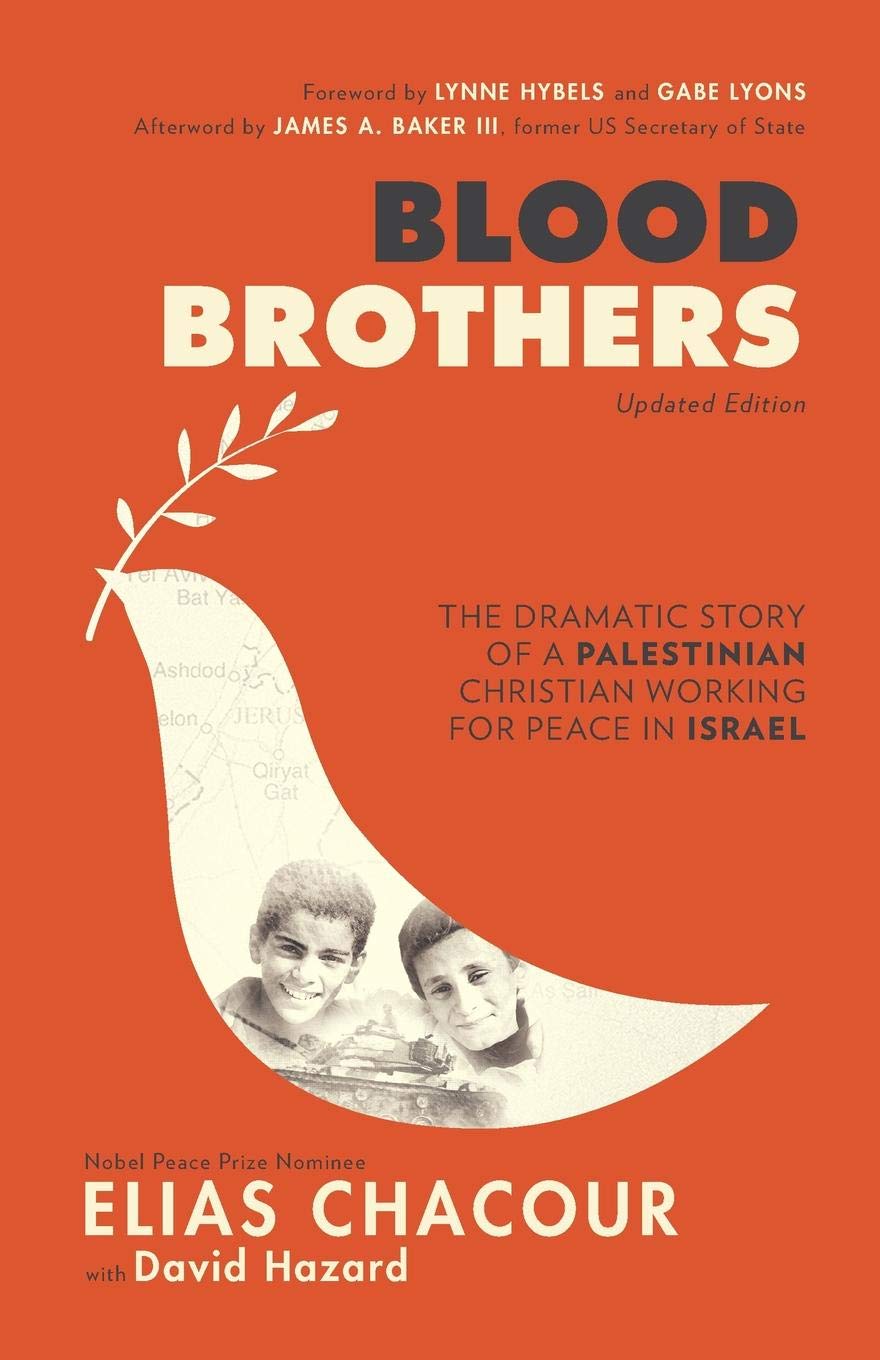
Book Review: Elias Chacour's 'Blood Brothers'


Image result for elias chacour blood brothers

I'm leading a trip to Israel with Prairie College in 2020, so as part of my preparation I'm trying to get a handle on the history of the Israeli-Palestinian conflict. The first book on my list was Elias Chacour's Blood Brothers, which has been recommended to me several times. It was a fascinating read!

Chacour is a Palestinian Christian leader who came of age in the midst of great turmoil in the Middle East. He tells of his peaceful childhood in a Christian village in Galilee where his family had owned and tended the land for generations. They understood themselves to have been grafted in to the "olive tree" of Abraham through faith in Jesus. Chacour's father regularly did business with Jewish villages nearby, treating them as brothers. Like the rest of the watching world, his family sympathized with the plight of European Jews. Chacour's village was ready to welcome new Jewish settlers fleeing Europe to live among them and farm the land. But they were never given this chance.

The peace of their community was shattered when Zionist soldiers arrived after WWII, kicking Palestinian residents off of their own land and confiscating their property. The violence of the war seems to have infected the "peacekeeping" troops, who were funded by a variety of nations with special interest groups. Unlike their Jewish neighbors, these troops were violent and their aim was conquest. It was the beginning of a decades-long conflict that is still unresolved today.

Chacour has devoted his life to working for peace between Arabs and Jews. A Nobel Peace Prize nominee, he has watched communities transformed by hope and brotherhood. So although this story is a brutal one, the undercurrent is hope -- hope for a peace made possible by restoring the dignity of every human being.

Given the almost unqualified support for the state of Israel extended by many American Christians, this story is vitally important for us to hear. Chacour does not call upon Westerners to reverse history and force Jews out of Palestine, but rather to withhold judgment on who is terrorizing whom when we lack the proximity to make such judgments. He laments, "How terribly sad that men could ignore God's plan for peace between divided brothers, even supporting one group as it wielded its might to force out the other" (142). We must learn to listen and heed the teaching of the prophet Isaiah, "Practice justice and righteousness, and then you will have peace" (227). If we want to walk in the way of peace, Chacour will be an able guide.

Sunday, July 28, 2019

Book Review: Richard Mouw's "Restless Faith"

Do you wrestle with your evangelical identity? Do you ever wonder whether it's time to throw in the towel and walk away?

If so, this book is for you.

As president of Fuller Seminary and former professor at Calvin College, Richard J. Mouw has spent many decades as an evangelical. All of them, he says, were restless years. This book is his explanation of why he's choosing to stay.

These are trying times for evangelicals. Cultural pressures from the outside and deep disagreements on the inside make evangelicalism an uncomfortable place for many Christians. The most recent national election in the US, to cite just one example, threatened to split families right down the middle.

Mouw takes us behind the scenes in the institutions where he has served to demonstrate that evangelicalism has always been this way. He reminds us of the core tenets that hold such a diverse group together, suggesting that these central values -- belief in the need for conversion, the authority of the Bible, the centrality of the cross, and an emphasis on daily discipleship -- cannot be found in this combination anywhere else.

He talks about Billy Graham, Christianity Today, Ann Voskamp, World Vision, and the National Association for Evangelicals on the one hand, as well as Norman Vincent Peale, Robert Schuller, Rob Bell, and the National Council of Churches on the other. We learn about his efforts to promote Mormon-Evangelical and other types of inter-faith dialogue without watering down his own Evangelical commitments. We read of his lonely engagement in the civil rights movement and politics during the 1960s when many Evangelicals' only concern was to "save souls." He wrestles with the individual and communal aspects of salvation and considers the value of both hymns and contemporary worship songs. In the end, he advocates "holding on while staying restless" as an Evangelical.

Speaking as an academic, I did not find the book to be heavy reading, but rather patchwork autobiography in accessible prose. Yet one does not have to know Richard Mouw to appreciate his reflections -- his wisdom shines through on every page and offers hope for Evangelicals who are feeling squirmy in today's politicized climate. He concludes,
"For me, the only way to be a properly functioning evangelical is to keep arguing about what it means to be an evangelical. Restlessness in claiming that label has long been the way I have kept moving. I hope that many of us can stay restless as we hold on while exploring together whether the best way to remain faithful to the legacy is to let go of the label. . . . For the present, I am inclined to go with the second option -- working for evangelical renewal, rather than simply allowing the movement's label to be co-opted by leaders who have departed from the best of the legacy." (174)
If you share his restlessness, this book may be just the thing you need to refresh your perspective and refuel your evangelical commitment. Mouw does not suggest that we hold doggedly to the label "evangelical," but he offers good reasons to keep it for the time being.

Tuesday, July 16, 2019

Book Review: Ben Witherington's "Priscilla" and Paula Gooder's "Phoebe"

Two of the most recent contributions to the burgeoning collection of novels written by biblical scholars are worth reading. Historical fiction about the Bible is not a new genre. What's new is that reputable scholars, with PhD's in New Testament and an impressive array of other academic publications, are harnessing their training for this unique genre and publishing these works with academic publishers (in this case IVP Academic).

Ben Witherington III fills out the story of the biblical Priscilla, or Prisca, mentioned in Acts 18 and Romans 16. The New Testament does not tell us much about her -- she's a tentmaker and church leader with her husband Aquila, both of whom work with the apostle Paul, and mentor the young evangelist named Apollos. Witherington weaves these facts about Priscilla into a coherent narrative in which the aging church leader tells her story to her adopted daughter, who is coming of age.

Witherington's story is well researched and loaded with historical and theological insight. Each chapter begins with an excerpt from a historical document (e.g. Pliny the Younger). And yes, this novel has footnotes. Historical fiction is an enjoyable way to learn about life and culture in the first century, making history more accessible to students and laypeople. The chapters are short. The plot is believable. His interpretation of scripture and its context is plausible.

We're introduced to the apostles Peter and Paul as well as Apollos, the emperors Nero, Claudius, and Domitianus, seasons of persecution and pressure for the young church, the tension between Jewish and Gentile followers of Jesus, the gladiatorial games, and even the eruption of Mt. Vesuvius. We're given Witherington's conjecture about Paul's mission to Spain, his return to Rome, and his death -- none of which are recorded in the New Testament but are matters of great curiosity for biblical scholars. 

If I have one complaint, it is near the end of the book, as Priscilla and her daughter discuss the relationship between Jews and Gentiles. Their re-reading of Paul's letter to the Romans (chapters 9-11) is surprisingly flat. I've not read much of Witherington's voluminous contribution to New Testament scholarship, so perhaps his interpretation here is in keeping with what he has said elsewhere. For a stronger reading of that passage, see N. T. Wright's work. Still, my disappointment with this one chapter should not detract from the overall quality of the book. It remains a solid introduction to the contributions of women in the earliest churches.

Witherington's other books of this genre include A Week in the Fall of Jerusalem (IVP, 2017) and A Week in the Life of Corinth (IVP, 2012).  

Another outstanding book in this genre is Phoebe, by Paula Gooder (IVP, 2018) which reconstructs the life of the female deacon who delivered Paul's letter to the Romans. It's a page-turner and well worth reading!

How does a woman with a slave name end up delivering Paul's letter to the Romans? How does she have the means to undertake such a journey? How was she educated to the point that Paul chooses her to explain his letter? What did she think of the church in Rome? Gooder answers all these questions in a compelling way. She kept my attention from beginning to end. Friends who are not biblical scholars have enjoyed the book, too. Highly recommended. 

One of these days, biblical scholars need to start writing historical fiction on the Old Testament . . .

Friday, May 17, 2019

The Sound of Music and the Audacity of Praise

I've been working on the "ugliest psalms" lately, the imprecatory psalms, which call upon God to bring harm on the psalmist's enemies. These challenge our sense of what belongs in the Bible and what are appropriate ways to pray. "Break my enemy's teeth" certainly seems an audacious prayer.

We might imagine that praise psalms are much more innocuous. With all their attention on God, they steer clear of the mud-slinging of human conflict and simply celebrate what we like about him.  Perhaps we think of praise psalms like a Mother's Day card ("Best Mom Ever!" . . . not to mention the only mom we've ever had) or like a standing ovation at the end of a an orchestra concert (Well done!). But praise psalms are much more audacious than that. I've written a piece for the Political Theology network on the audacity of praise, but here I'd like to offer a further illustration of what I mean.

To dial in to what's really at stake, we must consider their context.

Have you seen The Sound of Music? I think it offers an analogy that will help us with the significance of praise psalms. Captain von Trapp is a retired naval officer in Austria raising his 7 children with the help of one governess after another. The children are hard on these substitute mothers, so the captain turns to a nearby Abbey for help -- maybe a nun can keep his children in line! The Abbey sends him a novitiate, Fräulein Maria, who wins the hearts of the children as well as their Father. Their romance is set against the backdrop of a growing threat of occupation by Nazi Germany in 1938. They return home from their honeymoon to a Nazi flag flying over their front door, a summons to serve in Hitler's navy, and an (unrelated) invitation to perform in the Salzburg Music Festival. They attempt to escape to neutral Switzerland as a family that very night under the cover of darkness, but are caught in the act. Thinking quickly, the family pretends they are heading to perform in the music festival instead.

Photo: Stephane Mingot on Unsplash

The joyous evening of music is strained by the presence of Nazi soldiers guarding the exits. In the front row sits the Nazi officer who was sent to escort Captain von Trapp to his new post in Hitler's navy. While the judges evaluate the results of the competition, Captain von Trapp regales the waiting crowd. Alone in the spotlight, he sings "Edelweiss," a simple song about a white alpine flower native to Austria. The lyrics are not in themselves seditious, but sung in this context, his audacity is plain. The lilting melody evokes for the crowd a longing for Austrian independence. The Captain is overcome with emotion, unable to finish the song. Maria, the children, and the entire audience join him for the finish, ending with the hopeful plea, "Bless my homeland forever!"

The psalms are like this. On their own, they don't strike us as rebellious, but set against the backdrop of Assyrian or Persian rule, they are a form of insurrection. Psalms of praise exalt Yahweh above all human rulers and rival gods, diminishing their claim to power.

To see what I mean, head on over to the Politics of Scripture blog to read my post.

Tuesday, June 26, 2018

TIME, Trump, The Death of Socrates, and The Art of Biblical Interpretation

Journalism ethics is all the rage this week (literally), with a provocative TIME magazine cover on the topic of immigration. (With apologies to readers interested in the politics of immigration and assurances to those weary of the debate, this post is not about immigration, but rather the relationship between art and truth). Are the facts at odds with the truth?

The Facts: President Trump has never met this girl from Honduras. Her separation from her mother at the border was only momentary, as her mom was searched. Afterward they were (at least temporarily) reunited as they awaited processing.

The Truth: Still, the girl comes to represent the many hundreds of children who have been separated from their parents while seeking a better life. The moral outrage following the public's realization of this is understandable, no matter how you propose to handle illegal immigration.

TIME's cover reminds me of a painting from the 1700's -- "The Death of Socrates," by Jacques-Louis David. David depicts Socrates surrounded by his disciples, on the verge of drinking his death sentence in poison. He teaches until the final moments of his life, remaining stoic in the face of death.

"The Death of Socrates" by Jacques-Louis David (1786)
Public Domain / Wikimedia Commons
Here's the connection with TIME's cover: Plato, from whom we learn the story of Socrates' death, was not present when it happened, yet David depicts him seated at the foot of the bed, slumped over and facing away.

Why include such an inaccuracy in this painting?

The Facts: David knew from Plato's own writings that he was not present at Socrates' death.

The Truth: Plato was deeply affected by Socrates' death and opposed it. By positioning him at the foot of the bed, looking away, the artist accurately captured Plato's disposition toward the death of his esteemed colleague. If Plato had been missing from the painting, we would lose this central point the artist is trying to make -- a point that coveys the truth of history creatively.

From time to time, feathers are ruffled when someone dares to suggest that the writers of Scripture  were brilliant artists. To some, this implies a disconnect with truth and a denial of divine inspiration. The second objection is easily solved. The God who created all things endows humans with creativity and invites us to participate in his work. As a prime example, take Bezalel and Oholiab, the men charged with designing the tabernacle (Exodus 31). These men were Spirit-filled and skilled creatives, in spite of the fact that their task was to construct something that already had very detailed blueprints. If their creativity was not a valuable asset for this project, God would have been better served finding an automaton. No, he chose humans, men who had spent years honing their skills in weaving and engraving and woodworking and all types of art.

But does art imply a disconnect with truth? Put another way, would the exercise of artistic license in the production of sacred Scripture get in the way of truth?

A great place to test this theory is in the Gospels. Matthew, Mark, Luke, and John each tell us the story of Jesus. With their words they paint a portrait for us of his life and ministry. They share much in common, at times even whole episodes or chapters. But there are differences, and some of these are rather puzzling. Did Jesus drive out the money changers in the temple at the beginning of his ministry (as John tells it)? or at the end (as Matthew, Mark, and Luke recount)?  Some Christians assume that Jesus must have driven them out twice -- once at the beginning and another time at the end of his ministry. But could this be an example of creative license?

Each Gospel writer introduces us to the historical Jesus by showing us something distinct about who he really is -- the Jewish Messiah (Matthew), the suffering Son of God (Mark), the Savior for all people (Luke), the Son who reveals the Father (John). To show us what is true about Jesus, in some instances they are best served by rearranging events so that everything will point in the direction they want us to look. This is not because they are trying to hide the truth, but because truth is their main concern. They arrange the details so that we as readers don't get muddled -- so that we can see what they see.

Matthew, Mark, and Luke may have saved this story until the end to illustrate how the opposition to Jesus gained momentum, resulting in his crucifixion. On the other hand (I suspect this is the better explanation), John may have chosen to tell us about the temple cleansing earlier because he's arranging the episodes of Jesus' life topically. The temple cleansing fits a string of stories illustrating Jesus' redefinition of Jewish institutions (sacred vessels, temple, rabbis, and sacred sites; John 2:1-4:54).* The cluster of stories among which the temple cleansing sits is followed by a series of stories in which Jesus redefines Jewish festivals (Sabbath, Passover, feast of Tabernacles, and feast of Dedication). Together, these two clusters make up the "Book of Signs," where John presents 7 signs that reveal Jesus' identity and call people to faith, setting us up for the "Book of Glory," where Jesus is glorified by offering his life on the cross.

However you slice it, artistic license is clearly at work. Either somebody moved this event out of chronological order, or all four gospel writers chose to omit a second occurrence. In my opinion, the truth has been gloriously served.

*For a fuller discussion of John's arrangement of material, see Gary M. Burge, Lynn H. Cohick, and Gene L. Green, The New Testament in Antiquity (Zondervan, 2009), 216-219.

Saturday, January 28, 2017

Hidden Figures: America's Pathway to Greatness

Imagine if your best work went unnoticed.
Imagine if you wrote a report but someone else's name went on the cover.
Imagine if that same someone else was paid a great deal more than you were.
Imagine if they resented your presence in the office.
Imagine if everyone else in the office shared that opinion and made it obvious.
Imagine if you couldn't speak up about it because this was normal.

If you were an African American woman working at NASA in the early 1960s, you would not need any imagination. This would be your life.

Hidden Figures is a movie that will take you into the world of three women who walked in these shoes. Given the segregated times during which these brilliant women lived, I suspect that their experience was widely shared by people of color.

A lot of progress has been made since the 60s, but friends of color tell me that we still have a long ways to go. Assumptions and stereotypes about aptitude, motivation, or immigration status plague these brothers and sisters. Guarded suspicion is more readily extended than friendship.

We are much closer now than we were then to equity and equality, but let's not imagine there is no work left to be done. 2016 made that painfully obvious. Perhaps President Trump's most lasting legacy will be bringing the blatantly racist attitudes that persist in America into the light of public discourse. As troubling as this was, we might as well know the truth about where we are as a nation. Maybe this truth will compel us to seek justice.

The flurry of executive actions in Donald Trump's first week as President underscores the urgent need for private citizens, churches, and non-profit organizations to champion the cause of justice. If in the past we have relied on governmental agencies to ensure a just society, we know now that such an approach is inadequate. This has always been true. But now it's undeniable.

In Soong-Chan Rah's Prophetic Lament: A Call for Justice in Troubled Times, Rah urges his readers to cultivate "a personal connection to the corporate sin that has entered our culture." He says, "We must move from 'let's just get over it' to 'how do I personally continue to perpetuate systems of privilege?' Justice must move from the third person to the first person, from the abstract to the personal" (125–26). This is such timely advice.

Just this morning I heard about an African American PhD student in Chicago who was pulled over in 2015 and accosted harshly by police for suspected auto theft in spite of his respectful compliance with law enforcement officers. Friends, the man was beaten for driving his own car. Examples like these can be readily multiplied. As long as we live in a world where this can happen, we cannot rest.

The only great America will be the America where every human being — no matter their race or gender — is treated with dignity, compensated fairly, given credit for their work, and given a voice and a place at the table. If this is the America we want, we need to create it. Let's get to work!

Thursday, January 5, 2017

a prayer companion for the next four years

Evangelicals have found ourselves in an awkward place this election season — heavily courted and yet publicly disdained. One day wooed, the next betrayed. There has been no easy way to navigate political conversations with friends and neighbors as emotions run deep and issues flare. Choosing how to vote created a conundrum for many people. Which policies are most compatible with Christian faith? Which issues should be highest priority—the economy? immigration? the unborn? race relations? How much should a candidate's personal beliefs (or lack thereof) and character (or lack thereof) play into our decision?

Some Evangelicals concluded that the only Christian vote was a Republican vote because it had the best chance of overturning Roe vs. Wade or was most likely to preserve the freedoms enjoyed by Christian institutions. Other Evangelicals felt passionately that the Democratic candidate best embodied the biblical ideals of caring for the poor and the oppressed. Still others felt that neither candidate had the personal character necessary to occupy the oval office. Some of us voted for a third party candidate. Others abstained in protest.

Wherever you find yourself on that spectrum, if you consider yourself an Evangelical, like it or not the polls have securely linked the president-elect with your vote. That means the world is watching, and you will be blamed for whatever happens next. A change in leadership always brings opportunities and risks. Whether you are concerned about what these next four years may hold or you are celebrating regime change, I've got a book to recommend just for you.

In a world full of pressing needs and deep divisions, this book is a call to prayer and fuel for action. For those whose hearts are heavy, this is one way to transform your burden to focused prayer. For those who are optimistic about the incoming administration, this book will augment your prayers for our new president in ways that consistently reflect God's kingdom priorities.

Offering a quote each week and a Scripture verse for each day of this four-year administration, Praying for Justice functions like a lectionary. As the authors describe it,

The title of this book contains an invitation to pray for justice, but this book contains no overt prayers. Many of the more than fourteen hundred Bible passages contained here are prayers or portions of prayers. To read these texts is to be invited to join them in prayer.  
This book invites us to use each day's verse as a meditation or reflection for that day and each week's quotation as an examination of the ways in which your life images God's redemptive justice in the world. 
This book is also a call to action. Now is not a time for Christians to sit and trust that others will take care of people on the margins of our society. Christians must not content themselves with mere social media activism or personal piety. Christians must act often. Christians must act publicly. Christians must act sacrificially. Christians must act with courage and compassion. Christians must act as if it matters - because it does.
This book was a labor of love by three of my colleagues at George Fox University. Anderson, Steve, and Paula worked like the wind for four weeks straight after election day so that you could have this resource in your hands in time for the inauguration. All the proceeds will be donated to Church World Service, to aid them in their work resettling refugees.  You can order your copy on Amazon.

Thursday, December 29, 2016

Top 12 Posts of 2016

2016 has been deeply satisfying for me personally. This is ironic, considering the tumultuous waters we have traveled as a nation and the looming crises internationally. By the grace of God, the collective lament and angst and fear has opened doors for me to write, teach, and speak in ways that are more culturally connected than ever before. This is evident on my blog, as I've come out of my academic cave and touched on issues of race, immigration, social media, vocation, politics, death, and tough questions of the faith.

Perhaps you haven't read it regularly, and you'd like to catch the highlights. In case you blinked, my blog changed titles this year, and so did I! Here are the posts that have (mostly) generated the most hits this year. I've skipped a couple and added one of my own favorites.

On race, immigration, and politics
2/1   refugees and religious extremists -- what to do?
7/12 an open letter to people who think they're white
7/14 so you think you're white
11/7 election day encouragement

On living life fully in God's presence
4/4   learning how to celebrate
5/18 a simple path to joy, part 1 and part 2
11/2 the surprising beauty of unanswered prayer
12/7 undone by the Psalms

On finding our vocation
1/3   leaning in
4/12 lasting impressions and do-overs
7/4   perspective on cape perpetua
7/26 quilted hearts: mentoring for the long haul


Monday, November 7, 2016

election day encouragement

It is hard to imagine a more sobering election cycle in America. I watched the primaries with interest and the nominations with alarm. I am quite simply speechless. Are these really the best candidates for President that our nation could produce? I'm tempted to list the shocking specifics that make this election unprecedented, but you've had enough of that already, and my goal is to encourage you.

I borrow the words of the prophet Micah:
"Listen, you leaders of Jacob, you rulers of Israel.
Should you not embrace justice, you who hate good and love evil?" (Micah 3:1–2a)
"Hear this, you leaders of Jacob, you rulers of Israel,
who despise justice and distort all that is right;
who build Zion with bloodshed, and Jerusalem with wickedness.
Her leaders judge for a bribe, her priests teach for a price,
and her prophets tell fortunes for money.
Yet they look for the LORD's support and say,
'Is not the LORD among us? No disaster will come upon us." (Micah 3:9–11) 
Like ancient Israel, this campaign season has been drenched with distortion and lies, wickedness and injustice, and yet the candidates vie for endorsement from religious leaders. Tomorrow as millions of Americans head to the polls, they will likely send a clear signal that it's okay to cheat your way to the top, okay to take advantage of the system, okay to abuse power to get what you want, and okay to consider yourself above the law. To be clear, I am not vilifying any single candidate. Either major party nominee will bring with them to the White House a long list of offenses. It's enough to invite despair.

But then there's the Psalms. I've just read through the "enthronement psalms" -- Psalms 93–99. These psalms are intriguing, in part because they directly follow the despair of an apparently failed Davidic covenant (Psalm 89), in a section of the book that mentions neither David nor another human king. Who's in charge? How can we have enthronement if there's no king? For those in exile, this was an urgent question.

For the enthronement psalms the answer is simple: Yahweh is king over the whole earth. And what a candidate he is!

God is utterly blameless:
"Your statutes, LORD, stand firm; holiness adorns your house for endless days." (Psalm 93:5)
God is full of loving compassion for the weak:
"When I said, 'My foot is slipping," your unfailing love, LORD, supported me." (Psalm 94:18)
God is praiseworthy:
"Great is the LORD and most worthy of praise." (Psalm 96:4a) 
 Even his foreign policy is celebrated:
"The LORD reigns, let the earth be glad; let the distant shores rejoice." (Psalm 97:1)
God will make just decisions and treat people fairly:
"He will judge the world in righteousness and the peoples with equity." (Psalm 98:9b)
Now that's a leader I can get behind.

And so on this election day, vote your conscience. Make every effort to elect leaders whose character will compel them to uphold justice and govern wisely. Choose the best you can. But remember this: our hope does not rest in humans. The one who sits enthroned above all is the God who saves.
"Exalt the LORD our God and worship at his footstool; he is holy." (Psalm 99:9)
Against the black backdrop of this election cycle, this is very good news indeed.

Saturday, July 23, 2016

preventing the holocaust: three things that went wrong

Are you like me? Do you have the same perennially nagging questions about WWII: How could the holocaust have been allowed to happen? And how can we prevent it from happening again? If so, read on. I've found a few answers this summer.

However, before I share this list I offer a disclaimer: I am not an expert in WWII. I have not engaged in academic research on these matters. I am, like most of you, simply curious, with a long-standing uneasiness regarding this part of human history. Even now similar narratives are playing out in other parts of the world. Will we look back in 60 years and wonder how we could have stood idly by while whole people groups are slaughtered?

1. Insidious Propaganda

The first reason I encountered for the holocaust (or Shoah) is explored in John Boyne's young adult novel, The Boy in the Striped PyjamasIn my opinion, the movie is even more achingly powerful than the book. You simply must watch it.

Although this is a work of historical fiction, it goes a long way toward answering my questions about the German populace during WWII. In this story, even the Commandant's family, living next door to a concentration camp, are unaware of its inhumane conditions. They don't realize the acrid smoke comes from burning bodies and that their own father is responsible for the daily murder of countless humans. They are shown videos that depict happy Jews, well-fed and grateful for a place to live. For the average German, it was less psychologically taxing to believe the propaganda than to push for answers, especially when those who did so risked personal harm.

2. Incredulity

I encountered another reason for the widespread devastation of the holocaust in Elie Wiesel's Night. This one gave me chills. Wiesel describes how a member of their Jewish community in Poland had been deported to a prison camp, escaped, and returned to warn the community. But nobody believed him. The horrors he described were so unthinkable that the other Jews decided he must have gone crazy. They had plenty of time to escape before they were rounded up, but they stayed put, confident that the war would soon be won and the Nazis would go home to Germany.

Ironically, I finished Wiesel's autobiography of the war years on the very day he died, old and full of years. What a gift he gave us all with his unflinching description of Nazi brutality. What a wonder he survived it! Self-deception can run very, very deep and animate the most egregious behavior imaginable. Let us not forget it.

3. Insufficient Sympathy

The final, nauseating insight is from Chaim Potok, author of My Name is Asher Lev and also of The Chosen, a fantastic novel about Jews in Brooklyn in the 1950's. He explains, "There had been public meetings in England, protests, petitions, letters—the whole machinery of democratic expression had been set in motion to impress upon the British Government the need for action [during WWII]—and not a thing was done. Everyone was sympathetic, but no one was sympathetic enough. The British let some few Jews in, and then closed their doors. America hadn't cared enough, either. No one had cared enough. The world closed its doors, and six million Jews were slaughtered. What a world! What an insane world!" (197, emphasis added)

If Potok is correct, immigration policy played a role in the mass devastation. Jews who had nowhere to go were left vulnerable to Nazi occupation, deportation, and death in a concentration camp.

Closer to home . . .

Are we believing lies about the true status of refugees?
     These are moms and dads with children who are desperate for a safe place to call home, not dangerous criminals.

Are we believing the truth when it is told? Or do we dismiss the stories as highly unlikely?
     Entire villages are being destroyed. Women are being sold as sex slaves to ISIS militants. Entire museums and ancient monuments are being blown to smithereens.

Are we sympathetic enough to do something about it?
"If anyone, then, knows the good they ought to do and doesn't do it, it is sin for them." (James 4:17 NIV)

The solutions are complex because the problems are complex, but let's not turn and look away. These are our brothers and sisters.

Thursday, July 14, 2016

so you think you're white

What does that mean exactly?

If you're referring to the color of your skin, let's be honest — "white" is not the most accurate descriptor. White stands at one extreme of the color spectrum, and black at the other. Yet every human being I know falls somewhere in the middle — a rainbow of rich hues: peach and olive and tan and brown, which my set of 24 colored pencils cannot adequately represent. By labeling ourselves "black and white," we polarize, forcing everyone to one side or the other.

White is not a skin color (even for albinos).
White is not an ethnicity.
It's a way of organizing society, and it's so pervasive that it has changed what we think we are seeing.
A month ago this had not yet occurred to me.
But I'm over being white.

If it matters to you, I'm an American of Dutch descent. What little skin pigment I have has gathered itself into a thousand freckles on my arms and legs and face, defying categorization.
Above all, I'm human. Made as the image of God.
And so are my brothers and sisters across the pigment spectrum.
Every one of them is his image.

Language matters.
When we assign a label to something we place it in relation to other things.
We say what it is not.
In these challenging times, where emotions run high, let's choose our words carefully.
A word aptly spoken can open up new avenues for dialogue or it can dig trenches and build walls.

From now on, I'm human.