Showing posts with label race. Show all posts

Friday, February 11, 2022

Becoming Human: My Visit to an SBC Seminary

It was an unlikely invitation. 

Would I travel to Wake Forest, NC to speak on personhood at Southeastern Baptist Theological Seminary? 

I, who am neither a member of the SBC nor the daughter of a member of the SBC. 

I, a woman who teaches Bible and even preaches on occasion.

It was not my first SBC connection. First, my book appeared in the book store at The Southern Baptist Theological Seminary in Louisville, where Al Mohler is president back in early 2020. (Unexpected!) Then, the same book was a finalist for an award from Midwestern Baptist Theological Seminary in Kansas City. (Who knew?!) The next thing I knew, Lifeway Publishing asked me to contribute to a women's study Bible. (Huh.) And then Southern invited me to present my research to their PhD students and faculty over Zoom in 2021. (!!)

And then this. A plenary address at an SBC seminary. What did I have to lose? Plenty, actually.

As I said, I'm not a member of the SBC. But I am SBC-adjacent. I'm close enough to the movement to know that all is not well. I watched Beth Moore walk away (gulp!). I watched Russell Moore make his exit (wow.). I saw the troubling statement released by the six white SBC seminary presidents on Critical Race Theory -- a statement crafted without the input of any people of color or anyone who had even studied CRT (um...). I watched talented African American leaders cut ties with the denomination. I waited on pins and needles while the delegates voted for a new president at last year's convention, and while they decided how to handle allegations of sexual abuse and how to care for survivors. I groaned a few months later when the Executive Committee waffled over whether to submit to outside investigation.

I care very much where things go in the SBC because the denomination wields enormous influence. People's faith and health are at stake. And so is the witness of the church at large.

Here was my conundrum: attending the conference would allow me to learn from the other presenters and work on issues related to my current book project and get feedback. But would taking the stage at an SBC seminary somehow align me with the denomination and its problems? Would it make me complicit? (If you think I'm overreacting, consider that the invitation was issued from a building named after Paige and Dorothy Patterson, the seminary's notorious former president and his wife.)

I concluded that I could not participate without addressing the problems as I see them. I refuse to pretend that all is well. It would be irresponsible to talk about the biblical doctrine of the image of God without pointing to the myriads of ways that evangelicals as a whole and the SBC in particular have failed to live these truths. That would compromise my integrity.

So I took a deep breath, said yes, and submitted this title:

The Rise and Fall of the Imago Dei?: Assessing Evangelical Theology and Practice

My title intentionally evoked the long-form journalistic podcast produced by Christianity Today that investigated a particularly egregious form of "evangelical" ministry with a narcissistic leader. I took my cues from Mike Cosper, who demonstrated the value of evangelical self-critique. Here is my abstract:

Evangelicals all agree that human identity and vocation are rooted in the creation accounts of Genesis, but the particulars are often a matter of debate. We’ll consider the recent work of several evangelical scholars on the imago Dei—Ryan Peterson, John Kilner, Catherine McDowell, and Richard Middleton—each of whom has clarified Old Testament teaching in profound ways. Building on their work, we will reassess the priorities of the contemporary evangelical church and suggest ways of embodying practices that align with Scripture’s clear teaching on the imago Dei.

Carmen Imes speaking at the Exploring
Personhood Conference sponsored by
the Bush Center for Faith and Culture
(Photo: Chip Hardy)
The first half of my presentation drew out insights from the four scholars named above, with a bit of extra nuance from me in the area of gender. But then came the scary part -- I addressed head on the ways that evangelicals have failed in three broad areas: sanctity of human life (ahem, after birth), partnership of men and women, and creation care.

My talk will be posted soon on the Bush Center for Faith and Culture's website, so there's no need for me to repeat the litany here. It's enough to say that I pointed to examples of racism, ableism, sexism, LGBTQ-related issues, inhospitality to singles, failure to protect and advocate for victims of abuse, and neglect of creation care. I hit all these hot topics, issued a clear call for change, and cast a vision for a different way of living out what we say we believe. With my integrity intact, the question became 'would I lose my voice?' Would this be the first and last opportunity to speak on this campus?

I've been mulling over all of this for months, reading widely, and imagining how this might go. I asked people to pray and I prayed about it myself. I sought advice and wondered if this was career suicide. In the end, I said what I felt I must be said with as much love and empathy as I could muster. One thing is true -- of all the possible reactions I imagined, a standing ovation was not one of them. Everyone clapped, and more than half a dozen stood in solidarity.

Conference Panel Discussion
(Photo: Bush Center for Faith and Culture) 
This message struck a chord with so many, who thanked me with tears in their eyes. Faculty, students, and guests alike shook my hand and new friendships were born. To be clear, the warm reception is not a sign that all is well, of course. It's a sign that the problems I listed truly are problems. On that we agree.

And this is what gives me hope.

Because agreeing on the problem is the first essential step toward finding solutions.

So now the real work begins. Now we must invest our energies into the work of listening to new voices, reexamining how we do things, building new alliances, and prayerfully finding new ways forward. Change takes time, but the road is not so lonely as it seemed.

This conference taught me something about human personhood that was not on the stated agenda: Caricatures are difficult to maintain in person. I'm under no illusion that 48 hours on campus gave me an accurate picture of the SBC as a whole, or even SEBTS in particular. But it reminded me of the value of embodied community and courageous conversations. It showed me that the loudest voices on Twitter do not always (or even usually?) represent the majority. I found far more allies than I dared to hope. I'm relieved that a bridge has been built, rather than burned.

As we learned from Dr. Justin Barrett, compared to animals, humans are immensely social creatures capable of shared attention, mental space, expertise, and cooperation across a remarkably large group of unrelated humans. I saw this in action at Southeastern. 

Father John Behr and Dr. Jeff Schloss both talked about the telos of love, helping us think about the uniquely human capability of self-sacrifice for another. According to Behr, it is in laying down our lives for another that we truly become human. I felt this in the way people thanked me for saying hard things, and in the way Dr. John Hammett offered loving pushback to each of us.

If Behr is right, then all of us who participated in this exchange became a bit more human this week.

For that I am profoundly grateful.

Tuesday, June 5, 2018

Racial Injustice Today? (Part Five)

Bryan Stevenson is a modern day hero. As a young lawyer, he devoted his life to the cause of justice. His work on death row uncovered the sobering realities of systemic racial injustice today in our prison system. In my most recent post on Racial Injustice, I cited a number of statistics pointing to injustice in the American court system. African Americans living in the US today are much more likely to be given the death penalty than white Americans accused of the same crime. Decades of injustice in our court system have resulted in a largely disproportionate number of black inmates on death row, many of whom were not given a fair trial.

One of these was Walter McMillian, an upstanding business owner who was put on death row before he even faced trial for a 1986 murder he could not possibly have committed. Innocent until proven guilty? Apparently not if you're black in America. McMillian's only "criminal history" was a consensual affair with a white woman. McMillian was at home with his family at the time of the murder. Dozens of people could vouch for that, as there was a fish fry fundraiser for church members going on in his front yard all that day. His arrest satisfied a white community bent on finding the perpetrator of the crime. He was framed by a white social outcast with criminal background whose outlandish accusations against McMillian were a ploy to gain attention and a more lenient sentence. The accuser was known as an unreliable witness with a colorful history of criminal activity. The concocted story was corroborated by a black prisoner in exchange for payment and for his own release from prison.

When the key witness later recanted his testimony, investigators didn't take him seriously. The trial was moved to a neighboring county, where the black population was low so a nearly all-white jury could be guaranteed. McMillian was found guilty and sentenced to death. Appeal after appeal, met with miscarriage of justice until 60 Minutes made the story national news. After 6 agonizing years on death row, further investigation revealed conclusively that McMillian was innocent.

Stevenson "founded the Equal Justice Initiative, a legal practice dedicated to defending the poor, the wrongly condemned, and those trapped in the furthest reaches of our criminal justice system" (from the back cover of his book, Just Mercy). He has courageously entered some of the darkest and most dehumanizing spaces of our nation in an effort to restore dignity and beat the drum for justice. He tells his gripping story in Just Mercy: A Story of Justice and Redemption, a New York Times Bestseller readily found in your local library. Just Mercy is undoubtedly the most important book I've read on my quest to understand racial inequality in the United States. Stevenson's decades of work as a lawyer has taken him behind bars and into courtrooms and archives where you and I will never go. He brings dark stories out into the light, where they can awaken us from our ignorance and indifference.

McMillian's is only one of the many stories Stevenson tells -- stories that began in the 80s and 90s or more recently that are only now seeing the light of justice.

I invite you to listen to Stevenson himself as he describes another problem in the US criminal justice system, the sentencing of minors to life in prison without parole. He writes about a boy named Charlie who watched his mother's live-in boyfriend (a police officer) slug her in an alcoholic rage. She fell to the floor. Blood poured from her head, but the boyfriend had gone into the bedroom, leaving her unconscious in the arms of her son. This was the fourth time the man had beat her to the point of needing medical attention. Fourteen-year-old Charlie unsuccessfully tried to stop the bleeding. Finally, he went to the bedroom to call 911 for help, but found the abusive boyfriend there sound asleep. Before calling for an ambulance, Charlie found the abusive man's gun and shot him to protect himself and his mother, who he thought might already be dead. Charlie was sentenced as an adult for killing a police officer and sent to an adult prison. There he was repeatedly and brutally assaulted and raped by other prisoners (116-126). Stories like Charlie's should leave no doubt about the brokenness of our criminal justice system.

Because of the tireless work of the Equal Justice Initiative, it is now "constitutionally impermissible" to sentence children who are not guilty of homicide to life imprisonment. In cases of homicide it is no longer mandatory to sentence children to life without parole (295). This will help young people like Charlie who act in self-defense. Over 100 prisoners have been released from death row. But the work of restoring dignity and working for a more just society is just beginning.

In April 2018, a new museum was opened in Montgomery, Alabama. It unveils the sordid story of America's recent past in order to open the way for a more hopeful future. Rates of arrest, conviction, and incarceration still make it more dangerous to be black and innocent than to be white and guilty. This should not be. In his late 20s, Stevenson himself was confronted by police without cause, who illegally searched him and his car while parked outside his own apartment, quietly listening to a song on the radio. He knows firsthand how dehumanizing the wrongful assumption of guilt can be. That evening, his only guilt was being black in America.

The roots of racial prejudice still run deep. Although the US federal prohibition on inter-racial marriage was abolished in 1967 (Loving v. Virginia), by 2011 46% of Mississippi Republicans still supported a ban (29). As long as we see those with different skin color than our own as anything other than fellow humans made as God's image, we perpetuate an injustice that looks at a human and sees something less. I fear that as white Americans slowly leave behind prejudice against those of African descent, it will merely be replaced with a new "Other" -- immigrants from the Middle East or Latin America, or Asia.

Bryan Stevenson's book is no easy read. It will wreck your day, as this blog post has wrecked mine. But the longer we hide from reality, the longer injustice prevails. Let's work for a better future -- for everybody. Red and yellow, black and white, they are precious in his sight. Human. What will it take to live like we believe this is true?

Wednesday, March 28, 2018

Racial Injustice Today? (Part Four)

It's a small thing, writing these blog posts on racial injustice. It's no replacement for action, but action starts with awareness, and to that end I write. May these words nudge us toward greater awareness, and may our hands and feet follow.

-----

During this Holy Week, we reflect on the Cross, reminded of Jesus' suffering at the hands of an angry mob whose fervor was fueled by rumors and half-truths whispered in dark alleyways by those who clung with white knuckles to power they neither deserved nor used for the benefit of others. Jesus played scapegoat to their fear. He was made to pay for crimes he did not commit so others could walk free.

Photo: C Imes
James Cone's The Cross and the Lynching Tree invites us to consider the dark side of America's not-so-distant past in light of the cross. Jesus' innocent death on the cross, with its trumped-up charges and false witnesses, is echoed again in America's shadowy history, where a sideways glance could get a man (or boy!) tortured and hanged without a fair trial -- if he was black. Cone's book holds the potential of awakening us to what we have missed.

In some yesterdays, lynching happened under the cover of darkness, with murderous faces obscured by white hoods. Community leaders by day -- elected officials, doctors, judges, businessmen, pastors even -- and the ghosts of white supremacy by night.

But in other yesterdays, lynching became a spectator sport, highly publicized and attended by young and old alike, who jeered as victims were openly burned, beaten, and hung, "crucified" outside of court without a trial. Gawkers brought picnic lunches. Wore their Sunday best. Bought postcards to send to those who missed the big event. Some lynchings drew massive crowds.
Julius Bloch, "The Lynching," 1933

The Emancipation Proclamation was a start, but it did not abolish the narratives that allowed slavery to flourish. Like water running downhill, when blocked, those narratives simply changed course, finding new and insidious ways to channel white fear and subjugate black Americans. Blacks could no longer be owned, but they were still not considered fully human. Blacks were beaten down in a thousand other ways. Curfews. Segregation. Discrimination. Abuse with impunity. They were denied services. They were prevented access to education, health care, the right to vote or hold office, the right to buy or rent housing. They were lynched.

Lynching outlasted slavery, gathering speed as it flowed downhill.
Lynching outlasted legalized segregation (though de facto segregation persists today).

Generations of Americans, especially in the South, viewed lynching as "an efficient and honorable act of justice" (5). Even children were tortured beyond recognition and lynched (65).

The Lynching of Thomas Shipp and Abram Smith, 1930
Notice the crowds of men and women spectators.
Just as the end of slavery was not the end of racial injustice, so the decline of lynchings did not result in equality. Cone writes that in the early 1950s (my parents' lifetime!), "spectacle lynching was on the decline," but racial discrimination was merely brought indoors under the guise of the law, replacing white mobs with all-white juries, judges, and lawyers who "used the criminal justice system to intimidate, terrorize, and murder blacks" (49). We could expand this list to include law enforcement. Sundown towns persisted in some areas until the mid 70s.* Since then, our legal system has worn deep ruts in the business of sending young black men to jail. At the writing of this book, "one-third of black men between the ages of eighteen and twenty-eight are in prisons, jails, on parole, or waiting for their day in court" (163). One third.

The war or drugs continues to apprehend, convict, and incarcerate black men at a far higher rate than white men, although the use and sale of drugs is about equal among whites. And the uneven application of the death penalty illustrates that we have a long way to go to ensure that our justice system is truly just. Consider these statistics, cited by the Death Penalty Information Center:
• Jurors in Washington state are three times more likely to recommend a death sentence for a black defendant than for a white defendant in a similar case. (Prof. K. Beckett, Univ. of Washington, 2014).
• In Louisiana, the odds of a death sentence were 97% higher for those whose victim was white than for those whose victim was black. (Pierce & Radelet, Louisiana Law Review, 2011). 
• A study in California found that those convicted of killing whites were more than 3 times as likely to be sentenced to death as those convicted of killing blacks and more than 4 times more likely as those convicted of killing Latinos. (Pierce & Radelet, Santa Clara Law Review, 2005). 
• A comprehensive study of the death penalty in North Carolina found that the odds of receiving a death sentence rose by 3.5 times among those defendants whose victims were white. (Prof. Jack Boger and Dr. Isaac Unah, University of North Carolina, 2001).
These are hard facts to swallow, especially when you look at the dates of these studies. We're no longer talking about the decades before we were born. We're talking about now. Bryan Stevenson offers a plethora of other recent examples in his book Just Mercy, which I'll unpack in my next post in this series. The focus of this post is to highlight Cone's work connecting the cross and the lynching tree, and to suggest that the narratives of white superiority under which slavery and then lynching became part of our American past have not yet been fully replaced. They have simply found other means of expression.

------

*Have you ever heard of a "sundown town"? The concept dates back to the early days after the Civil War. These are towns in which a black person was risking his life if he was caught there after dark. According to Cone, "whites often lynched blacks simply to remind the black community of their powerlessness. Unemployed blacks passing through an area with no white man to vouch for them could easily find themselves on a prison chain gang or swinging from a lynching tree" (12). However, sundown towns were not just a feature of the deep South. DuPage County, IL, home of Wheaton and Downers Grove, is likely to have been a sundown county. Oregon City, Oregon, was a sundown town. In 1926, the only black resident of Oregon City, a business owner, was threatened with lynching and run out of town. In 1980, none of Oregon City's 14,000+ residents was black. By 2000, only 150 blacks lived in Oregon City, though the population had swelled to over 25,000. In Grants Pass and Medford, Oregon, "sundown" signs were not removed until the late 60s or early 70s, in spite of the passing of the Fair Housing Act in 1968.

This is par for the course in Oregon, a state which outlawed slavery in 1844, but also banned African Americans residents altogether. The laws excluding blacks were not repealed until 1927. Laws against interracial marriage were not repealed until 1951.

Saturday, February 3, 2018

Racial Injustice Today? (Part Three)

Is racial injustice really a problem today? Or has the problem been exaggerated?

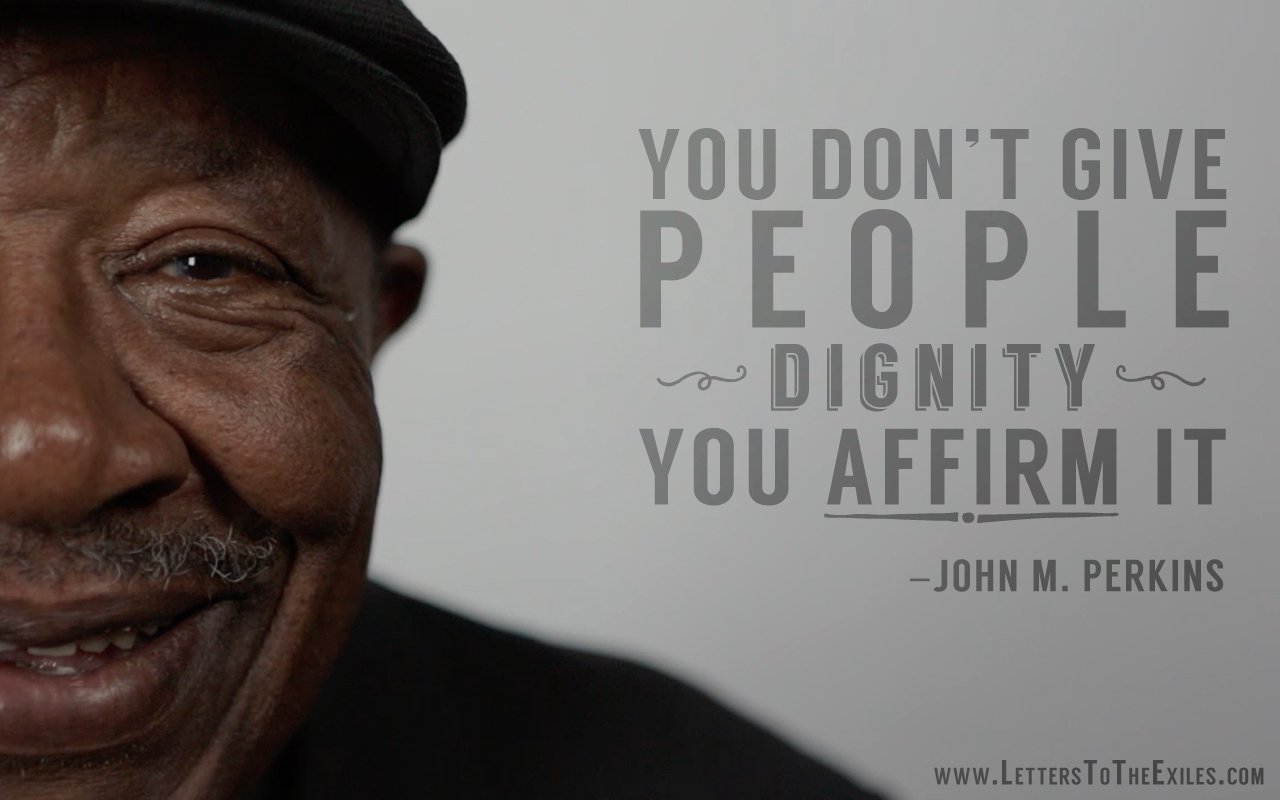
In my first two posts, I introduced the series and told of my chance meeting with John M. Perkins. A few examples from his book, Let Justice Roll Down, might help to set the stage for understanding racial tensions today.

Mississippi Department of Education
Statistics from the year preceding
Brown vs. Board of Education
-Perkins, Let Justice Roll Down, 86 
In my parents' lifetime, the "separate but equal" school system in Mississippi just prior to the famous Brown vs. Board of Education distributed funds in a way predicated on racial discrimination. Someone somewhere determined that black students "required" less money to educate, so black schools were allocated less than white schools in the same district. Although roughly half of the students in Mississippi were black, only a fifth of the transportation money was spent on getting them to school. Their teachers' salaries were only about 75% of what white teachers made. And almost three times more money was spent on instruction in white schools. (Perkins, Let Justice Roll Down, 86-87).

This is not our distant past. These statistics mean that a black man my Dad's age grew up using inferior textbooks, learning from teachers who were not fairly compensated, and likely walking long distances to school. He grew up hearing the strong message that he was not as valuable, not worth the investment, that he need not have any aspirations beyond manual labor. As a nation we failed these boys and girls and their parents, teachers, and communities. The men and women alive today who were educated in the 50s are still living with the repercussions of their most formative years. They have not forgotten. But have we?

John Perkins himself was unjustly imprisoned in 1969 for trying to help diffuse a tense public situation and again in 1970 for peacefully demonstrating in Mendenhall, Mississippi. He and his friends were beaten bloody and tortured by drunk police officers before being released, though they had done nothing wrong. He explains,
"After I was beaten by white policemen, I began to see things a little more clearly. I was able to see the needs of white people and what racism was doing to them. You see, I had gotten set to the fact that the sickness of racism had affected the black community in a way that kept them from functioning as a healthy community. A lot of our people were sick -- affected by generations of slavery, oppression and exploitation -- psychologically destroyed. But I had never thought much before about how all that had affected whites -- how they had been affected by racism, by attitudes of racial superiority, by unjust lifestyles and behavior." (166)
Most troubling of all was the effect racism had on white churches. Visiting a white church as a black man could get you thrown out by the police. Perkins laments:
"The most systematic haters are ministers and Sunday school teachers. In fact, most of the outstanding killings and murderings of blacks in the South have had white ministers involved in them. This was true even of the killing and secret burying of the three civil rights workers in Philadelphia, Mississippi, in 1964." (164) 
Not all white ministers were racists. Indeed, those who spoke out against racial injustice were themselves mistreated. Rev. James Spencer, a white Presbyterian minister, helped with initial efforts to start Bible classes in Perkins' community, but quit under pressure from the Ku Klux Klan (93-94).

Another white pastor, Dr. Odenwald, slowly started preaching about God's love for everyone, gently questioning whether the attitudes of the white community toward blacks was consistent with biblical teaching. His messages met with great resistance from his congregation. Under the strain, Dr. Odenwald ended his own life (96-97).

Such a legacy of injustice does not evaporate overnight. If we want to understand the tensions in our world today, it helps to know the history.

My aim in this series is modest. I'm writing to people like myself who have grown up in mostly white neighborhoods and who can't readily produce first-hand examples of racial injustice. Reading a few books and citing a few examples will not solve the world's problems. But it will help us to take a longer view on race relations, to become more aware of how the same community can be experienced in such vastly disparate ways. I hope we'll get a sense of what it's like living in someone else's skin. I hope we'll be bothered by these stories, and more aware of ways that "the system" benefits us at the expense of others. Most of all, I hope that blog posts like this one will foster our Christian commitment to living out the gospel in practical ways.

Sunday, January 21, 2018

Racial Injustice Today? (Part Two)

The year was 2008. I was in New Orleans for my first academic conference, the annual meeting of the Evangelical Theological Society. It was a giddy experience to walk the halls with those who had taught me so much through their writings. A living bibliography surrounded me. One thing that struck me was how white this conference was. As a woman, I represented less than 10% of those attending. But when I looked around, I was hard pressed to find anyone of color.

Perhaps that’s why he made such an impression on me. A friend and I were riding the elevator up to the ballroom level for a plenary session. Mid-way there, the elevator stopped and the door opened. Three men entered the elevator. I remember nothing about the other two men, except that they were taller but more deferential. Leading the way was a short, black man with a storied face. His eyes sparkled. He was the kind of man whose whole body exuded so much energy that he couldn’t stand still. Most people look down when they get on an elevator, avoiding eye contact. Not him. He surprised us by looking us straight in the eye, eager for conversation. I’ll never forget his southern drawl, “Now, are you ladies here for the theology-thang? Or for the nursing-thang?”

I’m sure we both smiled, almost giggled, at his energy. “We’re here for the theology thing.”

I wish you could have seen his face light up. “Oh! That’s wonderful!” Then, as if admitting a secret, he leaned in and added, “There aren’t near enough women here, are there?”

At that point the elevator arrived at our floor and we exited.

Imagine our surprise in the next plenary session when our elevator friend took the stage. It was the venerable John Perkins! I had heard his name before, but didn’t know him well enough to recognize him. Perkins had been imprisoned and beaten unjustly, and had labored long and hard for civil rights in some of the most segregated corners of our nation.

Our encounter was arresting. Here was a man who’d been invited to address thousands of (mostly white) participants. He was neither cocky nor self-centered. He had no chip on his shoulder. In our brief conversation he celebrated our presence at a conference that was planned, led, and addressed by only men. He saw us.


Ever since, I have wanted to read about his work. Last summer seemed the perfect time. Let Justice Roll Down is the amazing, heart-breaking, inspiring story of his struggle for justice in the South. It is neither textbook nor how-to manual. It is simply his story. But he opened my eyes to the ugly realities of racial inequality in our nation. It’s easy to imagine that because slavery ended in the 1800s and African Americans have gained the right to vote, that the struggle for civil rights is long over. But here is a man who has lived the struggle and still lives today. I can no longer imagine that the suffering of blacks in our nation is a thing of the distant past. This man – friend of Martin Luther King Jr. – steps into the elevator and looks me in the eye. His verve confronts my complacency. I can no longer say “That was so long ago.” This is now.


Monday, January 15, 2018

Racial Injustice Today? A Series in Honor of Martin Luther King Jr.

Today it’s his actual birthday, the man who refused to take ‘no’ for an answer. The man who spoke and kept on speaking until white America was listening, too. The man who would not be content until there was truly “liberty and justice for all” within our borders.
And he achieved it, didn’t he?
They got what they wanted, didn’t they?
Today there may be Americans who wonder about the value of yearly reliving our storied and painful past, about the emotions that it stirs.
Slavery was over a long time ago.
People should just get over it and move on.
If African Americans want to make something of themselves, then they should just work hard, the way we did.
Nobody has handed me anything free. I’ve had to work for everything I’ve got.
Inequality? What inequality? Everyone in America has the same opportunities.
I wish someone could give an example of prejudice today. How exactly are Blacks being mistreated?
I’ve heard these words often enough from the mouths of people who look like me that I went looking for answers. The claim from the African American community that injustice lives on sounds strange to fair-skinned Americans whose personal experience offers no pertinent examples. Sure, life’s not fair. We all get a raw deal sometimes. No need to get so bent out of shape over it. Of course black lives matter. All lives do. 

America is still so segregated that it’s possible to live one’s whole life without a friend of another color. As a result, we can be puzzled by public protests or cries for justice.

I wanted to understand. I wanted to see the world through the eyes of someone who grew up wearing different skin. In my quest for answers over the past year or two, I've done some reading:
Ta-Nahesi Coates, Between the World and Me 
John M. Perkins, Let Justice Roll Down 
Sharon Draper, Stella by Starlight
Mildred D. Taylor, Roll of Thunder, Hear My Cry
James Cone, The Cross and the Lynching Tree
Bryan Stevenson, Just Mercy
Daniel Hill, White Awake
These books gave me answers – loud and clear – a whole legacy of injustice that is far from over, a monstrosity that has been codified in law (in some cases) and petrified in our systems of criminal “justice.”  Racial inequality is not a thing of the past. It is heart-sickeningly present today. In the coming weeks, I’d like to share what I learned. If you’re looking for examples, you are invited to start right here.

It’s not enough to celebrate what was accomplished in the 1960’s. Let’s take a hard look at 2018 and see what remains to be done.

Saturday, June 3, 2017

Why We Need Latin Americans to Help Us Understand the Bible

I'm beginning to see the Bible with new eyes.

It began with a syllabus. Increased ethnic diversity at both of the universities where I teach has made me more conscious of how "white" and Western my assigned readings have been. With the help of my beautifully diverse Facebook community, I've made the effort to discover books written by Africans, Asians, and Latinos. Armed with a list of friend-approved favorites, I ordered copies of a half dozen or more.

I want to tell you about two favorites. Both are from Latin America. Both are slim, inexpensive, and accessible. Both are rocking my world.

Justo Gonzalez is known for his work as a church historian. But in Santa Biblia, he offers us a glimpse of what it's like to read the Bible through Hispanic eyes. Some of you may object: "We should be reading the Bible for what it says, not for what we bring to it. Our ethnicity doesn't change what the text means."

Agreed. But our social location can prevent us from seeing what is there. We make assumptions about the situations the Scriptures address because we see the world from a particular vantage point—say, white, middle-class, suburban American—unaware of the authors' context and concerns. We have blinders on.

Old Testament Israelites and New Testament Christians have far more in common with the average Latino, African, or Asian than they do with wealthy Americans. That's one reason the perspective of these communities is so valuable. They are a bridge.

Gonzalez is not engaged in a special hermeneutic, as far as I can tell. He is simply reading the Scriptures with his community and noticing what it says. But because of his life experience, he notices things I miss. In some cases, his observations simply add insight. In other cases, he turns my interpretation on its head.

Here's an example from his first chapter, focusing on marginality. Gonzalez takes us to Luke 4, where Jesus gives his inaugural sermon in Nazareth, quoting Isaiah 61. At first, Jesus' listeners are pleased (v. 21–22). Gonzalez notes,
"But Jesus suddenly changed his tune—or at least, it would seem so from the point of view of his audience. Until then he had said that they were at the very center of things. The Scripture was being fulfilled right there, 'in your hearing.' Now he tells him to expect no special privileges. He is not about to do in his hometown the things he did at Capernaum." (Gonzalez, 43)
Jesus brings up two Old Testament examples, Elijah and Elisha. Both prophets went to those at the margins, to non-Israelites—a Phoenician and a Syrian, in fact—to work their miracles. The mood in the room radically shifts. Gonzalez explains,
"This was no longer a message about how they were at the very center of things, seeing the Scripture fulfilled before their eyes. This was rather a warning that they should expect no privileges, for God often works at the margins rather than the center. No wonder they tried to hurl him off a cliff!" (Gonzalez, 43)
Imagine if Jesus appeared in your church this Sunday, announcing that God's kingdom had arrived, and that he was here to make all things as they should be. Great, right? But what if he told you his first plan of action was to welcome exponentially more Syrian and Lebanese refugees, to help them set up shop in your neighborhood, and to live among them? How would you feel then?

We tend to read Scripture as though it is God's good news to us. But in the case of Luke 4, the good news indicts those who prefer to keep all the kingdom benefits for themselves. I never noticed this until Gonzalez showed me.

In her book, The Scandalous Message of James, Elsa Tamez brings a similar perspective, but instead of offering examples from various places in Scripture, she works her way carefully through the book of James.

James is a practical book, addressing matters of wealth and poverty, among other things. Tamez explains how a Latin American reading of the book is different:
"For James the oppressors are the rich (plousioi). He does not hesitate to point them out as such. His antipathy toward them and his sympathy with the poor is undeniable. Interestingly enough, many of the commentaries on James dedicate long pages to the rich, thus consciously or unconsciously attempting to relativize this contrasting picture that James paints." 
"This great concentration on the rich is to be expected: on the one hand, many biblical commentaries from Europe and the United States are written in situations where there are many rich people in the churches. How does one tell these members that according to James there is no room for them in the church? We should note that many of the points made in these commentaries are accurate enough; what is striking is simply the angle of the perspective and the special concern for the rich. A Latin American reading of the epistle, on the other hand, fixes its gaze on the oppressed and dedicates long pages to them, their sufferings, complaints, oppression, hope, and praxis." (Tamez, 21, emphasis added)
By now it should be obvious why these books will not just be important for students of color, but for all of us in the classroom. Reading outside our tradition overcomes myopia.

I've heard it said (I don't remember where) that the Bible is intended to comfort the afflicted and afflict the comforted. Reading the Bible with people from other cultural and socio-economic backgrounds reinvigorates the Bible's message and sharpens its critique of our own complacency.

This won't be easy, but our brothers and sisters from Latin America stand ready to help. Together we can learn more, love more, and become more. Are we willing to listen?

Saturday, January 28, 2017

Hidden Figures: America's Pathway to Greatness

Imagine if your best work went unnoticed.
Imagine if you wrote a report but someone else's name went on the cover.
Imagine if that same someone else was paid a great deal more than you were.
Imagine if they resented your presence in the office.
Imagine if everyone else in the office shared that opinion and made it obvious.
Imagine if you couldn't speak up about it because this was normal.

If you were an African American woman working at NASA in the early 1960s, you would not need any imagination. This would be your life.

Hidden Figures is a movie that will take you into the world of three women who walked in these shoes. Given the segregated times during which these brilliant women lived, I suspect that their experience was widely shared by people of color.

A lot of progress has been made since the 60s, but friends of color tell me that we still have a long ways to go. Assumptions and stereotypes about aptitude, motivation, or immigration status plague these brothers and sisters. Guarded suspicion is more readily extended than friendship.

We are much closer now than we were then to equity and equality, but let's not imagine there is no work left to be done. 2016 made that painfully obvious. Perhaps President Trump's most lasting legacy will be bringing the blatantly racist attitudes that persist in America into the light of public discourse. As troubling as this was, we might as well know the truth about where we are as a nation. Maybe this truth will compel us to seek justice.

The flurry of executive actions in Donald Trump's first week as President underscores the urgent need for private citizens, churches, and non-profit organizations to champion the cause of justice. If in the past we have relied on governmental agencies to ensure a just society, we know now that such an approach is inadequate. This has always been true. But now it's undeniable.

In Soong-Chan Rah's Prophetic Lament: A Call for Justice in Troubled Times, Rah urges his readers to cultivate "a personal connection to the corporate sin that has entered our culture." He says, "We must move from 'let's just get over it' to 'how do I personally continue to perpetuate systems of privilege?' Justice must move from the third person to the first person, from the abstract to the personal" (125–26). This is such timely advice.

Just this morning I heard about an African American PhD student in Chicago who was pulled over in 2015 and accosted harshly by police for suspected auto theft in spite of his respectful compliance with law enforcement officers. Friends, the man was beaten for driving his own car. Examples like these can be readily multiplied. As long as we live in a world where this can happen, we cannot rest.

The only great America will be the America where every human being — no matter their race or gender — is treated with dignity, compensated fairly, given credit for their work, and given a voice and a place at the table. If this is the America we want, we need to create it. Let's get to work!

Thursday, December 29, 2016

Top 12 Posts of 2016

2016 has been deeply satisfying for me personally. This is ironic, considering the tumultuous waters we have traveled as a nation and the looming crises internationally. By the grace of God, the collective lament and angst and fear has opened doors for me to write, teach, and speak in ways that are more culturally connected than ever before. This is evident on my blog, as I've come out of my academic cave and touched on issues of race, immigration, social media, vocation, politics, death, and tough questions of the faith.

Perhaps you haven't read it regularly, and you'd like to catch the highlights. In case you blinked, my blog changed titles this year, and so did I! Here are the posts that have (mostly) generated the most hits this year. I've skipped a couple and added one of my own favorites.

On race, immigration, and politics
2/1   refugees and religious extremists -- what to do?
7/12 an open letter to people who think they're white
7/14 so you think you're white
11/7 election day encouragement

On living life fully in God's presence
4/4   learning how to celebrate
5/18 a simple path to joy, part 1 and part 2
11/2 the surprising beauty of unanswered prayer
12/7 undone by the Psalms

On finding our vocation
1/3   leaning in
4/12 lasting impressions and do-overs
7/4   perspective on cape perpetua
7/26 quilted hearts: mentoring for the long haul


Saturday, July 23, 2016

preventing the holocaust: three things that went wrong

Are you like me? Do you have the same perennially nagging questions about WWII: How could the holocaust have been allowed to happen? And how can we prevent it from happening again? If so, read on. I've found a few answers this summer.

However, before I share this list I offer a disclaimer: I am not an expert in WWII. I have not engaged in academic research on these matters. I am, like most of you, simply curious, with a long-standing uneasiness regarding this part of human history. Even now similar narratives are playing out in other parts of the world. Will we look back in 60 years and wonder how we could have stood idly by while whole people groups are slaughtered?

1. Insidious Propaganda

The first reason I encountered for the holocaust (or Shoah) is explored in John Boyne's young adult novel, The Boy in the Striped Pyjamas. In my opinion, the movie is even more achingly powerful than the book. You simply must watch it.

Although this is a work of historical fiction, it goes a long way toward answering my questions about the German populace during WWII. In this story, even the Commandant's family, living next door to a concentration camp, are unaware of its inhumane conditions. They don't realize the acrid smoke comes from burning bodies and that their own father is responsible for the daily murder of countless humans. They are shown videos that depict happy Jews, well-fed and grateful for a place to live. For the average German, it was less psychologically taxing to believe the propaganda than to push for answers, especially when those who did so risked personal harm.

2. Incredulity

I encountered another reason for the widespread devastation of the holocaust in Elie Wiesel's Night. This one gave me chills. Wiesel describes how a member of their Jewish community in Poland had been deported to a prison camp, escaped, and returned to warn the community. But nobody believed him. The horrors he described were so unthinkable that the other Jews decided he must have gone crazy. They had plenty of time to escape before they were rounded up, but they stayed put, confident that the war would soon be won and the Nazis would go home to Germany.

Ironically, I finished Wiesel's autobiography of the war years on the very day he died, old and full of years. What a gift he gave us all with his unflinching description of Nazi brutality. What a wonder he survived it! Self-deception can run very, very deep and animate the most egregious behavior imaginable. Let us not forget it.

3. Insufficient Sympathy

The final, nauseating insight is from Chaim Potok, author of My Name is Asher Lev and also of The Chosen, a fantastic novel about Jews in Brooklyn in the 1950's. He explains, "There had been public meetings in England, protests, petitions, letters—the whole machinery of democratic expression had been set in motion to impress upon the British Government the need for action [during WWII]—and not a thing was done. Everyone was sympathetic, but no one was sympathetic enough. The British let some few Jews in, and then closed their doors. America hadn't cared enough, either. No one had cared enough. The world closed its doors, and six million Jews were slaughtered. What a world! What an insane world!" (197, emphasis added)

If Potok is correct, immigration policy played a role in the mass devastation. Jews who had nowhere to go were left vulnerable to Nazi occupation, deportation, and death in a concentration camp.

Closer to home . . .

Are we believing lies about the true status of refugees?
     These are moms and dads with children who are desperate for a safe place to call home, not dangerous criminals.

Are we believing the truth when it is told? Or do we dismiss the stories as highly unlikely?
     Entire villages are being destroyed. Women are being sold as sex slaves to ISIS militants. Entire museums and ancient monuments are being blown to smithereens.

Are we sympathetic enough to do something about it?
"If anyone, then, knows the good they ought to do and doesn't do it, it is sin for them." (James 4:17 NIV)

The solutions are complex because the problems are complex, but let's not turn and look away. These are our brothers and sisters.

Wednesday, July 20, 2016

a granddaughter of immigrants speaks up


In 1949, my Oma and Opa were among the first European immigrants to fly to the Americas after WWII. They left behind a country ravaged by war, where the land had been raped and pillaged by years of fear and poverty. They determined to put as many miles as possible between themselves and the memory of war. They were not well educated. They were not highly skilled workers. They were young farmers, newly married, who hated farming and wanted to begin a new life. They were not "white"; they were Dutch, and their only ticket to Canada was (ironically) through the sponsorship of a Canadian farmer who gave them work. The little English they spoke was hampered by a thick brogue. They brought little wealth to contribute to the economy. Just two pair of calloused hands and a willingness to try again to build a better life for themselves and the son they would bear.

They looked no different than Germans. I wonder whether their accents ever aroused suspicion among their new neighbors. They had been victims of war brutality, risking life and limb to subvert the German advance, but only a thin border separated them from Nazi headquarters. With the same light skin and big noses, did people wonder? Did all Europeans look the same? After all, they shared a religion with Nazi Germany — Protestant Christianity.

How soon we forget.

My father crossed the Canadian border into the United States to attend Calvin College. He met and married my mother in Grand Rapids, Michigan, beginning life as a U.S. Citizen.

That makes me the granddaughter of immigrants — immigrants who fled a war-torn country to make a new beginning. They followed their married son to Colorado so they could watch me grow up. I was nurtured and raised in a close-knit Denver community whose shared origins defined us (even today, the children of my Dutch cousins and Dutch classmates are dropping off their children at Calvin Camp, the same camp we attended almost 30 years ago, and my other grandparents are living out the remainder of their years in a retirement home populated mostly by people of Dutch descent). My community successfully integrated. No one my age that I know of actually spoke Dutch. We were Americans.

But roll back the clock just a few generations and most of our families were not in the United States.

How grateful I am that my grandparents were allowed to move here — that they were not turned back at the border on the outside chance that they were Nazi sympathizers.

I'd like to extend that opportunity to others fleeing war-torn lands.
Every human being deserves a place to live and raise a family without fear for their safety.
Let's work together to make it happen.
There's a sea of refugees out there who are just as afraid of ISIS as we are.
We can start by opening our hearts to them.

Saturday, July 16, 2016

Ta-Nehisi Coates: On Being Black in America

Between the World and Me is sweeping across America. When both Time magazine and Christianity Today urged me to read it, I figured I should listen! Coates frames his incisive prose as an extended letter to his teenage son on growing up black in America. Though much has changed since his own childhood, still the black body seems fragile -- dispensable to those who think they are white. 

Coates is a gifted writer, and his vision is clear. 

He writes, "And I saw that what divided me from the world was not anything intrinsic to us [as blacks] but the actual injury done by people intent on naming us [i.e., whites], intent on believing that what they have named us matters more than anything we could ever actually do. In America, the injury is not in being born with darker skin, with fuller lips, with a broader nose, but in everything that happens after." (120)

He describes the effect of Black History month, and the emphasis on non-violent resistance as model black behavior — a behavior that to him ensures that white power continues unabated. The only authorized black heroes are the meek: "All those old photographs from the 1960s, all those films I beheld of black people prostrate before clubs and dogs, were not simply shameful, indeed were not shameful at all—they were just true. We are captured, brother, surrounded by the majoritarian bandits of America. And this has happened here, in our only home, and the terrible truth is that we cannot will ourselves to an escape on our own. Perhaps that was, is, the hope of the movement: to awaken the Dreamers, to rouse them to the facts of what their need to be white, to talk like they are white, to think that they are white, which is to think that they are beyond the design flaws of humanity, has done to the world." (146, emphasis added)

He leaves readers with this call to action: "And still I urge you to struggle. Struggle for the memory of your ancestors. Struggle for wisdom. . . . Struggle for your grandmother and grandfather, for your name. But do not struggle for the Dreamers. Hope for them. Pray for them, if you are so moved. But do not pin your struggle on their conversion. The Dreamers will have to learn to struggle themselves, to understand that the field for their Dream, the stage where they have painted themselves white, is the deathbed of us all." (151, emphasis added)

Perhaps you think this is overstated. That we really are white, and that whiteness matters. 

I'll admit that until I read Coates' book, it had never occurred to me that I was anything but white. Now I find it strange that I didn't see before what a misleading term it is, a label that has drawn a line between us and them and has ushered me into privilege while others wait outside. I'm ready to move on. Ready to go full color.

Let's be clear. Humanity matters. Every one of us, no matter our skin color, our country of origin, or our religion. And as long as this doesn't translate into equitable treatment, then we must raise our voices and work for a better world.

Thursday, July 14, 2016

so you think you're white

What does that mean exactly?

If you're referring to the color of your skin, let's be honest — "white" is not the most accurate descriptor. White stands at one extreme of the color spectrum, and black at the other. Yet every human being I know falls somewhere in the middle — a rainbow of rich hues: peach and olive and tan and brown, which my set of 24 colored pencils cannot adequately represent. By labeling ourselves "black and white," we polarize, forcing everyone to one side or the other.

White is not a skin color (even for albinos).
White is not an ethnicity.
It's a way of organizing society, and it's so pervasive that it has changed what we think we are seeing.
A month ago this had not yet occurred to me.
But I'm over being white.

If it matters to you, I'm an American of Dutch descent. What little skin pigment I have has gathered itself into a thousand freckles on my arms and legs and face, defying categorization.
Above all, I'm human. Made as the image of God.
And so are my brothers and sisters across the pigment spectrum.
Every one of them is his image.

Language matters.
When we assign a label to something we place it in relation to other things.
We say what it is not.
In these challenging times, where emotions run high, let's choose our words carefully.
A word aptly spoken can open up new avenues for dialogue or it can dig trenches and build walls.

From now on, I'm human.

Tuesday, July 12, 2016

an open letter to people who think they're white

Dear "White" America,

(That includes me.)

We have two options.

Option 1:

Go ahead, tell yourself you can be silent because "all lives matter."
Keep imagining that this is a fictional problem, created by the media to divide our country and boost ratings.
Excuse yourself from the conversation because Black Lives Matter is not inherently "gospel centered."
Assume that this is someone else's problem because you have no black neighbors and no black friends.

Option 2:

Resolve to understand what others call injustice.
Determine to listen to their cries so you can be part of the solution in some small way.
Decide that you are not content to carry on without friends of other colors.
Develop empathy by trying on other shoes.

Above all, look deeply into your own soul and be brutally honest — racism starts with me. It starts when I cross the street to avoid close proximity with someone who is not part of my "tribe." It starts when I value the lives lost in Paris more than the lives lost in South Sudan or Syria or New Orleans. It starts when I assume that someone has nothing to offer me that I need, simply because our skin tones don't match.

It's time to wake up.
It's time to listen to the urgent cries of our brothers and sisters.
It's time to recognize that there is no such thing as "white." White is no more an ethnicity than yellow or red or blue. "Caucasian" is no more scientifically defensible than "Aryan." Both terms (now abandoned by anthropologists) served Hitler's eugenics project nicely to separate "us" from "them," while a simple DNA test would reveal our common humanity. We are cousins, each created as God's image.

American history should make all of us wary of our own rationalizations and good intentions. Abolishing slavery, as important as that was, did little to rectify the disparaging attitudes toward those of African descent. When those in power decide that the exploitation of another human being is essential to the smooth operation of our economy, that certain people are better suited to menial labor and that they aren't worth educating, then it will take generations to undo the damage. Generations. The damage is still not undone.

When we consistently define people as either "white," "black," "Asian," "Muslim," or "Mexican," we betray our cultural blindness. When we perpetuate stereotypes rather than cultivate sensitivity, we compound the problem. When we speak of immigration as "infiltration" and refugees as dangerous, we foster the very fear that creates the hostile environment in which extremism takes root among the isolated and victimized. Let me say it plainly. Our extremism fosters theirs.

Can we move beyond this?
Let's not turn our backs now, when we're needed most, and assume there's nothing we can do about it.
We can all do something.
We can start by caring.

By reading this far, you've shown that you're open to option 2.
May I suggest a next step?

Read Ta-Nehisi Coates' Between the World and Me. I suspect it is the Uncle Tom's Cabin of our generation — the book that will awaken all of us who think we're white (he calls us "the Dreamers") to the plight of blacks in America. He didn't write it for us. He wrote it for his son. But if we want to be part of the solution, we need to listen in, too.

I'm no expert on dissolving racial tension or resolving the immigration crisis, but from my vantage point both are heart issues that can no longer be ignored.

Sincerely,
A Fellow "White" American

Wednesday, March 24, 2010

who's not here?

It's on my mind almost any time I walk into church, or a classroom or a conference like ETS.  I hadn't put it into words, though, until just a few days ago.  Ken Baker asked this question in his thought-provoking session on cultural diversity in missions at ETS.  Who's not here?

I've already mentioned the fact that ETS is dominated by white men.  Their presence is not a bad thing, but the list of who's not here is rather long.  Are there vibes or assumptions or invisible walls keeping others away?  There are, of course, many evangelicals who believe that Bible teaching is a role reserved for men.  That accounts for the lack of women.  But why not black men? asian men? latino men?  Is the notion of an academic society too thoroughly western?  Perhaps.

I was delighted to find in my intital seminary classes that there was no majority.  Race, gender, age, denominational background, economic class ... our classrooms were a total mix.  Learning is rich in such an environment.  (It's hard for a Reformed student to build a straw Arminian and knock it down in class when he's sitting beside one!)  I have found, however, that this does not hold true for upper level classes (Hebrew Exegesis, for example).  Things are looking white, white, white (and in some classes male, male, male).  It's not as though I wish there were fewer white men in my classes, it's just that my list of who's not here grows longer.  And why does it matter?  Because if we only listen to ourselves our theology will be lopsided, no matter how hard we try to keep our eyes fully open to Scripture.  We need each other - brothers and sisters of other races and backgrounds - to help us understand the full message of Christ for the church.

According to Rev 7:9, we will finally be able to stop asking this question around the throne of God.  Then, finally, all nations will be represented.  But on this side of eternity, why do we keep to our own kind?  Ken suspects that we carry around in our hearts the belief that people who are not like us don't have anything to offer that we need.  Ouch.  So look around and ask yourself, who's not here?  Because what - or who - you don't know can hurt you.