Showing posts with label Perkins. Show all posts

Saturday, February 3, 2018

Racial Injustice Today? (Part Three)

Is racial injustice really a problem today? Or has the problem been exaggerated?

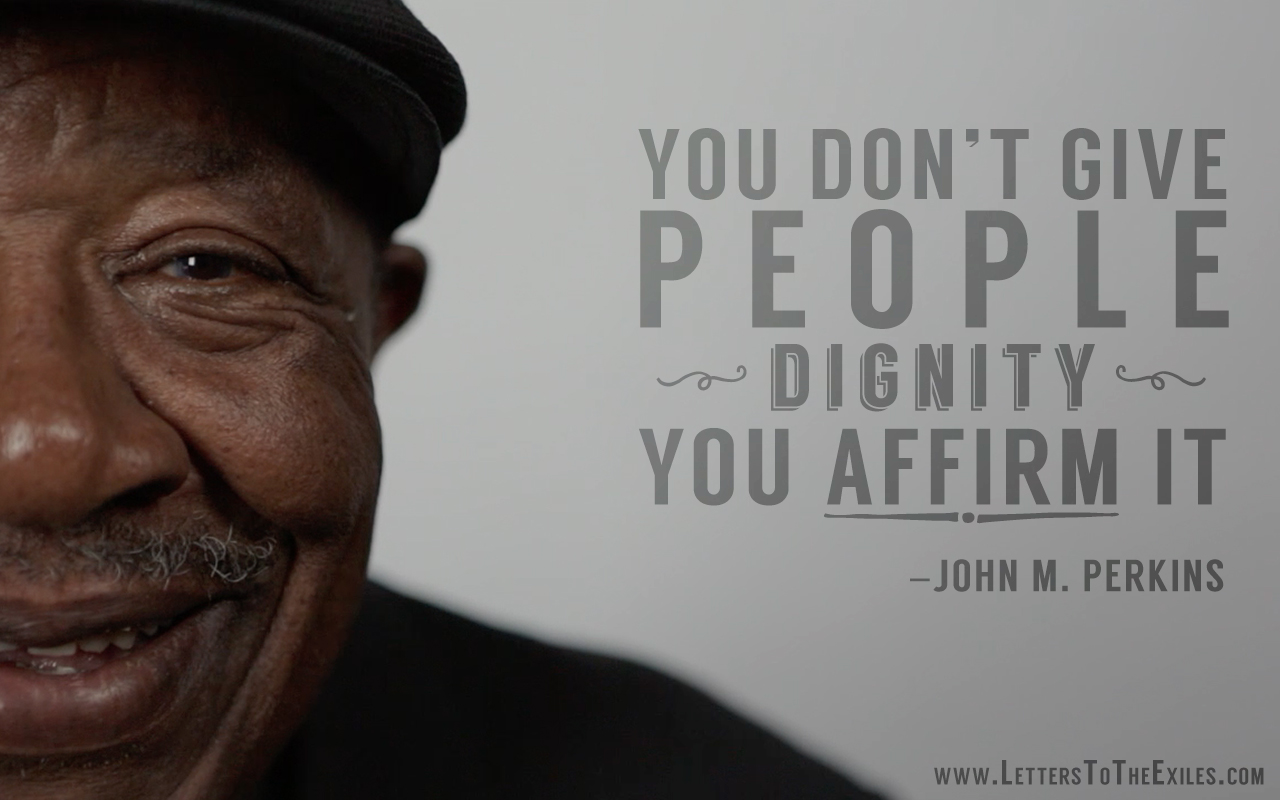
In my first two posts, I introduced the series and told of my chance meeting with John M. Perkins. A few examples from his book, Let Justice Roll Down, might help to set the stage for understanding racial tensions today.

Mississippi Department of Education
Statistics from the year preceding
Brown vs. Board of Education
-Perkins, Let Justice Roll Down, 86 
In my parents' lifetime, the "separate but equal" school system in Mississippi just prior to the famous Brown vs. Board of Education distributed funds in a way predicated on racial discrimination. Someone somewhere determined that black students "required" less money to educate, so black schools were allocated less than white schools in the same district. Although roughly half of the students in Mississippi were black, only a fifth of the transportation money was spent on getting them to school. Their teachers' salaries were only about 75% of what white teachers made. And almost three times more money was spent on instruction in white schools. (Perkins, Let Justice Roll Down, 86-87).

This is not our distant past. These statistics mean that a black man my Dad's age grew up using inferior textbooks, learning from teachers who were not fairly compensated, and likely walking long distances to school. He grew up hearing the strong message that he was not as valuable, not worth the investment, that he need not have any aspirations beyond manual labor. As a nation we failed these boys and girls and their parents, teachers, and communities. The men and women alive today who were educated in the 50s are still living with the repercussions of their most formative years. They have not forgotten. But have we?

John Perkins himself was unjustly imprisoned in 1969 for trying to help diffuse a tense public situation and again in 1970 for peacefully demonstrating in Mendenhall, Mississippi. He and his friends were beaten bloody and tortured by drunk police officers before being released, though they had done nothing wrong. He explains,
"After I was beaten by white policemen, I began to see things a little more clearly. I was able to see the needs of white people and what racism was doing to them. You see, I had gotten set to the fact that the sickness of racism had affected the black community in a way that kept them from functioning as a healthy community. A lot of our people were sick -- affected by generations of slavery, oppression and exploitation -- psychologically destroyed. But I had never thought much before about how all that had affected whites -- how they had been affected by racism, by attitudes of racial superiority, by unjust lifestyles and behavior." (166)
Most troubling of all was the effect racism had on white churches. Visiting a white church as a black man could get you thrown out by the police. Perkins laments:
"The most systematic haters are ministers and Sunday school teachers. In fact, most of the outstanding killings and murderings of blacks in the South have had white ministers involved in them. This was true even of the killing and secret burying of the three civil rights workers in Philadelphia, Mississippi, in 1964." (164) 
Not all white ministers were racists. Indeed, those who spoke out against racial injustice were themselves mistreated. Rev. James Spencer, a white Presbyterian minister, helped with initial efforts to start Bible classes in Perkins' community, but quit under pressure from the Ku Klux Klan (93-94).

Another white pastor, Dr. Odenwald, slowly started preaching about God's love for everyone, gently questioning whether the attitudes of the white community toward blacks was consistent with biblical teaching. His messages met with great resistance from his congregation. Under the strain, Dr. Odenwald ended his own life (96-97).

Such a legacy of injustice does not evaporate overnight. If we want to understand the tensions in our world today, it helps to know the history.

My aim in this series is modest. I'm writing to people like myself who have grown up in mostly white neighborhoods and who can't readily produce first-hand examples of racial injustice. Reading a few books and citing a few examples will not solve the world's problems. But it will help us to take a longer view on race relations, to become more aware of how the same community can be experienced in such vastly disparate ways. I hope we'll get a sense of what it's like living in someone else's skin. I hope we'll be bothered by these stories, and more aware of ways that "the system" benefits us at the expense of others. Most of all, I hope that blog posts like this one will foster our Christian commitment to living out the gospel in practical ways.

Sunday, January 21, 2018

Racial Injustice Today? (Part Two)

The year was 2008. I was in New Orleans for my first academic conference, the annual meeting of the Evangelical Theological Society. It was a giddy experience to walk the halls with those who had taught me so much through their writings. A living bibliography surrounded me. One thing that struck me was how white this conference was. As a woman, I represented less than 10% of those attending. But when I looked around, I was hard pressed to find anyone of color.

Perhaps that’s why he made such an impression on me. A friend and I were riding the elevator up to the ballroom level for a plenary session. Mid-way there, the elevator stopped and the door opened. Three men entered the elevator. I remember nothing about the other two men, except that they were taller but more deferential. Leading the way was a short, black man with a storied face. His eyes sparkled. He was the kind of man whose whole body exuded so much energy that he couldn’t stand still. Most people look down when they get on an elevator, avoiding eye contact. Not him. He surprised us by looking us straight in the eye, eager for conversation. I’ll never forget his southern drawl, “Now, are you ladies here for the theology-thang? Or for the nursing-thang?”

I’m sure we both smiled, almost giggled, at his energy. “We’re here for the theology thing.”

I wish you could have seen his face light up. “Oh! That’s wonderful!” Then, as if admitting a secret, he leaned in and added, “There aren’t near enough women here, are there?”

At that point the elevator arrived at our floor and we exited.

Imagine our surprise in the next plenary session when our elevator friend took the stage. It was the venerable John Perkins! I had heard his name before, but didn’t know him well enough to recognize him. Perkins had been imprisoned and beaten unjustly, and had labored long and hard for civil rights in some of the most segregated corners of our nation.

Our encounter was arresting. Here was a man who’d been invited to address thousands of (mostly white) participants. He was neither cocky nor self-centered. He had no chip on his shoulder. In our brief conversation he celebrated our presence at a conference that was planned, led, and addressed by only men. He saw us.


Ever since, I have wanted to read about his work. Last summer seemed the perfect time. Let Justice Roll Down is the amazing, heart-breaking, inspiring story of his struggle for justice in the South. It is neither textbook nor how-to manual. It is simply his story. But he opened my eyes to the ugly realities of racial inequality in our nation. It’s easy to imagine that because slavery ended in the 1800s and African Americans have gained the right to vote, that the struggle for civil rights is long over. But here is a man who has lived the struggle and still lives today. I can no longer imagine that the suffering of blacks in our nation is a thing of the distant past. This man – friend of Martin Luther King Jr. – steps into the elevator and looks me in the eye. His verve confronts my complacency. I can no longer say “That was so long ago.” This is now.


Monday, January 15, 2018

Racial Injustice Today? A Series in Honor of Martin Luther King Jr.

Today it’s his actual birthday, the man who refused to take ‘no’ for an answer. The man who spoke and kept on speaking until white America was listening, too. The man who would not be content until there was truly “liberty and justice for all” within our borders.
And he achieved it, didn’t he?
They got what they wanted, didn’t they?
Today there may be Americans who wonder about the value of yearly reliving our storied and painful past, about the emotions that it stirs.
Slavery was over a long time ago.
People should just get over it and move on.
If African Americans want to make something of themselves, then they should just work hard, the way we did.
Nobody has handed me anything free. I’ve had to work for everything I’ve got.
Inequality? What inequality? Everyone in America has the same opportunities.
I wish someone could give an example of prejudice today. How exactly are Blacks being mistreated?
I’ve heard these words often enough from the mouths of people who look like me that I went looking for answers. The claim from the African American community that injustice lives on sounds strange to fair-skinned Americans whose personal experience offers no pertinent examples. Sure, life’s not fair. We all get a raw deal sometimes. No need to get so bent out of shape over it. Of course black lives matter. All lives do. 

America is still so segregated that it’s possible to live one’s whole life without a friend of another color. As a result, we can be puzzled by public protests or cries for justice.

I wanted to understand. I wanted to see the world through the eyes of someone who grew up wearing different skin. In my quest for answers over the past year or two, I've done some reading:
Ta-Nahesi Coates, Between the World and Me 
John M. Perkins, Let Justice Roll Down 
Sharon Draper, Stella by Starlight
Mildred D. Taylor, Roll of Thunder, Hear My Cry
James Cone, The Cross and the Lynching Tree
Bryan Stevenson, Just Mercy
Daniel Hill, White Awake
These books gave me answers – loud and clear – a whole legacy of injustice that is far from over, a monstrosity that has been codified in law (in some cases) and petrified in our systems of criminal “justice.”  Racial inequality is not a thing of the past. It is heart-sickeningly present today. In the coming weeks, I’d like to share what I learned. If you’re looking for examples, you are invited to start right here.

It’s not enough to celebrate what was accomplished in the 1960’s. Let’s take a hard look at 2018 and see what remains to be done.