2016 has been deeply satisfying for me personally. This is ironic, considering the tumultuous waters we have traveled as a nation and the looming crises internationally. By the grace of God, the collective lament and angst and fear has opened doors for me to write, teach, and speak in ways that are more culturally connected than ever before. This is evident on my blog, as I've come out of my academic cave and touched on issues of race, immigration, social media, vocation, politics, death, and tough questions of the faith.
Perhaps you haven't read it regularly, and you'd like to catch the highlights. In case you blinked, my blog changed titles this year, and so did I! Here are the posts that have (mostly) generated the most hits this year. I've skipped a couple and added one of my own favorites.
On race, immigration, and politics
2/1 refugees and religious extremists -- what to do?
7/12 an open letter to people who think they're white
7/14 so you think you're white
11/7 election day encouragement
On living life fully in God's presence
4/4 learning how to celebrate
5/18 a simple path to joy, part 1 and part 2
11/2 the surprising beauty of unanswered prayer
12/7 undone by the Psalms
On finding our vocation
1/3 leaning in
4/12 lasting impressions and do-overs
7/4 perspective on cape perpetua
7/26 quilted hearts: mentoring for the long haul
Showing posts with label joy. Show all posts
Showing posts with label joy. Show all posts
Thursday, December 29, 2016
Top 12 Posts of 2016


 Dr. Carmen Imes is the Associate Professor of Old Testament at Biola University in La Mirada, CA, and serves the broader church through teaching, speaking, writing, and creating YouTube videos. She earned a PhD in Biblical Theology (Old Testament) from Wheaton College under Dr. Daniel Block, an MA in Biblical Studies from Gordon-Conwell Theological Seminary (Charlotte), and a BA in Bible and Theology from Multnomah University. She and her husband, Daniel, served as missionaries with SIM 15 years. They have three children: Ana, Emma, and Easton.
Thursday, May 26, 2016
a simple path to joy (part 3): faith for the bend in the road
In the first two posts of this series, I've suggested that true joy comes when we face life honestly and cultivate gratitude for what we have and where we are. These choices get us through the gate and onto joy's path, and they help us navigate each intersection.

The third choice on the pathway
to joy comes when we reach a bend in the road. It's a fact of life that we
can't see what's ahead. But joy does not depend on knowing what comes next or
being able to control it. True joy cannot
be seized or managed. We don't get there
by straining harder, but rather by releasing our hold on what we cannot control
anyway. Christian joy comes when we recognize our own helplessness. That is, it
comes through faith -- faith rooted in the reality of what God has done
for us in Jesus Christ, and in what he promises to do for all creation. We
await the renewal of all things. We believe it is coming. Trouble may lurk
around the next bend, but the pain, sorrow, and madness of this world is not
final. It is merely a symptom of our world's brokenness and need for
restoration. That restoration has been promised by the God who created all
things. We can count on it. And it has already begun to take effect with the
resurrection of Jesus.
The story of Jesus is powerful precisely because when he
became human he entered fully into the mess and the brokenness of this world.
But his life was fully surrendered to God the Father and therefore fully
energized by the Holy Spirit. His mastery of being human, his perfection, is
more than just a model for us to follow (though it is that). It's what
qualified him to break the power of sin and death by offering himself in our
place. He took the punishment we deserved. He died our death, so that we could
truly live.
The New Testament calls joy a fruit
— one of the character qualities that naturally arises from a life
energized by the Holy Spirit. This, too, suggests that joy comes not by
straining, but by surrender, not by trying, but by trust in the transforming power of God. That power is made available to us in Jesus
Christ. A gift to each of us who surrenders. We can walk in this joyful reality
by facing our brokenness with honesty, embracing our present with gratitude,
and responding in faith to life's uncertainties. We may not know what the
future holds, but we know who holds the future. And that makes all the
difference.
Now for a word of warning. The
pathway to joy is not a path we walk only once. Honesty,
gratitude, and faith are not quick fixes for joy. They must become habits. We
must continue to face life with honesty, to receive our circumstances with
gratitude, and to embrace the future with faith. As one Bible scholar puts it,
"Like muscles, the capacity for joy atrophies if we do not use it
regularly. Those who wait for some great occasion for joy and gratitude to God
are not likely to recognize it when it happens." (Ellen Davis, Proverbs,
Ecclesiastes and the Song of Songs, 221; quoted in James Limburg, Encountering
Ecclesiastes: A Book for our Time, 114). We begin practicing honesty,
gratitude and faith right here, with whatever we're facing.
Paul was among the early
Christians who traveled around the Roman world to spread the news about Jesus'
resurrection from the dead. He had some utterly strange things to say about
joy:
In his letter to the church in
Corinth he said, "In all our troubles my joy knows no bounds." (2 Corinthians 7:4) He spoke of others who had "overflowing joy" "in the midst
of a very severe trial (2 Corinthians 8:2). And Paul was not alone in noticing that joy
and trials often went hand-in-hand. James, the brother of Jesus, wrote
"Consider it pure joy, my brothers and sisters, whenever you face trials
of many kinds." (James 1:2) Pure joy? When facing trials? Why? He
goes on to say, "because you know that the testing of your faith produces
perseverance. Let perseverance finish its work so that you may be mature and
complete, not lacking anything." (James 1:4) James is saying we ought to be
grateful for the effects of those trials on our
character. Through the eyes of faith, we know that hard times help us to grow
in important ways -- provided we respond with open hands and open hearts. That
brings pure joy.
We no longer need to worry about
what's ahead. If something good happens, we can celebrate. If we face difficult
times, we can be glad for what those experiences will do in us so that we can
become who we were meant to be. We win either way! That frees us to face our
present situation honestly and receive it with gratitude.
And so can you!
Dr. Carmen Imes is the Associate Professor of Old Testament at Biola University in La Mirada, CA, and serves the broader church through teaching, speaking, writing, and creating YouTube videos. She earned a PhD in Biblical Theology (Old Testament) from Wheaton College under Dr. Daniel Block, an MA in Biblical Studies from Gordon-Conwell Theological Seminary (Charlotte), and a BA in Bible and Theology from Multnomah University. She and her husband, Daniel, served as missionaries with SIM 15 years. They have three children: Ana, Emma, and Easton.
Monday, May 23, 2016
a simple path to joy (part 2): the intersection of gratitude
In my first post in this series, I claimed that true joy is impossible to find when we are living in denial. We begin our journey to joy by facing life's messes head on and choosing to be honest. That's how we enter the gateway on the path to joy.

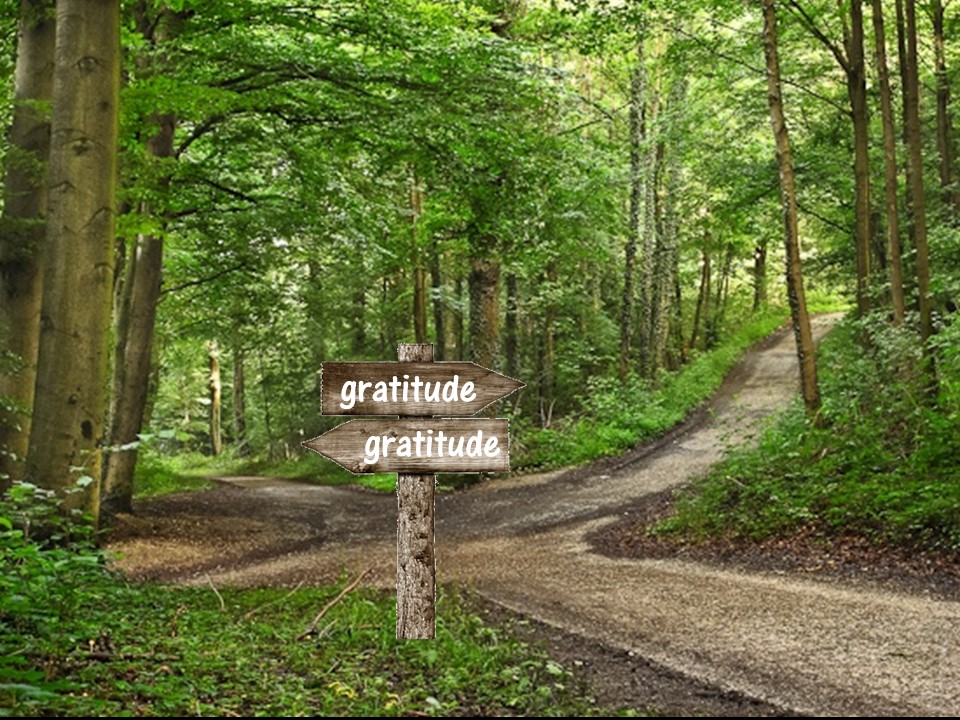
Next we come to an intersection,
and we have to make our second choice: gratitude. We cannot be
everything we might have been, have everything that can be had, go everywhere
there is to go. We can only be and do and have this. Once we have faced our
disappointments with brutal honesty, we are free to move on with gratitude for
what our life actually holds.
Our world is full of constant
reminders of what we don't have. Ads surround us incessantly, telling us
all day long about the products and services that will make life easier, or
sweeter, or more successful. But joy depends not on what we have but on
our disposition towards what we have. The Greek philosopher Epicurus
warned, "Do not spoil what you have by desiring what you have not."
Put another way, "Happy is the woman who wants what she has." In
fact, sometimes we uncover joy by having less, by simplifying our lives --
clearing out our closets and giving things away. Every item we own gets a piece
of our care and attention until we have no energy left to care for the things
that really matter. It is freeing to declutter, to downsize, to keep only what
we actively use.
But this intersection on the pathway to joy
isn't only about what we have. It's also about where we are and who we've
become. There are more possibilities in life than we have time to try, more
opportunities than we can pursue. When we cultivate the habit of thankfulness,
our hearts are positioned for joy. We cannot take every path, but we did take
this one. To spend our time wondering about all the other paths we could have
taken robs us of joy. I am not an astronaut. I am not a midwife. I am not a
famous singer. I am not a jungle missionary. I am not even one of those amazing
stay-at-home moms who actively volunteers at the elementary school and whose
kids have really creative birthday parties every year. Saying 'yes' to one path
has meant saying 'no' to others.
About a year ago we realized that
I would probably never finish my doctoral degree unless I started to say 'no'
to good opportunities. I resolved not to say 'yes' to anything but family until
I was finished. At first it was painfully difficult. The things I was asked to
do were right up my alley. They were things that would energize me. Ways to
plug into my church and my community for which I was uniquely suited -- lead a
small group, speak in chapel, teach a college class. But after half a dozen
difficult 'no's' my schedule was completely open for the task I dreaded --
revising my dissertation. And I discovered that when I had complete focus, I
did much better work and enjoyed it far more than before! I relished the gift
of concentration. We shoot ourselves in the foot when we try to do it all or
have it all, or spend our energy wondering what would have happened or what
could have been. Those things are not. This is what is. Here is where we are.
So let's embrace it and move forward with gratitude.
This is a sure way to begin to find joy. But what about the uncertainties ahead? In my next post, I'll talk about what to do when we can't see around the bend in the road.
Dr. Carmen Imes is the Associate Professor of Old Testament at Biola University in La Mirada, CA, and serves the broader church through teaching, speaking, writing, and creating YouTube videos. She earned a PhD in Biblical Theology (Old Testament) from Wheaton College under Dr. Daniel Block, an MA in Biblical Studies from Gordon-Conwell Theological Seminary (Charlotte), and a BA in Bible and Theology from Multnomah University. She and her husband, Daniel, served as missionaries with SIM 15 years. They have three children: Ana, Emma, and Easton.
Wednesday, May 18, 2016
a simple path to joy (part 1): the gateway to honesty
Last week I had the opportunity to speak at the May Festival at Evangelical Bible Church in Dallas, Oregon. My assigned topic was "Joy in Simplicity." Here's a glimpse of what I shared:
-----

-----
How do we find joy? Joy
is not automatic. A life free from trouble is no guarantee of joy, and a
difficult life does not prevent it.
From 2002 to 2005 we lived in the
Philippines. In spite of widespread government corruption, crippling poverty,
oppressive heat, and high unemployment, we found Filipinos to be some of the
happiest people we've ever met. They can fall asleep anywhere, turn a
1-year-old's birthday into a wedding-sized celebration, and laugh in the face of
trouble. They are among the poorest in Asia, but arguably the happiest.
Clearly, joy does not depend on circumstances. So how do we get there?
If we imagine a pathway to joy,
forward movement depends on three deliberate choices. (There may be others; I'm addressing three here.) The first comes at
a gateway, the second at an intersection, and the third at a bend in the road.
To enter the gateway we need to choose honesty. To navigate the intersection we
must choose gratitude. And to lend perspective for the bends in the path, we
need faith.

We make the first deliberate
choice at the gateway of honesty. We will never arrive at true joy by
pretending to be happy. Denial is the enemy of joy —a closed door to
joy's garden path. We cannot bypass grief and pain, guilt or
unforgiveness and expect to find joy. That thing that robs us of joy must be
faced head on. We must look it in the eye and name it.
In fact, psychologists tell us
that when we avoid honesty, we invite poor health, both emotionally and
physically. In the words of one scholar who has studied this phenomenon (Brent
Strawn, on James Pennebaker's study, in Brueggemann, From Whom No Secrets
Are Hid, xix), "Inhibition is hard work, and that work eventually
takes its toll on the body's defenses." So you want real joy? Step one is
to grieve your losses. Admit your fault. Express your anger. Own your failures.
Voice your disappointment. Forgive those who have let you down.
This is a bit awkward to say in church. Most
churches have lost the art of making space for this kind of honesty. We give
the distinct impression that "putting on your Sunday best" always
includes a bright smile. We rarely confess our sins, name our failures, face
our fears, and grieve our losses in community. And so our unexpressed emotions
become roadblocks to joy. One way to recover these practices is to pray the
Psalms together. The Psalms let it all hang out. Every ugly emotion you can
imagine. It's like reality TV, minus the
TV.
God, I cry out by day, but you do
not answer! By night, but I find no rest! (22:2)
Do not be far from me, for
trouble is near and there is no one to help! (22:11)
Break the arm of the wicked man;
call the evildoer to account for his wickedness (10:15)
All night long I flood my bed
with weeping and drench my couch with tears (6:6)
Heal me, Lord, for my bones are
in agony. My soul is in deep anguish. How long, Lord, how long? (6:2-3)
Against you, you only, have I
sinned and done what is evil in your sight. (51:4)
Troubles without number surround
me; my sins have overtaken me, and I cannot see (40:12)
Let evil recoil on those who
slander me; in your faithfulness destroy them (54:5)
Through prayer, all these raw and
gritty realities are brought into the presence of God and given over for Him to
handle. The Psalms are proof that God invites us to come as we are. To say it
like it is. And by doing so, to find a new way forward. There's no way around
it.
So we begin our journey to joy by
choosing to be honest.
Then we come to an intersection, and we have to make our second choice: gratitude. I'll talk about that intersection in my next post on joy.
Dr. Carmen Imes is the Associate Professor of Old Testament at Biola University in La Mirada, CA, and serves the broader church through teaching, speaking, writing, and creating YouTube videos. She earned a PhD in Biblical Theology (Old Testament) from Wheaton College under Dr. Daniel Block, an MA in Biblical Studies from Gordon-Conwell Theological Seminary (Charlotte), and a BA in Bible and Theology from Multnomah University. She and her husband, Daniel, served as missionaries with SIM 15 years. They have three children: Ana, Emma, and Easton.
Monday, April 4, 2016
learning how to celebrate
Eat, drink, and be merry, says Qohelet.*
And yet—
I have spent a lifetime avoiding excess, choosing moderation, working weekends, and feeling guilty when I'm unproductive.
Qohelet would have words with me.
It's not that our work doesn't matter, but he urges us to slow down, to stop taking ourselves so seriously, to spend time enjoying the fruits of our labor.
Eat, drink, and be merry.
Celebrate together.
Don't store it all up for "Someday." You may die before you can enjoy what you've earned.
This is not what I expected.
I would rather hear him say, "Give it away. Be generous with those in need. Save for the future." (Other parts of the Bible say these things. And we should listen to them, too. I'm most comfortable with these parts.)
But Qohelet says, Loosen your belt buckle and eat another helping of dessert.
Relish what God has given.
Life.
Work—this, too, is a gift.
Do what you love and love what you do. But then stop and play. Work isn't everything.
Recognize that God has things in hand. He's in charge. You are not.
Rest in that.
Life won't always make sense. It will feel like things go round and round without progress, or those who don't deserve it get the lucky break and those who do lose everything. But don't panic.
As meaningless as it seems, God hasn't stopped ruling the world. He'll work it out eventually.
In the meantime, work, love, and . . . party.
No need to be more pious than God. He wants you to accept His gifts.
For this Dutch girl, the whole thing sounds suspicious, like a coupon that will turn out to be expired once I've driven across town and stood in line for 20 minutes ("I knew it was too good to be true"). Or like an advertisement for a beach house that looks much better on screen than in person ("You get what you pay for.").
Is this a trap? or a test of my motives? Is celebration a slippery slope that will land me in a self-indulgent mess?
I decide that frugality, taken to an extreme, is a failure to demonstrate gratitude for what God has provided. I must learn to think differently, enlarging my capacity for celebration.
I start small. We're on a date—the first in months—and I order Duck Curry instead of the usual chicken. The extra $2 tastes delicious.
Then I head to Wheaton for my dissertation defense. The weekend goes so incredibly well that I know it's just the sort of occasion Qohelet is talking about—a time to celebrate. At a dinner with friends I stay up late and "taste my first champagne" (not bad, actually!). But the real surprise, the real opportunity to test drive Qohelet's philosophy comes when I arrive home.
 It's midnight, thanks to a delayed flight out of Chicago, and I am exhausted. But as we pull up to the house my jaw drops. Parked in the driveway with an enormous red bow is a car, a new car, just for me!
We'd been talking about "Someday," that time when I have a full-time job with a real salary and we can afford a newer car for my commute. But it appears that my parents have been reading Ecclesiastes, too. They felt that it was time to celebrate—that someday was now. And so they dug deep and orchestrated a surprise I will never forget. Though this extravagance cost me nothing, it will be a daily reminder of God's lavish love for me, a love not limited by "what's on sale" or "what's practical."
He's teaching this Dutch girl how to celebrate.

------
*Qohelet is the name some scholars use to refer to the "Teacher" in Ecclesiastes, since it's hard to know exactly what the translation would be. It's simply his Hebrew title rendered in English letters.
Dr. Carmen Imes is the Associate Professor of Old Testament at Biola University in La Mirada, CA, and serves the broader church through teaching, speaking, writing, and creating YouTube videos. She earned a PhD in Biblical Theology (Old Testament) from Wheaton College under Dr. Daniel Block, an MA in Biblical Studies from Gordon-Conwell Theological Seminary (Charlotte), and a BA in Bible and Theology from Multnomah University. She and her husband, Daniel, served as missionaries with SIM 15 years. They have three children: Ana, Emma, and Easton.
Thursday, December 31, 2015
15 best blog posts of 2015
Are you counting down 'til midnight? Wondering how to stay awake for the rest of the evening?
Join me in re-living this year's highlights by re-reading some of my best blog posts from 2015.
Some of these had the most hits, while others are simply my favorites. It's been a good year.
Thanks for giving me over 13,000 reasons to write in 2015!
on the academic journey (and life in general)
Feb 20 - now is the time for no
July 18 - on being finite
July 9 - why bother writing a dissertation?
on finding beauty in the ordinary
Aug 23 - unforgettable day
Dec 8 - a beautiful thing
on life and ministry
May 19 - an unlikely blessing
Sept 15 - life in the middle of nowhere
Nov 16 - when you don't (think) you have what it takes
on parenting
May 11 - Best. Mother's Day. Ever.
Aug 7 - how I've failed my kids
Dec 11 - another beautiful thing
on the Bible
July 25 - bored by Leviticus or lost in Numbers? don't miss this
Oct–Nov - does the new NIV distort the Scriptures? (a 7-part series)
in loving memory
Mar 13 - a giant has fallen (tribute to Dr. Harry Hoffner)
Sept 7 - four things I inherited from Oma
Dr. Carmen Imes is the Associate Professor of Old Testament at Biola University in La Mirada, CA, and serves the broader church through teaching, speaking, writing, and creating YouTube videos. She earned a PhD in Biblical Theology (Old Testament) from Wheaton College under Dr. Daniel Block, an MA in Biblical Studies from Gordon-Conwell Theological Seminary (Charlotte), and a BA in Bible and Theology from Multnomah University. She and her husband, Daniel, served as missionaries with SIM 15 years. They have three children: Ana, Emma, and Easton.
Tuesday, December 8, 2015
a beautiful thing
 |
| Photo: Aviva by Kameel |
 |
| Kameel Srouji (Photo: Aviva by Kameel) |
A hug? Doesn't that break some kind of food service code? Nevertheless, the businessman in front of us in line ducked around the counter into the kitchen area to hug the man who was larger than life. The chef's eyes twinkled. He lost no time in filling another plate. "Thank you. God bless you. Have a beautiful weekend."
I'm afraid I was a bit thrown, wondering if this was for real. (Is he saying "God bless you" because he heard that the Evangelical Theological Society is meeting next door? Did some study show that enthusiasm is good for business?) When I got to the cashier, I asked, "Is he always like this?" A big smile spread across her face. "Every day!"
 |
| Photo: Aviva by Kameel |
The food was delectable.
And so the next day, with another friend, I did my time in line again. Brittany had her kids along with her at the conference, and her mom came to watch them. So the five of us waited, tasted falafel, and rounded the corner.
The booming voice. "You came back! How can I make you happy today?" (How can he possibly remember me when he serves hundreds of customers every day? Is it because he looks every one of us in the eye and recognizes that we are made in the image of God?) I suspect so.
Brittany asked if there was something less spicy for her kids. "Ah! For the little ones. This one is on me. No charge. Tell me -- what do they like to eat?" He proceeded to pile a plate with falafel, shwarma, grilled vegetables, and hummus. "Your children are beautiful. Thank you for feeding them real food!"
 |
| Kameel's passion for food is obvious! Photo: Aviva by Kameel |
When I arrived home from Atlanta I was still thinking about Kameel. We found him online, smiling just the way I remembered. I also learned the source of his joy. Kameel is a Catholic believer from Nazareth, eager to share God's love with everyone he meets.
When we have the privilege of meeting someone who has "found their calling" in life it's a beautiful thing. In that moment we get a glimpse of God's creative and redeeming power at work in our midst. Kameel's passion rekindled my own passion to serve God wholeheartedly in my own corner of the world. Whether restaurant or classroom, office or farm, retail outlet or machine shop, when we're doing what we were born to do, and doing it well, He gets the glory.
"And whatever you do, whether in word or deed, do it all in the name of the Lord Jesus, giving thanks to God the Father through him." (Colossians 3:17)
Dr. Carmen Imes is the Associate Professor of Old Testament at Biola University in La Mirada, CA, and serves the broader church through teaching, speaking, writing, and creating YouTube videos. She earned a PhD in Biblical Theology (Old Testament) from Wheaton College under Dr. Daniel Block, an MA in Biblical Studies from Gordon-Conwell Theological Seminary (Charlotte), and a BA in Bible and Theology from Multnomah University. She and her husband, Daniel, served as missionaries with SIM 15 years. They have three children: Ana, Emma, and Easton.
Monday, December 15, 2014
a chat with Jesus
I merged into the morning traffic on 205 northbound, headed for the library at Multnomah. Since the car I was driving lacked a stereo, I thought I'd have a chat with Jesus to pass the time. This was one of those rare moments sans kids, sans distraction, where I might have called Oma. But I can't do that anymore. I began to pray, and then a happy thought struck me -- I could call Joanne! In retrospect, it was a chat with Jesus all the same.
Joanne is a treasure. We used to be able to see her home from our back window in Charlotte, and we often ran into her on her daily walks through the neighborhood. We were thrust together, really, since we both worked for the same organization, and lived so close together in the same neighborhood. Ron suffered a stroke not long after we moved in, which meant he could no longer drive. Joanne had spent most of her adult life as a missionary in Africa and had never learned to drive. At almost 80, she felt it was too late to learn the skill, and so they walked or rode with friends. Sometimes we did our grocery shopping together.
During the 4 1/2 years we lived as neighbors, Joanne exuded joy, no matter her circumstances. Ron's health continued to decline. After a time she could no longer leave him home alone while she took her daily walk through the neighborhood. He came along and they walked to the end of the block and back. As her walks got shorter and her world got smaller, Joanne's faith only grew. Some months ago when I called her, she reported that they were no longer able to go to church. It was just too hard on Ron. This was a huge loss for her, as she readily acknowledged, but responded in faith. "Carmen, you know what? God's grace is sufficient. We've had many happy years in church, and now our world is shrinking. It will be okay."
I often think to call her in the evening, but the time change between us makes that impossible. A morning commute was the perfect time to catch her. She sounded so delighted to hear my voice (I imagine that adult conversation lends a little bit of sanity to an otherwise trying day). I asked about Ron. Joanne is careful to honor her husband, when he's in earshot and when he's not, but reading between the lines . . . I could tell things were getting pretty tough. He's gone way downhill. Confused, I gather. And easily frustrated, perhaps? I ask Joanne if she's able to manage on her own. She pauses, trying to find the right words. When she does, they are life-giving, "Able? I don't suppose that's the best word. No, I'm not able. But I'm 'enabled.' He gives us everything we need, doesn't he?"
Joanne doesn't want to talk about herself, except to say how sweet the Lord is, or to read me a bit of poetry she came across that enlarged her soul, or perhaps to confess the ways that God is convicting her of sin and challenging her to grow. She wants to know how we are. How is Danny's work with Sports Friends? How are the kids? How are my studies? It feels strange to tell her about the opportunities, the open doors, our adventures ranging far and wide. But there is no hint of self-pity on the other end of the line. Only celebration, and the sense that she is somehow living large through me.
In addition to raising kids and keeping a home, Joanne spent her years in Africa teaching Bible while Ron worked for the mission in finance and accounting. This combination of gender/career paths is obviously not the norm, and certainly not for their generation. I'm sure this is a big reason why we bonded the way we did (think about it: wife Bible teacher/husband accountant). We are kindred spirits, 40+ years apart. When I told her the news that I'll be teaching at Multnomah, and that I chose as a textbook the book she was the first to tell me about, Joanne was thrilled (Lynn Cohick is a family friend of hers). Within moments, she had other ideas about books I should find in the library that had been a great help in her own understanding of the gospels.
And so we talked. We sighed. We praised. And we prayed our way up 205 together. And when I hung up the phone, I was utterly convinced that I had just spent the drive in the presence of Jesus.
Joanne is a treasure. We used to be able to see her home from our back window in Charlotte, and we often ran into her on her daily walks through the neighborhood. We were thrust together, really, since we both worked for the same organization, and lived so close together in the same neighborhood. Ron suffered a stroke not long after we moved in, which meant he could no longer drive. Joanne had spent most of her adult life as a missionary in Africa and had never learned to drive. At almost 80, she felt it was too late to learn the skill, and so they walked or rode with friends. Sometimes we did our grocery shopping together.
 |
| A Birthday Party for Jesus with Ron and Joanne (2009) |
 |
| Easter with Joanne, Ron, Phil, and Julie (2011) |
I often think to call her in the evening, but the time change between us makes that impossible. A morning commute was the perfect time to catch her. She sounded so delighted to hear my voice (I imagine that adult conversation lends a little bit of sanity to an otherwise trying day). I asked about Ron. Joanne is careful to honor her husband, when he's in earshot and when he's not, but reading between the lines . . . I could tell things were getting pretty tough. He's gone way downhill. Confused, I gather. And easily frustrated, perhaps? I ask Joanne if she's able to manage on her own. She pauses, trying to find the right words. When she does, they are life-giving, "Able? I don't suppose that's the best word. No, I'm not able. But I'm 'enabled.' He gives us everything we need, doesn't he?"
Joanne doesn't want to talk about herself, except to say how sweet the Lord is, or to read me a bit of poetry she came across that enlarged her soul, or perhaps to confess the ways that God is convicting her of sin and challenging her to grow. She wants to know how we are. How is Danny's work with Sports Friends? How are the kids? How are my studies? It feels strange to tell her about the opportunities, the open doors, our adventures ranging far and wide. But there is no hint of self-pity on the other end of the line. Only celebration, and the sense that she is somehow living large through me.
In addition to raising kids and keeping a home, Joanne spent her years in Africa teaching Bible while Ron worked for the mission in finance and accounting. This combination of gender/career paths is obviously not the norm, and certainly not for their generation. I'm sure this is a big reason why we bonded the way we did (think about it: wife Bible teacher/husband accountant). We are kindred spirits, 40+ years apart. When I told her the news that I'll be teaching at Multnomah, and that I chose as a textbook the book she was the first to tell me about, Joanne was thrilled (Lynn Cohick is a family friend of hers). Within moments, she had other ideas about books I should find in the library that had been a great help in her own understanding of the gospels.
And so we talked. We sighed. We praised. And we prayed our way up 205 together. And when I hung up the phone, I was utterly convinced that I had just spent the drive in the presence of Jesus.
Dr. Carmen Imes is the Associate Professor of Old Testament at Biola University in La Mirada, CA, and serves the broader church through teaching, speaking, writing, and creating YouTube videos. She earned a PhD in Biblical Theology (Old Testament) from Wheaton College under Dr. Daniel Block, an MA in Biblical Studies from Gordon-Conwell Theological Seminary (Charlotte), and a BA in Bible and Theology from Multnomah University. She and her husband, Daniel, served as missionaries with SIM 15 years. They have three children: Ana, Emma, and Easton.
Tuesday, September 23, 2014
after the storm
Art speaks powerfully. The artistry of Israel's tabernacle captured a sense of God's majesty with its gold overlays, fine fabrics, rich colors, and sparkling gemstones. Images of cherubim, lush fruits, and verdant trees evoked memories of the Garden. Aaron's fabulous clothes illustrated his role as intercessor for the nation. The design of the tabernacle and its furnishings was important enough to God that he gave Moses detailed plans to follow and set apart two men uniquely gifted in the arts to carry out the work (Exodus 30:1–11).
In a recent web article, Christian leadership guru Michael Hyatt claimed,
My friend, Jasmine May, author of Deep Waters, has graciously agreed to let me share some of her beautiful artwork with you. Like the artistry of the tabernacle, Jasmine's art speaks. While our journeys have been vastly different, we've both experienced pain and brokenness as well as healing.
Her painting so stunningly portrays the state of my soul. The worst of the storm is over and the sun has begun streaming down from the clouds. The tree is surprised to look down and discover that she has not been destroyed. In fact, the power of the storm has stirred up deeper beauty. Her joy unfolds like a flower. Jasmine explains, "As the wind blows the leaves, it carries the seeds of the tree's beauty to the world at large, spreading life."
Thanks, Jasmine, for sharing this gift with the world and lifting our eyes to look to God!
In a recent web article, Christian leadership guru Michael Hyatt claimed,
"Art has the power to point us to the divine, to the ultimate Artist. It doesn’t answer all the questions, but it can shine a light on questions we didn’t even know we had."
My friend, Jasmine May, author of Deep Waters, has graciously agreed to let me share some of her beautiful artwork with you. Like the artistry of the tabernacle, Jasmine's art speaks. While our journeys have been vastly different, we've both experienced pain and brokenness as well as healing.
 |
| "After the Storm" by Jasmine May |
Thanks, Jasmine, for sharing this gift with the world and lifting our eyes to look to God!
Dr. Carmen Imes is the Associate Professor of Old Testament at Biola University in La Mirada, CA, and serves the broader church through teaching, speaking, writing, and creating YouTube videos. She earned a PhD in Biblical Theology (Old Testament) from Wheaton College under Dr. Daniel Block, an MA in Biblical Studies from Gordon-Conwell Theological Seminary (Charlotte), and a BA in Bible and Theology from Multnomah University. She and her husband, Daniel, served as missionaries with SIM 15 years. They have three children: Ana, Emma, and Easton.
Friday, April 25, 2014
a note to my happy friends
I've had a lot to say over the past year about suffering. But perhaps you are in a season of celebration. If so, I rejoice with you. Lilias Trotter has a timely word for souls in springtime:
"You are right to be glad in His April days while He gives them. Every stage of the heavenly growth in us is lovely to Him; He is the God of the daisies and the lambs and the merry child hearts! It may be that no such path of loss lies before you; there are people like the lands where spring and summer weave the year between them, and the autumn processes are hardly noticed as they come and go. The one thing is to keep obedient in spirit, then you will be ready to let the flower-time pass if He bids you, when the sun of His love has worked some more ripening. You will feel by then that to try to keep the withering blossoms would be to cramp and ruin your soul. It is loss to keep when God says 'give.'" (A Blossom in the Desert, 111, emphasis mine)
 |
| From Lilias Trotter's Travel Journal, 1900 |
Dr. Carmen Imes is the Associate Professor of Old Testament at Biola University in La Mirada, CA, and serves the broader church through teaching, speaking, writing, and creating YouTube videos. She earned a PhD in Biblical Theology (Old Testament) from Wheaton College under Dr. Daniel Block, an MA in Biblical Studies from Gordon-Conwell Theological Seminary (Charlotte), and a BA in Bible and Theology from Multnomah University. She and her husband, Daniel, served as missionaries with SIM 15 years. They have three children: Ana, Emma, and Easton.
Saturday, April 19, 2014
waiting for the glory
I received a precious gift earlier this week made by one of my students. Its stunning beauty spoke in parables to me about the glory that comes through suffering -- so appropriate for this holy week.

The rim of the bowl is blood red. This vessel has been filled to overflowing with suffering. And yet, forged in the fire of adversity, the glaze is transformed to striking purple, the color of kingship, with hints of radiant sapphire.

Deep in the center a surprise awaits -- a vibrant green -- proof of life after suffering, even in and through it.

Peter was convinced that the sufferings of Christ provide a paradigm for our own suffering as believers. The fires of adversity work out a glorious finish in us.


Today we stand midway between Good Friday and Resurrection Sunday. Though the piercing pain and raw wounds are behind us, we have yet to see the full glory that is promised. May this parable remind us of the beauty wrought through suffering, forged in the fire, and stamped by the Great Designer whose purposes are being worked out in ways we cannot yet see.
The rim of the bowl is blood red. This vessel has been filled to overflowing with suffering. And yet, forged in the fire of adversity, the glaze is transformed to striking purple, the color of kingship, with hints of radiant sapphire.
Deep in the center a surprise awaits -- a vibrant green -- proof of life after suffering, even in and through it.
Peter was convinced that the sufferings of Christ provide a paradigm for our own suffering as believers. The fires of adversity work out a glorious finish in us.
"Christ suffered for you, leaving you an example, that you should follow in his steps. 'He committed no sin, and no deceit was found in his mouth.' When they hurled their insults at him, he did not retaliate; when he suffered, he made no threats. Instead, he entrusted himself to him who judges justly. 'He himself bore our sins' in his body on the cross, so that we might die to sins and live for righteousness; 'by his wounds you have been healed.'" (1 Peter 2:21-24)
"Dear friends, do not be surprised at the fiery ordeal that has come on you to test you, as though something strange were happening to you. But rejoice inasmuch as you participate in the sufferings of Christ, so that you may be overjoyed when his glory is revealed." (1 Peter 4:12-13)
Today we stand midway between Good Friday and Resurrection Sunday. Though the piercing pain and raw wounds are behind us, we have yet to see the full glory that is promised. May this parable remind us of the beauty wrought through suffering, forged in the fire, and stamped by the Great Designer whose purposes are being worked out in ways we cannot yet see.
 |
| Pottery: Rebecca Ito / Photos: Carmen Imes |
Dr. Carmen Imes is the Associate Professor of Old Testament at Biola University in La Mirada, CA, and serves the broader church through teaching, speaking, writing, and creating YouTube videos. She earned a PhD in Biblical Theology (Old Testament) from Wheaton College under Dr. Daniel Block, an MA in Biblical Studies from Gordon-Conwell Theological Seminary (Charlotte), and a BA in Bible and Theology from Multnomah University. She and her husband, Daniel, served as missionaries with SIM 15 years. They have three children: Ana, Emma, and Easton.
Subscribe to:
Posts (Atom)