Showing posts with label OT Law. Show all posts

Tuesday, December 20, 2022

Are Tattoos OK for Christians? (Part 2)

I knew this would be a controversial topic. Already the debates are breaking out on social media over the first post in the series, where I consider the Christian's relationship with law in the Hebrew Scriptures. For some, Leviticus 19:28 provides the definitive answer: NO to tattoos. Others' concern with tattoos arise from their desire to avoid worldliness.

In order for us to do this topic justice, we need to consider the purpose of the law given to ancient Israel. I tell my students every semester that the key to faithful biblical interpretation is to read each passage in its historical, literary, and theological context. Imagine that these are the three legs of a stool. If one is missing, the stool falls over! Paying attention to each of these dimensions can help us discern the purpose of the law without distorting its message.

I recall a story about a woman baking ham. She had grown up watching her mother slice both ends off the ham before baking it. She wasn't sure why, but she figured "mother knows best," so she continued the practice when she had a home of her own. One day she got curious and asked her mom the purpose of slicing off the ends. Her mom looked surprised: "Our pan wasn't long enough!" Tradition on its own is not a good reason to do things. When we don't understand the purpose, we run the risk of missing the point altogether.

It's not always possible to know the purpose behind a law in the Bible. But it's worth asking the question. In the case of the tattoo law, we have a clue right in the text itself. 

Do not cut your bodies for the dead or put tattoo marks on yourselves. I am the LORD. (Lev. 19:28 NIV)

Historically speaking, it seems that the Israelites were tempted by surrounding cultures to disfigure themselves either to commemorate or maintain connection with the dead. Roy Gane explains that 

"Lacerating oneself in mourning was a heightened expression of sorrow (Jer. 16:6, 41:5). In the Ugaritic Myth of Baal, when the chief god 'Ilu (El) learns that Ba'lu (Baal) is dead, he goes into paroxysms of grief that emphasize the magnitude of the catastrophe" (Zondervan Illustrated Bible Backgrounds Commentary I:315). El slices his skin with stones and razors, pours dirt and dust on himself, and wears unique clothing. 

Were tattoos also associated with these distraught mourning practices? It's possible. 

A similar passage found in Deuteronomy 14:1-2 offers further insight:

You are the children of the LORD your God. Do not cut yourselves or shave the front of your heads for the dead, for you are a people holy to the LORD your God. Out of all the peoples on the face of the earth, the LORD has chosen you to be his treasured possession. (Deut. 14:1-2 NIV) 

Deuteronomy sheds light on the purpose of this law by explaining the motivation for obedience. Somehow, this bodily disfigurement was inconsistent with Israel's identity as the people belonging to God, YHWH's treasured possession. Some scholars think that Moses' farewell sermon in Deuteronomy 12-26 is modeled after the Ten Commandments by expanding on each one in order. If they are right, then the law against bodily disfigurement appears in the section of Deuteronomy that expands upon the Name Command (Exodus 20:7), that is, the command not to bear God's name in vain. Are you starting to see the connection?

Literarily, the command appears in a chapter that covers every conceivable domain of Israelite life in order to illustrate how holiness might be expressed. The refrain is "Be holy, because I, YHWH your God, am holy." The point is to express the character of God in our interactions with others.

One thing we do know from the ancient context is that tattoos were used to mark slaves, either privately owned or those who served in temples. When we consider the background to the Sinai instructions, the bigger purpose becomes clearer. YHWH had rescued the Israelites from slavery to Pharaoh so that they could serve him instead. In that context, a tattoo would conflict with YHWH's claim on them and their purpose to represent him to the nations.

Photo by Ben P L
Wikimedia Commons

Theologically, this connects with the wider theme of bearing God's name, which I've written about elsewhere. In a nutshell, God's claim on Israel was like an invisible tattoo. He placed his name on them via the priestly blessing (Numbers 6:27) so that they would serve him as a kingdom of priests (Exodus 19:4-6). They were not to carry that name in vain by living like pagans (Exodus 20:7). The high priest wore a gold medallion on his forehead that announced he was "holy, belonging to YHWH" (Exodus 28:36) and the seals of the 12 tribes on his chest, which he carried before the Lord (Exodus 28:29). His uniform enabled him to represent every Israelite.

Can you see now why in that context a tattoo might obscure their God-given identity and vocation? To disfigure their bodies for the dead or tattoo themselves to indicate allegiance to another master could compromise their testimony.

This background sets us up to consider the third relevant question: what does a modern tattoo communicate? We'll tackle that question in Part 3 of this series.

Monday, December 19, 2022

Are Tattoos OK for Christians? (Part 1)

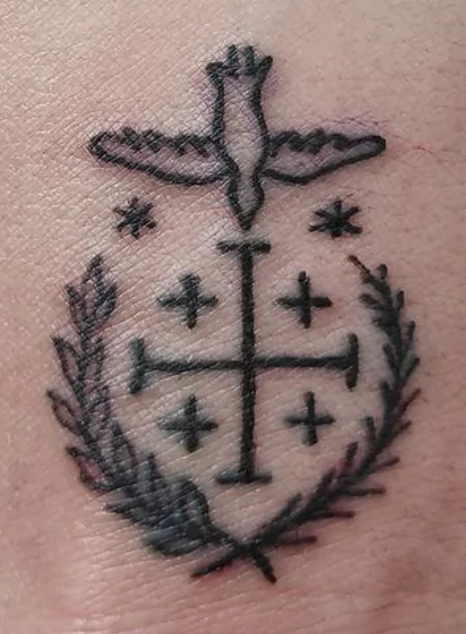
Jerusalem Cross - Razzouk Tattoo

The world's oldest tattoo shop is situated in the Christian Quarter of the Old City in Jerusalem. That in itself may come as a surprise to those who -- like me -- grew up in Christian communities that frowned on tattoos.  It's not your average tattoo parlour. For 28 generations (since 1300AD!), the Razzouk family has been tattooing Christian pilgrims, first in Egypt, and now in Israel. The shop is filled with Christian symbols -- the Jerusalem cross, the crucifix, Mary, St. George and the Dragon, the crown of Christ's victory, the dove of the Holy Spirit, and many others. 

Growing up, I don't remember seeing tattoos on any of the Christians in my community. My grandparents and parents were so firmly against the idea that the topic never even came up in our home. It was simply obvious that Christians shouldn't get tattoos because it directly contradicted Scripture. The Old Testament book of Leviticus clearly says, "Do not cut your bodies for the dead or put tattoo marks on yourselves. I am the LORD." (Lev. 19:28 NIV) For many Christians, that ends the discussion. 

But since childhood I've met many Christian friends with tattoos that did not predate their conversion. Were my grandparents wrong about this? Are tattoos actually ok for Christians? Or are these Christians disobeying Scripture?

This is a complex question that requires us to carefully think through several related issues.

To answer that question, we must consider a few things: (1) the role of Old Testament law for followers of Jesus the Messiah, (2) the purpose of this particular law in Leviticus, and (3) what a modern-day tattoo communicates. I'll talk about each of these in a separate blog post.

The Role of Old Testament Law for Christians

Christians take a variety of positions on this issue. On one end of the spectrum are those who say that all the laws have been set aside in Christ. We'll call this view the anti-law group. On the other extreme are those who say that Christians need to obey all of them. We'll call this the pro-law group. Most Christians fall somewhere in the middle, seeing ongoing validity to some laws, but not all of them. Deciding which ones still apply--and how--is the tricky part.

In Matthew 5:17-20, Jesus insists that his purpose was not to do away with the Torah or the Prophets, but to bring them to their fulfillment. He says "until heaven and earth disappear, not the smallest letter, not the least stroke of a pen, will by any means disappear from the Torah until everything is accomplished" (v. 18; modified NIV). It's obvious why those in the pro-law group would gravitate toward this passage. In fact, Jesus insists that "anyone who sets aside one of the least of these commands and teaches others accordingly will be called least in the kingdom of heaven!" (v. 19)

This is one reason I wrote a book with the subtitle Why Sinai Still Matters. I don't think that Christians can ignore the commands of the Old Testament. However, it's not as simple as following all of them. Many of the commands can no longer be kept because the temple was destroyed in 70AD. Laws pertaining to ritual purity and the sacrificial system are no longer relevant in the same way they used to be. Not only was the temple destroyed, but Jesus claimed to replace the temple with himself (John 2:19-22; Matthew 12:6). The apostles spoke of believers in Jesus as being built into a new temple (e.g. 1 Peter 2:4-8; 2 Cor. 6:16). That tells me that we no longer need to observe the laws pertaining to temple purity in the same ways that Israel did. However, we can see that Paul still felt they were instructive for believers. He tells the Corinthians that their role as the temple of the Spirit necessitated their separation from worldliness (2 Cor. 6:17). These laws still teach us about holiness and help us understand Jesus' relationship with purity, and they instruct us by analogy to ways of honoring God.

The purpose of some of the other laws (e.g., kosher diet and circumcision) was to separate between Jews as God's covenant people, and non-Jews. What we eat marks us as a community and either prevents or allows our fellowship with other people. I'm writing this post from the JFK airport in New York, where I've just come from a week in Israel. I saw firsthand how carefully Jewish communities still keep kosher food laws. Jewish passengers on my flight had different meals and scrutinized even the fruit juices to see if they were ok to drink. 

In Acts 15, leaders of the early church met together to determine how to handle Gentiles who wanted to follow Jesus, the Jewish Messiah. They prayerfully decided that Gentiles could follow Jesus as Gentiles. They did not have to first convert to Judaism by undergoing male circumcision and keeping Kosher food laws. The basis for their decision was James' exposition of Amos 9:11-12, which explicitly refers to "all the nations that bear my name." To bear Yahweh's name was to be a covenant member. The idea that Gentiles could be covenant members seemed revolutionary, but it was right there in the Prophets! 

Peter added to James' insight by noting that as he preached to Gentiles, the Spirit came upon them. Since the Spirit is a sign of covenant renewal, Peter's experience testified that God had already chosen Gentiles to belong to him. Early Jewish followers of Jesus needed to adjust their expectations of what constitutes covenant membership. 

First Peter 2:9-10 confirms this idea that Gentile followers of Jesus are covenant members. Peter is writing to a mixed audience of Jewish and Gentile followers of Jesus, but he applies to them the covenant titles conferred at Sinai: royal priesthood, holy nation, treasured possession. 

Acts 15 and 1 Peter 2:9-10 are the reason why I believe that Christians are members of Yahweh's covenant with Israel, and why I conclude that Sinai still matters for us. In Paul's words, we have been grafted into the covenant (Romans 9-11). That means the law is still relevant, even if aspects of it change on the other side of the cross. We cannot easily dismiss the rest of the laws of Leviticus. That brings us to our second question: what was the purpose of the law against tattoos? 

As I've already noted, not all the laws apply today in the same way as in Old Testament times. That doesn't mean that we can go through the Torah with a black Sharpie, crossing out the laws that no longer apply. Every law remains useful for "teaching, rebuking, correcting, and training in righteousness," as Paul tells Timothy (2 Tim 3:16). For an extended discussion of the ongoing relevance of the law with examples, see Richard Averbeck's new book The Old Testament Law for the Life of the Church. Averbeck has spent a lifetime studying and teaching Old Testament law from a Christian perspective and his approach to the subject is very helpful.

I'll address the answer to the question of the purpose of this particular law in Part 2 of this series.