Thursday, July 14, 2016

so you think you're white

What does that mean exactly?

If you're referring to the color of your skin, let's be honest — "white" is not the most accurate descriptor. White stands at one extreme of the color spectrum, and black at the other. Yet every human being I know falls somewhere in the middle — a rainbow of rich hues: peach and olive and tan and brown, which my set of 24 colored pencils cannot adequately represent. By labeling ourselves "black and white," we polarize, forcing everyone to one side or the other.

White is not a skin color (even for albinos).
White is not an ethnicity.
It's a way of organizing society, and it's so pervasive that it has changed what we think we are seeing.
A month ago this had not yet occurred to me.
But I'm over being white.

If it matters to you, I'm an American of Dutch descent. What little skin pigment I have has gathered itself into a thousand freckles on my arms and legs and face, defying categorization.
Above all, I'm human. Made as the image of God.
And so are my brothers and sisters across the pigment spectrum.
Every one of them is his image.

Language matters.
When we assign a label to something we place it in relation to other things.
We say what it is not.
In these challenging times, where emotions run high, let's choose our words carefully.
A word aptly spoken can open up new avenues for dialogue or it can dig trenches and build walls.

From now on, I'm human.

Tuesday, July 12, 2016

an open letter to people who think they're white

Dear "White" America,

(That includes me.)

We have two options.

Option 1:

Go ahead, tell yourself you can be silent because "all lives matter."
Keep imagining that this is a fictional problem, created by the media to divide our country and boost ratings.
Excuse yourself from the conversation because Black Lives Matter is not inherently "gospel centered."
Assume that this is someone else's problem because you have no black neighbors and no black friends.

Option 2:

Resolve to understand what others call injustice.
Determine to listen to their cries so you can be part of the solution in some small way.
Decide that you are not content to carry on without friends of other colors.
Develop empathy by trying on other shoes.

Above all, look deeply into your own soul and be brutally honest — racism starts with me. It starts when I cross the street to avoid close proximity with someone who is not part of my "tribe." It starts when I value the lives lost in Paris more than the lives lost in South Sudan or Syria or New Orleans. It starts when I assume that someone has nothing to offer me that I need, simply because our skin tones don't match.

It's time to wake up.
It's time to listen to the urgent cries of our brothers and sisters.
It's time to recognize that there is no such thing as "white." White is no more an ethnicity than yellow or red or blue. "Caucasian" is no more scientifically defensible than "Aryan." Both terms (now abandoned by anthropologists) served Hitler's eugenics project nicely to separate "us" from "them," while a simple DNA test would reveal our common humanity. We are cousins, each created as God's image.

American history should make all of us wary of our own rationalizations and good intentions. Abolishing slavery, as important as that was, did little to rectify the disparaging attitudes toward those of African descent. When those in power decide that the exploitation of another human being is essential to the smooth operation of our economy, that certain people are better suited to menial labor and that they aren't worth educating, then it will take generations to undo the damage. Generations. The damage is still not undone.

When we consistently define people as either "white," "black," "Asian," "Muslim," or "Mexican," we betray our cultural blindness. When we perpetuate stereotypes rather than cultivate sensitivity, we compound the problem. When we speak of immigration as "infiltration" and refugees as dangerous, we foster the very fear that creates the hostile environment in which extremism takes root among the isolated and victimized. Let me say it plainly. Our extremism fosters theirs.

Can we move beyond this?
Let's not turn our backs now, when we're needed most, and assume there's nothing we can do about it.
We can all do something.
We can start by caring.

By reading this far, you've shown that you're open to option 2.
May I suggest a next step?

Read Ta-Nehisi Coates' Between the World and Me. I suspect it is the Uncle Tom's Cabin of our generation — the book that will awaken all of us who think we're white (he calls us "the Dreamers") to the plight of blacks in America. He didn't write it for us. He wrote it for his son. But if we want to be part of the solution, we need to listen in, too.

I'm no expert on dissolving racial tension or resolving the immigration crisis, but from my vantage point both are heart issues that can no longer be ignored.

Sincerely,
A Fellow "White" American

Monday, July 4, 2016

perspective on cape perpetua

We had clamored over the volcanic rocks along with many others, their skin tones a wide range of hues and their languages sharply distinct — Spanish, French, Arabic, Russian, Japanese. Surely others, too. We were united in our fascination with the coastline and our awe as the pounding surf was thrown back by the sharp black rocks on which we stood.

Cape Perpetua (Phtoto: C Imes)
Every dozen yards or so the water had prevailed, with its persistent pounding, slicing a trench that progressively narrowed into stubborn rock. Here the waves picked up speed with a kind of focused frenzy, hurling themselves at the obsidian walls that taunted and restricted their progress.

The surge, the deep boom, the spray, and then the clatter of droplets, thrown helpless on the solid barrier, only to slide back down and drip into the churning sea.


Innumerable mussels clung fast to the hardened lava, daring the waves to pry them free, depending on the moisture and food delivered with each flailing attempt to carve stone.

Emma on the edge (Photo: C Imes)
We—my family and I, along with at least a dozen others—took our places around a deep bowl, hollowed out by the sea, which rushed to fill it through some unseen tunnel. Again and again the water would flood the enormous bowl and then be sucked out, leaving a gaping chasm encrusted with dripping mussels. Then, just as suddenly it would swell again with seawater, splashing and churning, lapping at the toes of the most foolhardy among us, eliciting gasps and shouts from all. Flush, fill, flush, fill. We watched, awestruck, as the sun slipped toward the horizon.

A few hours in the presence of such raw, unbridled power and my life feels very small indeed.
Cape Perpetua (Photo: C Imes)

Then, like the rapidly receding ocean water, we hurried to retrace our steps and climb the path to our parked car. We had just a few minutes to make it to the top of the cape for a birds' eye view of the sunset. The road wound up and up and up for two full miles, ending at the top of a coastal mountain. We rushed to the edge of the trail to look out across the expanse. I was dumbstruck.

View of the Coastline from Cape Perpetua (Photo: C Imes)
The powerful, churning waves were so far below us now that their pounding produced little more than a whisper. The sharp black rocks that held the waves at bay—merely a fringe for the heaped blanket of coastal mountains that towered above. The endless sea lay quiet and glistening beneath us as the sun slipped at last beyond the horizon.

The lesson in the crashing surf was merely a foretaste. If my life shrank beside the surge of seawater, it nearly vanished from the tip of Cape Perpetua.

And yet—

the incomprehensible mystery—

I, though infinitesimally small, have been invited to contribute, to partner with the One who designed all this.

Cape Perpetua 2016 (Photo: C Imes)
I am to cherish and share this creation with others. Still more—I get to participate in its ongoing development. I get to speak to it, engage with it, and shape it (for good or for ill).

The Creator shares with me the joy of co-creation, the dignity of service, the delight of influence.

And so I write, hoping to capture the brilliancy of a single evening in typed words so you can join me there on the cape, awestruck. You, too, are changing the world.

Thursday, June 30, 2016

chastened intuitions

My blog has needed an update for quite some time. At first, "seminary mom" made sense. I was a mom in seminary, and this somewhat unusual combination of vocations defined my educational journey. Then we moved to Wheaton for PhD studies and happened to land on Seminary Avenue. That gave my url a few more years of relevance (at least for those who knew where to find me!). I've been running on fumes for two years now, far from seminary and from Seminary avenue. And though my hands and my heart are both full, it was time for a change of title as well.

So here it is!

Starting today you can find my blog at www.carmenjoyimes.blogspot.com. I've re-titled it "Chastened Intuitions," and for that I owe you an explanation. The idea came to me several years ago while reading John Barton's Reading the Old Testament: Method in Biblical Study. Barton has the guts to say what many biblical scholars avoid admitting (to themselves or anybody else): competent reading of Scripture involves a great deal of intuition.

In his words, "much harm has been done in biblical studies by insisting that there is, somewhere, a 'correct' method which, if only we could find it, would unlock the mysteries of the text" (5). He examines a whole spate of methods (literary criticism, form criticism, redaction criticism, the canonical approach, structuralist criticism, and new criticism), concluding that each method contributes something, but none is the be-all-end-all of biblical study. Any one of these, when taken to the extreme, collapses upon itself.*

He continues, "I propose that we should see each of our 'methods' as a codification of intuitions about the text which may occur to intelligent readers" (5). They are ways of circling the text and looking at it from different angles. Barton is not saying that the meaning of the biblical text is open to any and every interpretation, whatever a reader wishes to see, but that our intuitions are re-shaped by the reading process so that we become increasingly competent. In other words, we bring our intuitions to the text and in the process of reading we are chastened and changed by it.

This is true of life as well. We think we know how things ought to go, but they don't quite play out as we expected. We take a step back, readjust, and carry on, wiser for the experience.

I believe that when we approach the text and the world with eyes of faith, eager to learn and expecting to be changed, we become increasingly conformed to the image of Christ. Along the way our interpretations of the text and of life become more reliable.

This blog has been and will continue to be a place where I process the lessons God is teaching me as I study his word and engage his world. You're welcome to join me by reading along!

------

*Sometimes Christians resist the idea of "method" in biblical study altogether because they misunderstand the doctrine of perspicuity (that is, the doctrine from the Protestant Reformation that teaches that the Scriptures are clear). While the basics of God's saving grace in Christ are communicated at a level that even a child can understand and embrace, the Bible is not an "easy read." A host of theological and practical problems arise when we assume that we should simply take the Bible "literally," without regard for its ancient context, its genre, and figurative language.

Thursday, May 26, 2016

a simple path to joy (part 3): faith for the bend in the road

In the first two posts of this series, I've suggested that true joy comes when we face life honestly and cultivate gratitude for what we have and where we are. These choices get us through the gate and onto joy's path, and they help us navigate each intersection.

The third choice on the pathway to joy comes when we reach a bend in the road. It's a fact of life that we can't see what's ahead. But joy does not depend on knowing what comes next or being able to control it.  True joy cannot be seized or managed.  We don't get there by straining harder, but rather by releasing our hold on what we cannot control anyway. Christian joy comes when we recognize our own helplessness. That is, it comes through faith -- faith rooted in the reality of what God has done for us in Jesus Christ, and in what he promises to do for all creation. We await the renewal of all things. We believe it is coming. Trouble may lurk around the next bend, but the pain, sorrow, and madness of this world is not final. It is merely a symptom of our world's brokenness and need for restoration. That restoration has been promised by the God who created all things. We can count on it. And it has already begun to take effect with the resurrection of Jesus. 

The story of Jesus is powerful precisely because when he became human he entered fully into the mess and the brokenness of this world. But his life was fully surrendered to God the Father and therefore fully energized by the Holy Spirit. His mastery of being human, his perfection, is more than just a model for us to follow (though it is that). It's what qualified him to break the power of sin and death by offering himself in our place. He took the punishment we deserved. He died our death, so that we could truly live.

The New Testament calls joy a fruit — one of the character qualities that naturally arises from a life energized by the Holy Spirit. This, too, suggests that joy comes not by straining, but by surrender, not by trying, but by trust in the transforming power of God. That power is made available to us in Jesus Christ. A gift to each of us who surrenders. We can walk in this joyful reality by facing our brokenness with honesty, embracing our present with gratitude, and responding in faith to life's uncertainties. We may not know what the future holds, but we know who holds the future. And that makes all the difference.

Now for a word of warning. The pathway to joy is not a path we walk only once. Honesty, gratitude, and faith are not quick fixes for joy. They must become habits. We must continue to face life with honesty, to receive our circumstances with gratitude, and to embrace the future with faith. As one Bible scholar puts it, "Like muscles, the capacity for joy atrophies if we do not use it regularly. Those who wait for some great occasion for joy and gratitude to God are not likely to recognize it when it happens." (Ellen Davis, Proverbs, Ecclesiastes and the Song of Songs, 221; quoted in James Limburg, Encountering Ecclesiastes: A Book for our Time, 114). We begin practicing honesty, gratitude and faith right here, with whatever we're facing.

Paul was among the early Christians who traveled around the Roman world to spread the news about Jesus' resurrection from the dead. He had some utterly strange things to say about joy:

In his letter to the church in Corinth he said, "In all our troubles my joy knows no bounds." (2 Corinthians 7:4) He spoke of others who had "overflowing joy" "in the midst of a very severe trial (2 Corinthians 8:2). And Paul was not alone in noticing that joy and trials often went hand-in-hand. James, the brother of Jesus, wrote "Consider it pure joy, my brothers and sisters, whenever you face trials of many kinds." (James 1:2) Pure joy? When facing trials? Why? He goes on to say, "because you know that the testing of your faith produces perseverance. Let perseverance finish its work so that you may be mature and complete, not lacking anything." (James 1:4) James is saying we ought to be grateful for the effects of those trials on our character. Through the eyes of faith, we know that hard times help us to grow in important ways -- provided we respond with open hands and open hearts. That brings pure joy.

We no longer need to worry about what's ahead. If something good happens, we can celebrate. If we face difficult times, we can be glad for what those experiences will do in us so that we can become who we were meant to be. We win either way! That frees us to face our present situation honestly and receive it with gratitude.

Paul discovered this. He wrote, "I have learned to be content whatever the circumstances. I know what it is to be in need, and I know what it is to have plenty. I have learned the secret of being content in any and every situation, whether well fed or hungry, whether living in plenty or in want. I can do all this through him who gives me strength." (Philippians 4:11–13)

And so can you!

Monday, May 23, 2016

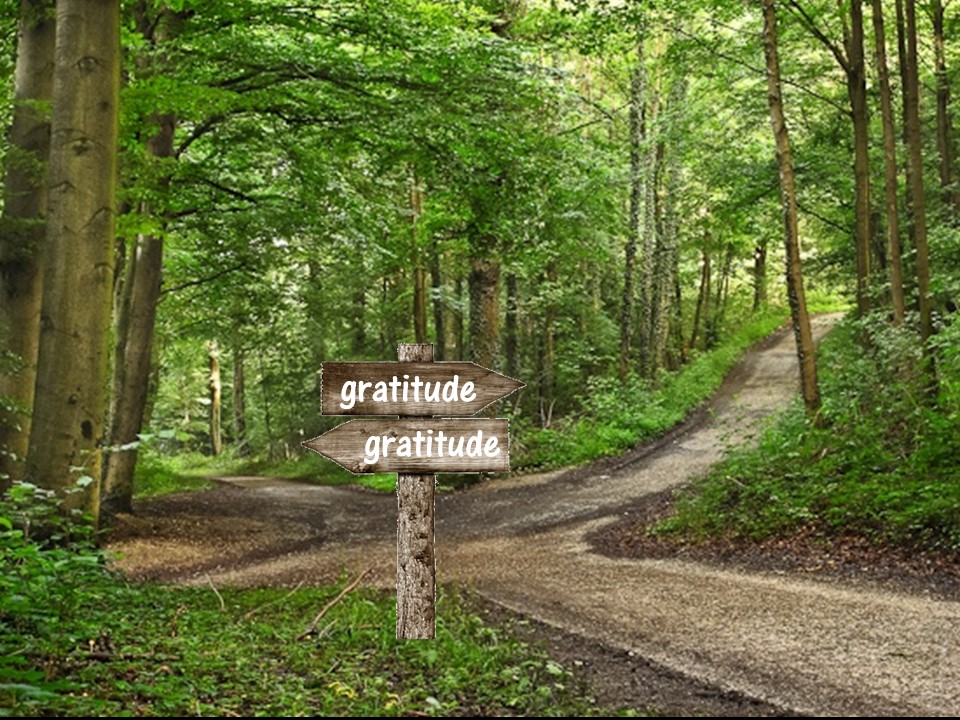
a simple path to joy (part 2): the intersection of gratitude

In my first post in this series, I claimed that true joy is impossible to find when we are living in denial. We begin our journey to joy by facing life's messes head on and choosing to be honest. That's how we enter the gateway on the path to joy.

Next we come to an intersection, and we have to make our second choice: gratitude. We cannot be everything we might have been, have everything that can be had, go everywhere there is to go. We can only be and do and have this. Once we have faced our disappointments with brutal honesty, we are free to move on with gratitude for what our life actually holds.

Our world is full of constant reminders of what we don't have. Ads surround us incessantly, telling us all day long about the products and services that will make life easier, or sweeter, or more successful. But joy depends not on what we have but on our disposition towards what we have. The Greek philosopher Epicurus warned, "Do not spoil what you have by desiring what you have not." Put another way, "Happy is the woman who wants what she has." In fact, sometimes we uncover joy by having less, by simplifying our lives -- clearing out our closets and giving things away. Every item we own gets a piece of our care and attention until we have no energy left to care for the things that really matter. It is freeing to declutter, to downsize, to keep only what we actively use.

But this intersection on the pathway to joy isn't only about what we have. It's also about where we are and who we've become. There are more possibilities in life than we have time to try, more opportunities than we can pursue. When we cultivate the habit of thankfulness, our hearts are positioned for joy. We cannot take every path, but we did take this one. To spend our time wondering about all the other paths we could have taken robs us of joy. I am not an astronaut. I am not a midwife. I am not a famous singer. I am not a jungle missionary. I am not even one of those amazing stay-at-home moms who actively volunteers at the elementary school and whose kids have really creative birthday parties every year. Saying 'yes' to one path has meant saying 'no' to others.


About a year ago we realized that I would probably never finish my doctoral degree unless I started to say 'no' to good opportunities. I resolved not to say 'yes' to anything but family until I was finished. At first it was painfully difficult. The things I was asked to do were right up my alley. They were things that would energize me. Ways to plug into my church and my community for which I was uniquely suited -- lead a small group, speak in chapel, teach a college class. But after half a dozen difficult 'no's' my schedule was completely open for the task I dreaded -- revising my dissertation. And I discovered that when I had complete focus, I did much better work and enjoyed it far more than before! I relished the gift of concentration. We shoot ourselves in the foot when we try to do it all or have it all, or spend our energy wondering what would have happened or what could have been. Those things are not. This is what is. Here is where we are. So let's embrace it and move forward with gratitude. 

This is a sure way to begin to find joy. But what about the uncertainties ahead? In my next post, I'll talk about what to do when we can't see around the bend in the road.

Wednesday, May 18, 2016

a simple path to joy (part 1): the gateway to honesty

Last week I had the opportunity to speak at the May Festival at Evangelical Bible Church in Dallas, Oregon. My assigned topic was "Joy in Simplicity." Here's a glimpse of what I shared:

-----

How do we find joy? Joy is not automatic. A life free from trouble is no guarantee of joy, and a difficult life does not prevent it.

From 2002 to 2005 we lived in the Philippines. In spite of widespread government corruption, crippling poverty, oppressive heat, and high unemployment, we found Filipinos to be some of the happiest people we've ever met. They can fall asleep anywhere, turn a 1-year-old's birthday into a wedding-sized celebration, and laugh in the face of trouble. They are among the poorest in Asia, but arguably the happiest. Clearly, joy does not depend on circumstances. So how do we get there?

If we imagine a pathway to joy, forward movement depends on three deliberate choices. (There may be others; I'm addressing three here.) The first comes at a gateway, the second at an intersection, and the third at a bend in the road. To enter the gateway we need to choose honesty. To navigate the intersection we must choose gratitude. And to lend perspective for the bends in the path, we need faith.

We make the first deliberate choice at the gateway of honesty. We will never arrive at true joy by pretending to be happy. Denial is the enemy of joy —a closed door to joy's garden path. We cannot bypass grief and pain, guilt or unforgiveness and expect to find joy. That thing that robs us of joy must be faced head on. We must look it in the eye and name it.

In fact, psychologists tell us that when we avoid honesty, we invite poor health, both emotionally and physically. In the words of one scholar who has studied this phenomenon (Brent Strawn, on James Pennebaker's study, in Brueggemann, From Whom No Secrets Are Hid, xix), "Inhibition is hard work, and that work eventually takes its toll on the body's defenses." So you want real joy? Step one is to grieve your losses. Admit your fault. Express your anger. Own your failures. Voice your disappointment. Forgive those who have let you down.

This is a bit awkward to say in church. Most churches have lost the art of making space for this kind of honesty. We give the distinct impression that "putting on your Sunday best" always includes a bright smile. We rarely confess our sins, name our failures, face our fears, and grieve our losses in community. And so our unexpressed emotions become roadblocks to joy. One way to recover these practices is to pray the Psalms together. The Psalms let it all hang out. Every ugly emotion you can imagine.  It's like reality TV, minus the TV.

God, I cry out by day, but you do not answer! By night, but I find no rest! (22:2)
Do not be far from me, for trouble is near and there is no one to help! (22:11)
Break the arm of the wicked man; call the evildoer to account for his wickedness (10:15)
All night long I flood my bed with weeping and drench my couch with tears (6:6)
Heal me, Lord, for my bones are in agony. My soul is in deep anguish. How long, Lord, how long? (6:2-3)
Against you, you only, have I sinned and done what is evil in your sight. (51:4)
Troubles without number surround me; my sins have overtaken me, and I cannot see (40:12)
Let evil recoil on those who slander me; in your faithfulness destroy them (54:5)

Through prayer, all these raw and gritty realities are brought into the presence of God and given over for Him to handle. The Psalms are proof that God invites us to come as we are. To say it like it is. And by doing so, to find a new way forward. There's no way around it.


So we begin our journey to joy by choosing to be honest.

Then we come to an intersection, and we have to make our second choice: gratitude. I'll talk about that intersection in my next post on joy.