Wednesday, August 9, 2023

Companion Videos for 'Being God's Image'!

Two weeks from today, my new video course on Being God's Image: Why Creation Still Matters is launching with Seminary Now. We've filmed a video to go with each chapter of the book. Some of the content overlaps with the book, but in each video I extend that content to include new illustrations or applications.

10 chapters -- 10 videos -- about 10 minutes each

Audiobook available here
It's the kind of resource that makes it easy to lead a group through the book. The videos work with or without the book. If you've already read Being God's Image, these videos will reinforce what you've read and offer new things to think about. If you're not a reader, the videos will give you some of the most important content. (But also, you non-readers, did you know that I narrated the audiobook?)

Being God's Image explores what the Bible says about what it means to be human. Laying a foundation from the early chapters of Genesis, I explore implications for a host of topics:

What's wrong with the way many Christians read Genesis 1?

What relevance does Genesis 1-2 have for debates about gender roles?

Can the image of God help us with questions about abortion or assisted suicide? 

Where is hope hiding in Genesis 3? 

What can we learn from Jesus' ministry about being human?

How does pornography inhibit human flourishing?

How is death a blessing? 

Should we be worried about artificial intelligence?

How has the church failed people with disabilities?

What does skateboarding have to do with the church? 

Why does creation still matter? Isn't the whole world gonna burn?

All this and more is included in my course on the image of God.

Watch the trailer for my new course on Being God's Image here.

Seminary Now is a subscription-based platform with streaming content from some of my favorite and most trusted colleagues in the areas of Old Testament, New Testament, Church Ministry, and more. If you sign up, you'll have immediate access to ALL of the courses, including videos by Esau McCaulley, John Walton, Ruth Haley Barton, Sandra Richter, David deSilva, Brenda Salter McNeil, Craig Keener, Richard Middleton, Ruth Padilla DeBorst, Derwin Gray, Lynn Cohick, Tish Harrison Warren, Scot McKnight, and MORE! You'll also have access to my course on Bearing God's Name (2020). 

Best of all, if you register at Seminary Now, you can view the first three lessons of my new course FREE!

If you're a Seminary Now subscriber, comment below with your favorite courses. My favorites are Sandra Richter's Stewards of Eden and Ruth Haley Barton's Strengthening the Soul of Your Leadership.

Tuesday, June 27, 2023

Celebrating 25 Years!

Twenty-five years ago today, I was surprised that I didn't float down the aisle. A wedding seemed like it ought to be the dreamiest day, but when the time came, my Dad and I simply put one foot in front of the other as we made our way toward the front of the church, toward the man who would soon become my life partner. Walking felt so ordinary.

Our Wedding at Third Christian Reformed Church
in Denver, Colorado. June 27, 1998

Don't get me wrong -- the dress and the music and the flowers and the dear friends and family who had gathered were nothing but ordinary. It was our wedding! But as I look back, that ordinary walk down the aisle toward a life filled with ordinary moments seems fitting.

In the classic film, Fiddler on the Roof, when Tevye and Golde reached this milestone, Tevye's urgent question to his wife of 25 years was "Do you love me?" After all, their marriage was arranged, so the question of affection had been irrelevant on their wedding day. But now he wonders..."Do you love me?"

Golde's answer canvases the ordinary days they have shared, wondering whether the question is even relevant:

For twenty-five years I've washed your clothesCooked your meals, cleaned your houseGiven you children, milked the cowAfter twenty-five years, why talk about love right now?

For twenty-five years I've lived with himFought him, starved with himTwenty-five years my bed is hisIf that's not love, what is?

But that's the thing about love. It proves itself in ordinary ways. Golde is right -- cooking and cleaning and childbearing and gathering food -- these are the building blocks of a life together. Love is not just a feeling of affection but a commitment to someone else's flourishing.

Our marriage has not been ordinary in the sense of typical. We have moved fifteen times, lived in three countries, raised three children, and earned a certificate and four degrees between the two of us. Much of the love we've shared has come in the form of packing and unpacking and learning to pay bills in a new city or taxes in a new country. 

Our roles may seem unconventional. At the beginning of our marriage I did the laundry, the cooking, the shopping, and most of the childcare. Now our roles are reversed; I vacuum and help with dinner clean up while Daniel manages almost everything else, including most of the taxi-driving for our teenagers.

But I know this: Our partnership in life and ministry has been such a generous gift from God!

Do I love him? Absolutely! 

Does he love me? When I get home from work, I'm greeted by the smell of love: a healthy dinner cooking.

Dinner may seem ordinary, but it's the stuff of legend and of romance. Every day that I find clean socks in my drawers and milk in the fridge or flowers on the table, I don't even have to ask.

I know.

University of British Colombia

Ordinary faithfulness is what we signed up for. We celebrated 25 years of ordinary moments with an extra-ordinary cruise to Alaska. The stunning scenery and delicious food and quality service could hardly compare to the joy of experiencing it all together. 

Glacier Bay National Park
So now we go from glaciers and bears and mountain goats and sea otters back to ordinary -- doctor's appointments and bills to pay and emails to answer and dishes to wash.

Happy 25th Anniversary, Honey! I'm so glad to be spending my life with you. 

Here's to 25 more years of ordinary days ... together.


Saturday, April 1, 2023

New Book Announcement: Being God's Image: Why Creation Still Matters


Carmen Imes holding copies of both of her books -- Bearing God's Name and Being God's Image.
Being God's Image: Why Creation Still Matters
(IVP) official releases on June 6.
Bearing God's Name: Why Sinai Still Matters has a prequel! Being God's Image: Why Creation Still Matters is my attempt to demonstrate what the Bible teaches about being human in God's world. 

Like the first book, this one is accessible and easy to read. It's a work of biblical theology that traces a theme through the entire Bible. Like the first book, this one is neatly divided into 10 chapters of roughly equal length making it ideal for a small group study or classroom use. Like the first book, this one includes discussion questions and QR codes that link to relevant videos from the Bible Project for each chapter. 

Unlike the first book, this one is not based on my dissertation research. Instead, I'm introducing you to the work of other brilliant scholars who have taught me so much.

Here are some of the key ideas in Being God's Image:

  • Every human is the image of God.
  • Our identity as God's image cannot be lost or destroyed.
  • The imago Dei is the basis for human dignity.
  • Our status as God's image comes with responsibility to benevolently rule creation.
  • This responsibility is shared by both men and women, who are equally God's image.
  • Our embodiment is the key marker of our human identity.
  • The fact that Christ became an embodied human reaffirms the goodness of creation.
  • Christ's bodily resurrection signals that in the new creation, our bodies will still matter.
  • We await resurrection, too, and eternal life in the new creation.
Throughout the book, I consider the implications of these doctrinal claims for a host of issues: creation care, sexuality, pornography, gender roles, race, ability/disability, work, prayer, suffering, healing, human emotion, the quest for meaning, and more. Because these are controversial issues, readers may find themselves disagreeing with my conclusions now and then. This book is not meant to be the final word on anything, but I hope it furthers the conversation on issues that matter if we're serious about living in alignment with Scripture.

The book will also be available on June 6 in Kindle format, for Logos Bible software, and as an audiobook, read by yours truly!

Until June 5, you can pre-order physical copies directly from InterVarsity Press for 30% off and FREE shipping using the discount code IMES30. The books have already arrived in the warehouse, so you should get yours right away!


Thursday, December 29, 2022

Best Books of 2022

Many books that cross my desk are aimed at students or laypeople, rather than biblical scholars. I read and enjoy many of them in order to be able to recommend them to students and others interested in biblical studies. I leave at least a brief review of all the books I read on GoodReads. Of the 40 books I read this year, I'm limiting my "best books" list to those that were game-changers for me personally. 

Each of the following six books is not only beautifully written and impeccably researched, but opened up new vistas in how I think about God, Scripture, and the life of faith. I'm so grateful for the hard work that went into writing each one and to all those who were involved in releasing these to the world.

Women and the Gender of God, by Amy Beverage Peeler

This is a daring book. Amy Peeler tackles a controversial issue: the gender of God and its implications for women. For some, to raise these questions at all is objectionable. For others, Peeler's high view of Scripture will suggest that she herself is captive to patriarchy. However, readers who take the time to engage her argument will find that neither critique has merit.

Like it or not, many people today reject the Christian faith because of their perception that the Bible portrays God as masculine/male. Is the Bible even good for women? Peeler patiently shows why these questions are worth asking and how the Bible itself offers a robust response that both affirms women and glorifies God, without making God male. Part of her answer is to help Protestants recover the biblical portrait of Mary.

Peeler's grasp of the secondary literature is impressive. Her arguments are sophisticated and theologically astute. She is attentive to nuance in Scripture, and her faithful reading yields an illuminating vision of a good God who invites women to be full participants in God's work in the world. I'm so grateful for her work. I expect it will be an essential resource for years to come.
 

Cursing with God: The Imprecatory Psalms and the Ethics of Christian Prayer, by Trevor Laurence

A remarkable work--lyrically inspiring and imaginatively compelling. For many, it will represent a paradigm shift. Laurence not only rehabilitates the imprecatory psalms for use by the church, but he demonstrates their compatibility with Jesus' call to love our enemies. This is more than a treatise on imprecation; Laurence offers a profound work of biblical theology in service of the church. He draws our attention to imprecation hiding in plain sight in the New Testament, and he charts a path for churches who are ready to recover this neglected aspect of the whole counsel of God. In a world plagued by injustice, this book is a gift we urgently need.

One of my favorite things about this book is the sample liturgy in the appendix. Although this is the published version of Laurence's dissertation, he offers such practical help for church leaders who want to shepherd their congregations in praying the imprecatory psalms.

Paul and Gender: Reclaiming the Apostle's Vision for Men and Women in Christ, by Cindy Westfall

In the stuffy room marked "Paul's Views on Women," where a weary debate has been at an impasse for centuries, Westfall raises the blinds and throws open the windows, letting in light and fresh air.
With my three degrees in theology and four-and-a-half decades in the church, I thought I had heard it all. But just ask my husband (at home) if he's ever seen me gasp so many times while reading in bed, and if I've ever interrupted him so many times to read him a sentence or a paragraph.

Westfall's conclusions are carefully researched and well argued. She has a way of turning things inside out to help readers see what was right there in the Bible all along. Her book simultaneously delighted and depressed me. If she's right -- and I think she is -- then some corners of the church have unnecessarily missed out on hearing the Spirit-empowered voices of women for a very long time.

Church leaders, I beg you to read this book. You can't afford not to.

Abuelita Faith: What Women on the Margins Teach Us about Wisdom, Persistence, and Strength, by Kat Armas 

Magnificent!

Kat's exegesis is impeccable and her stories are captivating. She weaves personal and international stories with stories of women in the Bible. The result is a compelling invitation to reconsider what counts as theology and to (re)discover the voices of those hiding in plain sight. An absolute must read. I devoured it in one day!


Disability and the Way of Jesus: Holistic Healing in the Gospels and in the Church
, by Bethany McKinney Fox

Fox's book is such a gift to the church. The opening chapter was worth the price of the book! It shifted the way I think about disability. Each chapter addressed Jesus' healing ministry from a different angle--first century context, medical perspective, disabled persons' perspective, and pastors' perspective--followed by chapters on the seven marks of healing in the way of Jesus and the seven ways this can be lived out in the church. 

Although the first six chapters focus primarily on physical disabilities, the final chapter offers many ideas on how to include people with intellectual disabilities in the church. One of Fox's big ideas is that inclusion of people with disabilities is not simply an act of compassion modeled after Jesus, but that people with disabilities have so much to offer the church. She advocates for full inclusion of people with disabilities in the decision-making and ministries of the church and challenges us to re-think our services so that they are less reliant on verbal proclamation and more holistic and multi-sensory. I'm grateful for her careful thinking and clear vision. It's usefulness goes beyond the church -- this book has given me much to think about with regard to college classroom instruction and campus life. It was well worth the read!


Jesus and the Forces of Death: The Gospels' Portrayal of Ritual Impurity within First-Century Judaism, by Matthew Thiessen

An excellent reexamination of Jesus' healing narratives, demonstrating that Jesus did not disregard Jewish law. Several of his healings focused on those suffering from ritual impurity caused by lepra (a skin disease sometimes erroneously translated "leprosy"), genital discharges, and death. Rather than set aside the ritual purity system, Jesus removed the sources of ritual impurity, showing that his power was even greater than the temple.

Theissen includes a chapter on exorcisms and on Jesus' Sabbath "violations" as well as an appendix on dietary laws. These contribute to the overall picture that Jesus upheld Jewish law.
 

So much of what Thiessen points out is evident to those reading closely, but somehow with all my years reading and studying the Bible I had missed it. An illuminating book!

----

What's the best book you read this year? I'd love to hear about it in the comments below!


Wednesday, December 21, 2022

Are Tattoos OK for Christians? (Part 3)

If you're just joining the conversation, you'll want to read the first two posts in the series first (Part 1 and Part 2). In those posts I address the important questions of the role of Old Testament law for Christians and the purpose of the law in Leviticus that prohibits tattoos.

I've argued that Old Testament law is still relevant for followers of Jesus, but that we need to do the careful work of discerning the purpose of a law in order to see how it can and should inform our lives today. Now we've come to the practical question: so can I get a tattoo?

That all depends. The next step is to consider what tattoos in general communicate in your context and what the tattoo you want to get communicates. I began this series by talking about how my grandparents frowned on tattoos. Were they wrong? Not necessarily. In their generational and cultural context, a tattoo carried an ethos of rebellion and disrespect. In many cultures or contexts around the world today that may still be the case. Some jobs prohibit them. In some cases, a tattoo will close doors or shut down conversations. In other cases, a tattoo facilitates connections with others.

The operative question, then, is what will a tattoo communicate to those with whom I come in contact? Will it open up conversations? Or will it shut them down? Will a tattoo get in the way of my obedience to God's calling on my life? Will it interfere with ministry or relationships?

Tattoos are very common where I live in Southern California. For that matter, they're very common in rural Alberta and in Portland, too. That makes them not particularly edgy or rebellious, even in church or academic settings. At least three of my colleagues down the hall in Biola's Bible department have tattoos. Your setting might be different.

If you discern that a tattoo is not problematic in your context, then it's time to ask the more specific question: what does this particular tattoo communicate? Obviously you want to choose something that you will not tire of seeing. Tattoos are permanent! But beyond that, the most important question is whether your tattoo will conflict with your Christian testimony. Will it send mixed messages? Will it distract from your identity as a follower of Jesus? If so, then I would advise you not to get it because it falls into the same category as bodily disfigurement in Leviticus 19:28 that I discussed in the previous post.

My Tattoo, Hebrew for 
"Belonging to YHWH"

I first had the idea of getting a tattoo while I was working on my doctoral dissertation. I was writing about Israel's "invisible tattoo" to which the Name Command pointed: "You shall not bear the name of YHWH your God in vain" (my translation of Exodus 20:7 from Hebrew). My study of this passage convinced me that it does not prohibit speaking the divine name, but rather that it draws on a wider biblical concept of God's claim on the covenant people. YHWH's name was attached to them via the priestly blessing (Num. 6:27). Their behavior ought to reflect the one to whom they belonged. As I explained earlier, the apostles taught that through faith in Jesus the Messiah, believers are grafted in to that same covenant (Rom 9-11; 1 Pet. 2:9-10). Peter speaks of our identity in terms of name-bearing (1 Pet. 4:16). I thought it would be meaningful to make the invisible visible--a permanent reminder of my Christian vocation. Deuteronomy 7:6 reads, 

For a holy people you are, belonging to YHWH [‎ליהוה] your God. YHWH your God has chosen you out of all the peoples on the face of the earth to be his people, his treasured possession.

The underlined text here matches what it says on the high priest's forehead medallion. The high priest literally bears God's name as he goes about his priestly duties. His life is dedicated to God's service.

Later in Scripture, Isaiah speaks of a future day when God would pour out his Spirit with the result that the people of Israel would again be eager to identify as covenant members:

Some will say, 'I belong to the LORD' [‎ליהוה]; others will call themselves by the name of Jacob; still others will write on their hand, 'The LORD's' [‎ליהוה], and will take the name Israel. (Isa. 44:5 NIV)


Both of these underlined phrases mirror what is written on the forehead of the high priest. They also bring to mind the righteous in Revelation 7 who are marked with God's "seal." Revelation 14:1 specifies that God's name was written on their foreheads. Seals with writing on them nearly always included the owner's personal name with "L" attached to the front of it indicating that the seal belongs to the person by that name. The most natural way to understand the seal on the foreheads of the righteous in Revelation is to suppose that it says LYHWH [‎ליהוה]. These people are the counterparts to those designated with the mark of the beast. 

Here's how I see it: every human being throughout history bears the name of the one to whom they offer their allegiance. In John's vision in Revelation, the invisible becomes visible. Our allegiances become obvious.

Nizar Razzouk, 28th generation tattoo artist
at Razzouk Tattoo in Old City Jerusalem

In the new creation, I'll have a tattoo on my forehead. Until then, I'm declaring my allegiance to YHWH by writing his name on my hand, in the spirit of Isaiah's prophecy. During my recent trip to Israel, I made an appointment at the world's oldest tattoo shop, Razzouk Tattoo, where Nizar Razzouk marked me as one "belonging to YHWH." Nizar is the 28th generation in his family to make a living by tattooing Christian pilgrims, which tells me that this is a very old practice indeed. For 700 years, Christians have wanted to permanently mark their allegiance to God in this way.

Believe me when I say that I'm not trying to become "the tattoo lady." I'm still very cautious about permanent body markings. However, I hope that this series has helped to model the kinds of questions we should be asking of the biblical text as well as ourselves. The point is not to "get around" a biblical prohibition, but to understand why it matters to God so that we can respond faithfully. I pray that I have done so, and that these reflections have helped you to think well about how you can do so, too.

--------

If this series has piqued your curiosity about the biblical concept of bearing God's name, you can read further in my accessible book, Bearing God's Name: Why Sinai Still Matters (IVP), or in my more technical published dissertation, Bearing YHWH's Name at Sinai: A Reexamination of the Name Command of the Decalogue (Eisenbrauns). For a complete list of podcasts where I've talked about these concepts, click here.

Tuesday, December 20, 2022

Are Tattoos OK for Christians? (Part 2)

I knew this would be a controversial topic. Already the debates are breaking out on social media over the first post in the series, where I consider the Christian's relationship with law in the Hebrew Scriptures. For some, Leviticus 19:28 provides the definitive answer: NO to tattoos. Others' concern with tattoos arise from their desire to avoid worldliness.

In order for us to do this topic justice, we need to consider the purpose of the law given to ancient Israel. I tell my students every semester that the key to faithful biblical interpretation is to read each passage in its historical, literary, and theological context. Imagine that these are the three legs of a stool. If one is missing, the stool falls over! Paying attention to each of these dimensions can help us discern the purpose of the law without distorting its message.

I recall a story about a woman baking ham. She had grown up watching her mother slice both ends off the ham before baking it. She wasn't sure why, but she figured "mother knows best," so she continued the practice when she had a home of her own. One day she got curious and asked her mom the purpose of slicing off the ends. Her mom looked surprised: "Our pan wasn't long enough!" Tradition on its own is not a good reason to do things. When we don't understand the purpose, we run the risk of missing the point altogether.

It's not always possible to know the purpose behind a law in the Bible. But it's worth asking the question. In the case of the tattoo law, we have a clue right in the text itself. 

Do not cut your bodies for the dead or put tattoo marks on yourselves. I am the LORD. (Lev. 19:28 NIV)

Historically speaking, it seems that the Israelites were tempted by surrounding cultures to disfigure themselves either to commemorate or maintain connection with the dead. Roy Gane explains that 

"Lacerating oneself in mourning was a heightened expression of sorrow (Jer. 16:6, 41:5). In the Ugaritic Myth of Baal, when the chief god 'Ilu (El) learns that Ba'lu (Baal) is dead, he goes into paroxysms of grief that emphasize the magnitude of the catastrophe" (Zondervan Illustrated Bible Backgrounds Commentary I:315). El slices his skin with stones and razors, pours dirt and dust on himself, and wears unique clothing. 

Were tattoos also associated with these distraught mourning practices? It's possible. 

A similar passage found in Deuteronomy 14:1-2 offers further insight:

You are the children of the LORD your God. Do not cut yourselves or shave the front of your heads for the dead, for you are a people holy to the LORD your God. Out of all the peoples on the face of the earth, the LORD has chosen you to be his treasured possession. (Deut. 14:1-2 NIV) 

Deuteronomy sheds light on the purpose of this law by explaining the motivation for obedience. Somehow, this bodily disfigurement was inconsistent with Israel's identity as the people belonging to God, YHWH's treasured possession. Some scholars think that Moses' farewell sermon in Deuteronomy 12-26 is modeled after the Ten Commandments by expanding on each one in order. If they are right, then the law against bodily disfigurement appears in the section of Deuteronomy that expands upon the Name Command (Exodus 20:7), that is, the command not to bear God's name in vain. Are you starting to see the connection?

Literarily, the command appears in a chapter that covers every conceivable domain of Israelite life in order to illustrate how holiness might be expressed. The refrain is "Be holy, because I, YHWH your God, am holy." The point is to express the character of God in our interactions with others.

One thing we do know from the ancient context is that tattoos were used to mark slaves, either privately owned or those who served in temples. When we consider the background to the Sinai instructions, the bigger purpose becomes clearer. YHWH had rescued the Israelites from slavery to Pharaoh so that they could serve him instead. In that context, a tattoo would conflict with YHWH's claim on them and their purpose to represent him to the nations.

Photo by Ben P L
Wikimedia Commons

Theologically, this connects with the wider theme of bearing God's name, which I've written about elsewhere. In a nutshell, God's claim on Israel was like an invisible tattoo. He placed his name on them via the priestly blessing (Numbers 6:27) so that they would serve him as a kingdom of priests (Exodus 19:4-6). They were not to carry that name in vain by living like pagans (Exodus 20:7). The high priest wore a gold medallion on his forehead that announced he was "holy, belonging to YHWH" (Exodus 28:36) and the seals of the 12 tribes on his chest, which he carried before the Lord (Exodus 28:29). His uniform enabled him to represent every Israelite.

Can you see now why in that context a tattoo might obscure their God-given identity and vocation? To disfigure their bodies for the dead or tattoo themselves to indicate allegiance to another master could compromise their testimony.

This background sets us up to consider the third relevant question: what does a modern tattoo communicate? We'll tackle that question in Part 3 of this series.

Monday, December 19, 2022

Are Tattoos OK for Christians? (Part 1)

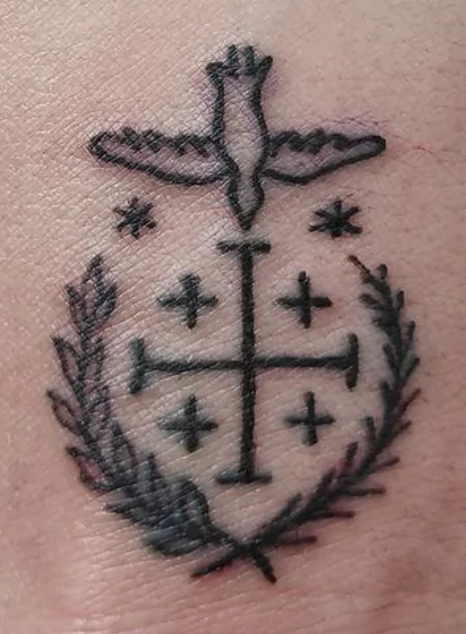
Jerusalem Cross - Razzouk Tattoo

The world's oldest tattoo shop is situated in the Christian Quarter of the Old City in Jerusalem. That in itself may come as a surprise to those who -- like me -- grew up in Christian communities that frowned on tattoos.  It's not your average tattoo parlour. For 28 generations (since 1300AD!), the Razzouk family has been tattooing Christian pilgrims, first in Egypt, and now in Israel. The shop is filled with Christian symbols -- the Jerusalem cross, the crucifix, Mary, St. George and the Dragon, the crown of Christ's victory, the dove of the Holy Spirit, and many others. 

Growing up, I don't remember seeing tattoos on any of the Christians in my community. My grandparents and parents were so firmly against the idea that the topic never even came up in our home. It was simply obvious that Christians shouldn't get tattoos because it directly contradicted Scripture. The Old Testament book of Leviticus clearly says, "Do not cut your bodies for the dead or put tattoo marks on yourselves. I am the LORD." (Lev. 19:28 NIV) For many Christians, that ends the discussion. 

But since childhood I've met many Christian friends with tattoos that did not predate their conversion. Were my grandparents wrong about this? Are tattoos actually ok for Christians? Or are these Christians disobeying Scripture?

This is a complex question that requires us to carefully think through several related issues.

To answer that question, we must consider a few things: (1) the role of Old Testament law for followers of Jesus the Messiah, (2) the purpose of this particular law in Leviticus, and (3) what a modern-day tattoo communicates. I'll talk about each of these in a separate blog post.

The Role of Old Testament Law for Christians

Christians take a variety of positions on this issue. On one end of the spectrum are those who say that all the laws have been set aside in Christ. We'll call this view the anti-law group. On the other extreme are those who say that Christians need to obey all of them. We'll call this the pro-law group. Most Christians fall somewhere in the middle, seeing ongoing validity to some laws, but not all of them. Deciding which ones still apply--and how--is the tricky part.

In Matthew 5:17-20, Jesus insists that his purpose was not to do away with the Torah or the Prophets, but to bring them to their fulfillment. He says "until heaven and earth disappear, not the smallest letter, not the least stroke of a pen, will by any means disappear from the Torah until everything is accomplished" (v. 18; modified NIV). It's obvious why those in the pro-law group would gravitate toward this passage. In fact, Jesus insists that "anyone who sets aside one of the least of these commands and teaches others accordingly will be called least in the kingdom of heaven!" (v. 19)

This is one reason I wrote a book with the subtitle Why Sinai Still Matters. I don't think that Christians can ignore the commands of the Old Testament. However, it's not as simple as following all of them. Many of the commands can no longer be kept because the temple was destroyed in 70AD. Laws pertaining to ritual purity and the sacrificial system are no longer relevant in the same way they used to be. Not only was the temple destroyed, but Jesus claimed to replace the temple with himself (John 2:19-22; Matthew 12:6). The apostles spoke of believers in Jesus as being built into a new temple (e.g. 1 Peter 2:4-8; 2 Cor. 6:16). That tells me that we no longer need to observe the laws pertaining to temple purity in the same ways that Israel did. However, we can see that Paul still felt they were instructive for believers. He tells the Corinthians that their role as the temple of the Spirit necessitated their separation from worldliness (2 Cor. 6:17). These laws still teach us about holiness and help us understand Jesus' relationship with purity, and they instruct us by analogy to ways of honoring God.

The purpose of some of the other laws (e.g., kosher diet and circumcision) was to separate between Jews as God's covenant people, and non-Jews. What we eat marks us as a community and either prevents or allows our fellowship with other people. I'm writing this post from the JFK airport in New York, where I've just come from a week in Israel. I saw firsthand how carefully Jewish communities still keep kosher food laws. Jewish passengers on my flight had different meals and scrutinized even the fruit juices to see if they were ok to drink. 

In Acts 15, leaders of the early church met together to determine how to handle Gentiles who wanted to follow Jesus, the Jewish Messiah. They prayerfully decided that Gentiles could follow Jesus as Gentiles. They did not have to first convert to Judaism by undergoing male circumcision and keeping Kosher food laws. The basis for their decision was James' exposition of Amos 9:11-12, which explicitly refers to "all the nations that bear my name." To bear Yahweh's name was to be a covenant member. The idea that Gentiles could be covenant members seemed revolutionary, but it was right there in the Prophets! 

Peter added to James' insight by noting that as he preached to Gentiles, the Spirit came upon them. Since the Spirit is a sign of covenant renewal, Peter's experience testified that God had already chosen Gentiles to belong to him. Early Jewish followers of Jesus needed to adjust their expectations of what constitutes covenant membership. 

First Peter 2:9-10 confirms this idea that Gentile followers of Jesus are covenant members. Peter is writing to a mixed audience of Jewish and Gentile followers of Jesus, but he applies to them the covenant titles conferred at Sinai: royal priesthood, holy nation, treasured possession. 

Acts 15 and 1 Peter 2:9-10 are the reason why I believe that Christians are members of Yahweh's covenant with Israel, and why I conclude that Sinai still matters for us. In Paul's words, we have been grafted into the covenant (Romans 9-11). That means the law is still relevant, even if aspects of it change on the other side of the cross. We cannot easily dismiss the rest of the laws of Leviticus. That brings us to our second question: what was the purpose of the law against tattoos? 

As I've already noted, not all the laws apply today in the same way as in Old Testament times. That doesn't mean that we can go through the Torah with a black Sharpie, crossing out the laws that no longer apply. Every law remains useful for "teaching, rebuking, correcting, and training in righteousness," as Paul tells Timothy (2 Tim 3:16). For an extended discussion of the ongoing relevance of the law with examples, see Richard Averbeck's new book The Old Testament Law for the Life of the Church. Averbeck has spent a lifetime studying and teaching Old Testament law from a Christian perspective and his approach to the subject is very helpful.

I'll address the answer to the question of the purpose of this particular law in Part 2 of this series.