Monday, February 17, 2020

FAQ about 'Bearing God's Name' (IVP)

For the past four months, since before Bearing God's Name was even released, I've spent a good deal of energy traveling to speak about the book and interviewing for blogs and podcasts. Now that many hundreds of copies of Bearing God's Name are in circulation, thoughtful readers from around the world have written to tell me how much the book has meant to them. (I love hearing from readers!) Some of them have also asked me questions. Maybe you've wondered these things, too:

1. Which Bible translation are you reading that says "You shall not bear the name of Yahweh your God in vain"? I've checked all over the place and I can't find that one.
I'm using my own translation from the Hebrew "original" (we don't have the very first Hebrew texts, but I'm translating from the standard Hebrew text used today, which is the product of very careful scholarly reconstruction). English translators have apparently been befuddled by Exodus 20:7 in Hebrew and concluded that it is figurative or shorthand for something related to speech. But there are no speech-related verbs or other clues in the verse that would make it about speaking God's name. And nowhere else in the Hebrew Bible is the verb "bear" used to mean speech without explicit clues in the immediate context. Instead, the verse appears in close proximity to a passage where the high priest is physically bearing or carrying names (Exodus 28:29). 
2. If all believers wear an invisible tattoo of God's name, what does that mean for actual tattoos? Are they okay for Christians or not?
In the Torah, tattoos and other permanent body markings are prohibited (Lev 19:28 and Deut 14:1-2). In that ancient context, markings like this apparently showed allegiance to the dead or to other deities. In my view, Yahweh was asking his people not to send mixed messages about their allegiance. While tattoos today do not usually carry the same connotations as in ancient times, I think the same principle can be applied. If you're considering a tattoo, ask yourself whether it competes with your claim to belong fully to God. Does it send mixed messages? 
3. Is bearing God's name similar to being made in the image of God? Is Genesis 1 really talking about the same concept?
There are similarities between these concepts, but they are not the same thing. Every human being is the image of God, but only members of the covenant community bear God's name. I talk about this briefly in Bearing God's Name, but I'm hoping to write a prequel that explores more fully what it means to be God's image.
4. How do you know that 1 Peter was written to a Gentile audience? If you're wrong about that, does the whole thing fall apart?
Not everyone agrees that Peter was writing primarily to Gentiles, but all scholars agree that he was writing to followers of Jesus. Peter clearly saw Jesus-followers as covenant members, no matter their ethnicity. Acts 10, 11, and 15 bear clear witness to Peter's theology -- he no longer sees a distinction between Jews and Gentiles. The early church leaders made a clear call that Gentiles who follow Jesus "bear God's name" (see Acts 15:14). So my argument does not rely solely on the audience of 1 Peter. There are other persuasive ways to make the case.
5. In this book do you talk about all the names of God?
No. Strictly speaking, God only has one name -- Yahweh. The rest are titles that describe aspects of his character or role. The focus of my book is on how God claims people as his own by placing his unique, personal name on them.
6. What did you mean on page 66 when you said that God repented? Are you saying God sinned?
No, God did not sin. To repent is to change your mind about something. In Exodus 32:14, the same word that is elsewhere translated "repent" is used to describe what God did in response to Moses' intercession. God had decided to destroy the rebellious Israelites, but Moses persuaded him not to on the basis of God's own character. What a mystery! 
7. How long did it take you to write this book?
I began writing in May of 2018 and finished in early September of 2018, so basically 4 months. That's fast, but I had 8 years' worth of research already completed (for my doctoral dissertation and several other research projects during seminary and grad school), so it was simply a matter of saying what I already knew.
8. Is there a study guide to go with Bearing God's Name so that a small group can read it together?
Yes! The study questions are listed in the back of the book, along with suggested Scripture passages to read and Bible Project videos to illuminate each chapter.
9. Are you going to make a video curriculum to go with the book?
Yes! I'm filming a video curriculum at the end of February 2020 to go with the book. Watch this space for information about where to find it!
10. Are you available to come speak to my church or small group?
I love speaking to church groups. Contact me about speaking for your congregation, small group, church retreat, or other special events. Because I'm a full-time professor, I have constraints on when I can travel, but I'd love to explore whether we can work something out.
If you have other questions, feel free to post them in the comments below!

Monday, January 27, 2020

2019 IVP Academic Reader's Choice Award Finalists


Bearing God's Name: Why Sinai Still Matters 
is among the ten finalists at IVP Academic's annual Reader's Choice Book Awards. What an honor to be listed beside these great projects! This means dozens of readers took the time to nominate my book. Bearing God's Name is already in its 3rd printing since its release on December 10th. This is largely thanks to enthusiastic readers who have spread the word about the book. Thank you!

If you'd like to cast your vote, you have until February 7th to vote here.

While you're at it, check out the rest of these finalists:

A Week in the Life of Rome, by James L. Papandrea
The God Who Trusts, by Wm. Curtis Holtzen
Sculptor Spirit, by Leopoldo A. Sanchez M.
The Making of Stanley Hauerwas, by David Hunsicker
Disability and the Way of Jesus, by Bethany McKinney Fox
The Genealogical Adam & Eve, by S. Joshua Swamidass

Some of them have made their way onto my own reading list. I'm so grateful for the team at IVP that continues to produce thoughtful books to deepen our understanding and cultivate faithfulness.

Update as of Feb 10, 2020: Congratulations to Lucy Peppiatt and Bethany McKinney Fox, whose books won this year's award!


Tuesday, January 21, 2020

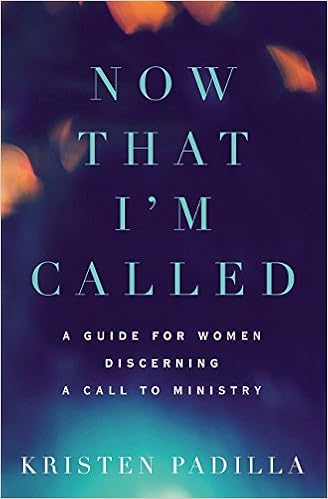
Author Interview: Kristen Padilla, "Now That I'm Called"


Image result for now that i'm called kristen padilla
Today I had the privilege of interviewing Kristen Padilla about her book entitled Now That I'm Called: A Guide for Women Discerning a Call for Ministry (IVP 2018). I have already recommended her book to students multiple times, so it was great to hear the backstory of the book.

Since the particular roles open to women differ from one denomination to another, Kristen explores ways that women from all kinds of churches can walk in obedience to God's call to participate in his mission. In her book, she says, "I want people, especially women, to understand that receiving this kind of call does not mean that they must hold a church office -- the role of a pastor, elder, or deacon, for example. The Holy Spirit gives gifts to the people of God, and these gifts can be exercised outside of a particular office in the church" (13). Her approach makes this book suitable for women from churches across the theological spectrum.

What inspired you to write this book? I was inspired to write this book for several reasons. First, I wrote this book because I saw a need for it. When I was a young woman sensing a call to vocational ministry, I had no one and no resource to guide me through the discernment process, the questions pertaining to being a woman in ministry, and next steps. As I say in my book, I felt like I was in a dark room with my arms outstretched trying to find my way to the door. By the time I was in seminary and had conversations with other women my age or younger called to ministry, I realized my story was not unique—it was the story of many women called to ministry. Thus, God put the idea and passion for this book in my heart, and ten years later it finally came to fruition. Second, I wrote this book out of a deeply held biblical conviction that God calls women to gospel ministry and that the Church of Jesus Christ needs women who are called by God to engage in gospel ministry in the church and world. I wanted to write a book that would encourage and aid these women in the journeys of discernment for the purpose of equipping future generations of female ministers of the gospel.

What was the most difficult aspect of the project? The most difficult aspect of writing was perhaps the most obvious one: writing a chapter on 1 Timothy 2:11-15. As many know, this passage has been used to silence and forbid women from many avenues of gospel ministry. It is the battleground where most of the fighting regarding women in ministry takes place. In my mind, I could not write a book for women called to ministry without addressing this passage of Scripture. However, I wanted to demonstrate a fidelity to the authority of Scripture and a humble and generous interpretative posture and tone. I also wanted to address head-on problematic and false interpretations that have held many women from pursuing ministry, namely that the female gender is by nature more easily deceived and that a certain “creation order” is a fail-proof guard against false teaching.

Author Kristen Padilla
What do you want readers to take away from your book? I want readers to walk away with a theological and biblical vision for women in ministry. I want them to see in Scripture that God’s plan has always included women and that women play an equally vital and important role in gospel ministry. My prayer is that women who read the book walk away with confidence grounded in Scripture and theology to follow God’s call to serve him in whatever role he has called them in obedience and humility.

Your book occupies the unpopular middle ground between the debate over women in ministry–not progressive enough to satisfy those who ordain women and too progressive for those who don't. What was your heart behind writing for those in this middle space? This is a great question. One of the first responses I received from the book was told to a friend of mine, “I wasn’t sure if she was complementarian or egalitarian.” A compliment or a criticism? I made the decision early on to write a book from that neither-complementarian-nor-egalitarian space or the in-between space for two reasons. First, I wanted the book to meet women in churches and traditions on both sides of this interpretive divide. My goal is to address the beginning of one’s call to vocational ministry—to lay the groundwork, if you will. Therefore, secondly, I did not see the need to talk from a strictly complementarian or egalitarian perspective, whatever that means today, since my goal wasn’t to talk about ordination or roles per se. I believe these two approaches have more in common than is often acknowledged. Most women in these so-called camps are tired of the debate and want to focus on the question: does God call women like me to serve him in ministry? I actually believe that this “in-between” space includes many women. This does not mean I do not have a particular interpretation of 1 Timothy 2:11-15 nor does it mean I am somehow theologically neutral when it comes to the roles of women in ministry. However, I did not believe it would be helpful to advocate from one perspective or another given the purpose of this book. Some will “blacklist” books if they are written from the other “side.” Even though I tried to stay in that middle space, I knew that for some my book would not be complementarian or egalitarian enough and would therefore be censored. This is indeed what has happened. In spite of this, I strongly believe that there is a strong middle and ecumenical ground where conversations about women in ministry can and should take place. I pray the posture and position I take in the book draws people together rather than exclude them.

In the year since your book has released, you've undoubtedly heard from many readers. What would you like to say to those who haven't read it yet? Or what would you want to add to what you've said in the book? Yes, I have been very fortunate and blessed to have heard from readers around the world, namely women for whom the book came at a time in their life when they needed biblical encouragement and guidance concerning the next steps in ministry. Hearing personal testimonies from readers is an author’s great reward. To those who haven’t read the book yet, I would of course say, “Read it!” On a more serious note, I try to bring out from Scripture stories of women called by God to proclaim the word of God for the people of God. There are many examples of women in Scripture doing just that—proclaiming a message from God to edify people in their day, and, by God’s design as Holy Scripture, edifying us today! In my book, I put the stories of these women next to stories of well-known men in Scripture to show a common pattern in how he calls and uses both men and women for his purposes. It would be a shame if the discussion about women’s place in God’s kingdom was limited to a few verses from the New Testament and did not take into account all of Scripture. If I could revise the book today, I would add more examples of women God uses in Scripture whose words are included for our edification today, such as the wise woman of 2 Samuel 20 and the Queen of Sheba. I want to continue to shine a light on the ways in which God is using women in his kingdom, which is why I am glad to say that I am writing a second book with Dr. Timothy George on women of the Reformation. My prayer is that the Church would be filled with God-called, theologically trained spiritual mothers who, alongside spiritual fathers, are equipping the saints for the work of ministry.

Thanks, Kristen, for writing this book and giving us a glimpse of your journey!

Saturday, January 11, 2020

Five Things They Didn't Tell Me about Writing a Book


Bearing God's Name
turned one month old yesterday! I had watched all the helpful training videos from InterVarsity Press about writing, editing, and marketing my book. But like parenting, no matter how much you prepare, there are still surprises. Here's what they didn't tell me:

1. They didn't tell me how much time it would take.

I wrote the book in one summer. And then I mostly waited. I anticipated this, as editors and peer reviewers took their turn, followed by copyeditors and graphic designers. Now and then I had a job to do -- responding to suggestions or checking page proofs. But I think I imagined my work would be basically finished when the final document headed off to print. In reality, that's when the big push began.

Last semester I had a lighter teaching load. I had big plans for all the writing I was going to do with my extra time. I did write a bit, but mainly I got ready for the book launch by taking on extra speaking engagements -- in Washington and Oregon and Texas and California and Alberta. I created memes, contacted speaking venues, set up events, traveled, ordered books, interacted with book stores, tracked book sales, responded to readers, interviewed for podcasts, and wrote blog posts. The whole process has taken tons of energy.

2. They didn't tell me what a splash it would make.

The fact that it's been time-consuming sounds negative. But here's what's blowing me away:

People are reading my book.
Pastors are preaching about it.
Teachers are teaching about it.
Parents are telling their children.
Facebook groups are discussing it.
Couples are processing it together.
Small groups are deciding to read it this year.

One man looked up every Scripture reference in the entire book to check my work. He gave a glowing report.

Readers are telling their friends and writing reviews and recommending it to their pastors. Some of the top Christian podcasts have interviewed me about the book.
The message is getting out there that the Old Testament matters for Christians, and that if we want to understand our identity and vocation as believers, we need Sinai.
 This is a dream come true!

Me at the book launch with 
James Enns (Photo: Sheena Mejia)


3. They didn't tell me how many new friends I would gain.


I hear daily from readers -- people I don't even know -- who are grateful for this book. They are befriending me, not just in the sense of following me on Facebook, but in some cases letting me into their lives and their stories.

This week I heard from the parents of a reader who is so on fire about the book that it is changing her relationship with God. She can't get enough of God's Word. This couple drove 45-minutes one way just to meet me and thank me in person.

For some reason, I didn't anticipate this. I've probably been in the academic bubble for too long. When I published my dissertation in 2018, I heard from a grand total of about 5 people who took the time to tell me how much they learned from it. Now I'm hearing from that many people every day.

4. They didn't tell me my dream was too small.

My dream was to write a book that the whole church could read. In reality, I imagined my parents, friends, and students' parents reading it.

My dream was to write a book with IVP, a reputable publisher that consistently produces quality books for Evangelicals. I pictured how my book would look in their catalog, and the thrill of seeing my name on the cover. I even had the audacity to imagine my book on the shelves of brick and mortar stores. I just hadn't imagined, or hadn't dared to imagine, what would happen next.

Book Launch (Photo: Sheena Mejia)

IVP has already ordered three printings of the book! Barnes and Noble is carrying it, along with a bunch of seminary bookstores. Library Journal highly recommended it. Christianity Today promoted it. IVP chose it as a Book Club selection and gave copies to women at the IBR breakfast. Bearing God's Name was consistently in the top 5 new releases in multiple categories on Amazon this month. And we're just getting started. The book is only one month old!

5. They didn't tell me how much fun this would be!

The whole experience has far exceeded my expectations. I've discovered that not only do I enjoy writing, but I also enjoy marketing. Even more than that, I enjoy interacting with readers. And I can't wait to get started on the sequel!

Saturday, January 4, 2020

Top 10 Posts of the Decade

My blog-o-versary passed without notice a few months ago. I've been blogging for 10 years! Not prolifically and not methodically, mind you, but often enough that I've published 525 posts that have so far collected over 150,000 views. Still small potatoes in this big wide world, but a wonderful way to practice writing and build community.

Most of my posts haven't made a big splash, but here are the top 10, all of which had over 900 views. Clearly 2018 was a banner year, yielding 6 of the top 10 posts. If you've been reading for a decade, enjoy this walk down memory lane. If we've only met recently, here's a taste of what you've been missing. Thanks for reading!


Confronting Modern Day Slavery -- closer than you think - on cell phone addiction

What John Piper Said . . .

Is Christianity Essentially Masculine?

Christmas in October - a tribute to a dying friend

Navigating the Valley of Disappointment - when I didn't get the job

#readwomen: Taking the Challenge - submitting a book proposal

Shattered: Top Ten Myths about the Ten Commandments (Part 1)

Shattered: Top Ten Myths about the Ten Commandments (Part 2)

Shattered: Top Ten Myths about the Ten Commandments (Part 3)


Thursday, December 26, 2019

My Favorite Books of 2019

I entitled this blog Chastened Intuitions as a way of recognizing that our gut feelings about something need reshaping in light of research and exposure to other perspectives. Reading is a powerful way to pursue that kind of learning. I read 40 books in 2019. The five listed below made the most significant contribution to my own growth, chastening my intuition in important ways.

Surprised by Jesus Again: Reading the Bible in Communion with the Saints
by Jason Byassee

I encountered this book as a skeptic, but I was quickly disarmed, even charmed. I did not find every reading persuasive, but I was won over by his central thesis. Byassee winsomely, playfully invites Christian readers of Scripture to delight in its mysteries and to participate in God's passionate quest to lavish his love an on ever-widening circle of faithful followers. He is right to chide biblical scholars for our lack of imagination. Reading this book has reignited my passion for a pedagogy that ushers fellow readers of Scripture into a place of wonder. A finalist in the Christianity Today 2019 Book Awards, this book is well worth reading.


The Liturgy of Creation by Michael LeFebvre

Given LeFebvre's brilliant doctoral work on Old Testament law, I expected this book to be carefully researched and lucidly written. I was not disappointed. LeFebvre skillfully brings into focus the parts of the Pentateuch readers are most likely to skip, showing how the purpose of each calendar notation in the Torah, including its opening chapter, is liturgical―to order the work and worship of the covenant people. His reassessment of Genesis 1 moves beyond the stalemate in the creation debates without recourse to extrabiblical or scientific arguments. His thesis grows organically from a close reading of the biblical text. LeFebvre shows himself to be a master teacher with pastoral sensitivity, able to patiently explain what he has so carefully studied. This book will change the way I teach the Torah. I can't wait to share it with my students!
Blood Brothers
by Elias Chacour

A powerful and enlightening story of a Palestinian Christian living in the aftermath of WWII. His story unveils the dark side of the Israeli-Palestinian conflict, its origins outside the land of Palestine, and the way both sides have been caught in the crossfire between nations whose complex interests are not above board. Chacour's hope is that Arabs and Jews can learn to live together as neighbors. He has devoted his entire life to this aim: PEACE. Such an eye-opening and hope-filled book!
Hope for the Oppressor by Patrick Oden

Hope for the Oppressor is a brave undertaking. Patrick Oden suggests that efforts to liberate the oppressed will never be successful until oppressors experience liberation, too. Without true liberation of all parties, new cycles of coercion result. But there's hope. He locates that hope in Christian community, where our notion of selfhood can be reconceived and our fractured selves healed in light of God's holy love. Oden's thesis is grounded in theologically rich readings of biblical texts and skillful engagement with historical and systematic theology. His book issues a life-giving invitation for all of us — those with privilege and those without — to participate in a different kind of kingdom. His book has the potential to fuel a revolution for those who dare to reexamine their lives in light of his claims.

Phoebe by Paula Gooder

How does a woman with a slave name end up delivering Paul's letter to the Romans? How does she have the means to undertake such a journey? How was she educated to the point that Paul chooses her to explain his letter? What did she think of the church in Rome? Gooder answers all these questions in a compelling way. She kept my attention from beginning to end. Friends who are not biblical scholars have enjoyed the book, too. Together with Holly Beers' A Week in the Life of a Greco-Roman Woman and Ben Witherington III's Priscilla, 2019 was my year to discover what is was like for women of the Roman Empire in the first century.

Friday, December 20, 2019

Podcast Tour: Bearing God's Name: Why Sinai Still Matters

I've had several opportunities to interview about Bearing God's Name across a wide range of venues. As the interviews go live, I'll keep adding the links below. Choose your favorite and give it a listen!

Podcast Interviews

The Naked Bible Podcast with Michael Heiser (74 minutes)
We discuss the nature of Old Testament law, the heart of biblical theology, and what it's like to be a woman in the world of biblical scholarship.
Heath in Pursuit with Heath Hollensbe (48 minutes)
This was such a fun interview! We talk about the Ten Commandments, the beauty of the Old Testament, the power of liminal space, how to find Jesus in the Old Testament, and more.
The Shaun Tabatt Show (29 minutes)
Shaun asked such great questions! We talked about the relevance of the OT and what we miss if we "unhitch" from it, the uniqueness of God's personal name, the power of liminal space, the literary structure of Exodus, the Ten Commandments, my favorite Hebrew word, the meaning of Exodus 20:7, and how it relates to the Lord's Prayer. I also tell the story of some miracle french bread.
Disrupters Podcast with Esau McCaulley (48 minutes)
Esau and I discussed my journey into biblical studies as a woman and consider ways to encourage women and minorities in scholarship. I tell stories of how I was disruptive as a kid. I claim that the lists of names in Numbers are very good news. We also touch on the book, in particular reconciling my very positive view of the Torah with Paul's view. Esau wants you all to know that he started reading my blog long before I was famous. 
Food Trucks in Babylon (Western Seminary) with Patrick Schreiner and Todd Miles (51 minutes)
In this interview I show how uncultured I am when it comes to eating out, and I make my best attempt to bridge to the disciplines of theology and New Testament studies. This was a good conversation about what's at stake when we "unhitch" from the Old Testament.
Bible Project with Tim Mackie and Jon Collins (56 minutes)
Join us as we talk about the Name Command (Exodus 20:7), how the Israelite high priest is a visual model of the role of Israel as a nation, how this relates to the temple being the "place of the name," and how God's name is profaned and sanctified. We touch on the Lord's Prayer, John's vision in Revelation, and the way the my book breaks new ground in publishing. As a bonus, we also talk about how we met and how Ray Lubeck influenced all three of us. Little known fact: Jon Collins was one of my first students!
OnScript with Matt Lynch (55 minutes)
We discuss what's new about the new covenant, what it means to be God's treasured possession, and how to interpret the command not to "take" God's name in vain. I talk about the influence of my mentor, Daniel Block. We also do a "speed round" in which I answer the question, "How do you solve a problem like Maria?"
The Outpost with Josh McNall


Radio Interviews

Prairie Radio with Dan Callaway (17 minutes)
We discuss the release of Bearing God's Name and some of its big ideas.
Songtime Radio with Adam Miller (27 minutes)
We talk about why the Old Testament is essential for Christians and how we can find grace in it.
Remnant Radio with Josh Lewis and Michael Roundtree (66 minutes)
We talk about the OT law and how it applies to Christians, how different denominations count the 10 commandments differently, what's new about the new covenant, and how Jesus relates to the law.